


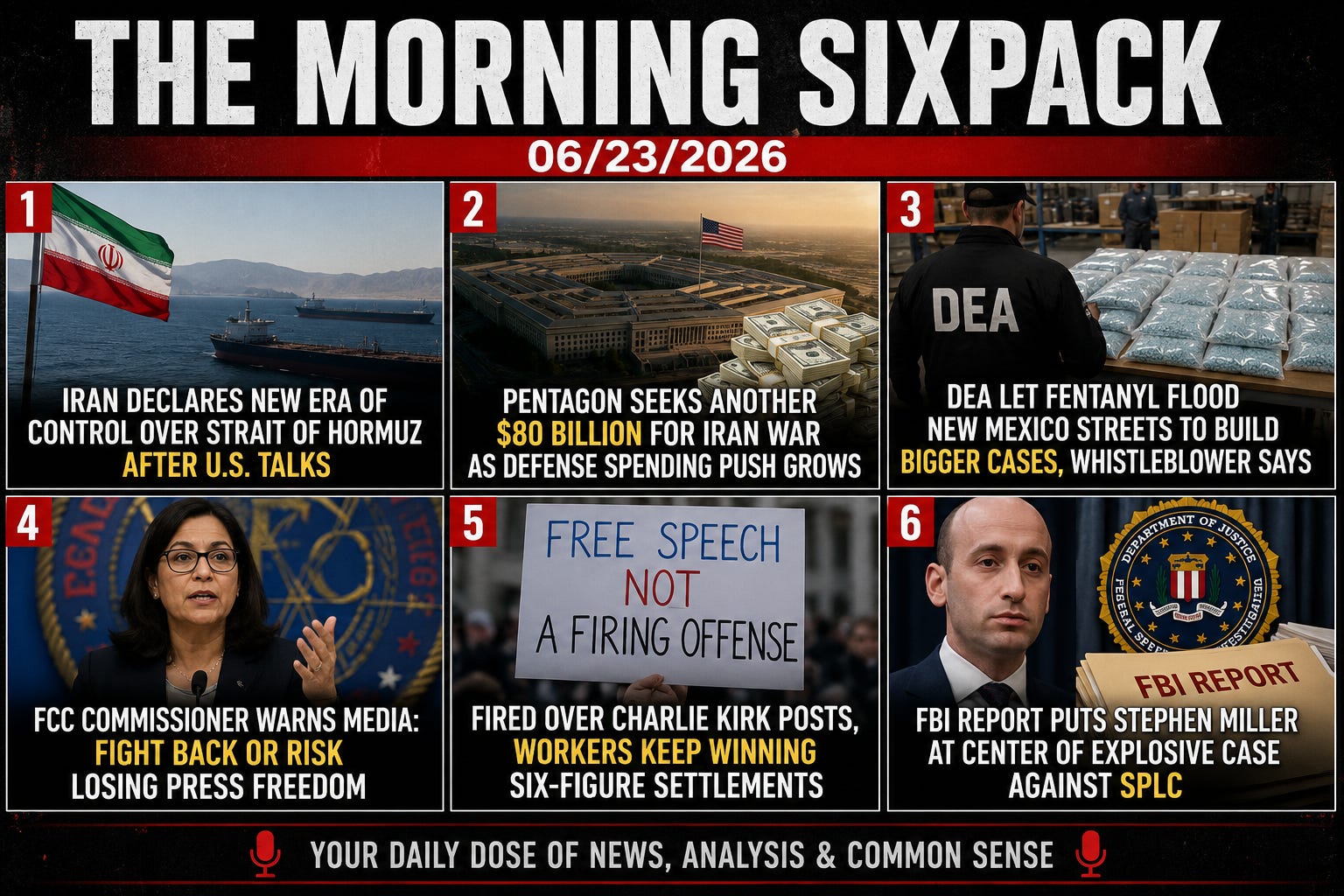
Iran says the Strait of Hormuz is now under permanent Iranian administration—a reminder that temporary geopolitical arrangements have a way of becoming permanent when one side controls the choke point.
Iran Declares New Era of Control Over Strait of Hormuz After U.S. Talks
Iran says the Strait of Hormuz will not return to its pre-war status and will instead be administered under Tehran’s arrangements. The announcement follows talks with the United States in Switzerland that produced agreements on shipping safety, frozen assets, and a 60-day framework for broader negotiations.
The world’s most important energy chokepoint is entering a fundamentally different phase of control.
Iranian Parliament Speaker Mohammad Bagher Ghalibaf said the strategic waterway will remain under Iranian administration while still operating within international law. The Strait of Hormuz carries a major share of global oil and gas exports, making any change in governance a matter of worldwide economic interest.
The talks also produced tangible concessions. Iran reportedly secured access to $12 billion in frozen assets, while both sides agreed to establish a direct maritime hotline and coordination center aimed at preventing incidents in the narrow shipping corridor. Tehran also pledged safe commercial passage for the next 60 days without transit fees.
As former White House energy adviser Amos Hochstein put it: “Iran controls the strait. Control means a lot of different things. But, effectively, they are planning for control with eventually a toll of some kind or a fee structure of some kind.”
What happens next depends on whether the 60-day roadmap leads to a broader agreement. A successful deal could create a more stable framework for maritime traffic, while failure could open the door to transit fees, tighter controls, renewed tensions, and fresh shocks to global energy markets.
Source: MSN article
Editor: For decades, the global economy has depended on keeping this shipping lane open and predictable. Now the conversation appears to be shifting from “Who secures it?” to “Who owns the leverage?” Markets tend to notice the difference a little faster than diplomats do.
And let’s NEVER FORGET: None of this would have happened had Trump not tried to distract from the #EpsteinFiles by starting a stupid fucking war.
The Pentagon’s latest math says the Iran war will cost another $80 billion—because military budgets never seem to shrink after the shooting stops. (And has the shooting really stopped? Let’s ask Israel.)
Pentagon Seeks Another $80 Billion for Iran War as Defense Spending Push Grows
The Pentagon is quietly seeking roughly $80 billion more from Congress to cover costs tied to the U.S. war against Iran. The request comes on top of President Trump’s already massive push for a record $1.5 trillion defense budget.
Washington’s answer to expensive problems remains remarkably consistent: spend even more money.
Defense Secretary Pete Hegseth has been lobbying lawmakers while Deputy Defense Secretary Stephen Feinberg reportedly informed senators that the Pentagon’s $80 billion request has already been forwarded to the White House Office of Management and Budget. Much of the money would replenish depleted weapons stockpiles, repair equipment, and support ongoing military operations.
The request arrives at a politically awkward moment. Many lawmakers remain skeptical of both Trump’s agreement with Iran and the broader costs of the conflict. Democratic Sen. Patty Murray put it bluntly, telling Hegseth, “You’re spending families’ hard-earned tax dollars on a war that many strongly oppose.”
The new figure is a major jump from the Pentagon’s earlier estimate of $29 billion presented to Congress just last month. Initial wartime projections reportedly reached as high as $200 billion before settling lower. Some lawmakers, including Sen. Brian Schatz, believe the final bill could ultimately exceed the current $80 billion request.
Republicans argue the funding is necessary to rebuild military readiness. As Sen. Jim Banks framed it, “To me it’s less about the war, it’s more about the stockpiles.”
Meanwhile, lawmakers are already discussing packaging the defense request alongside disaster relief and agricultural aid in hopes of attracting enough votes to pass.
Source: Associated Press report
Editor: Funny how every war starts with promises of limited costs and ends with accountants needing bigger calculators. At this pace, "temporary spending" has become one of Washington's most permanent institutions.
Maybe the Pentagon, through the President, should have asked first for the money before sending the bill to taxpayers. Just a thought.
One more thing: You can ALWAYS count on anything the US federal government estimates and multiply it by FOUR.
DEA agents reportedly watched hundreds of thousands of fentanyl pills hit New Mexico streets without seizing them—all in pursuit of bigger cases against drug traffickers. This was IRL Breaking Bad, but this time it wasn’t Walter White but Uncle Sam.
DEA Let Fentanyl Flood New Mexico Streets to Build Bigger Cases, Whistleblower Says
A DEA whistleblower says federal agents knowingly allowed massive quantities of fentanyl to reach New Mexico communities while building larger criminal cases against traffickers. The allegations raise difficult questions about whether law enforcement’s pursuit of kingpins came at the expense of public safety.
The agency behind the “One Pill Can Kill” campaign is now being accused of watching millions of those pills move through neighborhoods without stopping them.
DEA Special Agent David Howell says agents repeatedly tracked fentanyl shipments, monitored transactions, and even counted pills changing hands, yet allowed the drugs to continue into the community. Howell, who filed a whistleblower complaint, told investigators and reporters that authorities often prioritized long-term investigations over immediate seizures. According to documents reviewed by the Associated Press, one monitored transaction alone involved 74,000 fentanyl pills.
Federal officials defend the tactic as a legitimate investigative tool used to identify and dismantle larger trafficking organizations. Former U.S. Attorney Alex Uballez argued that pursuing major drug networks can ultimately save more lives than intercepting every shipment. The DEA maintains that its decisions were lawful and consistent with Department of Justice guidance. Editor: Sure, lawful. But ethical? Moral? Not a fucking chance.
Critics aren’t buying it. Howell said, “We poisoned our community to make cases,” while alleging that authorities cannot account for many of the shipments they allowed to proceed. He estimates agents permitted at least 1.8 million fentanyl pills to move through distribution channels during one investigation that eventually led to a record-breaking seizure.
The controversy is amplified by New Mexico’s ongoing overdose crisis. While overdose deaths nationally declined last year, New Mexico saw a significant increase. Internal Justice Department guidelines originally instructed agents to seize fentanyl “as soon as practicable,” though those rules were later revised to provide investigators greater discretion in balancing public safety concerns against investigative goals.
Source: Associated Press
Editor: If a private citizen knowingly allowed lethal narcotics to flood a neighborhood while claiming it served a bigger purpose, prosecutors would have some very pointed questions. The government appears to have answered those questions with paperwork. And if “one pill can kill,” it’s fair to ask why anyone thought letting hundreds of thousands—or millions—of them keep moving was a risk worth taking.
One of the FCC’s own commissioners says the agency is being used to pressure media companies into changing coverage the administration doesn’t like.
FCC Commissioner Warns Media: Fight Back or Risk Losing Press Freedom
FCC Commissioner Anna Gomez says the federal agency charged with regulating the airwaves is being weaponized to pressure news organizations and broadcasters. And she’s urging media companies to stop folding and start fighting.
When a sitting FCC commissioner starts checking her email every morning to see whether she’s been fired, it’s a sign something unusual is happening in Washington. Besides, she should be checking Twitter and Truth Social.
In a wide-ranging interview with WIRED, Gomez—currently the FCC’s lone Democratic commissioner—argued that broadcasters are facing what she described as a coordinated effort to influence editorial decisions through regulatory pressure. She pointed to actions involving ABC, CBS and NBC, as well as disputes surrounding license renewals and merger approvals.
Gomez was especially critical of what she views as pressure applied to media companies seeking regulatory approval. Discussing the Paramount-Skydance transaction, she argued that FCC actions and ongoing complaints created leverage over companies with business before the agency. She also praised Disney for pushing back against FCC scrutiny, saying, “This is a fight worth having.”
The commissioner, whose term has officially expired but who can remain in office pending a replacement, acknowledged she expects retaliation could come at any time.
“I check my email every day to see if I’ve been fired,” Gomez said. She believes legal and procedural hurdles have so far prevented her removal.
Beyond media battles, Gomez warned that the FCC is neglecting broader priorities such as broadband access, affordability, and preparing underserved communities for an AI-driven economy. But her central message remained focused on the First Amendment: Media companies that challenge government pressure in court are likely to win, she argued, if they’re willing to fight.
Source: WIRED interview
Editor: Every administration complains about the press. That’s practically a constitutional tradition. But when a sitting FCC commissioner publicly tells media companies they need to lawyer up and defend themselves against their own regulator, we’ve wandered a long way from routine political grumbling. Then again, if your regulator is telling you to sue your regulator, perhaps the system is trying to tell us something.
People who lost jobs over social media posts about Charlie Kirk’s assassination are increasingly winning in court—and taxpayers are footing the bill. Because, of course!
Fired Over Charlie Kirk Posts, Workers Keep Winning Six-Figure Settlements
A growing number of public employees fired or punished for social media posts about Charlie Kirk’s assassination are now winning major legal settlements and First Amendment claims. The payouts are adding up, even as many of those involved say the personal damage lingers.
The message from the courts appears increasingly clear: Offensive speech is still protected speech, especially when the government is the employer.
NPR reports that several cases involving teachers, professors, government workers, and other public employees have ended with reinstatements or settlements ranging from $125,000 to more than $800,000. Many of the disciplinary actions followed complaints amplified by political activists, media outlets, and social media campaigns after comments viewed as unsympathetic toward Kirk circulated online.
One of the latest settlements involved Iowa public defender Maria Ruhtenberg, who was fired after posting comments such as “live by the sword, die by the sword” following Kirk’s death. She also stated that the shooter should go to prison. After being terminated, reinstated, and then filing a federal lawsuit, she received a $125,000 settlement.
Other settlements have been even larger. A Florida wildlife biologist received $485,000 after being fired over a reposted social media comment. A Tennessee professor received $500,000 and got his job back. A retired Tennessee law enforcement officer who was jailed over a meme eventually received an $835,000 settlement. According to Reuters, more than 600 people were fired, suspended or investigated in connection with statements made after Kirk’s assassination.
Legal experts interviewed by NPR pointed to concerns about the “heckler’s veto”—a situation where public pressure campaigns are used to punish speech. Courts have repeatedly examined whether employers can demonstrate actual workplace disruption rather than simply reacting to public outrage. So far, several employers have struggled to make that case.
Source: NPR report
Editor: None of this means the posts were smart, tasteful, or likely to win anyone “Employee of the Month.” But public employers keep learning the same expensive lesson: Firing someone because their opinion triggered a political firestorm is one thing; defending that decision in federal court is something else entirely. And when the settlements arrive, it’s usually taxpayers—not the people who made the firing decisions—who end up writing the check.
A newly disclosed FBI report reportedly suggests the federal case against the Southern Poverty Law Center may have started with a grievance from Stephen Miller. Of course it did.
FBI Report Puts Stephen Miller at Center of Explosive Case Against SPLC
Court filings suggest a newly uncovered FBI report may link Stephen Miller directly to the federal government’s case against the Southern Poverty Law Center. If true, the disclosure could force scrutiny of communications Miller has long kept shielded under executive privilege.
The question isn’t whether Miller disliked the SPLC—the question is whether that dislike helped trigger a federal prosecution.
According to court filings cited by Raw Story, the FBI report allegedly mirrors language from a letter conservative organizations sent to Miller criticizing the SPLC’s “Hate Map,” which tracks extremist and hate groups. Attorneys for the SPLC argue the similarities are so extensive that they suggest Miller’s concerns may have played a direct role in launching the government’s case.
The dispute carries years of baggage. The SPLC published reports in 2019 highlighting emails Miller allegedly sent to Breitbart News that promoted white nationalist sources and literature. Since then, relations between Miller and the organization have remained deeply hostile.
The latest court fight centers on efforts by SPLC attorneys to obtain communications between Miller and the Justice Department. They argue the FBI report provides evidence that Miller’s personal grievances may have influenced federal actions against the organization. Journalist Marcy Wheeler described the disclosure as evidence that Miller’s objections to the SPLC may have evolved into a legal theory targeting the group’s work.
Whether the court ultimately orders disclosure of those communications remains unclear. But for a White House official who has successfully kept many internal discussions behind the shield of executive privilege, the possibility of judicial review represents a significant development.
Source: Raw Story article
Editor: Remember, these are allegations contained in court filings, not proven facts. But if a federal prosecution can be traced back to a political score being settled, that’s a story far bigger than Stephen Miller or the SPLC. And if the government really has the receipts, executive privilege may be about to meet its natural enemy: Discovery.