


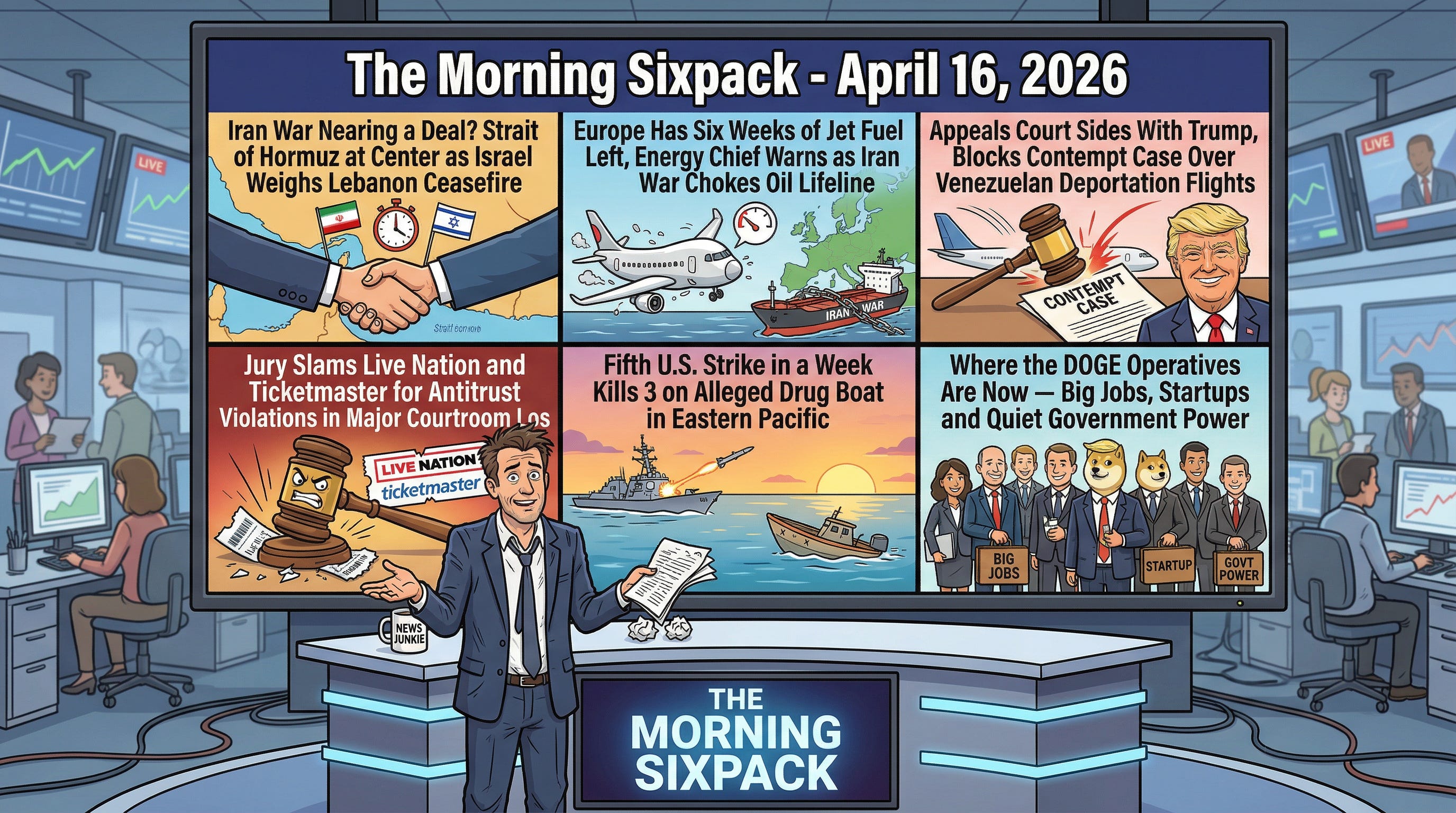
Iran War Nearing a Deal? Strait of Hormuz at Center as Israel Weighs Lebanon Ceasefire
After six weeks of war, mediators say progress is real, but Iran’s nuclear program and Lebanon fighting remain major sticking points.
If this deal collapses, the world’s oil artery stays squeezed-and the global economy keeps sweating.
There are fresh signs the six-week Iran war could be inching toward a real pause. A senior Iranian official said talks brokered by Pakistan’s army chief, Field Marshal Asim Munir, raised hopes for another round of negotiations and possibly extending the fragile two-week ceasefire. But Tehran made clear the core dispute—its nuclear program—is far from settled.
The U.S. has floated a 20-year suspension of Iran’s nuclear activity. Tehran countered with a three-to-five-year halt. Washington also wants highly enriched uranium removed from Iran, while Tehran demands sanctions relief. Meanwhile, U.S. Defense Secretary Pete Hegseth warned troops are ready to resume combat if talks implode. Translation: diplomacy with a loaded holster.
Hovering over everything is the Strait of Hormuz, the narrow passageway through which roughly a fifth of the world’s oil and gas flows. Iran has effectively shut it to most traffic, sending oil prices soaring and forcing the International Monetary Fund to downgrade its global outlook. Markets have rallied this week on hopes of a breakthrough, but they’re trading on optimism—not ink on paper.
There’s also the Lebanon front. Israel’s cabinet met to discuss a potential ceasefire as fighting with Hezbollah continues in southern Lebanon. President Donald Trump teased a possible call between Israeli Prime Minister Benjamin Netanyahu and Lebanese President Joseph Aoun, writing: “It has been a long time since the two leaders have spoken, like 34 years. It will happen tomorrow. Nice!” Lebanese officials quickly downplayed that chatter, saying no such call is on the books.
The war, which erupted after U.S.-Israeli strikes on Iran in late February, has killed thousands—mostly in Iran and Lebanon—and rattled investors worldwide. The U.S. Navy has expanded its blockade of Iranian shipping to include what it calls contraband ranging from weapons to oil products, warning vessels could be subject to “visit, board, search and seizure.” Thirteen ships have already turned around.
In other words, everyone is talking peace. But until the Strait reopens and the nuclear file is nailed down, this “near an end” moment feels more like halftime than the final whistle.
Source: Reuters
Editor: Nothing calms global markets like a potential ceasefire announced via social media at midnight. What could possibly go wrong?
Europe Has Six Weeks of Jet Fuel Left, Energy Chief Warns as Iran War Chokes Oil Lifeline
The head of the International Energy Agency says Europe may soon cancel flights if oil remains blocked in the Strait of Hormuz.
No reopening of Hormuz means grounded planes, higher prices and a global economy that keeps limping.
In a blunt assessment from Paris, International Energy Agency Executive Director Fatih Birol said Europe has “maybe six weeks or so (of) jet fuel left” if the Iran war continues to squeeze supplies through the Strait of Hormuz. “In the past there was a group called ‘Dire Straits.’ It’s a dire strait now, and it is going to have major implications for the global economy. And the longer it goes, the worse it will be for the economic growth and inflation around the world,” he said.
Birol warned that “soon we will hear the news that some of the flights from city A to city B might be canceled as a result of lack of jet fuel.” And he wasn’t just talking about Europe. “No country, no country is immune to this crisis,” he said, stressing that developing nations in Asia, Africa and Latin America will be hit hardest—but everyone pays.
More than 110 oil tankers and 15 liquefied natural gas carriers are stuck in the Persian Gulf, unable to move freely. Even if a peace deal materializes tomorrow, over 80 key regional energy assets have been damaged, more than a third severely. “It will take gradually, gradually, up to two years to come back where we were before the war,” Birol said.
He also blasted Iran’s so-called “toll booth” system—charging some ships to pass through Hormuz—warning it could set a dangerous global precedent. “If we change it once, it may be difficult to get it back,” he said. Translation: today Hormuz, tomorrow the Malacca Strait.
Oil, gas, jet fuel—this isn’t abstract geopolitics. It’s your ticket price, your heating bill and your grocery tab. And unless Hormuz fully reopens, those costs aren’t drifting lower anytime soon.
Source: AP News
Editor: We’ve gone from “energy transition” to “hope your flight isn’t canceled” in record time. Progress, 2026-style.
Appeals Court Sides with Trump, Blocks Contempt Case Over Venezuelan Deportation Flights
A divided federal appeals court halted a lower judge’s push to pursue criminal contempt charges against Trump administration officials over 2025 deportation flights.
Translation: no contempt hearings, no forced testimony, and no courtroom reckoning—at least for now.
In a 2–1 decision, the U.S. Court of Appeals in Washington, DC, ruled that District Judge James Boasberg overstepped when he tried to investigate whether former Homeland Security Secretary Kristi Noem and others defied his March 15, 2025 order to turn around two deportation flights bound for El Salvador. The majority called Boasberg’s effort a “clear abuse of discretion.”
At the heart of the fight: 137 Venezuelan nationals deported under the rarely used Alien Enemies Act, a 1798 law that gives presidents sweeping authority during wartime or invasion. The Trump administration said the migrants were linked to the Tren de Aragua gang. Their lawyers argued many were labeled gang members based on clothing and tattoos—and denied meaningful due process before being shipped out.
Boasberg had questioned whether officials acted “in bad faith” by pressing ahead with the flights while he was holding emergency hearings. But Judge Neomi Rao, writing for the majority, said the judge’s original order didn’t clearly bar transferring the migrants into Salvadoran custody. “Criminal contempt is available only for the violation of an order that is clear and specific,” she wrote, adding that the probe risked exposing sensitive national security deliberations.
The ruling fell along familiar lines. Judges Rao and Justin Walker—both Trump appointees—formed the majority. The dissent came from Judge J. Michelle Childs, appointed by former President Joe Biden. Boasberg himself was nominated by Barack Obama. Acting Attorney General Todd Blanche declared on X that the decision “should finally end Judge Boasberg’s year-long campaign against the hardworking Department attorneys doing their jobs fighting illegal immigration.”
The men deported in March 2025 were later released from El Salvador’s notorious CECOT prison in a July prisoner exchange with Venezuela. But the legal battle over executive power versus judicial oversight is far from over.
Source: Al Jazeera
Editor: When a court says your order wasn’t “clear and specific” enough, that’s legalese for “nice try.” Separation of powers—now streaming in prime time.
This is clearly as bullshit a ruling as could be. The judge did order the planes to turn around and they didn’t. The Trump regime ignored a lawful court order.
Jury Slams Live Nation and Ticketmaster for Antitrust Violations in Major Courtroom Loss
A New York jury found that Live Nation and its Ticketmaster subsidiary violated federal and state antitrust laws.
After the Trump administration settled its case, a coalition of states pushed forward—and just won.
The lawsuit traces back to the 2010 merger that combined concert giant Live Nation with ticketing powerhouse Ticketmaster. The U.S. Justice Department sued in 2024, arguing the deal created an illegal monopoly that squeezed competitors, performers, and fans. It was widely viewed as one of DOJ’s strongest antitrust cases in years—and politically popular given bipartisan frustration with ticket fees and market dominance.
But when the Trump administration opted to settle with what critics called minimal concessions, most states and Washington, DC, picked up the fight. After a month-long trial and four days of jury deliberation, the verdict landed squarely against the companies.
“We filed this case in 2024 because Live Nation and Ticketmaster used their dominance to lock out and intimidate rivals and drive up costs,” said Doha Mekki, a former DOJ antitrust official. “Today’s decision affirms that even the most powerful companies are not above the law—and it sends a strong signal that lawyers and citizens have the power to take on monopolies even when the federal government falls down on its obligation to do so.”
Live Nation says the fight isn’t over. “The jury’s verdict is not the last word on this matter,” the company said, pointing to pending motions that could affect liability and damages. It added that it “can and will appeal any unfavorable rulings.” The next phase will determine damages—and possibly whether Live Nation must divest Ticketmaster.
For an administration that touted tough talk on corporate power, this is an awkward headline. The states get a win. The jury gets the last word—for now. And Live Nation gets a very expensive encore.
Source: Axios
Editor: When even a jury thinks your ticket fees are too much, maybe it’s not just “dynamic pricing.” It’s dynamic consequences. And it’s about fucking time.
Fifth U.S. Strike in a Week Kills 3 on Alleged Drug Boat in Eastern Pacific
The U.S. military conducted a lethal strike on a vessel in the eastern Pacific, killing three people the Pentagon says were “narco-terrorists.”
The campaign—part of Operation Southern Spear—has now seen multiple deadly actions in days and drawn sharp legal and humanitarian criticism.
According to U.S. Southern Command, Joint Task Force Southern Spear carried out a “lethal kinetic strike” on April 15 against a vessel it claims was run by a “Designated Terrorist Organization” and traveling along known drug trafficking routes. The command said three male “narco-terrorists” were killed and no U.S. forces were harmed.
This latest attack follows a flurry of strikes in recent days. Similar U.S. operations earlier this week reportedly killed four people in another Pacific strike and two in a separate action, while weekend strikes on two vessels left at least five dead.
The overall death toll from U.S. strikes on alleged drug boats since last year is now 178 people, according to reporting that tallies these operations as part of a larger anti-drug maritime campaign stretching across the Caribbean and Pacific.
The Trump administration frames the ongoing strikes as part of an “armed conflict” against narcotics trafficking, but critics—including legal experts and rights groups—say many of the people killed may have been civilians and argue the strikes lack clear legal justification under international law.
As the controversial campaign continues alongside other global U.S. military engagements, questions about evidence, legality and accountability remain central to the debate over these lethal strikes.
Source: The Guardian
Editor: Five strikes in five days sounds like a PR blitz powered by kinetic verbs—not clarity. If there’s proof these weren’t fishing boats, the public still hasn’t seen it.
Where the DOGE Operatives Are Now—Big Jobs, Startups, and Quiet Government Power
Months after the collapse of the controversial Department of Government Efficiency (DOGE), many of its youthful operatives have moved into influential roles in government and the private sector.
Despite causing turmoil in federal agencies, the legacy of Musk’s experiment lives on through their new positions and projects.
DOGE, launched under Donald Trump with strong backing from Elon Musk, deployed tech-savvy but inexperienced workers into federal agencies to “cut waste, fraud, and abuse.” The effort drew widespread criticism for chaos and massive personnel cuts — yet now many of those same operatives haven’t vanished.
Edward “Big Balls” Coristine, once a lightning-rod figure in DOGE, has resurfaced as engineering lead at the National Design Studio after floating between roles at Social Security and other agencies. Gavin Kliger has been appointed chief data officer at the Department of Defense, while Jeremy Lewin now serves as undersecretary at the State Department, helping direct foreign assistance.
Others have taken private-sector paths: Nate Cavanaugh and Justin Fox co-founded an AI and crypto startup, Bridget Youngs launched an industrial tech company, and John Solly took a CTO role at defense contractor Leidos. Amanda Scales splits time between OPM and tech recruiting, steering new hires into the government’s burgeoning tech corps.
Yet some former DOGE members have literally vanished from public view, and watchdogs warn their influence may extend far beyond the original organizational structure—quietly embedded in agencies or shaping policy without clear oversight. The long tail of DOGE’s activities still ripples through U.S. governance.
Source: Wired
Editor: The kids who once “modernized” (i.e., destroyed) federal agencies are now running, advising, and launching companies—proving disruption doesn’t end just because the org chart does.
Make no mistake: This is STILL Elon’s government.