


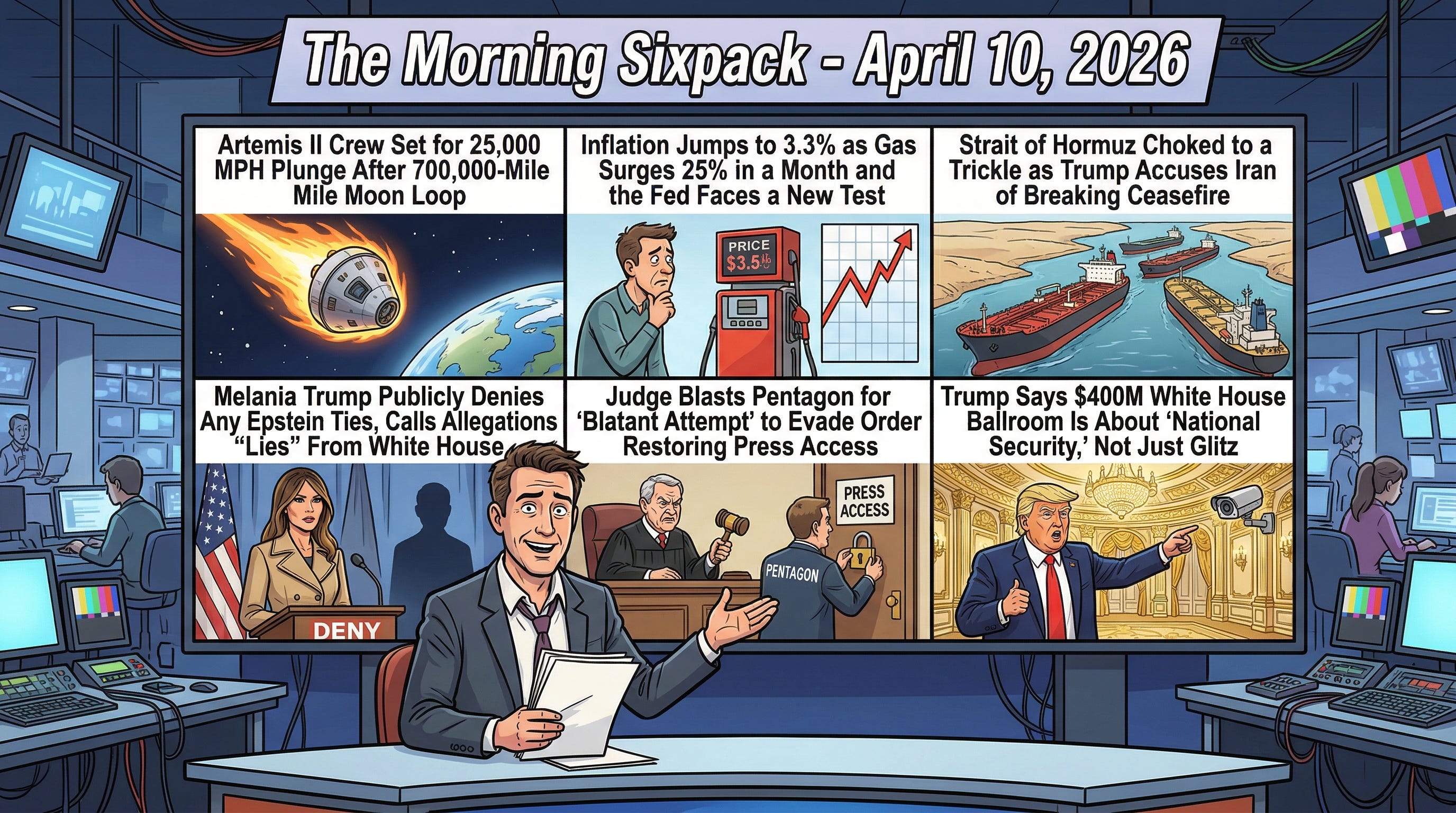
Artemis II Crew Set for 25,000 MPH Plunge After 700,000-Mile Moon Loop
After ten days and nearly 700,000 miles, NASA’s Artemis II astronauts are barreling home for a Pacific splashdown that will test every bolt, burn, and backup system on board.
They’ll slam into Earth’s atmosphere at just under 25,000 miles per hour before parachuting into the ocean off San Diego.
The four-person crew aboard Orion—Reid Wiseman, Christina Koch, Victor Glover and Canadian Space Agency astronaut Jeremy Hansen—have spent the past day reviewing return procedures, packing up the spacecraft and checking in with flight director Rick Henfling. So far, the mission has gone according to plan, including two of three engine burns needed to line up the reentry corridor. The final burn is slated for Friday afternoon.
As of Friday morning, the spacecraft—named Integrity—was less than 75,000 miles from Earth and cruising at more than 4,700 miles per hour. NASA expects splashdown around 8:07 p.m. EDT in the Pacific Ocean, where recovery teams will be waiting. After nearly a quarter-million miles out and back around the moon, it all comes down to a fiery descent and a controlled drop into the water.
There’s extra scrutiny this time. Artemis I’s uncrewed flight in 2022 saw unexpected heat shield damage during reentry, triggering an investigation. NASA insists the data, testing and analysis support the fixes. “Every system we’ve demonstrated over the past nine days—life support, navigation, propulsion, communications—all of it depends on the final minutes of flight,” said NASA associate administrator Amit Kshatriya. “We have high confidence in the system, and the heat shield and the parachutes and the recovery systems we put together.”
He doubled down: “The engineering supports it. The Artemis I flight data supports it. All of our ground tests supports it. Our analysis supports it. And tomorrow, the crew is going to put their lives behind that confidence.” That’s the kind of sentence that reminds you spaceflight is still an exercise in calculated risk—no matter how many simulations you run.
Source: Scientific American
Editor: Ten days around the moon and it all comes down to a heat shield, some parachutes, and a splash. Space travel: still the ultimate trust fall.
It’s a little surprising to me that NASA had severe issues with re-entry on Artemis I and chose NOT to test their fixes before sending up a human crew.
Oh well, what do I know?
Inflation Jumps to 3.3% as Gas Surges 25% in a Month and the Fed Faces a New Test
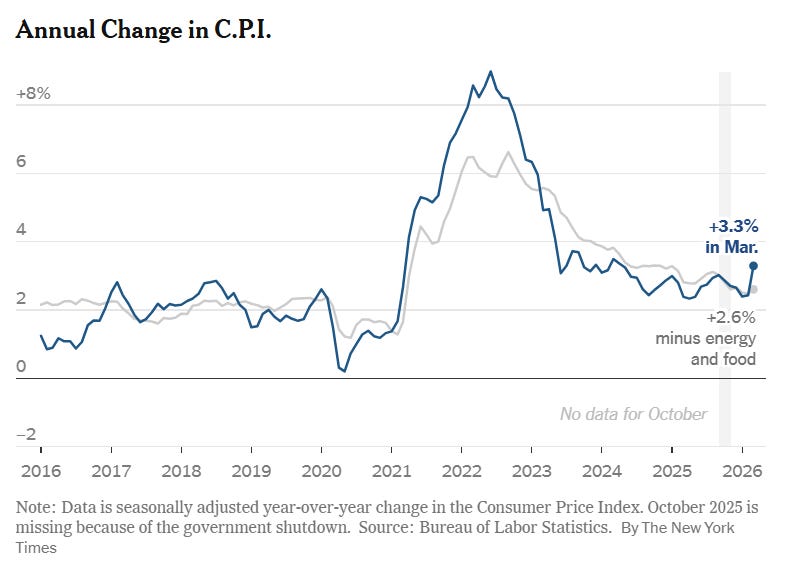
U.S. inflation accelerated to 3.3% in March, fueled by a massive energy spike tied to the Iran war and the biggest monthly price jump since 2022.
Gas prices alone shot up 25% in a single month—the fastest increase on record.
The Consumer Price Index rose 0.9% in March, driven largely by an 11% surge in energy costs. Gasoline was the main culprit, climbing 21% in the CPI and 25% at the pump compared to February. Americans are now paying around $4.15 a gallon on average, and the Energy Information Administration expects prices to flirt with $4.30 this month. That’s not a rounding error—that’s a household budget wrecking ball.
Core inflation, which strips out food and energy, rose a more modest 0.2% for the month and 2.6% year over year. That’s the good news—if you’re grading on a curve. The problem is wages aren’t keeping up. Real average weekly earnings fell 0.9% in March, and average hourly earnings are now rising just 3.5% annually, barely ahead of inflation. For a lot of families, that math doesn’t work.
The Federal Reserve now finds itself boxed in. Rates are sitting between 3.5% and 3.75%, and officials have been on pause since January. Policymakers worry that higher oil prices could bleed into broader categories—airfares already jumped 2.7% in March and are up nearly 15% from a year ago. If inflation expectations drift higher, rate cuts this year get harder to justify. Rate hikes? Not off the table.
Meanwhile, companies are passing along costs with little hesitation. Delta, United, JetBlue and Southwest have raised baggage fees. UPS, FedEx and Amazon have tacked on fuel surcharges. Even the Postal Service is adding an 8% temporary package surcharge. This is how an energy shock spreads—quietly, relentlessly and everywhere at once.
Consumers are still spending—for now. Retail sales haven’t cracked, and the S&P 500 remains up sharply over the past year. But the personal savings rate is scraping post-2008 lows, and economists warn it wouldn’t take much for real disposable income to tip negative and drag growth with it. Oil above $120 a barrel or a sharp market drop? That’s when the tone changes fast.
Source: The New York Times
Editor: Nothing says “temporary price pressure” like paying $4-plus for gas (way over $5 here in Washington) while your paycheck treads water. The Fed wanted patience. The pump wants cash.
Strait of Hormuz Choked to a Trickle as Trump Accuses Iran of Breaking Ceasefire
Iran has restricted traffic through the Strait of Hormuz to just 7% of normal levels, stranding more than 600 ships and rattling global energy markets.
The world’s most critical oil chokepoint is open in name only—and President Trump is publicly calling Tehran out.
After a 40-day bombing campaign and a fragile U.S.-Iran-Israel ceasefire, the main American condition was simple: reopen the strait. Instead, Iran has effectively kept a chokehold on the waterway, allowing only a handful of vessels through. Maritime trackers report just seven ships passed in the last 24 hours, with traffic crawling at a fraction of its usual 120 to 150 ships per day.
President Trump didn’t mince words. “Iran is doing a very poor job, dishonorable some would say, of allowing Oil to go through the Strait of Hormuz,” he wrote. “That is not the agreement we have!” Hours earlier, he had floated the idea of a joint U.S.-Iran toll system, calling it “a beautiful thing.” By afternoon, he was warning Tehran not to charge tankers at all. Mixed messages? You decide.
Iran reportedly warned ships they risk attack—or million-dollar “fees”—if they transit without permission. That’s left operators frozen, unsure who to pay, in what currency, or whether the tolls are even legitimate. Before the war, the strait was a toll-free international waterway governed by maritime law. Now it looks more like a geopolitical turnpike with armed guards.
The fallout is global. Oil surged above $100 a barrel before easing slightly, gasoline has topped $4 a gallon in the U.S., and Gulf nations are condemning Iran’s grip on the passage. Meanwhile, Israeli strikes on southern Lebanon continue despite the ceasefire, Hezbollah is firing back, and drone attacks have hit Gulf infrastructure. In other words: truce on paper, turbulence everywhere else.
High-level U.S.-Iran talks are scheduled in Islamabad, with Vice President Vance leading the American delegation. Israel and Lebanon are also set for direct negotiations next week—potentially historic talks between two countries that officially treat each other as enemies. But with airstrikes still flying and oil barely flowing, the durability of this ceasefire looks like an open question.
Source: NPR
Editor: Nothing steadies global markets like a ceasefire where the bombs pause but the oil doesn’t move. Investors love clarity. This isn’t that.
Melania Trump publicly denied any relationship with Jeffrey Epstein from the White House, reopening a controversy her husband has tried to bury.
Melania Trump Publicly Denies Any #Epstein Ties, Calls Allegations “Lies” From White House
Melania Trump declared from the White House that she never had a relationship with Jeffrey Epstein and was not one of his victims, thrusting the scandal back into the national spotlight. #EpsteinFiles #PedoFiles
Standing under the presidential seal, she flatly said: “The lies linking me with the disgraceful Jeffrey Epstein need to end today.”
In an extraordinary appearance in the Grand Foyer, the first lady said she first “crossed paths” with Epstein in 2000 at an event she attended with Donald Trump—two years after she met her future husband at a New York City party. “I have never been friends with Epstein,” she said, adding that overlapping social circles in New York and Palm Beach led to occasional shared invitations.
She also addressed a 2002 email to Ghislaine Maxwell that was released in government files. The message read: “Nice story about JE in NY mag. You look great on the picture. Give me a call when you are back in NY.” Melania Trump described it Thursday as “casual correspondence” and “a trivial note.”
The timing is notable. President Trump has repeatedly urged the country to “get on to something else” regarding Epstein, even firing Attorney General Pam Bondi last week amid backlash from his base over the slow release of files. Polling shows deep public skepticism—three-quarters of Americans believe the government is hiding information about Epstein’s alleged clients.
Melania Trump went a step further, urging Congress to hold public hearings for Epstein’s victims to testify under oath. But roughly a dozen survivors pushed back, saying they had already shared their stories and that the Justice Department should focus on enforcing transparency laws instead.
Whether this closes the matter—or pours gasoline on it—is anyone’s guess. A first lady addressing controversy from the White House floor is rare. Doing so on an issue the president wants to disappear? That’s political dynamite.
Source: Reuters
Editor: If the goal was to make Epstein fade from the headlines, marching to the podium under the presidential seal might not be the play. Washington has a funny way of revisiting whatever you try to bury.
Judge Blasts Pentagon for ‘Blatant Attempt’ to Evade Order Restoring Press Access
A federal judge ruled the Pentagon is defying a court order to restore press access, accusing the Defense Department of trying to sidestep constitutional protections for journalists.
He called it a “blatant attempt to circumvent a lawful order of the Court.”
U.S. District Judge Paul Friedman said the Defense Department must comply with his earlier injunction siding with The New York Times and other outlets that challenged new press restrictions at the Pentagon. “The Department cannot simply reinstate an unlawful policy under the guise of taking ‘new’ action and expect the Court to look the other way,” Friedman wrote.
The dispute stems from an October policy under Defense Secretary Pete Hegseth that allowed journalists to be labeled security risks and lose their credentials if they solicited unauthorized disclosures—even unclassified information in some cases. Of the 56 outlets in the Pentagon Press Association, only one agreed to sign an acknowledgment of the policy. The rest surrendered their badges.
Friedman ruled March 20 that the restrictions violated constitutional protections for news gathering and due process, ordering credentials restored immediately. But The New York Times told the court the Pentagon responded with an “interim” policy that still barred reporters from entering the building without escorts and imposed new limits on anonymity rules—steps the paper called a workaround to the judge’s ruling.
The Pentagon insists it complied and plans to appeal. A spokesperson said the department addressed all legal defects cited by the court. The Pentagon Press Association, which includes Reuters, ABC News and Fox News, blasted the revised rules as a violation of both the letter and spirit of the ruling.
This fight isn’t just about badges and building access. It’s about who controls the flow of information from the seat of U.S. military power—and whether the executive branch can rewrite the rules after a judge says no.
Source: Reuters
Editor: When a federal judge uses the phrase “blatant attempt,” that’s not legalese—it’s a warning shot. The Pentagon may appeal, but courts tend to frown on creative compliance.
Trump Says $400M White House Ballroom Is About ‘National Security,’ Not Just Glitz
The Trump administration is arguing in court that its controversial $400 million White House ballroom project is essential to national security and presidential safety—not just a luxury renovation.
Officials warned that halting construction would “imperil the President and national security” and leave a “large hole beside the executive residence.”
In filings with the U.S. Circuit Court of Appeals, the administration said a federal judge’s April 1 order to pause work creates serious safety concerns. The 90,000-square-foot replacement for the East Wing isn’t just a ballroom, they argue—it includes bomb shelters, a hospital and medical area, and what they describe as “top secret military installations, structures, and equipment.”
The project began last September with demolition of the existing East Wing, pitched by President Trump as a long-overdue modernization to create a proper event space. But costs have ballooned from an initial $200 million estimate to roughly $400 million. Trump has said it will be funded through private donations and completed before his term ends in 2029.
The National Trust for Historic Preservation isn’t buying the urgency. The group told the court that the injunction does not block work on underground bunker or military components—only the above-ground ballroom and public-facing redesign. “The District Court’s injunction does not prevent Defendants from working on the underground bunker their motion exhaustively describes,” the Trust said.
The administration is pushing for a fast ruling and signaled it would take the fight to the Supreme Court if necessary. Translation: this isn’t just about chandeliers and state dinners—it’s about executive power, preservation law and who gets to decide what counts as national security on the White House lawn.
Source: UPI
Editor: A $400 million ballroom that doubles as a bunker? In Washington, even the dance floor comes with classified footnotes.