


When a school becomes a battlefield, someone owes the world more than a shrug.
AP Investigation Raises New Questions About Iran School Attack
An Associated Press investigation examines a strike on a primary school in Minab, Iran, during the U.S.-Israeli conflict with Iran that killed more than 150 people, most of them children. The report reconstructs the events using interviews, satellite imagery, videos, and human rights research.
According to the AP, the U.S. military quickly learned that a school had been hit, but the Trump administration has not publicly accepted responsibility or released the results of the Pentagon’s investigation. President Donald Trump said he had not seen evidence that the United States carried out the attack.
The investigation says the school was located next to a Revolutionary Guard compound and served children from both Guard-affiliated families and the surrounding community. Researchers identified at least 157 victims, including 123 children, while the total death toll is estimated to be between 157 and 168.
The AP reports that Pentagon officials are examining whether outdated targeting information and changes to civilian-protection procedures contributed to the strike. Members of Congress have called for greater transparency, and the Pentagon says its investigation is still under review.
Source: AP News
Editor: If an investigation exists, release it. Accountability delayed starts looking a lot like accountability denied.
Brennan isn’t waiting for an indictment—he’s trying to preserve evidence now that he says could prove any prosecution is driven by retaliation rather than justice.
John Brennan Sues Ahead of Possible Trump Justice Department Indictment
Former CIA Director John Brennan is going to court before charges are even filed, arguing the Trump Justice Department is building a politically motivated case against him.
Brennan filed a lawsuit in federal court seeking an order requiring the Justice Department to preserve records tied to its investigation into his role overseeing intelligence work surrounding Russian interference in the 2016 election. His legal team argues the administration has turned federal law enforcement into a weapon against political opponents and wants to ensure documents aren’t “lost” before any criminal case is filed.
The investigation has reportedly expanded over several months, with prosecutors interviewing former intelligence officials and issuing subpoenas as they examine whether Brennan and others participated in what Trump allies describe as a conspiracy against the president. Brennan has repeatedly denied wrongdoing and says the investigation is designed to punish him for both his official actions and his criticism of President Trump.
Among the issues raised in the lawsuit are the replacement of career prosecutors, the appointment of officials who have publicly called for Brennan’s prosecution, and concerns over how the case has been handled inside the Justice Department. Brennan’s attorneys argue those developments point to selective and vindictive prosecution if charges are ultimately brought.
Whether prosecutors ever seek an indictment remains unknown. But by filing now, Brennan is signaling that any future criminal case won’t simply be a fight over the facts—it will also be a battle over whether politics, rather than evidence, drove the investigation.
Source: Washington Post (gift article)
Editor: If you’re filing a lawsuit before you’re even charged, you clearly expect the legal fight to be every bit as political as the investigation itself.
The job market is finally losing steam, and the Federal Reserve suddenly has a lot more to think about than interest rates.
U.S. Hiring Slows Sharply as Labor Market Finally Starts to Cool
America’s hiring engine downshifted in June, with employers adding just 57,000 jobs while earlier employment gains were revised lower. The report doesn’t scream recession, but it does tell the Federal Reserve that the labor market is no longer running nearly as hot as it was just a month ago.
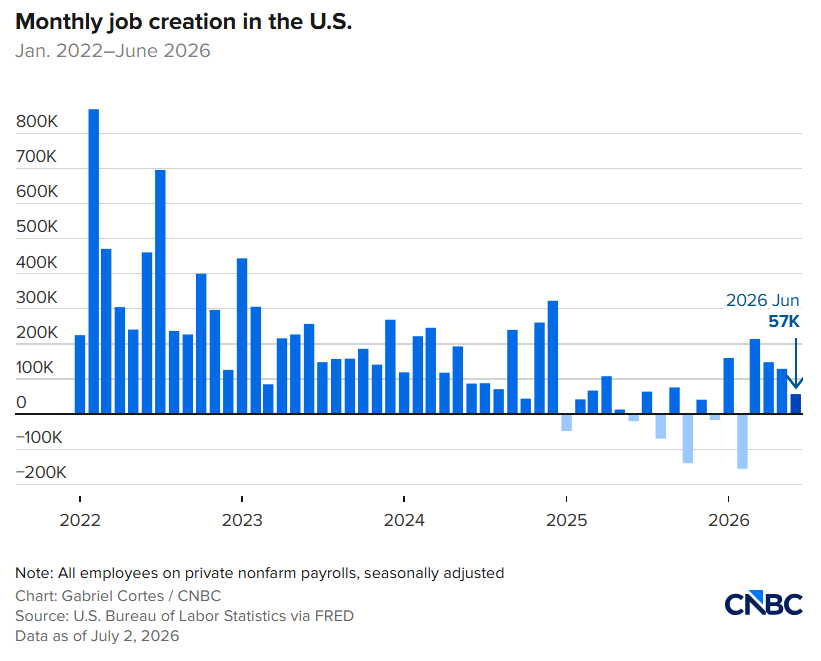
The June jobs report came in well below expectations, with employers adding only 57,000 positions after May’s total was revised down to 129,000. April’s gains were also trimmed, reinforcing the view that hiring has been cooling for several months. While the unemployment rate dipped to 4.2%, that decline came largely because roughly 720,000 people exited the labor force, pushing workforce participation to its lowest level since early 2021.
Financial markets immediately adjusted expectations for the Federal Reserve. Traders sharply reduced the odds of another interest-rate hike this month, though many still expect policymakers to raise rates later this year. Economists noted the softer hiring numbers now line up with other indicators that have suggested employers are becoming more cautious.
Professional and business services led June’s hiring, while healthcare and social assistance continued adding jobs. Leisure and hospitality, however, shed 61,000 positions despite hopes that the FIFA World Cup would generate seasonal hiring. Employers have largely avoided layoffs, choosing instead to slow new hiring after years of struggling to find workers following the pandemic.
Some economists believe uncertainty surrounding the conflict in the Middle East may have contributed to the weaker hiring picture, though it’s too early to determine how much of the slowdown is tied to geopolitical events. For now, the latest report suggests the labor market is gradually cooling rather than abruptly breaking.
Source: Reuters
Editor: Wall Street spent months wondering when the labor market would finally tap the brakes. June answered with a polite—but unmistakable—”now.”
Nothing says “public-private partnership” quite like offering Washington a slice of an $852 billion AI company.
OpenAI Floats Giving U.S. Government a $42 Billion Stake
OpenAI has reportedly proposed giving the U.S. government a 5% ownership stake as it looks to ease political pressure and keep Washington on its side. If the idea ever became reality, taxpayers wouldn’t just regulate the AI boom—they’d own a piece of it.
According to the Financial Times, CEO Sam Altman suggested the concept during discussions with the Trump administration, arguing that the public should directly share in the enormous financial upside created by artificial intelligence. At OpenAI’s latest valuation, a 5% stake would be worth roughly $42.6 billion.
The proposal reportedly goes beyond OpenAI. Altman is said to have envisioned a government investment vehicle that would hold similar 5% stakes in other leading U.S. AI developers, including Anthropic, Google and Meta. It’s unclear whether any of those companies would entertain the idea, and none have publicly commented on the report.
The discussions come as Washington increases scrutiny of AI companies over national security, export controls, and competition from increasingly capable Chinese AI models. Policymakers have also pushed for stronger safeguards around advanced AI systems, creating new pressure on U.S. developers to demonstrate they can innovate without creating unacceptable risks.
OpenAI has previously floated the idea of a “public wealth fund” that would allow Americans to benefit financially from AI’s rapid growth. Whether a government equity stake becomes part of that vision remains to be seen, but the proposal underscores how closely the future of artificial intelligence is becoming intertwined with public policy.
Source: CNBC
Editor: Silicon Valley has spent decades trying to keep government out of the boardroom. Now one of its biggest stars may be inviting Washington to pull up a chair—with equity attached. Or, is this just another bribe to Trump from a tech billionaire to ease off on regulating his business and the industry at large?
I suggest the latter. NONE of these tech wealthy give a fuck about the public good.
Team USA’s top scorer is out of the World Cup’s biggest match after a controversial VAR decision left players, coaches, and fans shaking their heads.
Video Assistant Referee (VAR) Sends Team USA’s Leading Scorer to the Sideline
Folarin Balogun’s World Cup breakout hit an abrupt stop after a lengthy video review ended with a red card that will keep him out of the Americans’ Round of 16 showdown against Belgium. The U.S. won the game but it may have lost its biggest offensive weapon when it matters most.
Balogun scored to help the United States defeat Bosnia and Herzegovina 2-0 before a lengthy VAR review determined he had committed serious foul play by accidentally stepping on defender Tarik Muharemović’s ankle.
U.S. coach Mauricio Pochettino blasted the decision afterward, saying, “For me, never it’s a red card. It was a normal action in football that happened by accident. But it’s not intentional.”
The controversy intensified because many fans pointed to a similar challenge by Lionel Messi earlier in the tournament that drew no red card. Unlike many domestic leagues, there is no appeal process available, meaning Balogun will automatically miss the Round of 16 match against Belgium as the Americans chase their first World Cup quarterfinal appearance since 2002.
Replacing Balogun won’t be easy. Ricardo Pepi, Haji Wright, and Christian Pulisic could all see expanded roles, but none has matched the scoring touch Balogun has displayed throughout the tournament. His absence creates a major challenge against what will be the toughest opponent Team USA has faced so far.
Source: Wall Street Journal (gift article)
Editor: VAR is supposed to eliminate obvious mistakes. When nearly everyone leaves arguing about the call, it may be time to ask whether the replay booth is creating as many controversies as it’s solving.
Saudi Arabia’s refusal to help launch a U.S. military operation exposed the biggest crack in the U.S.-Saudi alliance in years.
Saudi Arabia Forced Trump to Scrap Hormuz Military Operation
A behind-the-scenes dispute over the Strait of Hormuz revealed just how far Washington and Riyadh have drifted—even after years of rebuilding ties.
More than 100 U.S. aircraft were reportedly poised to support Project Freedom, a military operation designed to protect commercial shipping through the Strait of Hormuz, when Saudi Arabia refused to allow the use of its bases and airspace. The move forced the Trump administration to abandon the operation and triggered a tense diplomatic standoff between President Trump and Crown Prince Mohammed bin Salman.
The White House reportedly responded by warning Saudi Arabia that future deliveries of missile-defense interceptors could be delayed unless the kingdom reversed course. Riyadh ultimately relented, but not before exposing what officials described as the most serious rift in the relationship in years. The dispute reportedly left Washington weighing whether to reduce its military presence in Saudi Arabia and shift resources to allies viewed as more dependable.
At the heart of the disagreement was strategy. Saudi leaders feared a broader conflict with Iran would threaten regional stability, disrupt global energy markets, and invite retaliation against Gulf oil facilities. The kingdom pushed for diplomacy while the U.S. pressed ahead with military operations. As one Saudi official later argued, preserving stability at home had become the overriding priority.
The two countries remain close partners, but the episode underscored how much the Middle East has changed. Saudi Arabia has expanded its diplomatic outreach, strengthened ties with regional partners, and appears increasingly willing to chart its own course—even when that means telling Washington “no.”
Source: Wall Street Journal (gift article)
Editor: Alliances are strongest when everyone agrees. You find out how strong they really are the first time someone says, “Not this time.”