


The Morning Sixpack stays free because the news that shapes your life should not be hidden behind a paywall. Paid subscribers are not paying for access. They are helping fund the research, writing, and independent voice that goes into every issue. Become a paid subscriber and help keep smart, honest news analysis free for everyone.
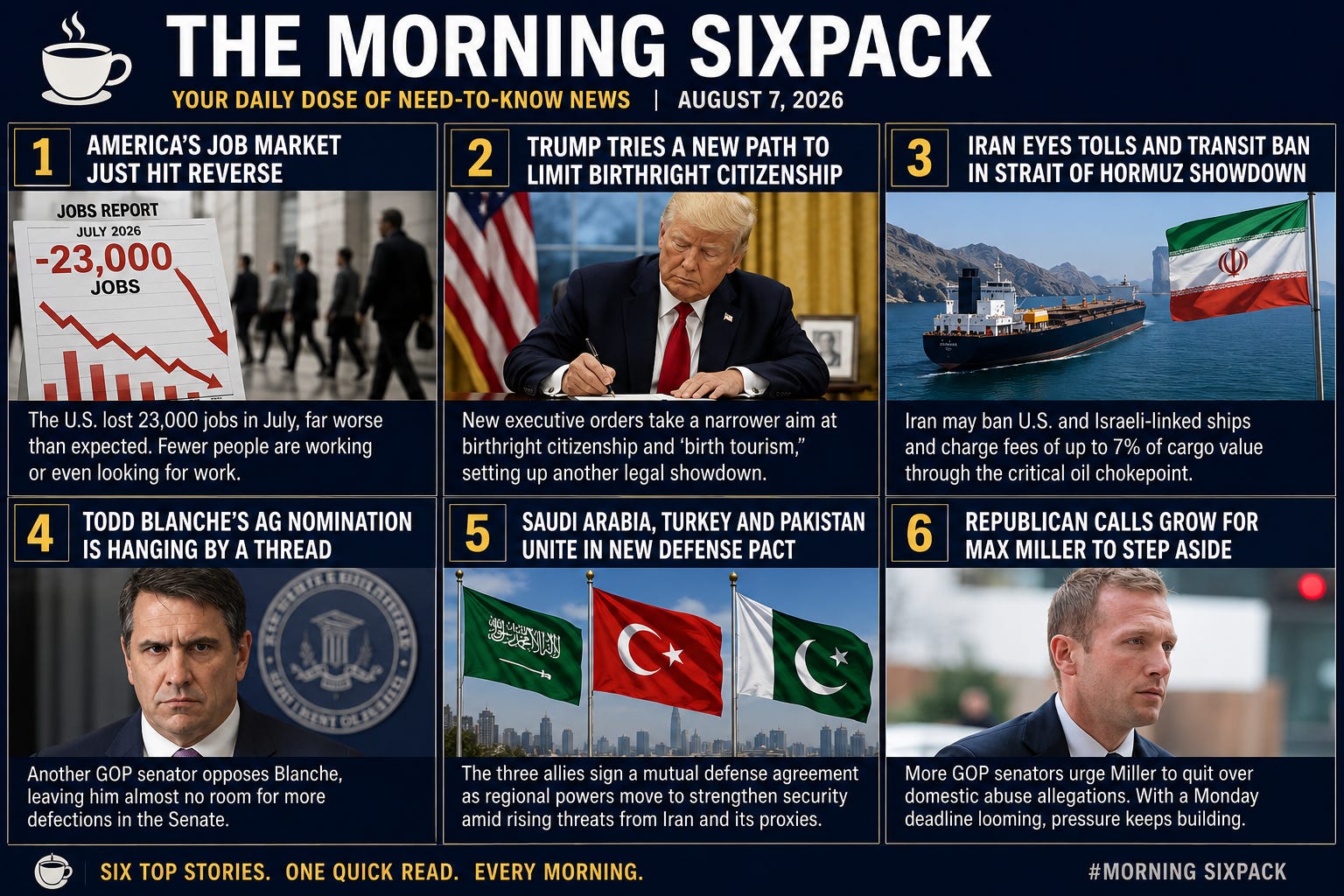
Job losses finally showed up in the official numbers, and the lower unemployment rate came from fewer Americans looking for work—not a stronger economy.
America’s Job Market Just Hit Reverse
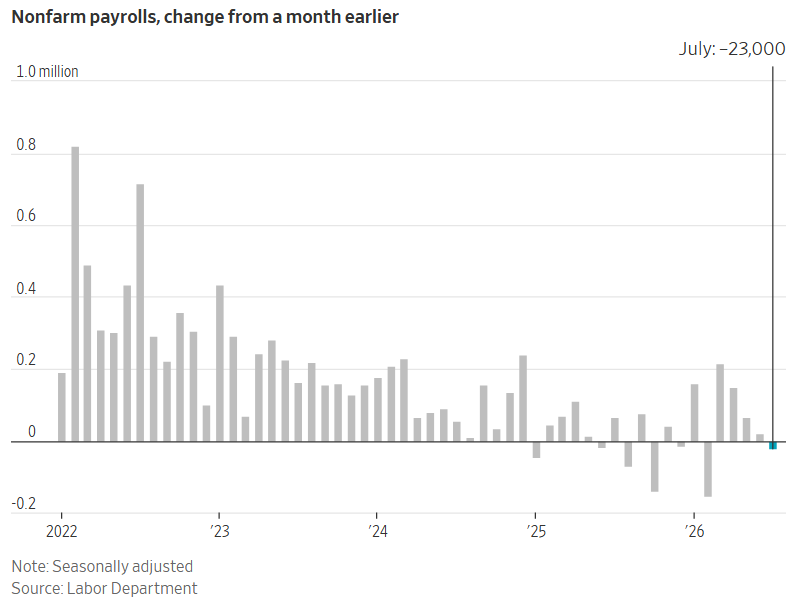
The U.S. economy lost 23,000 jobs in July, badly missing expectations and raising fresh questions about whether the labor market is weaker than Washington wants to admit.
The unemployment rate dipped only because more Americans stopped looking for work—a reminder that not every “good” headline is actually good news.
Wall Street was expecting the economy to add about 83,000 jobs. Instead, it lost 23,000, and the Labor Department also revised May and June payrolls down by a combined 103,000 jobs. That’s not exactly the kind of trend that inspires confidence if you’re trying to convince people the economy is humming along.
The unemployment rate edged down to 4.1% from 4.2%, but that came as more Americans exited the labor force altogether. If fewer people are looking for jobs, the unemployment rate can fall even while employment weakens. That’s a statistic politicians love to celebrate—and one that deserves a closer look.
The report also throws a wrench into the Federal Reserve’s next move. Some officials had been leaning toward another interest-rate hike because inflation remains elevated. A softer labor market could make them think twice, although inflation data due before September’s meeting will still play a major role. As Fed Governor Lisa Cook put it:
“I consider the risks to the inflation side of the dual mandate higher than the risks to the employment side at this point.”
Americans already felt the job market was losing momentum, and this report won’t ease those concerns. Hiring has slowed, layoffs remain relatively muted, and a growing share of unemployed workers have been searching for more than six months. That’s a recipe for frustration—even if the headline unemployment rate suggests everything is fine.
Source: The Wall Street Journal (free)
Editor: Losing jobs always gets dressed up as encouraging news because a percentage moved the “right” direction. Numbers matter—but understanding why they changed matters a whole lot more. It’s really simple math.
Trump is taking another run at birthright citizenship—this time with a narrower legal strategy after the Supreme Court rejected his first attempt.
Trump Tries a New Path to Limit Birthright Citizenship
President Trump signed new executive orders aimed at narrowing who automatically qualifies for U.S. citizenship at birth while cracking down on so-called birth tourism.
After losing at the Supreme Court once, the administration is betting a more targeted approach has a better chance of surviving in court.
Rather than reviving the broad executive order the Supreme Court blocked earlier this year, the new order focuses on specific categories. It targets children born to people connected to foreign embassies or international organizations, those classified as “alien enemies,” and cases where parents allegedly obtained citizenship through fraud.
Trump also signed a separate executive order designed to curb “birth tourism” by tightening visa restrictions for people traveling to the United States to give birth. While the administration argues the practice undermines the immigration system, existing law already allows visas to be denied if officials believe someone is traveling primarily to obtain citizenship for a child.
“I thought we were going to win it at the Supreme Court. Unfortunately, we had a bad decision, very unfair decision. Our country suffers because of it and we’re ending it a different way,” Trump said.
The legal battle is almost certain to continue. Immigration advocates argue the 14th Amendment clearly guarantees birthright citizenship, while the administration maintains the Constitution leaves room for these narrower restrictions. The ACLU has already signaled it expects this latest effort to meet the same fate as Trump’s earlier executive order.
Source: Associated Press
Editor: Washington has discovered that if Plan A gets tossed by the courts, there’s always Plan B. Whether this one survives is another question entirely—and one judges will almost certainly answer before long.
Iran is threatening to make the world’s most important oil chokepoint even more expensive—and even more dangerous.
Iran Eyes Tolls and Transit Ban in Strait of Hormuz Showdown
Iran’s parliament is considering legislation that would ban ships tied to the U.S., Israel, and other “hostile countries” from using the Strait of Hormuz unless Tehran is compensated for war damage.
If approved, the proposal would turn one of the world’s busiest shipping lanes into an even bigger geopolitical pressure point—with higher costs and more uncertainty for global trade.
The proposal would slap fees of up to 7% of a cargo’s value on commercial vessels passing through the strait and impose penalties of up to 20% of cargo value on ships that ignore Iran’s conditions. Tehran is also negotiating new shipping routes with Oman, though U.S. officials insist no country has the authority to charge tolls or require permission to use the international waterway.
The move follows months of conflict between Iran, the United States, and Israel that disrupted shipping through the Strait of Hormuz and sent energy markets scrambling. While Washington says negotiations to reopen normal transit are making progress, Iran is signaling it still intends to use the strategic chokepoint as leverage.
Regional tensions remain high. On Thursday, Iran-backed Houthi forces launched attacks in Saudi Arabia that injured 11 people, including a young child, while also claiming deadly strikes against Yemeni government forces. Gulf states are pushing for a temporary agreement to prevent another round of fighting that could put critical oil infrastructure in the crosshairs.
For now, the proposal remains under review in Iran’s parliament, and it’s unclear whether it will become law. But even the possibility of new restrictions on the Strait of Hormuz is enough to keep global energy markets and shipping companies on edge.
Source: NPR
Editor: Nothing says “we’re open for business” quite like threatening to charge a toll at one of the planet’s busiest shipping lanes. Markets have a funny habit of treating uncertainty like an added tax—even before anyone collects one.
Todd Blanche’s path to becoming attorney general just got a lot steeper after another Republican senator broke ranks.
Todd Blanche’s AG Nomination Is Hanging by a Thread
President Trump’s nominee for attorney general lost another key Republican vote Friday, putting his Senate confirmation in serious jeopardy.
With two GOP senators already opposed and another still undecided, Blanche may not have the votes to get across the finish line.
Sen. Lisa Murkowski of Alaska announced she will vote against Todd Blanche’s nomination, citing concerns about the politicization of the Justice Department and Blanche’s handling of a controversial settlement involving Trump’s claims against the IRS. Her opposition follows Sen. Susan Collins of Maine, who also announced this week that she would vote no.
“The country needs an Attorney General who will check the worst impulses of this administration,” Murkowski said. “I hope Mr. Blanche is able to achieve that, if confirmed, but I simply do not have confidence that will be the case.”
Blanche can only afford to lose two Republican votes under the current Senate math because Sen. Mitch McConnell remains absent while recovering from a fall. If one more Republican defects, the nomination is effectively dead unless the vote is delayed or circumstances change. Sen. Bill Cassidy has yet to publicly commit and has voiced concerns similar to those raised by Murkowski and Collins.
Senate Republican leaders had hoped to bring Blanche’s nomination to the floor before lawmakers leave for the August recess. With support now in doubt, those plans could be postponed while leadership gauges whether the votes are there.
Source: The Washington Post (free)
Editor: Confirmation votes are a lot like parachutes—you really don’t want to discover you’re missing one after you’ve already jumped.
Saudi Arabia, Turkey, and Pakistan just formalized a mutual defense pact as the Middle East’s security picture keeps getting darker.
Saudi Arabia, Turkey, and Pakistan Unite in New Defense Pact
Saudi Arabia, Turkey, and Pakistan signed a joint defense agreement Friday, pledging to treat an attack on one as an attack on all amid escalating regional conflict.
The alliance sends a clear message that key U.S. partners are building their own security network as Iran’s attacks and regional instability continue to grow.
The agreement, signed in Mecca after months of negotiations, commits the three Sunni-majority nations to mutual defense while emphasizing that the pact is defensive and not aimed at any specific country. Even so, the backdrop is impossible to ignore, with Iran-backed attacks and disruptions to Gulf shipping pushing regional governments to strengthen military cooperation.
Turkey brings NATO’s second-largest military to the partnership. Pakistan adds the Muslim world’s only nuclear arsenal, although analysts say its nuclear deterrent remains focused on India. Saudi Arabia contributes both economic muscle and strategic importance as one of the world’s largest oil exporters and guardian of Islam’s holiest sites.
The agreement comes as Gulf nations face repeated missile and drone attacks tied to Iran and its regional proxies, while shipping through the Strait of Hormuz remains heavily disrupted. Saudi officials have also warned they expect additional coordinated attacks from Iranian-backed groups, adding urgency to expanding defense partnerships beyond traditional U.S. security arrangements.
While the pact doesn’t replace existing alliances, it signals that regional powers are increasingly preparing to rely on one another as uncertainty grows across the Middle East. Whether it becomes a meaningful military partnership or remains largely symbolic will depend on how much cooperation follows the signatures.
Source: Reuters
Editor: When longtime allies start signing new mutual defense deals, it’s usually because they’re no longer convinced the old arrangements are enough. Insurance policies tend to get more popular when the forecast turns ugly.
More Republican senators are heading for the exits on Max Miller, turning a personal scandal into a political headache for the GOP.
Republican Calls Grow for Max Miller to Step Aside
Rep. Max Miller is facing mounting pressure to resign as more Republican senators abandon him over domestic abuse allegations made by his ex-wife.
With a ballot deadline just days away, Miller’s political future is suddenly hanging by a thread—and Republicans are openly worried he could cost them a safe House seat.
Ohio Sen. Jon Husted became the latest Republican to call for Miller to resign, saying the congressman should step aside and focus on what’s best for his daughter. Sens. Tim Sheehy, Katie Britt, Roger Marshall, Shelley Moore Capito, and others have also either called for Miller’s resignation or publicly backed those demands. Miller has denied the allegations and disputes the claims made during his contentious custody battle.
Rep. Max Miller Goes Nuclear After Abuse Allegations Rock His Family

The Morning Sixpack stays free because the news that shapes your life should not be hidden behind a paywall. Paid subscribers are not paying for access. They are helping fund the research, writing, and independent voice that goes into every issue. Become a paid subscriber and help keep smart, honest news analysis free for everyone.
“I believe Max would be making the right decision to step aside as a candidate and resign from Congress to focus on what is in the best interest of his daughter,” Husted wrote.
The pressure comes as Republicans race against Monday’s deadline for Miller to withdraw and allow local party leaders to select a replacement for the November ballot. Recent polling shows Miller trailing his Democratic opponent in a district President Trump carried comfortably in 2024, fueling fears that a once-safe Republican seat could suddenly become competitive.
Trump has warned Miller about the political risks but has stopped short of publicly calling for his resignation. House Speaker Mike Johnson acknowledged this week that the situation “doesn’t look good,” while Republicans privately continue weighing whether Miller’s candidacy has become more liability than asset.
Source: The Hill
Editor: Political careers can survive plenty of bad headlines. When your own party starts calculating whether replacing you is the safer option, the math usually isn’t working in your favor.