


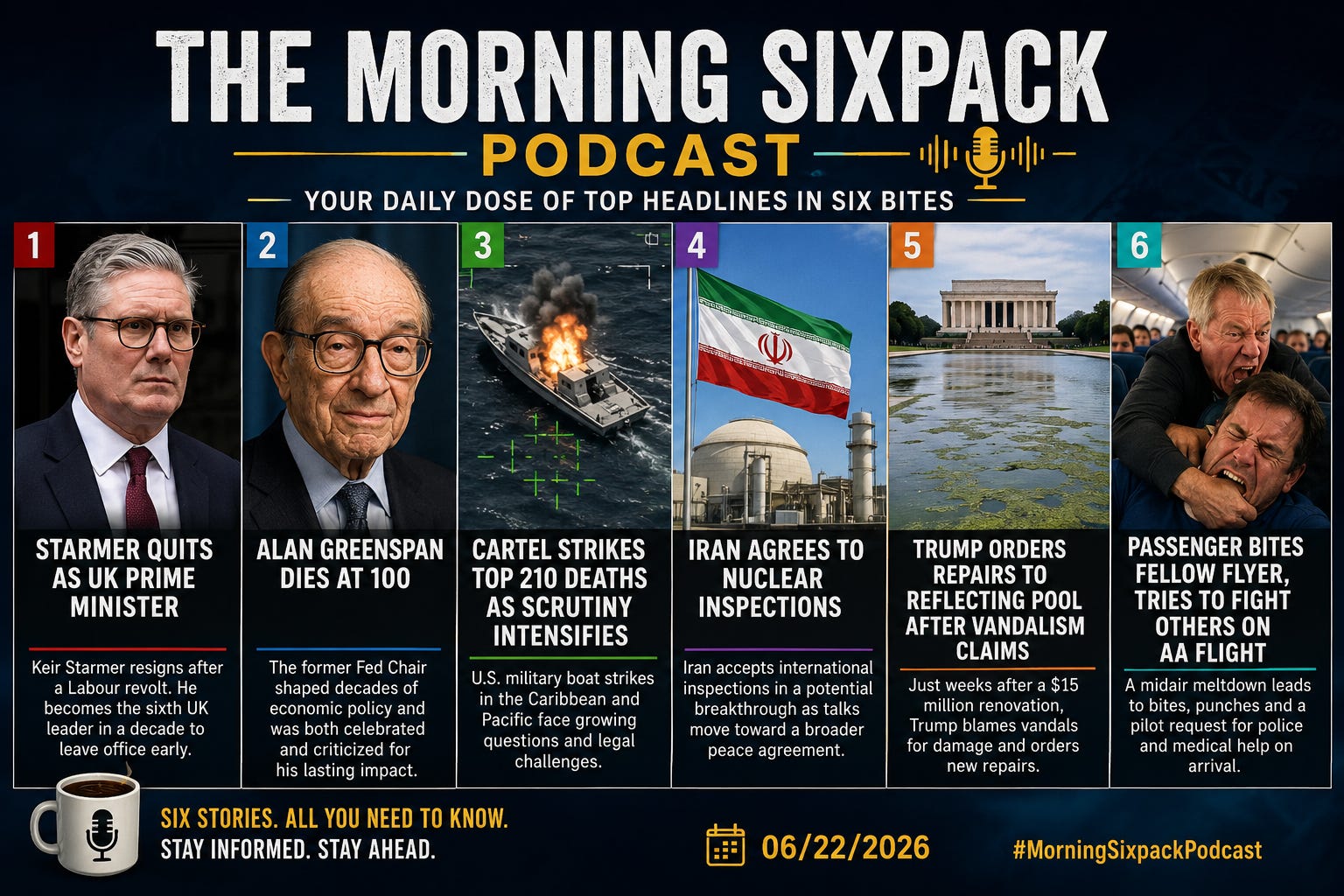
Britain just burned through another prime minister before a full term could pass—apparently Downing Street now has a shorter shelf life than a carton of milk.
Keir Starmer Quits as UK Prime Minister After Labour Revolt
Keir Starmer is stepping down as Britain’s prime minister and Labour leader less than two years after winning a massive election victory. Mounting pressure from his own party, collapsing poll numbers, and the emergence of a serious leadership challenger finally pushed him to the exit.
A landslide victory in 2024 turned into a leadership collapse by mid-2026, making Starmer the sixth British prime minister in a decade to announce an early departure.
Starmer said he will remain as caretaker prime minister while Labour chooses a new leader. Speaking outside 10 Downing Street, he acknowledged that lawmakers no longer believed he was the right person to lead the party into the next general election.
“The question my party is asking now is whether I am best placed to lead us into the next general election,” Starmer said. “I have heard the answer of my parliamentary party to that question, and I accept that answer with good grace.”
The immediate trigger was the rise of Andy Burnham, the former Greater Manchester mayor, whose victory in a special election positioned him as a likely contender for Labour’s top job. Former Health Secretary Wes Streeting has also signaled he could enter a leadership contest.
Starmer’s downfall comes after months of frustration over sluggish economic growth, persistent cost-of-living pressures, and Labour’s fading popularity. While he earned praise abroad for backing Ukraine and navigating international crises, voters at home appeared far less impressed—and Labour lawmakers decided they couldn’t afford to wait any longer.
Source: NPR report on Starmer’s resignation
Editor: The UK spent years mocking Italy for political turnover. At this rate, Britain may want to stop keeping score.
Alan Greenspan spent decades being treated like an economic wizard, then spent the rest of his career explaining why the magic trick didn’t quite work out.
Alan Greenspan Dies at 100, Leaving Behind a Legacy of Booms and Busts
Former Federal Reserve Chairman Alan Greenspan, one of the most influential economic figures in modern American history, has died at age 100. His nearly two decades leading the Fed helped fuel historic prosperity—but also left him tied to the financial excesses that later shook the global economy.
Greenspan was celebrated as the maestro of the 1990s economy, then forced to reckon with the financial crisis that exposed the limits of his faith in markets.
Appointed Fed chairman in 1987, Greenspan served under four presidents and became a rare celebrity central banker. He guided the U.S. through years of strong growth and low unemployment, often resisting calls to raise interest rates even as traditional economic models warned inflation was around the corner.
His influence stretched far beyond interest rates. Greenspan’s famously cryptic “Fedspeak” became legendary, though he later admitted he often spoke in circles to avoid rattling financial markets. One of his few clear warnings came in 1996 when he famously asked, “How do we know when irrational exuberance has unduly escalated asset prices?” The phrase entered economic history almost instantly.
But the reputation that made him a rock star of finance suffered lasting damage after the 2008 financial crisis. A believer in limited regulation and market discipline, Greenspan acknowledged after the crash that his confidence in bankers acting responsibly had been misplaced. “I was shocked because I had going for 40 years or more with very considerable evidence that it was working exceptionally well,” he told lawmakers investigating the meltdown.
Greenspan’s legacy remains complicated. Supporters credit him with helping deliver one of America’s longest economic expansions, while critics argue his low-rate policies and hands-off approach helped inflate the bubbles that eventually burst. In the end, he will be remembered both as the architect of an era of prosperity and as a symbol of the risks that prosperity sometimes concealed.
Source: NPR obituary for Alan Greenspan
Editor: For years, investors treated Greenspan’s every word like it came down from a mountain on stone tablets. Turns out even economic legends can mistake a bubble for a balloon.
When your anti-drug campaign racks up more than 210 deaths and still sparks legal questions, the paperwork may end up being as dangerous as the missiles.
Pentagon’s Anti-Cartel Boat Strikes Top 210 Deaths as Legal Scrutiny Intensifies
The U.S. military has now killed more than 210 people in a growing campaign of boat strikes targeting suspected drug traffickers in Latin America. The latest attack in the eastern Pacific left two people dead and six survivors unaccounted for, raising fresh questions about the operation’s legality and effectiveness.
What began as a crackdown on so-called “narcoterrorists” is increasingly becoming a debate over evidence, civilian casualties, and the rules of war.
According to U.S. Southern Command, the latest strike targeted a vessel traveling along a known drug-smuggling route. As in many previous cases, the military did not publicly provide evidence that the boat was carrying narcotics. Video released online showed a projectile hitting the speeding vessel before it erupted in flames.
President Donald Trump has defended the strikes as part of what he describes as an armed conflict against drug cartels, arguing that aggressive military action is necessary to curb the flow of narcotics into the United States. Critics counter that the fentanyl responsible for many overdose deaths typically enters the country through land routes from Mexico, not by sea.
The controversy deepened after reports that the military conducted a follow-up strike on survivors of an earlier attack. Two men who initially survived a strike that killed nine others were reportedly clinging to wreckage when a second strike killed them. The White House said the action was taken in self-defense and complied with the laws of armed conflict, but some legal scholars have strongly disputed that claim.
Now lawmakers are demanding the release of unedited video from the first strike, while the Pentagon inspector general reviews whether military targeting procedures were properly followed. The review will examine operational protocols, though not the broader question of whether the strikes themselves are lawful.
Source: Associated Press report on U.S. military boat strikes
Editor: The administration says it’s winning a war on cartel traffickers. Critics want to know who’s being targeted, who’s being rescued, and why those answers seem harder to find than the boats.
After years of arguing over inspections, sanctions, strikes, and uranium stockpiles, everyone seems to have rediscovered that actually checking what’s happening is a pretty useful idea.
Iran Agrees to Nuclear Inspections as Trump Team Pushes for Broader Peace Deal
Iran has agreed to allow international inspections of its nuclear program, marking a major breakthrough in negotiations aimed at turning last week’s ceasefire into a lasting agreement. The move would restore a key safeguard that disappeared after President Trump withdrew from the Obama-era nuclear deal in 2018.
For the first time in years, international inspectors could soon regain access to Iran’s nuclear activities—a critical test of whether diplomacy can hold after months of conflict.
Vice President JD Vance announced the development Monday from Switzerland, where U.S. and Iranian officials continue talks with mediators from Qatar and Pakistan. Vance called the inspections agreement “a major milestone for the American people, and the first step in permanently denuclearizing or permanently ending a nuclear weapons program in Iran.”
According to Vance, negotiations nearly derailed after President Trump warned that the United States could “hit Iran very hard again” if necessary. Iranian officials reportedly considered walking away from the talks but remained at the table into the early morning hours as negotiators worked through disagreements.
The broader ceasefire agreement signed last week gives both sides 60 days to resolve major issues, including the future of Iran’s uranium stockpile and guarantees that the Strait of Hormuz remains open to global shipping. The waterway remains one of the world’s most important energy chokepoints, and negotiators spent part of the weekend discussing mechanisms to keep commerce flowing without disruption.
The inspections could begin almost immediately through the International Atomic Energy Agency, which monitored Iran’s compliance under the 2015 nuclear agreement. Since the U.S. withdrawal from that deal and subsequent military actions against Iranian nuclear facilities, inspectors have faced significant restrictions on access. Whether this renewed cooperation evolves into a permanent agreement may determine if the current ceasefire becomes a durable peace—or just another pause in a long-running conflict.
Source: Washington Post report on Iran nuclear inspections talks
Editor: Funny how international inspections keep coming back into fashion. Every administration eventually discovers that “trust us” isn’t much of a verification system.
And let’s not forget that Obama had negotiated a deal a lot like this without going to war first and killing thousands of people and shutting down the Strait of Hormuz, choking off the global economy. But Trump couldn’t stand that Obama had made a deal better than he ever could, so he tore it up, started a war and financial crisis, and here we are, clearly worse off than if he hadn’t done ANY of the things.
When a freshly renovated Reflecting Pool needs repairs within weeks, somebody’s going to blame vandals—and somebody else is going to blame the renovation.
Trump Orders New Repairs to Lincoln Memorial Reflecting Pool After Vandalism Claims
President Trump says work will begin immediately on the Lincoln Memorial Reflecting Pool after what he describes as extensive vandalism at the recently restored landmark. The announcement comes just weeks after the completion of a $15 million renovation that has already faced criticism over algae blooms and peeling paint.
A project unveiled as a showcase ahead of America’s 250th birthday is now back under repair before the ribbon-cutting glow has even faded.
Trump said he personally inspected the Reflecting Pool and was stunned by what he saw. In a series of social media posts, he claimed vandals carved a 250-foot gash into the pool’s surface and poured corrosive chemicals into the water, forcing officials to undertake additional repairs. He also said multiple arrests had been made, though authorities had not publicly confirmed those claims as of Sunday.
“I just inspected it, and could only say to myself, and those gathered around me, WOW, who would do such a thing? SICK, DERANGED PEOPLE!” Trump wrote.
The Reflecting Pool restoration was completed earlier this month after months of work and a reported $15 million investment. But almost immediately, videos circulated online showing algae growth turning sections of the water green while other footage appeared to show blue coating material peeling from the pool floor. The administration has maintained that vandalism contributed to at least some of the problems.
Adding another twist, three-time U.S. Olympian David Hearn was arrested Friday in connection with alleged damage to the pool. Hearn insists he did nothing wrong, saying he merely touched paint that was already peeling away from the bottom surface. Whether investigators ultimately blame vandals, construction flaws, or a combination of both, taxpayers may be left reflecting on why a brand-new renovation is already back on the repair list.
Source: UPI report on Reflecting Pool repairs and vandalism claims
Editor: The pool was supposed to reflect the Lincoln Memorial. Instead, it’s reflecting the eternal truth of government projects: the warranty always seems to expire first.
Air travel used to come with peanuts and tiny sodas—now it apparently comes with bite risks and amateur boxing matches.
Passenger Bites Fellow Flyer, Tries to Fight Others on American Airlines Flight
An unruly passenger allegedly bit another traveler and attempted to fight multiple people aboard an American Airlines flight headed to Philadelphia. The bizarre midair disturbance prompted the pilot to request that emergency medical personnel and law enforcement meet the aircraft upon landing.
Flying the friendly skies isn’t feeling especially friendly these days when fellow passengers are treating a commercial flight like an unsanctioned cage match.
According to air traffic control audio, the incident occurred aboard American Airlines Flight 3046 from Charlotte, North Carolina, to Philadelphia. The pilot told controllers that a man believed to be in his 70s had bitten another passenger and was attempting to fight others onboard.
“I don’t know... if he’s hallucinating or whatever, but he just bit a passenger and he’s trying to fight everybody,” the pilot said in the recorded exchange. After arranging for emergency responders to meet the plane, the pilot added, “What a day, huh?” The controller’s response: “Happy Father’s Day!”
American Airlines later described the situation as a medical emergency and said the passenger was assisted before landing. The airline did not confirm whether police took action after the aircraft arrived at Philadelphia International Airport.
The incident is the latest reminder that airline crews increasingly find themselves managing far more than delayed departures and lost luggage. Whether caused by medical episodes, intoxication, or plain old bad behavior, disruptive passenger incidents have become a recurring part of modern air travel—making many travelers wonder whether the most stressful part of flying is still getting through security.
Source: UPI report on unruly American Airlines passenger incident
Editor: Somewhere in an airport boardroom, a marketing executive is still talking about “enhancing the customer experience.” Meanwhile, passengers are just hoping not to end up on the in-flight menu.