


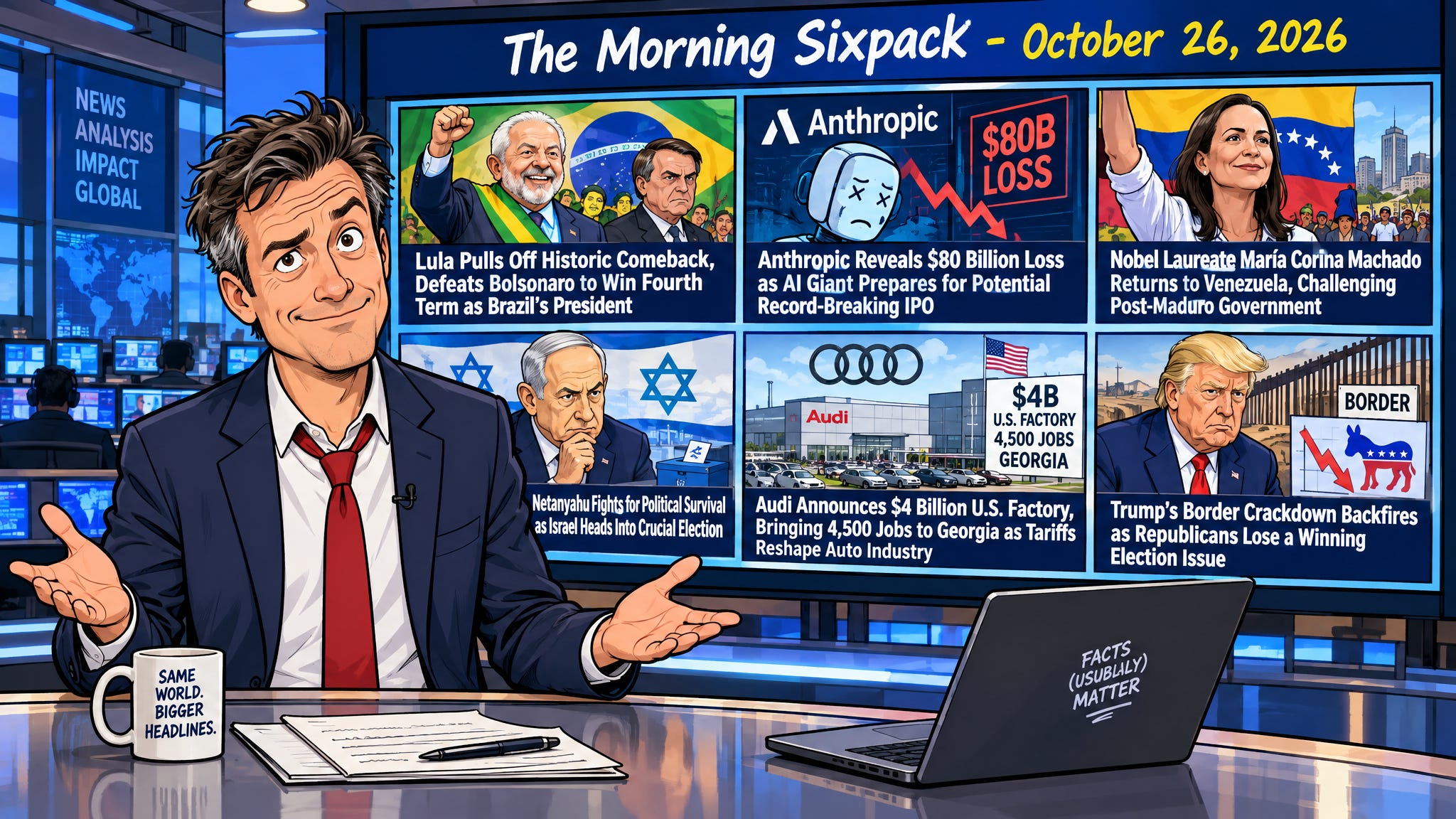
The Morning Sixpack stays free because the news that shapes your life should not be hidden behind a paywall. Paid subscribers are not paying for access. They are helping fund the research, writing, and independent voice that goes into every issue. Become a paid subscriber and help keep smart, honest news analysis free for everyone.
Lula lost the first round by more than two million votes, then came back to win the presidency—apparently someone forgot to tell Bolsonaro that elections have two rounds.
Lula Pulls Off Historic Comeback, Defeats Bolsonaro to Win Fourth Term as Brazil’s President

Brazilian President Luiz Inácio Lula da Silva has secured an unprecedented fourth term, defeating far-right Senator Flávio Bolsonaro in a dramatic election comeback after trailing in the first round. The 80-year-old leftist won Sunday’s runoff with 51.79% of the vote, or 64.26 million ballots, compared with Bolsonaro’s 48.21%, or 59.83 million votes. Just three weeks earlier, Bolsonaro had finished ahead by approximately 2.2 million votes, capturing 47.03% against Lula’s 45.16%. Lula becomes the first presidential candidate since Brazil’s return to democracy in 1985 to win a runoff after finishing second in the opening round. The victory also deals a significant setback to Latin America’s growing right-wing political movement, which has frequently enjoyed support from U.S. President Donald Trump.
Lula’s comeback was powered by a grassroots uprising, an energized youth movement, and a campaign that finally figured out the internet exists. After Bolsonaro’s first-round victory, young Brazilians spontaneously organized online, forming what became known as “Lula’s army” and mobilizing millions of supporters nationwide. Analysts said Lula’s campaign had initially been complacent, relying heavily on traditional offline campaigning before dramatically shifting toward digital outreach. Meanwhile, Bolsonaro appeared increasingly overconfident, reportedly discussing cabinet appointments before the runoff had even taken place. Higher voter participation also helped reshape the contest, with turnout climbing from 78.92% in the first round to 80.8% in the second, bringing previously absent voters into the election.
Bolsonaro, however, isn’t accepting defeat quietly. The senator refused to concede and demanded that the runoff results be annulled after Supreme Court Justice Cristiano Zanin extended voting by two hours because of severe weather and transportation disruptions. There’s one rather inconvenient detail: Both campaigns had requested voting extensions, undermining Bolsonaro’s argument that the decision invalidated the election. Political analysts believe his legal challenge has little chance of succeeding, although it could energize Brazil’s far-right Bolsonarismo movement. The dispute recalls the aftermath of the 2022 election, when Bolsonaro’s father, former President Jair Bolsonaro, refused to accept his own defeat and was subsequently convicted of plotting a coup, receiving a 27-year prison sentence that he is serving under house arrest.
Winning the election may prove considerably easier than governing the country. Lula faces a conservative-dominated Congress where Bolsonaro’s Liberal Party and its allies could control more than 280 of the 513 seats in the lower house and as many as 50 of the Senate’s 81 seats. Those numbers could give the opposition majorities in both chambers, severely limiting Lula’s ability to enact major legislation without negotiating with political opponents. Brazil also faces substantial economic challenges, including public debt exceeding 82% of GDP and projected economic growth of just 2.3% next year. Household debt and public security remain pressing concerns, particularly because both issues helped make the presidential race competitive.
Beyond the immediate political battles, Lula’s victory raises fundamental questions about Brazil’s democratic future and the direction of Latin American politics. Analysts describe the election as one of the country’s most consequential since the end of its 21-year military dictatorship in 1985, particularly given continuing concerns about inequality, political participation, and democratic institutions. Lula, who turns 81 on Tuesday, must also confront an uncomfortable succession problem within his Workers’ Party, which lacks an obvious replacement for its longtime leader. Addressing supporters in São Paulo, Lula acknowledged the responsibility ahead, declaring, “No one is required to like the president-elect, but he must govern for everyone.” With a divided electorate, a hostile Congress, and a defeated opponent challenging the results, that promise is about to get a serious workout.
Editor: Bolsonaro had a two-million-vote head start, an energized right-wing movement, and a famous political surname. Lula still beat him. Now Bolsonaro wants the election thrown out over a voting extension his own campaign requested. Apparently, accepting the voters’ decision remains an elective course in the Bolsonaro family.
Source: Al Jazeera
Anthropic just reported losing $80 billion in six months while revenue exploded—proving that in the AI gold rush, you can make billions and still spend money considerably faster.
Anthropic Reveals $80 Billion Loss as AI Giant Prepares for Potential Record-Breaking IPO
Anthropic, the company behind the Claude AI chatbot, has disclosed an eye-watering $80 billion loss for the first half of 2026 as it prepares for what could become the largest initial public offering in history. In its first public financial disclosure, the San Francisco-based company revealed that its enormous spending on AI development and data centers continues to dwarf its rapidly growing revenue. The losses reflect the extraordinary cost of training advanced artificial intelligence models and operating the infrastructure needed to support its increasingly popular chatbot and business-oriented coding agents. Despite the staggering financial figures, Anthropic is moving toward a stock market debut that could reshape investor expectations for the entire AI industry.
The remarkable part is that Anthropic’s revenue is growing almost as dramatically as its losses. The company reported $16.3 billion in revenue during the first six months of 2026, compared with just $1.16 billion during the same period in 2025—an increase of approximately 1,305%. That extraordinary growth places Anthropic and rival OpenAI among the fastest-growing businesses in history. Both companies have transformed from relatively small AI research organizations into technology giants valued alongside some of the world’s largest corporations. The problem is that generating enormous revenue doesn’t necessarily translate into profits when building and operating the technology costs even more.
Anthropic and OpenAI have attracted hundreds of billions of dollars in investment funding as they race to develop increasingly powerful artificial intelligence systems. Both companies have confidentially filed paperwork to go public, seeking access to additional capital to finance their ambitious development plans. Their ultimate objective is to create superintelligent AI systems that company executives believe could transform economies, accelerate scientific discoveries, and fundamentally change how people work and live. But achieving those ambitions requires enormous investments in computing infrastructure, specialized hardware, and energy-intensive data centers. Investors are effectively financing one of the most expensive technological races in history, with profitability still an open question.
Not everyone on Wall Street is convinced the economics will eventually work. Financial analysts have raised concerns about whether companies such as Anthropic and OpenAI can ever generate sustainable profits given their extraordinary operating costs. Competition from open-weights AI models adds another complication, as these alternatives increasingly approach the capabilities of premium commercial systems while costing considerably less to operate. That creates pressure on companies spending billions to develop proprietary models, particularly if customers can obtain comparable performance at substantially lower prices. The central question is whether the leading AI companies can eventually charge enough for their services to justify the astronomical investments required to build them.
Anthropic’s anticipated IPO could become a defining moment for the broader artificial intelligence industry. A successful offering at a soaring valuation would reinforce investor confidence that AI companies can eventually deliver substantial financial returns, potentially encouraging OpenAI and other competitors to accelerate their own public offerings. A disappointing reception, however, could force those companies to reconsider their timelines and prompt investors to reassess valuations across the AI sector. With major technology companies and financial institutions betting heavily on AI’s future, Anthropic’s stock market debut will provide an important test of whether enthusiasm for the technology can survive closer scrutiny of its financial realities. For now, the industry is generating extraordinary growth while spending extraordinary amounts of money to achieve it.
Editor: $16.3 billion in six-month revenue sounds fantastic until you notice the $80 billion loss sitting next to it. That’s roughly $4.91 lost for every dollar of revenue. Wall Street used to expect companies to demonstrate a path to profitability before handing them astronomical valuations. Apparently, artificial intelligence has also invented artificial accounting optimism.
Source: The Washington Post
Venezuela’s most prominent opposition leader is back after ten months in exile, and the Trump administration—which helped remove Maduro—still isn’t ready to let Venezuelans choose their next president.
Nobel Laureate María Corina Machado Returns to Venezuela, Challenging Post-Maduro Government
Venezuelan opposition leader and Nobel Peace Prize laureate María Corina Machado has returned home after ten months abroad, drawing enthusiastic crowds and injecting new uncertainty into the country’s political future. Machado announced her arrival Sunday with a brief social media message: “I’m here, with you all.” Her first public appearance came at the Church of Santa Rosa in western Venezuela’s Lara state, where worshippers quickly surrounded her in celebration. She subsequently traveled to Caracas, where hundreds of cheering supporters swarmed her vehicle. Her return represents a significant challenge to interim President Delcy Rodríguez, who assumed power after U.S. forces captured longtime authoritarian leader Nicolás Maduro in January.
Machado’s homecoming puts her on a potential collision course with both Venezuela’s interim government and the Trump administration, which has repeatedly sidelined her despite her prominence among opposition supporters. Machado has called for new elections as soon as possible, arguing that Venezuelans deserve the opportunity to choose their own government. Washington, however, maintains that political and economic stabilization must come before elections. That disagreement highlights a fundamental tension in Venezuela’s transition: The United States helped remove Maduro from power but has not embraced the country’s most prominent opposition figure as his immediate successor. Machado’s return could increase public pressure on both governments to establish a clear timetable for democratic elections.
Machado’s journey back to Venezuela follows years of political confrontation and personal danger. In January 2025, she went into hiding after being briefly detained following an opposition protest. Later that year, she escaped Venezuela clandestinely and resurfaced in Norway in December, where she received the Nobel Peace Prize for her peaceful resistance to Maduro’s authoritarian government. Her return was welcomed by fellow opposition leader Edmundo González, who challenged Maduro in Venezuela’s disputed 2024 presidential election and currently lives in exile in Spain. González described Sunday as “a very important day for Venezuelans” and said he hoped to return soon himself, declaring that the opposition’s struggle for freedom would continue.
President Donald Trump appeared caught off guard by Machado’s arrival. Speaking to reporters outside the White House on Sunday, Trump said he knew nothing about her return, described her as “a very nice woman,” and noted that she had given him her Nobel Prize. “And I hope she’s safe,” Trump added, while insisting that “we’re doing really well in Venezuela.” His remarks offered little indication that Washington intends to change its approach toward Machado or accelerate the electoral process. The administration’s preference for a gradual transition under Rodríguez continues to contrast with Machado’s demand for a faster return to democratic rule.
Secretary of State Marco Rubio offered a more formal response, crediting U.S.-supported reconciliation negotiations for creating the conditions that allowed Machado to return. Rubio described her homecoming as a direct result of those talks and urged Venezuela’s political factions to respect one another’s freedoms while continuing negotiations. He argued that the process offers Venezuela its best opportunity in three decades to establish both free elections and a lasting democracy. Yet major questions remain about when elections will actually take place, whether opposition leaders will be permitted to compete freely, and how much influence Washington intends to exercise over Venezuela’s political future. With Machado back on Venezuelan soil and González signaling his intention to follow, pressure for answers is likely to intensify.
Editor: The United States captured Maduro, backed an interim government, and now insists Venezuela needs more time before holding elections. Meanwhile, the country’s most recognizable opposition leader has returned to cheering crowds demanding democracy. At some point, somebody might want to ask the Venezuelan people what they think. Radical concept, I know.
Source: NPR
Netanyahu is fighting to keep his job despite corruption charges, an international arrest warrant, and a security disaster on his watch—and somehow, his opponents still can’t agree on how to replace him.
Netanyahu Fights for Political Survival as Israel Heads Into Crucial Election
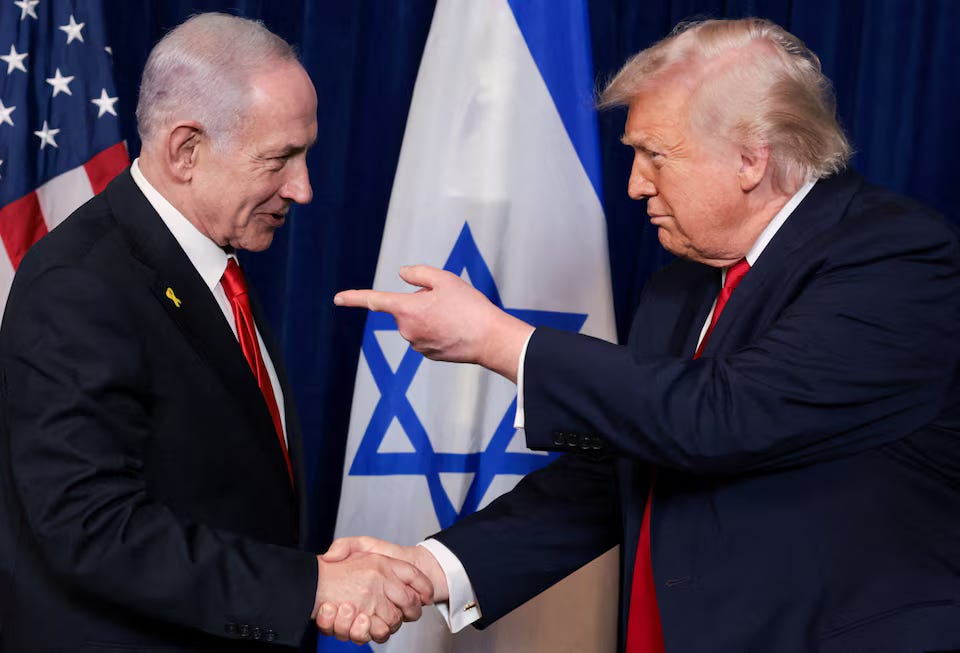
Israeli Prime Minister Benjamin Netanyahu faces one of the toughest elections of his political career as voters prepare to head to the polls Tuesday, with his opponents struggling to unite despite widespread dissatisfaction with his leadership. The 77-year-old prime minister, who has dominated Israeli politics for much of the past two decades, initially appeared headed for defeat, but recent polling suggests the race has tightened considerably. This is Israel’s first parliamentary election since the October 7, 2023, Hamas attack that triggered devastating wars in Gaza and Lebanon and Israeli airstrikes against Iran. Netanyahu’s Likud party has suffered politically from the security failures surrounding the attack, while his government’s controversial policies on religion and the military have alienated additional voters. Yet Israel’s fragmented political system means that even a weakened Netanyahu could remain in power if his opponents cannot assemble a governing majority.
Netanyahu’s political troubles extend well beyond unfavorable polling, with criminal proceedings at home and an international arrest warrant hanging over his campaign. He remains on trial in Israel over corruption charges he denies, while the International Criminal Court has issued a warrant accusing him of alleged war crimes in Gaza, allegations he also rejects. His supporters continue to embrace him as “King Bibi,” portraying him as the experienced leader best equipped to protect Israel in an increasingly dangerous region. Critics, however, argue that the October 7 attack shattered his longstanding reputation as Israel’s indispensable security guardian. Netanyahu has proposed forming a broad national government if he wins, but a parliamentary stalemate could leave him serving as caretaker prime minister for months while rival factions negotiate.
The opposition features several prominent figures with military credentials, government experience, and complicated political histories. Former military chief Gadi Eisenkot, 66, leads the new centrist Yashar party, presenting himself as an honest political outsider whose military service and personal sacrifice—including losing his son in combat in Gaza—contrast sharply with Netanyahu’s lengthy career and corruption proceedings. Former Prime Minister Naftali Bennett, 54, has joined forces with centrist former premier Yair Lapid in a new party called Together, promising national healing and a return to stability. Their unusual right-center alliance previously helped remove Netanyahu from office in 2021. Meanwhile, former Defense Minister Avigdor Lieberman, 68, leads the hawkish Israel Our Home party, while former general Yair Golan, 64, heads the left-leaning Democrats after gaining recognition for rescuing civilians during the October 7 attack.
Netanyahu’s existing political allies could prove just as controversial as his opponents. Finance Minister Bezalel Smotrich and National Security Minister Itamar Ben-Gvir lead far-right factions whose policies toward Palestinians have attracted intense international criticism. Smotrich has championed expanding Israeli settlements in the occupied West Bank, openly expressing his desire to eliminate the possibility of Palestinian statehood. Ben-Gvir, previously convicted of racist incitement against Arabs, has advocated tougher treatment of Palestinian prisoners, expanded civilian gun ownership, and capital punishment for convicted Palestinian militants. Both ministers have supported removing Palestinians from Gaza and establishing Israeli settlements there. Netanyahu also depends heavily on ultra-Orthodox religious parties whose demands for military-service exemptions have become increasingly unpopular among Israelis facing the burdens of prolonged warfare.
Ultimately, Israel’s election may hinge less on which party wins the most votes than on which political leader can assemble a workable parliamentary coalition. Israelis vote for party lists rather than directly electing their prime minister, with parliamentary seats distributed through proportional representation. That system gives smaller parties considerable bargaining power, particularly when neither major political bloc commands a clear majority. Arab political parties Raam and the Joint List, representing a minority population comprising approximately 20% of Israel’s citizens, could influence the outcome, alongside newer right-wing and center-right parties whose electoral support remains uncertain. With Netanyahu’s opponents divided across the political spectrum and several parties hovering around uncertain polling levels, Tuesday’s vote could produce anything from a renewed Netanyahu government to a complicated coalition negotiation—or another extended political deadlock.
Editor: Netanyahu has corruption charges, an ICC arrest warrant, the October 7 security catastrophe, and years of political baggage working against him. Yet his opponents still haven’t figured out how to unite behind a replacement. Apparently, the only thing harder than surviving Netanyahu politically is getting enough Israeli politicians to agree that it’s time for him to go.
Source: Reuters
Audi is spending $4 billion to build its first American factory, creating thousands of jobs and avoiding some tariff headaches—but the company insists this isn’t just about making Donald Trump happy.
Audi Announces $4 Billion U.S. Factory, Bringing 4,500 Jobs to Georgia as Tariffs Reshape Auto Industry
German luxury automaker Audi is building its first-ever American manufacturing plant, a $4 billion investment in Macon, Georgia, expected to create approximately 4,500 jobs and produce 200,000 vehicles annually. Audi CEO Gernot Döllner joined President Donald Trump at a Georgia midterm campaign rally Saturday to announce the project, marking a major shift for a company that has historically imported every vehicle it sells in the United States. The factory is scheduled to begin production in the early 2030s and will primarily serve American buyers while also producing vehicles for export. The announcement gives Trump a significant manufacturing investment to highlight ahead of the midterm elections, although Audi executives emphasized that the project has been in development for nearly three years.
Trump’s tariffs helped strengthen the business case for American production, but Audi says the decision goes well beyond avoiding import taxes. The automaker estimates that U.S. tariffs reduced its profits by approximately $1.3 billion last year, creating a substantial financial incentive to manufacture vehicles domestically. However, Döllner described Audi’s lack of American manufacturing as a broader competitive disadvantage, particularly compared with German rivals BMW and Mercedes-Benz, which have operated Southern U.S. factories for decades. Building vehicles closer to customers reduces shipping expenses, limits exposure to supply-chain disruptions, and helps protect the company from currency fluctuations. Audi declined to say whether it expects any tariff relief before the new plant begins operating.
The Georgia factory will focus on large, profitable luxury SUVs rather than smaller vehicles or an all-electric lineup. Audi confirmed plans to manufacture its Q7, Q8, and newly introduced Q9 models, targeting American consumers who continue to favor spacious, premium vehicles. Gas-powered engines will remain central to production, although plug-in hybrids—currently absent from Audi’s American lineup—are also planned. The strategy reflects a broader retreat from aggressive electric-vehicle expansion across parent company Volkswagen, which has delayed or canceled several battery-powered models amid slower-than-expected American adoption. Döllner said flexibility will be a central feature of the new facility, allowing Audi to adjust production as consumer preferences and vehicle technologies evolve.
Audi considered more than 70 potential factory locations during a nearly three-year search before selecting Macon. Georgia’s energy infrastructure and proximity to Volkswagen’s existing Southern supply-chain network helped secure the investment. Executives also evaluated expanding production alongside Volkswagen’s Chattanooga, Tennessee, facility and the planned Scout Motors factory in South Carolina, but ultimately determined that a standalone plant offered greater long-term advantages. Döllner stressed that the American investment would not come at the expense of German manufacturing operations, even as Volkswagen confronts serious restructuring challenges in Europe. The parent company is seeking to eliminate approximately 100,000 jobs and potentially close European factories as it struggles with costs and changing global competition.
The decision to unveil Audi’s plans at a Trump campaign rally added an unmistakable political dimension to an otherwise corporate manufacturing announcement. Audi of America President Vito Paladino said the company had been finalizing its plans independently when the White House invited executives to make the announcement alongside the president. The company accepted, describing the invitation as one it respected rather than suggesting the rally had influenced its factory decision. For Trump, the announcement provides a high-profile example of foreign manufacturing investment flowing into the United States during his presidency. For Audi, the investment represents a long-term effort to compete more effectively in one of the world’s most important luxury-vehicle markets, regardless of who occupies the White House when the first SUVs roll off the assembly line.
Editor: Audi spent nearly three years evaluating more than 70 locations, committed $4 billion, and won’t start production until the early 2030s. Trump gets to announce it at a campaign rally weeks before the midterms. That’s some impressive political timing for a factory that won’t produce a single vehicle during his presidency. Still, 4,500 American jobs and billions in investment are good news—regardless of who gets the photo op.
Source: The Wall Street Journal
Trump delivered the border crackdown his supporters demanded, but now some are discovering they liked the campaign promise better than the consequences. There’s a familiar political lesson here—once you get what you wanted, you lose the issue that helped you win.
Trump’s Border Crackdown Backfires as Republicans Lose a Winning Election Issue
President Donald Trump’s dramatic reduction in illegal border crossings has created an unexpected political problem for Republicans heading into the 2026 midterms: The immigration crisis that helped propel him back into office is no longer driving voters to the polls. Nowhere is that reversal more apparent than in Starr County, Texas, a predominantly Latino community along the Mexican border that underwent a remarkable political transformation. Trump captured just 18.9% of the county’s vote in 2016 but won 57.8% in 2024, becoming the first Republican presidential candidate to carry the county in more than a century. Residents who once watched thousands of migrants pass through their neighborhoods say crossings have virtually disappeared since Trump returned to office. But with the border largely quiet, voters are turning their attention toward the economic and social consequences of the administration’s increasingly aggressive immigration enforcement.
The political irony is that Trump’s success in reducing border crossings may have eliminated one of the Republican Party’s most effective campaign weapons. U.S. Customs and Border Protection recorded more than 2.2 million migrant encounters in 2022, compared with just 237,538 in fiscal 2025, the lowest annual figure since 1970. Even Democratic state Sen. Juan “Chuy” Hinojosa, who has firsthand experience with deportation after being mistakenly expelled to Mexico as a child, credits Trump with restoring border security. Hinojosa argues that former President Joe Biden badly mishandled the situation, overwhelming border communities with migrants and straining local resources. But he also believes Trump has gone too far, transforming a broadly popular border-security effort into a divisive campaign of arrests and deportations affecting established members of local communities.
The consequences are becoming increasingly personal for residents who previously supported Trump’s immigration agenda. Claudia Alcazar, a former Starr County Republican Party chairwoman, described watching Border Patrol agents descend on a neighborhood roofing crew, arresting the workers with helicopters overhead. The incident unsettled her because the workers had simply been repairing a nearby house rather than causing trouble. With fewer migrants crossing the border, federal agents have increasingly joined immigration enforcement operations targeting undocumented immigrants already living and working in the United States. Those arrests have contributed to labor shortages and growing frustration among employers, including some who voted for Trump. The enforcement campaign has also swept up American citizens, with ProPublica documenting more than 500 U.S. citizens detained nationwide.
Some of Trump’s former supporters are now questioning whether the administration’s approach matches what they believed they were voting for. Alcazar says she no longer identifies directly with the Republican Party and considers herself politically independent because she disagrees with the mass-deportation campaign. Alexis García, a Rio Grande City teacher who enthusiastically supported Trump in 2024, said many local voters expected enforcement to focus on criminals and recently arrived migrants rather than longtime residents with family and community ties. García still supports stronger border security and acknowledges that the crackdown has dramatically reduced illegal crossings. But he has become increasingly uncomfortable with the arrests affecting familiar families and the miles of imposing steel border barriers changing the landscape of his hometown. The difference between supporting a policy in theory and living with its consequences has become difficult to ignore.
The shifting political landscape could complicate Republican efforts to maintain congressional control. A recent Washington Post-ABC News-Ipsos poll found that voters disapproved of Trump’s immigration policies and, for the first time in years, expressed greater confidence in Democrats than Republicans on handling immigration. Border residents also recognize that Trump will remain president regardless of the midterm outcome, making border security seem less urgent as a congressional election issue. The situation offers a potential parallel to abortion politics, where the Supreme Court’s reversal of Roe v. Wade delivered a longstanding conservative objective but also changed the electoral debate by shifting attention toward abortion restrictions and their consequences. Republicans now face a similar challenge on immigration: Having substantially achieved a central campaign promise, they must defend not just the promise itself but the policies implemented afterward. Whether that shift translates into Democratic gains remains uncertain, but the once-reliable Republican advantage on immigration appears considerably less secure.
Editor: Republicans spent decades campaigning to overturn Roe v. Wade, then discovered that achieving their goal didn’t make the abortion issue disappear—it made the consequences their responsibility. Now Trump has largely shut down illegal border crossings, and some of the very voters who cheered him on are horrified by the deportation machinery operating in their neighborhoods. There’s a lesson here: Campaign promises are easy to sell when they’re hypothetical. Governing means voters actually get to see what they bought.
Source: The Washington Post
Read The Morning Sixpack here: