


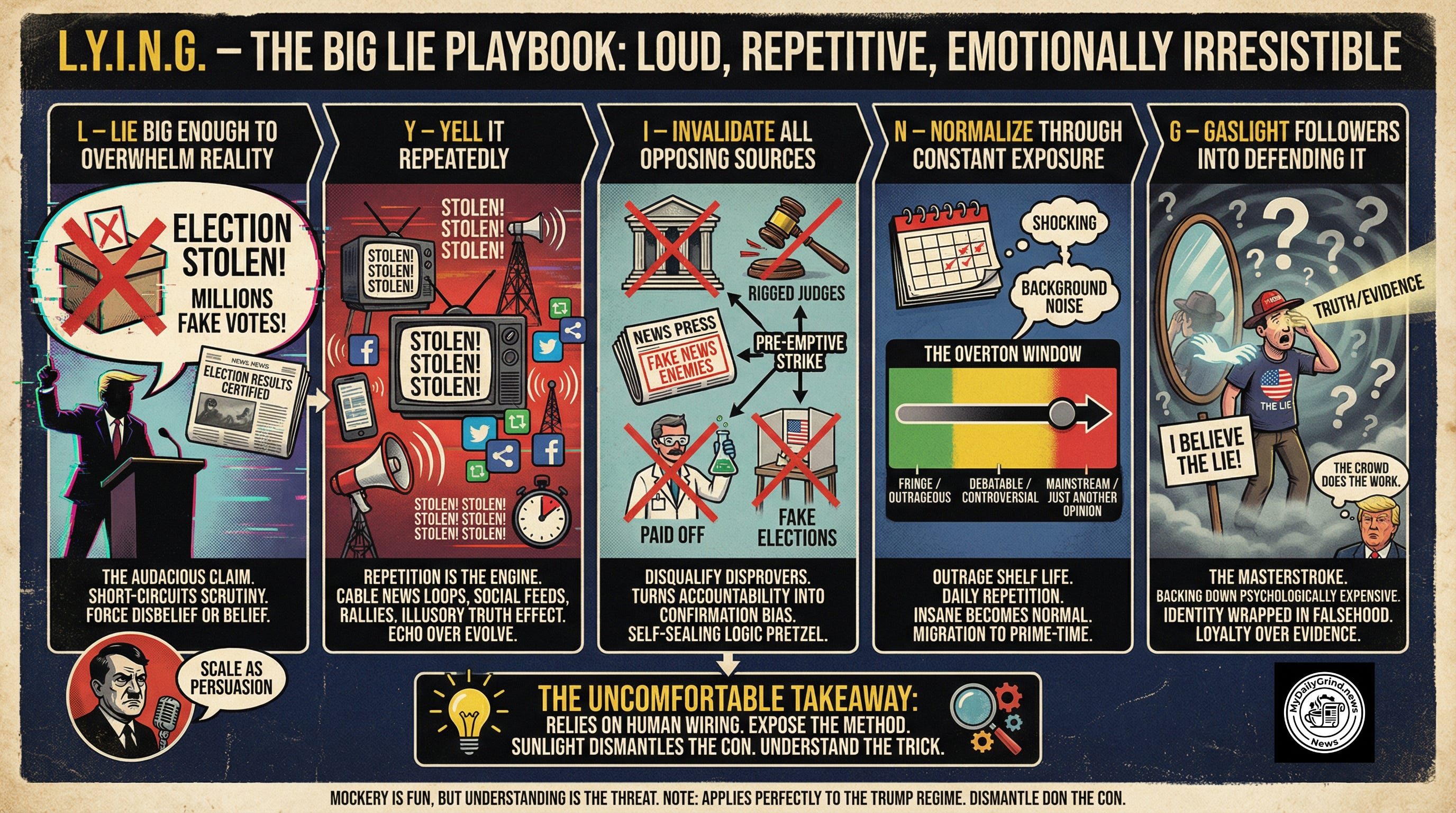
The most dangerous lies aren’t subtle. They’re loud, repetitive, and emotionally irresistible. That’s the core insight behind L.Y.I.N.G.—a simple framework that explains how the Big Lie doesn’t just survive fact-checks, but steamrolls right over them. This isn’t about one party or one era. It’s a playbook that keeps getting reused because, inconveniently, it works. NOTE, however, that it applies perfectly to the Trump Regime.
L — Lie big enough to overwhelm reality
A small lie invites scrutiny. A massive one short-circuits it. When a claim is audacious—the election was stolen, millions voted illegally, the country is being invaded—it forces the listener into disbelief or belief, skipping the boring middle ground where evidence lives. The tactic was famously articulated by Joseph Goebbels, who understood that scale itself can function as persuasion. People assume something so enormous wouldn’t be said unless it were true. That assumption is the trap.
Y — Yell it repeatedly
Repetition is the engine. Cable news loops, social feeds, rallies, podcasts—same message, different megaphone. Psychological research calls it the illusory truth effect: familiarity breeds credibility. The lie doesn’t need to evolve; it just needs to echo. By the time a correction appears, the false claim has already colonized the mental real estate. Truth whispers once; lies shout all day.
I — Invalidate all opposing sources
This is the pre-emptive strike. Judges are “rigged.” Journalists are “enemies.” Scientists are “paid off.” Elections are “fake.” The goal isn’t to prove your claim—it’s to disqualify anyone who might disprove it. When courts reject false allegations, the rejection itself becomes “evidence” of corruption. This tactic turns accountability into confirmation bias, a neat little logic pretzel that keeps the lie self-sealing.
N — Normalize through constant exposure
Outrage has a shelf life. Say something outrageous once and it shocks. Say it daily and it becomes background noise. What once sounded insane slowly becomes “controversial,” then “debatable,” then “just another opinion.” The Overton window doesn’t move politely—it gets dragged. We’ve watched ideas migrate from fringe message boards to prime-time talking points in a matter of months, not decades.
G — Gaslight followers into defending it
This is the masterstroke. Once supporters repeat the lie, share it, argue it, and wrap their identity around it, backing down becomes psychologically expensive. Admitting the truth would mean admitting they were wrong, duped, or manipulated. So the lie gets defended harder than it was ever sold. At that point, the originator barely matters—the crowd does the work for free. We’ve seen this dynamic play out vividly around Donald Trump, where disproven claims persisted not because of evidence, but because of loyalty.

Here’s the uncomfortable takeaway:
The Big Lie doesn’t rely on ignorance. It relies on human wiring—our attraction to certainty, our distrust of elites, our reluctance to admit error, and our tendency to equate repetition with truth. L.Y.I.N.G. works not because people are stupid, but because they’re human.
Calling out the lie isn’t enough. You have to expose the method. Once people see the machinery—the volume, the repetition, the source-smearing, the normalization, the gaslighting—the spell weakens. Sunlight doesn’t just disinfect facts. It dismantles the con. One could say it dismantles Don the Con.
And that’s the real threat to the Big Lie: not outrage, not mockery, but understanding how the trick is done.
Mockery of the big lie is fun, though.
The bigger the lie, the easier to believe, apparently, but life proves it.
Great Post!!!
When I was a kid, a long time ago, we played the telephone game. The adults had us sit in a circle. The first kid would whisper in the next kid’s ear and so on until we all “knew” what the first kid had said. Of course it was terribly garbled and made no sense by the time the last kid repeated it out loud. Then the first kid said out loud what he had originally whispered to the second kid. We laughed ourselves silly and started the game again. Gossip and lies work similarly.