



The Morning Sixpack stays free because the news that shapes your life should not be hidden behind a paywall. Paid subscribers are not paying for access. They are helping fund the research, writing, and independent voice that goes into every issue. Become a paid subscriber and help keep smart, honest news analysis free for everyone.
Congress Skips Town, the Oil Map Gets Complicated, and a Camera Company Gets Caught Fudging Its Résumé
Washington cleared out early this week, oil chokepoints multiplied instead of easing, and a surveillance company’s origin story quietly rewrote itself—so grab your coffee, because the news didn’t take the week off even if Congress did.
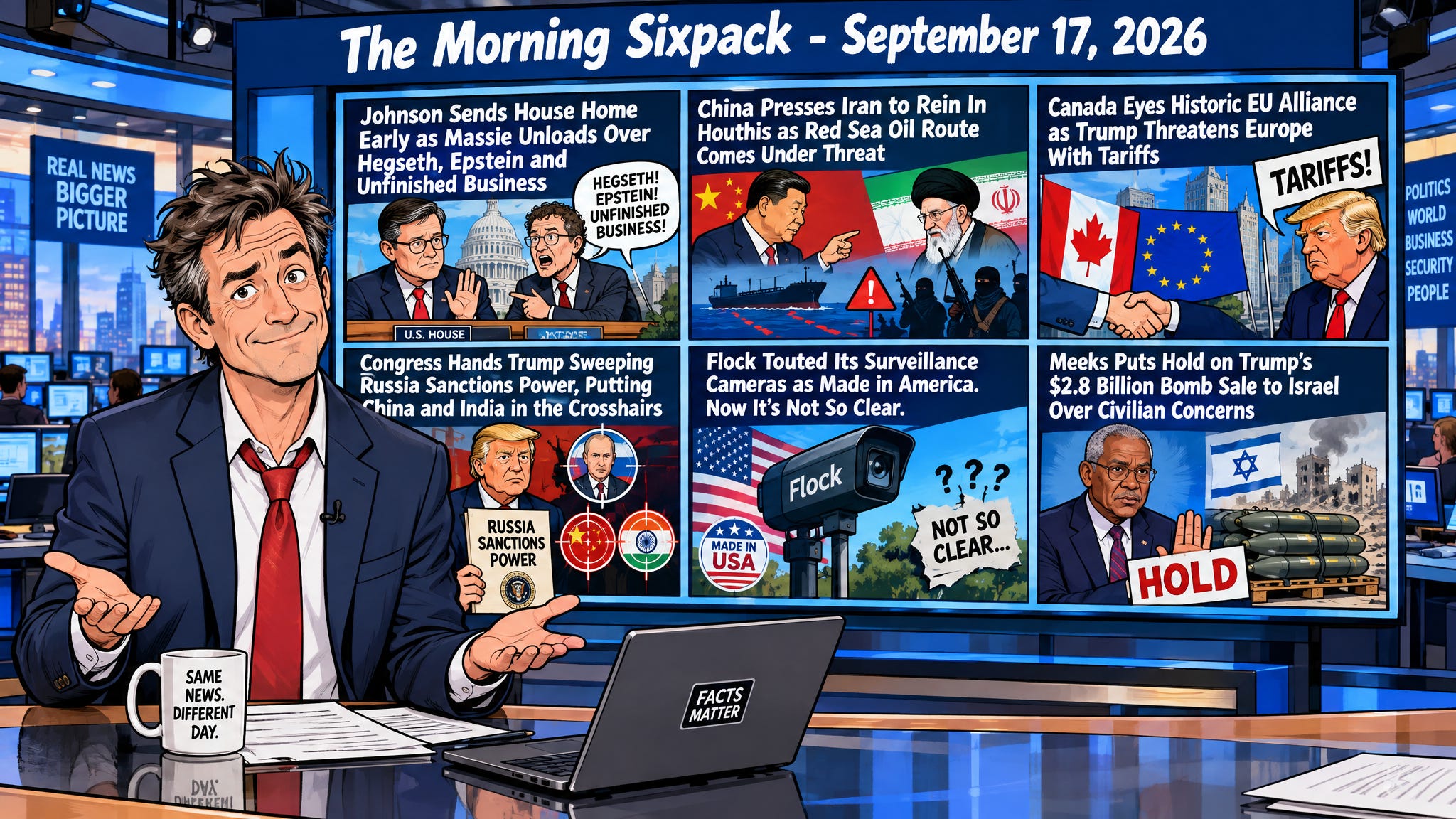
Johnson Sends House Home Early as Massie Unloads Over Hegseth, Epstein and Unfinished Business. House Speaker Mike Johnson sent lawmakers home early Wednesday to hit the campaign trail, defending the chamber’s record even as Republican Rep. Thomas Massie tore into the decision from the House floor, arguing Congress left the Iran war, Defense Secretary Pete Hegseth’s impeachment resolution, and the Epstein files fight all unresolved. Johnson insists lawmakers remain on 48-hour recall and points to hundreds of bills passed this session, while critics, including Democratic Leader Hakeem Jeffries, call the shortened calendar the mark of a “do-nothing” majority. Massie, on his way out after losing his primary, used the moment for a parting shot at leadership on his way out the door.
Source: Associated Press
China has privately urged Iran to use its influence over Yemen’s Houthis after Saudi Arabia appealed to Beijing for help, as the group’s advance around the Bab el-Mandeb Strait threatens shipping through another vital Middle East energy corridor. With traffic through the Strait of Hormuz already severely disrupted, trouble at Bab el-Mandeb could squeeze two major energy arteries simultaneously, and Beijing finds itself caught between its deep economic ties to Iran and its equally heavy dependence on Gulf oil and trade. China remains Iran’s largest trading partner and the top buyer of its oil, giving it real leverage, but analysts note that leverage cuts both ways since disrupting Hormuz would also hurt the power Tehran depends on. Whether Iran actually reins in the Houthis remains an open question, with Tehran instead tying regional stability to an end of the U.S.-Israeli war against Iran.
Source: Reuters
Canadian Prime Minister Mark Carney welcomed a proposal for Canada to become the European Union’s first “associate member,” setting up a potentially historic transatlantic realignment as President Trump threatens additional tariffs if he views the arrangement as hostile to U.S. interests. European Commission President Ursula von der Leyen unveiled the unprecedented status Wednesday, outlining cooperation spanning defense, critical minerals, artificial intelligence, energy, and cybersecurity, while Carney framed the alliance as a way to make Canada and Europe less vulnerable to economic coercion, not a bloc built to confront Washington. Trump called the arrangement “laughable” and threatened trade sanctions against Europe in response. The two sides already share a substantial foundation through their CETA trade agreement, and both note the details of “associate member” status still need to be negotiated and approved.
Source: CNBC
Congress has approved the Lindsey O. Graham Sanctioning Russia and Iran Act of 2026, giving President Trump authority to impose tariffs of up to 100% on major purchasers of Russian energy while expanding sanctions on Moscow’s energy and defense sectors. The House passed the measure 262-159 Wednesday after the Senate cleared it 86-11 in August, sending it to Trump’s desk and putting China and India—Russia’s two biggest crude customers—squarely in the crosshairs, though the law gives Trump discretion over whether and how aggressively to actually use that power. India has already warned Washington about potential fallout for bilateral relations and energy markets, while China has voiced opposition to penalizing its trade with Moscow. Russia, for its part, says the sanctions, if signed, would make reaching a Ukraine peace settlement harder.
Source: Al Jazeera
Flock Safety once advertised its controversial license-plate cameras as “made in the USA” and later “designed & manufactured in the U.S.,” but current marketing materials no longer identify where the cameras are assembled, according to WIRED. Import records show Flock increasingly receiving cameras, radar systems, and other components from Primax Electronics, a Taiwan-headquartered manufacturer with facilities in China and Thailand, even as tens of thousands of Flock cameras continue tracking vehicles on American roads. The company’s manufacturing story has shifted considerably over the years, from early prototypes built with Android phone cameras bought on Alibaba, to in-house Atlanta assembly, to contract manufacturing that still relies heavily on Asian components. Flock says its products comply with National Defense Authorization Act requirements, but privacy advocates argue the deeper issue is supply-chain transparency, not just final assembly location.
Source: WIRED
Rep. Gregory Meeks has refused to clear the Trump administration’s proposed $2.8 billion sale of 40,000 2,000-pound bombs to Israel, citing unresolved questions about compliance with U.S. law and protections for civilians. The ranking Democrat on the House Foreign Affairs Committee said the administration has not provided sufficient assurances that the weapons, which include MK-84 bombs, BLU-117s, and penetrator warheads, would be used lawfully in densely populated areas of Gaza or Lebanon. The move revives a long-running Washington debate over heavy bombs and civilian casualties that dates back to a Biden-era pause in 2024, later reversed by Trump shortly after taking office. For now, Meeks’ hold creates additional scrutiny rather than an outright cancellation, leaving the administration’s next move to determine whether the objection reshapes the sale or simply delays it.
Source: UPI
From an early congressional exit to a surveillance company’s murky supply chain, today’s stories share a common thread: transparency, or the lack of it, keeps shaping the biggest decisions in Washington and beyond.
Prefer to read The Morning Sixpack? Do that here:


