


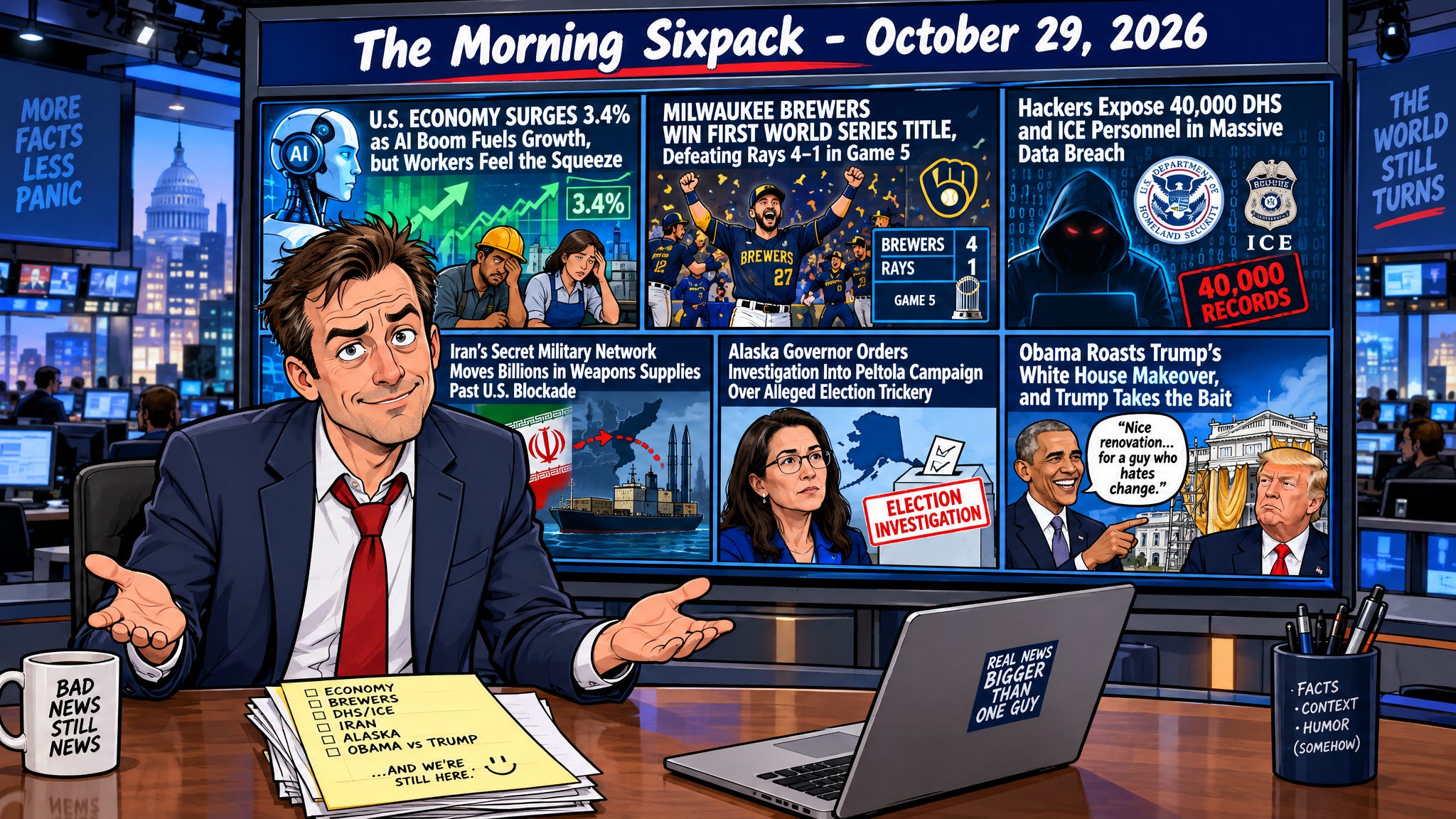
The Morning Sixpack stays free because the news that shapes your life should not be hidden behind a paywall. Paid subscribers are not paying for access. They are helping fund the research, writing, and independent voice that goes into every issue. Become a paid subscriber and help keep smart, honest news analysis free for everyone.
The U.S. economy grew at its fastest pace in a year, powered by AI investment and consumer spending—even as inflation keeps eating away at Americans’ paychecks.
U.S. Economy Surges 3.4% as AI Boom Fuels Growth, but Workers Feel the Squeeze
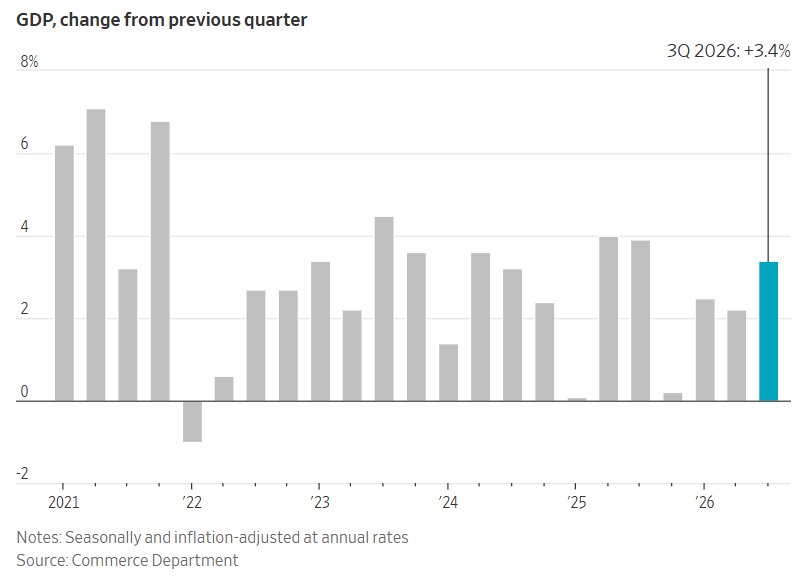
The U.S. economy expanded at a 3.4% annualized rate in the third quarter of 2026, beating economists’ expectations and recording its strongest growth in a year. The Commerce Department reported Thursday that gross domestic product accelerated from 2.2% in the previous quarter, surpassing the 3.1% forecast by economists surveyed by The Wall Street Journal. Business investment, particularly in artificial intelligence infrastructure, helped drive the expansion, while consumers continued spending despite rising gasoline prices and persistent affordability problems. The report arrives just days before Tuesday’s midterm elections, handing politicians a healthy headline number even as many Americans struggle to make ends meet.
Beneath the impressive GDP figures, the economy is showing an increasingly uncomfortable divide between booming investment and shrinking purchasing power. A key measure of underlying demand, known as final sales to private domestic purchasers, jumped 4.9%, its fastest pace since the pandemic recovery in 2021. But consumer inflation climbed to 3.7% in September, up from 2.4% in February, as the Iran war pushed energy prices higher. Meanwhile, average inflation-adjusted hourly earnings have declined for six consecutive months. Lower-income households are getting hit especially hard because gasoline consumes a larger share of their budgets. Apparently, a booming economy doesn’t automatically mean booming household finances.
The artificial intelligence investment frenzy is doing much of the economic heavy lifting. Goldman Sachs projects that AI investment will reach 1.9% of U.S. GDP, with companies pouring enormous sums into data centers, computing infrastructure, and construction. Although much of the spending goes toward imported computer chips, the race to build massive server facilities is generating domestic construction activity and helping offset weakness in residential homebuilding. That investment has become a significant engine of growth at a time when other sectors are struggling. The question is how much of this economic momentum translates into sustained improvements for ordinary workers rather than simply bigger technology infrastructure.
The Federal Reserve now faces an awkward balancing act between strong economic growth and stubborn inflation. Policymakers voted Wednesday to hold interest rates steady, but continued price pressures could force additional increases. Fed Chairman Kevin Warsh argued that stronger productivity may allow the economy to expand faster without triggering runaway inflation, suggesting officials aren’t convinced the economy is overheating. Meanwhile, the labor market offers little reason for celebration: Employers added just 29,000 jobs in September, substantially fewer than economists anticipated. Strong GDP growth alongside weak hiring and declining real wages makes for a complicated economic picture—and an even more complicated interest-rate decision.
Corporate America is experiencing its own version of this split economy. Royal Caribbean reported rising profits as affluent consumers continued spending heavily on vacations, with CEO Jason Liberty saying 2027 bookings were running ahead of historical levels at higher prices. But businesses dependent on home purchases and construction face a much less cheerful outlook. Appliance manufacturer Whirlpool expects to lose money this year, citing higher raw-material and fuel costs, while elevated interest rates continue weighing on housing-related industries. The result is an economy where high-end consumers, technology investment, and financial-market gains help propel headline growth, even as workers face shrinking real earnings and businesses tied to everyday household purchases struggle.
Editor: GDP is up, AI companies are building server farms like there’s no tomorrow, and wealthy Americans are booking cruises. Meanwhile, real hourly wages have fallen six months straight. Washington gets its victory lap; working Americans get another expensive trip to the gas station.
Source: The Wall Street Journal
After decades of waiting, Milwaukee finally has a World Series championship—and the Brewers did it the old-fashioned way, proving you don’t need to launch every baseball into orbit to win it all.
Milwaukee Brewers Win First World Series Title, Defeating Rays 4-1 in Game 5
The Milwaukee Brewers are World Series champions for the first time in franchise history, defeating the Tampa Bay Rays 4-1 Wednesday night at Tropicana Field to claim baseball’s biggest prize. Milwaukee capped a remarkable season that included a franchise-record 103 regular-season victories and an 11-2 postseason run. The Brewers relied on relentless contact hitting, aggressive baserunning, and dominant pitching rather than home-run power, having hit the fewest home runs in the National League during the regular season. Manager Pat Murphy credited the fans across Milwaukee and Wisconsin for pushing his team toward history. “This group of guys here will be remembered forever. They deserve that because they were a team.”
Milwaukee’s championship-clinching performance belonged largely to pitcher Jacob Misiorowski, whose blazing fastball overwhelmed Tampa Bay’s hitters. The towering 6-foot-7 right-hander fired an extraordinary 51 pitches clocked at 100 mph or faster, surrendering just two hits across 5 2/3 innings. Misiorowski is also positioned to become the first pitcher since Orel Hershiser in 1988 to win the Cy Young Award and a World Series championship in the same season. Relievers JoJo Romero, Abner Uribe, and Trevor Megill finished the job, with Megill shutting down a ninth-inning rally after the Rays managed their only run. Tampa Bay’s Richie Palacios grounded out to end the game, setting off Milwaukee’s long-awaited celebration.
Rookie shortstop Cooper Pratt delivered another outstanding performance, going 2-for-3 with two RBIs in the decisive Game 5. He opened the scoring with a second-inning single that brought home Brice Turang, then added a sixth-inning sacrifice fly. Pratt also established a World Series rookie record with hits in six consecutive at-bats, finishing the championship series batting .421. David Hamilton contributed an RBI single in the fifth inning, while catcher William Contreras doubled home another run in the sixth. Milwaukee’s ability to manufacture runs through timely hitting and sustained pressure proved too much for Tampa Bay throughout the series.
Contreras earned World Series MVP honors after batting .380 across the five games, while outfielder Jackson Chourio posted a remarkable .458 average, collecting 11 hits in 24 at-bats. The Brewers outhit the Rays 51-30 during the championship series and outscored them 25-12, dominating through consistent offensive production rather than spectacular individual home runs. Milwaukee’s pitching staff repeatedly neutralized Tampa Bay’s offense, while Brewers hitters forced opposing pitchers into difficult, high-pressure situations. The team’s emphasis on putting the ball in play and capitalizing on opportunities validated an approach that ran counter to baseball’s obsession with power hitting.
For Tampa Bay, the defeat extends a frustrating championship drought, leaving the Rays among four Major League Baseball franchises that have never won a World Series. The San Diego Padres, Colorado Rockies, and Seattle Mariners remain on that list, with Seattle still the only MLB franchise never to reach the Fall Classic. Milwaukee, meanwhile, can finally celebrate a championship after years of waiting.
Source: United Press International
Hackers exposed personal information belonging to more than 40,000 Homeland Security personnel, including undercover operatives, turning a fight over government accountability into a massive security nightmare.
Hackers Expose 40,000 DHS and ICE Personnel in Massive Data Breach
A hacktivist group calling itself the Department of Peace claims to have breached Department of Homeland Security personnel records, exposing names, phone numbers, and addresses belonging to more than 40,000 federal employees and associates. The information, released Wednesday, includes personnel connected to undercover operations, Immigration and Customs Enforcement (ICE), and Customs and Border Protection (CBP). The hackers say they compromised DHS’s single sign-on system to obtain the records, then distributed the information through the transparency organization Distributed Denial of Secrets (DDoSecrets). The resulting database, called Icepick, makes the stolen information searchable. The breach represents a serious security concern for an agency already facing intense scrutiny over its immigration enforcement operations.
The stolen records reportedly identify more than 21,000 Customs and Border Protection employees and another 10,000 personnel associated with ICE and Homeland Security Investigations. Although the exposed records cover roughly one-fifth of DHS’s workforce of more than 220,000 people, the information reportedly includes officials responsible for sensitive and covert operations. DDoSecrets cofounder Emma Best described the leak as extraordinary because it reveals connections between personnel overseeing undercover activities and those involved in deportation programs. The Department of Peace explicitly linked its actions to Homeland Security Secretary Markwayne Mullin’s July remarks about intensifying immigration enforcement. The group presented the attack as retaliation against the administration’s increasingly aggressive approach.
The leaked information was also provided to journalist Ryan Ottignon and Swiss hacker maia arson crimew, who collaborated on a searchable version of the database. Ottignon told NPR that crimew handled the technical work. Supporters of the disclosure argue that identifying government personnel could help journalists, researchers, and activists investigate DHS activities and submit more effective Freedom of Information Act requests. Without specific names or contact information, those requests can produce limited or unhelpful results. Publishing personal addresses and contact details, however, could expose employees, undercover personnel, and their families to harassment or physical danger.
DHS acknowledged the incident but stopped short of confirming the full extent of the reported compromise. In a statement, the department said it was aware of a potential breach and was working to address the situation while taking steps to protect affected personnel. The incident follows other significant cyberattacks targeting federal law enforcement, including recent intrusions involving the FBI. The reported compromise raises questions about how attackers obtained access to sensitive personnel information through a centralized authentication system. It also highlights the potential consequences when sensitive government employee records become accessible outside authorized channels.
Ottignon rejected accusations that publishing the information amounted to doxing, arguing that government officials exercising extraordinary enforcement powers should not be shielded from public identification and scrutiny. He pointed specifically to immigration officers operating in masks and plain clothes, saying that accountability requires knowing who is carrying out government actions. DDoSecrets adopted an even more confrontational position, writing, “They have our information, so it’s only fair that we have theirs.” But the controversy exposes a fundamental tension between government transparency and personal security, particularly when undercover operations are involved. Whether the disclosure ultimately produces meaningful oversight, dangerous retaliation, or both remains an open question.
Editor: There’s a legitimate argument for knowing who’s exercising government power, especially when agents operate behind masks. There’s also a legitimate argument against publishing home addresses and exposing undercover personnel. Accountability and personal safety aren’t mutually exclusive—or at least they shouldn’t be.
And DHS might want to take a closer look at its cybersecurity while it’s at it because this should be embarrassing AF for Trump’s DHS.
Source: NPR
Iran has been quietly importing billions of dollars in military equipment through thousands of secret government agencies, raising an uncomfortable question: How effective are American sanctions and a naval blockade if the weapons keep arriving?
Iran’s Secret Military Network Moves Billions in Weapons Supplies Past U.S. Blockade
Iran has built an enormous clandestine procurement network involving more than 5,000 military-linked agencies that have imported billions of dollars in weapons components, explosives, and heavy equipment despite Western sanctions and an American naval blockade. A sweeping Reuters investigation uncovered the operation through thousands of Iranian banking records, shipping documents, and corporate filings, revealing how Tehran continues replenishing its missile and drone arsenals during its war with the United States and Israel. One agency alone, identified as MOD 346428, imported approximately $2.3 billion in military-related goods between January 2025 and June 2026. Shipments included rocket fuel ingredients, detonators, aircraft components, precision machinery, and heavy-duty trucks that can be converted into mobile missile launchers. Much of the equipment was recorded as originating in China, Russia, Germany, and other countries, arriving through commercial shipping routes, cargo aircraft, and overland transportation.
The operation relies on an elaborate financial system designed to move military supplies without triggering the sanctions mechanisms intended to stop them. The agencies share a Tehran address associated with Iran’s Ministry of Defense and Armed Forces Logistics, while operating through intermediaries, shell companies, and trusted foreign representatives. According to Reuters, approximately 97% of the shipments it examined were settled without direct international currency transfers, allowing overseas intermediaries to purchase equipment using funds already held outside Iran. Much of that money reportedly originates from illicit oil sales. Investigators discovered that just 36 agencies held $1.2 billion in foreign-currency deposits at the end of 2024, while the broader network maintained another $1.8 billion in Iranian currency. Former Treasury sanctions official Miad Maleki described the operation as the military’s financial lifeline, revealing a parallel trading system that has operated largely outside Western sanctions enforcement.
The shipments continued even after the United States and Israel launched military operations against Iran on February 28. Reuters identified hundreds of tonnes of chemicals used in rocket propellants, titanium suitable for missile construction, and millions of dollars in Russian detonators. One June shipment alone contained $1.9 million worth of detonators originating in Russia, while earlier shipments included hundreds of heavy-duty Iveco trucks and thousands of Toyota vehicles that Iranian forces can adapt for weapons transportation and deployment. Iran also imported sophisticated industrial equipment capable of manufacturing missile and drone components domestically. Although military imports initially dropped sharply after the war began, their recorded monthly value recovered from $54 million in March to $77 million by May. The investigation suggests that military strikes and maritime restrictions have disrupted Iran’s supply chains without eliminating its ability to obtain critical materials.
The findings also raise difficult questions about the effectiveness of Western export controls and the role of international manufacturers. Reuters traced shipments involving vehicles and industrial equipment recorded as originating in European Union countries, despite sanctions targeting Iran’s military establishment. Iveco and Toyota denied knowingly supplying Iran’s military, emphasizing that vehicles can reach prohibited destinations through independent third parties beyond their control. China said it was unaware of the reported activities and rejected attempts to associate it with the conflict. President Donald Trump had previously dismissed suggestions that China and Russia were substantially assisting Iran’s war effort, writing on October 12 that he did not believe either country was providing meaningful support. The Treasury Department maintained that American sanctions were working, insisting Washington remained ahead of Iranian efforts to evade restrictions. Reuters’ findings, however, document continuing imports through multiple international routes, although the declared origins of some shipments could not be independently verified.
Beyond weapons procurement, the secret network connects directly to Iran’s powerful Islamic Revolutionary Guard Corps and organizations accused of violently suppressing domestic dissent. Reuters identified financial links involving military commanders sanctioned by the United States for alleged human rights abuses, including Brigadier General Hassan Shahvarpour, whose forces were accused of killing protesters in 2019. Documents also connected the network to military construction projects and powerful foundations controlled by Iran’s ruling elite. One particularly revealing example involved imported Toyota trucks used by Revolutionary Guard units, including vehicles appearing in state media footage alongside a bright pink Shahed drone. The investigation paints a picture of an interconnected military, financial, and political apparatus capable of acquiring weapons abroad, sustaining military operations, and supporting domestic repression. Despite years of sanctions, the machinery behind Iran’s military establishment appears far more resilient than Washington’s public assurances would suggest.
Editor: Washington says its sanctions are working and its blockade is choking off Iran’s military supplies. Reuters just uncovered 5,000 secret agencies, billions in imports, and a procurement operation that keeps humming along. Either somebody’s definition of “working” needs an overhaul, or the world’s most heavily sanctioned supply chain has figured out something the Pentagon hasn’t.
Source: Reuters
Alaska’s Senate race now features two candidates named Dan Sullivan, a criminal investigation, and a Justice Department lawsuit threatening to block election results. And Election Day is still five days away.
Alaska Governor Orders Investigation Into Peltola Campaign Over Alleged Election Trickery
Alaska Republican Gov. Mike Dunleavy has ordered a state investigation into allegations that Democratic Senate candidate Mary Peltola’s campaign helped recruit a candidate with nearly the same name as her Republican opponent. The controversy centers on retired teacher Dan J. Sullivan, an independent candidate whose name closely resembles that of incumbent Republican Sen. Dan Sullivan. A New York Times investigation suggested Peltola’s campaign was involved in recruiting the independent in an apparent effort to siphon votes from the Republican senator. Dunleavy directed Alaska’s Department of Public Safety to determine whether the alleged scheme violated state election laws and warranted criminal charges or civil action. The investigation comes just days before a closely contested Senate election that could help determine control of Congress.
Republicans are accusing Democrats of deliberately attempting to confuse voters, while Peltola’s campaign and its allies deny involvement or reject the allegations. Sen. Sullivan called the situation a major scandal, accusing Peltola, her campaign, and the Democratic Senatorial Campaign Committee of spending more than a year orchestrating a scheme to mislead Alaska voters. President Donald Trump went further, demanding that Peltola withdraw from the race and saying she should face criminal prosecution. The DSCC denied participating in the independent candidate’s campaign and countered that Republicans have their own history of recruiting third-party candidates to influence elections. Peltola’s campaign defended her candidacy, saying she entered the race to fight for lower costs and Alaska’s interests, not to engage in political gamesmanship.
The controversy has already produced multiple legal battles over whether both Sullivans should appear on the ballot. Alaska election officials initially moved to disqualify Dan J. Sullivan in June, agreeing that his candidacy appeared designed to confuse voters. However, the Alaska Supreme Court ruled that both candidates could remain on the ballot, allowing the independent to advance through August’s primary with 2.5% of the vote. The dispute escalated last week when the Trump administration’s Justice Department filed a federal lawsuit seeking to prevent certification of the election results if the Republican incumbent loses. That extraordinary intervention would potentially leave the outcome of a Senate election unresolved even after voters have cast their ballots.
Legal experts have questioned the Justice Department’s approach. University of Notre Dame election law professor Derek T. Muller described the department’s legal argument as exceptionally weak, calling it “absurdly thin” and “one of the worst ones I’ve ever seen.” Muller also argued that determining whether voters actually confused the two candidates would be virtually impossible. Peltola’s campaign condemned the federal lawsuit as a political threat and pledged to defend the voting rights of eligible Alaskans. Meanwhile, the governor’s newly announced investigation adds another layer of legal uncertainty, although no criminal wrongdoing by Peltola or her campaign has been established.
The stakes are particularly high because Alaska has emerged as one of the country’s most competitive Senate battlegrounds. Recent polling analyzed by The Washington Post shows Peltola leading the Republican incumbent by an average of five percentage points, despite President Trump carrying Alaska by 13 points in the 2024 presidential election. That makes the race a significant potential Democratic pickup in a traditionally Republican-leaning state. With the independent Sullivan still on the ballot, Republicans fear that even a relatively small number of confused voters could affect the outcome. But whether the alleged recruitment effort actually occurred as described, violated any laws, or meaningfully influences the election remains unresolved.
Editor: Recruiting a candidate with your opponent’s name to confuse voters would be a dirty trick, if that’s what happened. Investigate it.
But having the Justice Department threaten to block certification before anyone has even voted? That’s a whole different level of election interference.
Source: The Washington Post
Barack Obama compared Donald Trump’s gold-heavy White House makeover to a Cheesecake Factory run by Saddam Hussein. Trump took the bait, and somehow a joke about interior decorating became a White House communications priority.
Obama Roasts Trump’s White House Makeover, and Trump Takes the Bait
Former President Barack Obama has turned Donald Trump’s extravagant White House renovations into a running comedy routine, comparing the president’s decorating taste to something out of Saddam Hussein’s palace. Campaigning for Democrats in Ohio over the weekend, Obama delivered the line that quickly became a political spectacle: “He’s got the White House looking like Saddam Hussein opened a Cheesecake Factory.” The joke targeted Trump’s extensive use of gold-colored decorations and an ambitious renovation project reportedly expected to cost at least $900 million. The comparison combined the former Iraqi dictator’s notoriously lavish palaces with the restaurant chain’s famously over-the-top interior design. And judging by the administration’s reaction, Obama found a particularly sensitive nerve.
Trump responded to the insult during a Monday campaign rally in Mississippi, but his defense focused on the restaurant chain rather than the underlying criticism. “He said, ‘This isn’t a Cheesecake Factory.’ Can you believe it? Which is a very successful company. He doesn’t like successful companies,” Trump told supporters. The White House then joined the exchange by publishing a mock Cheesecake Factory menu promoting Trump’s policy accomplishments, claiming the administration’s achievements were even more extensive than the restaurant’s famously enormous menu. Conservative commentators piled on, accusing Obama of being disconnected from ordinary Americans. What began as a joke about presidential decorating choices had somehow become a debate over whether Barack Obama respects a restaurant franchise.
Obama returned to the subject Wednesday while campaigning in Georgia, mocking the administration for devoting so much attention to his joke while Americans struggled with rising prices.
“They mobilized a whole-of-government response to that joke, not to inflation, but to that joke,” Obama told the crowd. “This is what I mean when I say these are not serious people.”
He argued that the administration appeared more interested in defending Trump’s decorating decisions than addressing the economic pressures affecting American households. With inflation elevated and restaurant meals increasingly expensive, Obama suggested the White House had spectacularly missed the point of his original criticism.
The exchange comes during the final stretch of the 2026 midterm elections, with Obama serving as a prominent campaign surrogate for Democrats in competitive races. He has appeared alongside Senate and gubernatorial candidates in Michigan, Ohio, and Georgia, using his appearances to criticize Trump’s leadership and the administration’s handling of the economy. Trump, meanwhile, has been campaigning heavily for Republican candidates, relying on his ability to energize conservative voters. The two presidents’ increasingly personal exchanges have become part of the broader battle for control of Congress. Obama’s latest approach combines pointed political criticism with the kind of humor that can dominate news coverage without requiring a lengthy policy speech.
The underlying issue, however, extends beyond presidential taste in furniture and gold trim. Obama has repeatedly connected Trump’s White House renovations to broader questions about the administration’s priorities while ordinary Americans face rising living costs. The president’s decision to personally respond, followed by the White House’s elaborate social media rebuttal, gave Obama’s criticism additional attention. Rather than ignoring the joke, the administration helped turn it into a multiday political story. With Election Day approaching, Obama appears content to keep pressing the contrast between a president defending his extravagant surroundings and voters worrying about their household budgets.
Editor: Obama compared Trump’s White House to Saddam Hussein’s Cheesecake Factory, and Trump responded by defending the Cheesecake Factory’s business model. Then the White House actually made a menu. You couldn’t write a better punchline if you tried. Obama told one joke, and the administration volunteered to become the sequel.
Source: The Hill
Read The Morning Sixpack here: