


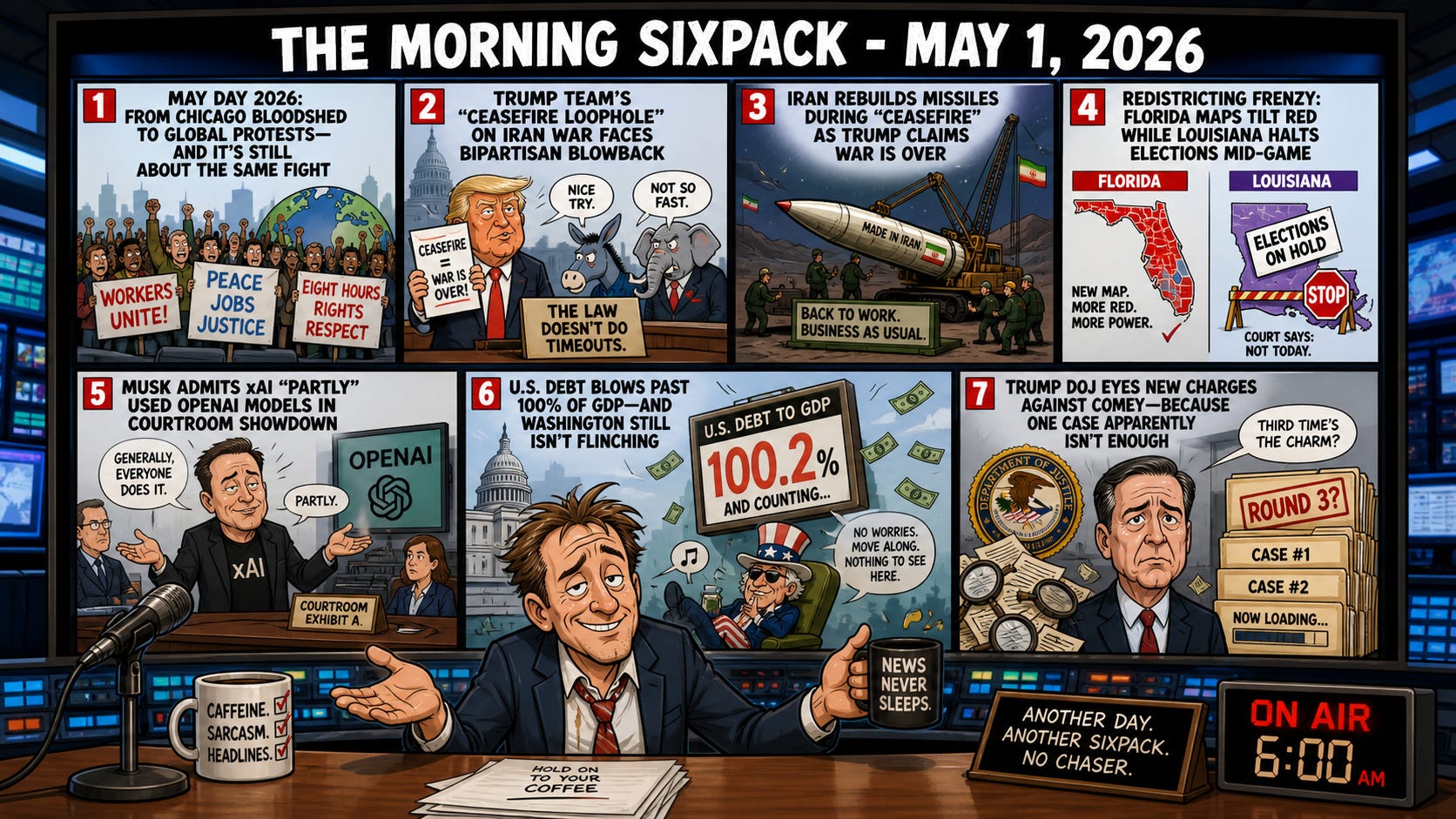
May Day 2026: From Chicago Bloodshed to Global Protests—And It’s Still About the Same Fight
May Day began with a deadly labor clash in 1880s Chicago—and more than a century later, workers worldwide are still marching over wages, power, and who pays the price in a changing economy. What started as a fight for an eight-hour workday has evolved into a global pressure valve for everything from inflation to war.
The issues have changed—but the anger hasn’t.
The holiday traces back to the 1886 Haymarket affair in Chicago, where a labor rally for shorter workdays turned violent after a bomb exploded and police opened fire. Several activists were later executed, and May 1 became a symbol of worker solidarity worldwide—ironically embraced more internationally than in the U.S. where it began.
Fast forward to today, and the themes feel familiar—just with bigger price tags. Across Europe, Asia, and the Americas, workers are rallying over rising living costs, fueled in part by the ripple effects of the Iran conflict. Protesters are demanding higher wages, stronger protections, and relief from inflation that’s eating into paychecks.
In places like France and Turkey, demonstrations are spilling into the streets, sometimes clashing with authorities. In the Philippines and Indonesia, workers are tying local economic pain directly to global politics, including U.S. foreign policy. And in the U.S., activists are organizing boycotts and protests under banners like “workers over billionaires,” targeting everything from wage inequality to immigration policy.
What’s changed is the scope. May Day isn’t just about factory conditions anymore—it’s about globalization, war, inflation, and who absorbs the shock when things go sideways. What hasn’t changed is the basic premise: Workers pushing back when they feel squeezed.
Source: AP News
Editor: More than a century later, the signs are different, the slogans are updated—but it’s still workers yelling that the system’s tilted. Some traditions really do stick.
Trump Team’s “Ceasefire Loophole” on Iran War Faces Bipartisan Blowback
The Trump administration is arguing a ceasefire with Iran effectively ended the war—letting it dodge a hard congressional deadline to authorize the conflict. It’s a legal pivot that hinges on redefining “hostilities,” even as U.S. forces remain actively engaged in the region.
A pause in fighting is being recast as the end of war—and that’s doing a lot of heavy lifting.
Defense Secretary Pete Hegseth told lawmakers the April ceasefire stopped—or at least froze—the 60-day clock under the War Powers Resolution. Administration officials say no direct fire since early April means the conflict is effectively over “for War Powers purposes,” despite a continued U.S. naval blockade and Iran’s grip on the Strait of Hormuz.
That argument is getting hammered from multiple angles. Sen. Tim Kaine called it a “very novel argument” with no legal backing, while Sen. Susan Collins warned, “That deadline is not a suggestion; it is a requirement.” Legal experts say the statute simply doesn’t allow for a timeout—full stop. As one analysis put it, nothing in the law suggests the clock “pauses, or stops” during a ceasefire.
Meanwhile, the White House and its allies are floating workarounds. Former NSC official Richard Goldberg even suggested relabeling the mission entirely—rolling from “Operation Epic Fury” into a sequel dubbed “Epic Passage”—to reset the legal framework while continuing operations.
Here’s the reality: the 60-day deadline tied to Donald Trump’s military action was set to expire May 1. Under the law, the administration must either get Congress to sign off or wind things down. Critics say calling an ongoing standoff “not a war” doesn’t change the underlying obligations—especially when ships are still being seized and blockades enforced in the region.
Source: AP News, Al Jazeera
Editor: If renaming a military operation resets the legal clock, expect “Operation Technicality” to launch any minute now.
Iran Rebuilds Missiles During “Ceasefire” as Trump Claims War Is Over
While the Trump administration argues the Iran war is effectively finished, new intelligence shows Tehran is actively rebuilding its missile arsenal under the cover of a ceasefire. That contradiction is turning a legal debate in Washington into a credibility problem abroad—and a ticking clock at home.
A war that’s “over” apparently still involves blockades, military planning—and an opponent rearming in real time.
Defense Secretary Pete Hegseth has insisted the ceasefire pauses the 60-day deadline under the War Powers Resolution, arguing hostilities have effectively stopped. The White House position: no active shooting, no legal clock. But critics across both parties—and pretty much every legal expert weighing in—say the law doesn’t allow for a timeout just because things got quiet.
Meanwhile, the battlefield reality tells a different story. U.S. officials say Iran is digging out buried missiles and munitions, trying to rapidly rebuild its strike capability in case fighting resumes. The goal: be ready if Donald Trump pulls the trigger again. Even after weeks of U.S. and Israeli strikes, Iran is believed to still retain a significant chunk of its arsenal—and is actively working to restore it.
And yes, the “ceasefire” still includes a U.S. naval blockade and Iran choking off the Strait of Hormuz—hardly a clean break. Lawmakers like Sen. Tim Kaine say calling this anything but ongoing hostilities is a stretch, while Sen. Susan Collins put it bluntly: “That deadline is not a suggestion; it is a requirement.”
As the May 1 deadline hits, the administration is floating creative workarounds—including simply rebranding the mission to reset the legal clock. Former NSC official Richard Goldberg even pitched a sequel operation name to sidestep the issue entirely. Because if the war doesn’t technically exist, maybe Congress doesn’t either.
Source: AP News
Editor: Calling it a ceasefire while your opponent is digging up missiles is less “peace process” and more “intermission.” Hope nobody forgot Act Two is usually louder.
Redistricting Frenzy: Florida Maps Tilt Red While Louisiana Halts Elections Mid-Game
A sweeping Republican push to redraw congressional maps is reshaping elections nationwide—boosting GOP prospects in Florida while forcing Louisiana to hit pause on voting altogether. The result: a high-stakes scramble for House control that’s rewriting the rules in real time.
District lines are moving fast—and in at least one state, the election itself just stopped.
In Florida, Gov. Ron DeSantis signed off on a new map that could net Republicans up to four additional House seats, using classic gerrymandering tactics like “packing” and “cracking” to dilute Democratic voters. Allies of Donald Trump have pushed aggressively for these redraws, seeing a chance to lock in gains ahead of the midterms. Democrats, meanwhile, are calling the map “a nakedly partisan scheme” and gearing up for legal fights.
Then there’s Louisiana—where things went from messy to unprecedented. After the U.S. Supreme Court weakened key Voting Rights Act protections, Republican Gov. Jeff Landry outright suspended congressional primaries just days before early voting. His reasoning: the current map is now unconstitutional. Critics say that’s a convenient way to change the battlefield mid-play.
“Allowing elections to proceed under an unconstitutional map would undermine the integrity of our system,” Landry said—but Democrats fired back that halting an election risks “mass confusion” and undermines trust just as much. Lawsuits are already flying, and a new map—and new election date—are now on the clock.
Zoom out, and this isn’t just two states acting independently. It’s the start of a broader redistricting arms race triggered by the court’s ruling, with Republicans eyeing gains in multiple states and Democrats bracing for impact. Even Trump is urging places like Tennessee to redraw maps quickly to capitalize.
Source: AP News (Florida), AP News (Louisiana)
Editor: When one state redraws the map and another cancels the game, it’s less democracy in action and more musical chairs with ballots. Better grab a seat before the music stops.
Musk Admits xAI “Partly” Used OpenAI Models in Courtroom Showdown
Elon Musk acknowledged under oath that his AI company xAI has “partly” used OpenAI models to train its own systems, confirming what rivals have long suspected. The admission came during a tense courtroom exchange that cut straight to the heart of the AI arms race—and who’s borrowing from whom.
Pressed repeatedly, Musk didn’t deny it—he just called it standard practice.
During cross-examination by OpenAI attorney William Savitt, Elon Musk initially framed “distillation” as a common industry technique—using one AI model to train another. But when asked directly whether xAI had done this with OpenAI’s tech, Musk ultimately conceded: “Partly.”
That matters because OpenAI—Musk’s former brainchild turned chief rival—has been actively trying to stop competitors from doing exactly that. The company has warned lawmakers and tightened safeguards, arguing that distillation risks letting others replicate cutting-edge models without footing the full research bill. OpenAI has even flagged concerns about foreign players like DeepSeek leveraging similar tactics.
Musk, for his part, leaned on the “everyone does it” defense, saying it’s “standard practice to use other AIs to validate your AI.” That might be true—but there’s a difference between benchmarking a rival and training on its outputs, and that’s exactly where the legal fight is now focused.
This courtroom clash is just one front in a broader war between AI labs, where access is tightening fast. Companies like Anthropic have already started cutting off rivals from their models altogether, signaling that the era of open experimentation is giving way to locked-down competition.
Source: WIRED
Editor: So after years of warning about AI risks, Musk’s defense boils down to “we only copied a little.” In Silicon Valley, that apparently counts as restraint.
U.S. Debt Blows Past 100% of GDP—and Washington Still Isn’t Flinching
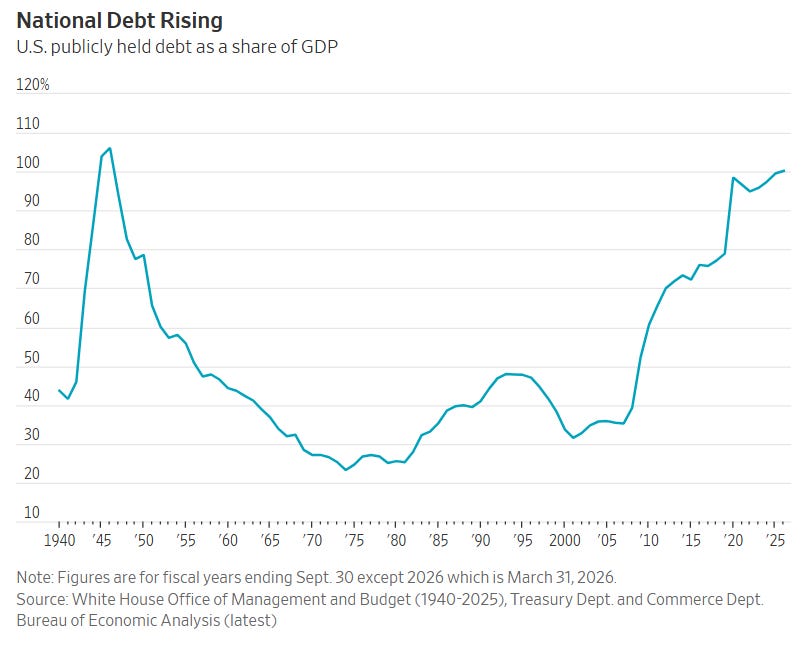
The U.S. national debt has officially surpassed the size of the entire economy, crossing the 100% of GDP mark for the first time since World War II. It’s a symbolic—and increasingly real—warning sign that decades of spending, tax cuts, and political gridlock are finally colliding.
Washington is now spending $1.33 for every $1 it brings in—and calling it sustainable.
As of March, publicly held U.S. debt hit $31.265 trillion, just edging past the nation’s total economic output. Economists say there’s nothing magical about 100%—but it’s a line policymakers used to treat as a red flag, not a milestone. Now it’s just another data point on a chart heading in the wrong direction.
The drivers aren’t temporary shocks like COVID—they’re structural. Persistent deficits nearing $2 trillion a year, rising interest costs, and an aging population pushing up entitlement spending are all baked in. Even modest interest rate increases now carry massive consequences, with debt service already eating up one out of every seven federal dollars.
There’s also a political reality check here. Both parties talk about fiscal discipline—until it comes time to vote. Tax cuts, spending increases, and zero appetite for tough trade-offs have left the system on autopilot. Even stabilizing debt at current levels would require trillions in unpopular decisions that nobody seems eager to make.
Meanwhile, the U.S. still benefits from the dollar’s global dominance and investor demand for Treasury bonds—but economists warn that cushion isn’t infinite. Keep pushing, and higher borrowing costs start hitting everything from mortgages to credit cards, squeezing the broader economy.
Source: Wall Street Journal (gift)
Editor: Crossing 100% used to be the warning. Now it’s the baseline—and the plan seems to be “let’s see how high this thing goes.”
Trump DOJ Eyes New Charges Against Comey—Because One Case Apparently Isn’t Enough
The Trump Justice Department is exploring fresh charges against former FBI Director James Comey over alleged classified leaks, even as he already faces a separate indictment. The move signals an escalating legal campaign that could mark the third attempt to prosecute Comey in less than a year.
This isn’t just a follow-up—it’s a full-court press.
According to officials familiar with the matter, prosecutors are reviving a previously stalled investigation into whether James Comey improperly shared classified information through an intermediary—specifically Columbia law professor Daniel Richman. The case had fizzled once before, but under acting Attorney General Todd Blanche, it’s back on the front burner.
This new push comes on top of an existing indictment tied to alleged false statements and a separate case involving claims that Comey made a social media threat against Donald Trump. Translation: multiple legal fronts, all converging at once.
Trump has long accused Comey of leaking sensitive information, dating back to memos that ultimately surfaced in the press during the early days of the Russia investigation. Now, prosecutors appear to be revisiting that history with renewed urgency—and potentially new legal angles.
The big question is where—and whether—this latest case lands. Prosecutors are weighing venues and timing, and it’s unclear if a grand jury will take it up. But the intent is clear: what was once a closed chapter is now very much back in play.
Source: Bloomberg Law (Archive), Bloomberg Law (Original Source, paywalled)
Editor: Third time’s the charm—or at least that seems to be the theory. At this rate, Comey might need a punch card for indictments.