


The Morning Sixpack stays free because the news that shapes your life should not be hidden behind a paywall. Paid subscribers are not paying for access. They are helping fund the research, writing, and independent voice that goes into every issue. Become a paid subscriber and help keep smart, honest news analysis free for everyone.
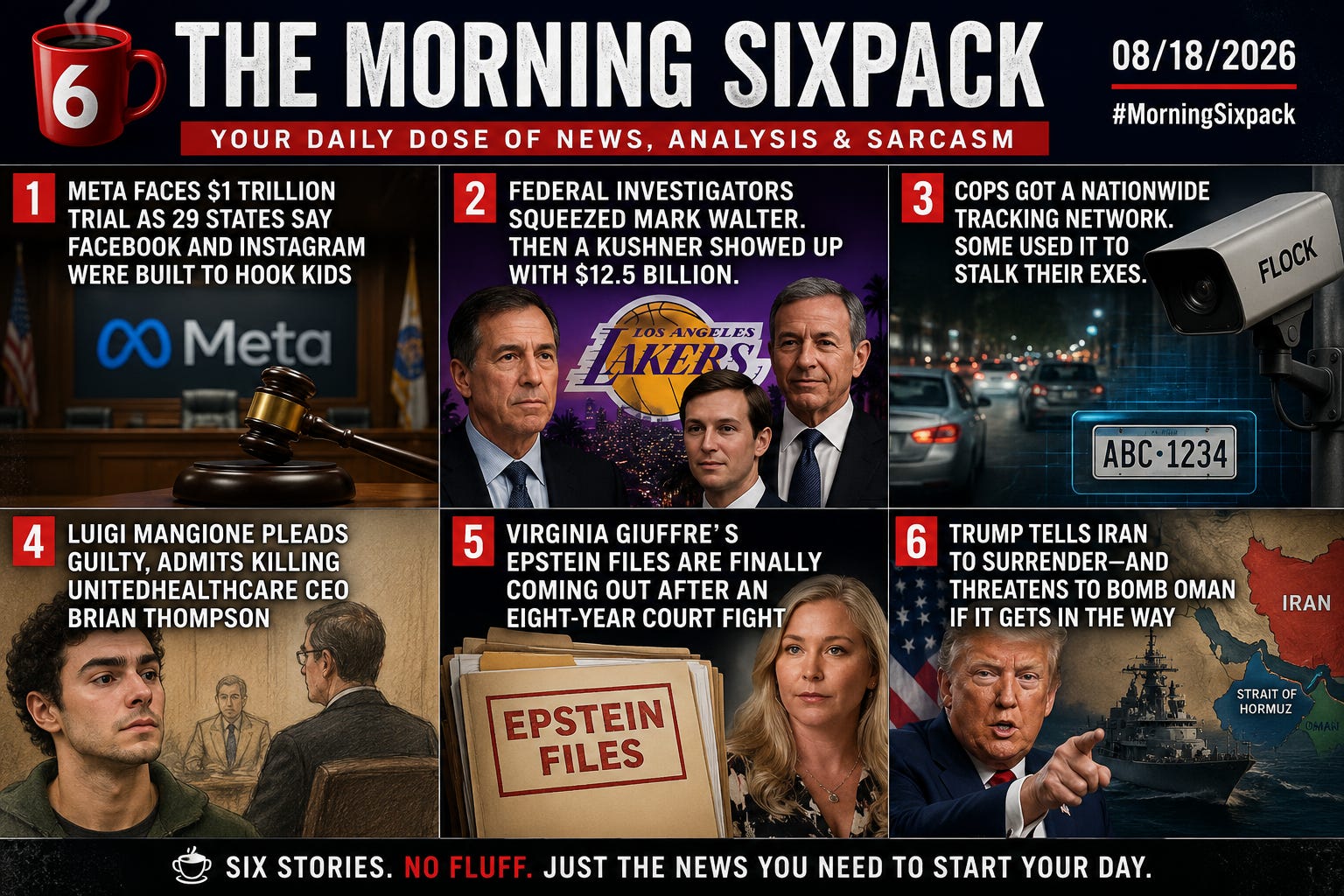
Meta is heading to court against 29 states and a potential $1 trillion tab over allegations it engineered Facebook and Instagram to hook kids—apparently “engagement” sounds less charming when attorneys general start comparing you to Big Tobacco.
Meta Faces $1 Trillion Trial as 29 States Say Facebook and Instagram Were Built to Hook Kids
Twenty-nine states are taking Meta to federal court, alleging Facebook and Instagram were deliberately designed to addict young users, harm their mental health, and collect children’s personal data without proper parental consent. The landmark case, led by California, Colorado, Kentucky, and New Jersey, was set to begin Tuesday in Oakland and could put some of social media’s most lucrative design tricks on trial.
The states aren’t just asking Meta to write a check—they want to force changes to the machinery that keeps kids scrolling.
The lawsuit seeks more than $1 trillion in damages and calls for changes including eliminating infinite scroll and public “like” counts, requiring parental verification for teenage users, moving away from what the states call “dopamine-manipulating recommendation algorithms,” and removing autoplay, disappearing posts, and some photo-altering features.
California Attorney General Rob Bonta put the accusation plainly: “Meta designed a dangerous product for young users, knew it to be dangerous, and then lied to children, families, and the community about how dangerous it was.”
Meta denies the allegations and says it will point to safeguards it has introduced for younger users and defend its record with consumers.
The case grew out of litigation first filed in 2023, accusing Meta of knowingly allowing children under 13 onto its platforms and failing to remove many accounts after underage users were flagged. The states also allege Meta violated the Children’s Online Privacy Protection Act by collecting and using personal information from children under 13 without parental consent.
Kentucky Attorney General Russell Coleman isn’t being subtle about the comparison: “AGs are in the perfect position to get this done. We did it with the Tobacco Settlement in the 1990s. We did it with the companies behind the opioid crisis. We’ll do it again with Meta.”
The financial stakes are enormous. UPI reported Meta shares slipped ahead of Tuesday’s market open as the potential liability approaches the company’s reported $1.43 trillion market capitalization. The trial also arrives shortly after Meta lost a separate New Mexico case involving harms to young users, resulting in a $567 million fund—including $420 million earmarked for treatment of social-media-related harms to children—on top of a $375 million fine imposed earlier in that case. Whatever the jury decides in Oakland, this is becoming a much bigger question than whether parents should simply confiscate the phone at dinner.
Editor: Meta spent years perfecting the art of keeping eyeballs glued to screens. Now 29 states would like a jury to decide whether some of those eyeballs were simply too young—and whether Meta knew exactly what it was doing.
Source: UPI
Federal investigators put billionaire Mark Walter’s financial empire under enormous pressure, he suddenly needed billions of dollars, and then the president’s son-in-law’s brother arrived with a $12.5 billion offer for the Lakers—nothing suspicious has been proved, but that’s one hell of a coincidence to leave unexplored.
The Feds Squeezed Mark Walter. Then a Kushner Showed Up With $12.5 Billion.
Los Angeles Dodgers owner Mark Walter is scrambling to unwind billions of dollars in investments after a federal investigation burrowed into his financial empire—and just as the pressure mounted, Josh Kushner and former Disney CEO Bob Iger appeared with an unsolicited $12.5 billion offer for Walter’s newly acquired Los Angeles Lakers. Walter accepted, reportedly after negotiations lasting about 72 hours, turning what began as an obscure Wall Street investigation into a story involving federal prosecutors, insurance-company money, two iconic sports franchises, and a Kushner with a very large checkbook.
There is no evidence the federal government engineered Walter’s predicament to pry the Lakers—or the Dodgers—out of his hands, but the timing is extraordinary enough that somebody ought to start asking who knew what, and when.
According to The Wall Street Journal, the investigation didn’t begin with the Lakers or Dodgers. A whistleblower inside Guggenheim Investments raised questions about possible accounting fraud involving a Middle East financing deal, sending authorities down a financial rabbit hole that eventually led them to ABS Capital, Amistad Financial, Bradford Allen, and Hudson Trading. Investigators subsequently discovered connections between those firms and entities that moved loans from Walter-controlled insurance companies to other Walter-linked businesses. An internal review eventually found roughly $20 billion in affiliate transactions that hadn’t been disclosed as such to Delaware regulators. Walter and his businesses haven’t been charged with crimes or found liable for civil penalties, and TWG Global says,
“We have always acted in good faith, and insinuations that we have in any way attempted to circumvent our obligations is simply false.”
Then the timeline gets awfully interesting. Walter agreed to acquire control of the Lakers in June 2025 in a deal valuing the franchise at $10 billion. Exactly three months later, according to the Journal, federal agents were waiting when Walter’s private plane landed at Chicago Midway International Airport. Armed with a search warrant, they seized Walter’s phone and laptop along with devices belonging to employees traveling with him. The resulting regulatory pressure left Walter’s insurers racing to unload or restructure billions in Walter-related investments to avoid ratings downgrades. Walter suddenly needed cash—a lot of it. That’s when Kushner, founder of Thrive Capital and brother of Jared Kushner, President Trump’s son-in-law, and Iger came knocking with an unsolicited Lakers offer valuing the franchise at $12.5 billion. Walter quickly said yes. Maybe Kushner simply spotted the world’s most expensive distressed-sale opportunity before everyone else. Maybe he paid a $2.5 billion premium because Walter otherwise wouldn’t sell. But the obvious question remains:
When did Kushner learn Walter needed billions, and from whom?
The Journal says Walter is also considering other asset sales, including his stake in Chelsea FC, while describing the Dodgers as the “jewel” of his portfolio. There is no indication Walter currently intends to sell the Dodgers, and there is no evidence federal officials tipped Kushner or deliberately targeted Walter to force a sports-franchise sale. That’s an important distinction.
But Walter bought the Dodgers in 2012 using financing connected to insurers, a practice that drew regulatory attention even then, and now federal investigators are examining the very financial architecture that helped build his sprawling empire. If that pressure eventually puts the Dodgers on the block—and another politically connected billionaire somehow gets to the front of the line—the coincidence meter is going to need a bigger dial.
Editor: Nobody has produced evidence that Washington ran a federal squeeze play so a Kushner could buy the Lakers. But when investigators squeeze a billionaire until he needs billions, and the president’s extended family suddenly arrives with $12.5 billion and closes the deal at warp speed, “nothing to see here” isn’t journalism. It’s an invitation to start asking better questions.
Source: The Wall Street Journal (free)
Flock built a nationwide license-plate surveillance network to help police catch criminals, but at least 50 officers have been accused of turning plate-reader systems into personal tracking devices—because apparently giving thousands of people a searchable map of everybody’s movements required a little more than the honor system.
Cops Got a Nationwide Tracking Network. Some Used It to Stalk Their Exes.
A Washington Post investigation found at least 50 law-enforcement officers were charged with or accused of misusing automated license-plate readers, including officers who allegedly tracked wives, girlfriends, exes, and other women without their knowledge. Flock Safety’s sprawling network now includes more than 120,000 cameras across more than 6,000 communities, recording a reported 20 billion license-plate scans every month—and giving authorized officers an extraordinarily powerful way to reconstruct where somebody has been.
The technology was supposed to help police find suspects. In some departments, the person doing the surveillance was the one wearing the badge.
One Georgia case shows exactly how creepy this can get. Police Chief Michael Steffman allegedly searched Flock for the license plates belonging to his former girlfriend, Marci Bakely, and her teenage daughter roughly 600 times. Bakely couldn’t figure out how Steffman seemed to know when she went grocery shopping, visited the doctor, or went on dates. She searched her car for hidden trackers before Steffman finally admitted he’d used Flock. Even after telling her, “I won’t ever look again,” records showed hundreds more searches over the following months. He was arrested in November 2025 on stalking, harassment, and license-plate-reader misuse charges, but died before trial.
The Post found 26 cases in which investigators or prosecutors said officers used license-plate technology to monitor wives, girlfriends, exes, their exes’ new partners, or women they wanted to meet. One Wisconsin officer allegedly checked whether his girlfriend had visited an abortion clinic. A Kansas police chief allegedly tracked an ex before appearing while she was intimate with another man. A Florida deputy allegedly put a young actress on a watch list and nearly caused a head-on collision while speeding to intercept her.
Flock says abuse represents a tiny fraction of its roughly 140,000 active users and points to audit logs and a voluntary system designed to flag suspicious searches. CEO Garrett Langley acknowledged the fundamental problem: “We’re not going to change humans, and humans make bad decisions.”
But that’s precisely the problem when “humans making bad decisions” have access to a system capable of tracking cars across thousands of communities. There is no comprehensive federal law governing license-plate-reader use, oversight varies dramatically among police departments, and some safeguards—including requiring a criminal case number before conducting a search—remain optional. Privacy advocates argue that searches should face stronger controls, while law-enforcement supporters warn that cumbersome requirements could undermine a tool capable of locating kidnapping victims and criminal suspects quickly. Flock CEO Langley has said, “I don’t think it’s our job to police the police.” Maybe not. But when you’re selling the police a nationwide surveillance network, somebody damn well better be doing it.
Editor: The debate isn’t whether Flock can catch criminals—it clearly can. The question is why a surveillance system powerful enough to follow somebody across town, across counties, and potentially across states was deployed so widely before anyone figured out who would watch the people doing the watching.
Source: The Washington Post (free)
Luigi Mangione finally said the words himself: He shot UnitedHealthcare CEO Brian Thompson and knew it was illegal—but the guilty plea may also be a calculated attempt to kneecap New York’s separate murder prosecution.
Luigi Mangione Pleads Guilty (But Not to Murder), Admits Killing UnitedHealthcare CEO Brian Thompson
Luigi Mangione pleaded guilty in federal court to stalking UnitedHealthcare CEO Brian Thompson and killing him outside a Manhattan hotel in 2024, publicly admitting responsibility for the first time in a case that became a national obsession. The 28-year-old could face life in federal prison, while his attorneys are now trying to use that guilty plea to derail the separate New York state murder case against him.
“I shot Mr. Thompson and he died. I knew that what I was doing was illegal.”
According to PBS NewsHour justice correspondent Ali Rogin, Mangione showed no remorse or contrition as he described the crime, while members of Thompson’s family reportedly cried in the courtroom. Mangione pleaded guilty to two federal counts of stalking resulting in Thompson’s death rather than a federal murder charge. His lawyers immediately moved to dismiss New York’s pending murder prosecution, arguing that continuing it after the federal plea would violate New York’s unusually strict protections against successive prosecutions stemming from the same act. The state trial is scheduled to begin in early September.
Mangione also provided new details about how he targeted Thompson. He said years of back pain and his belief that the health insurance system had worked against him contributed to his motivation. After learning UnitedHealthcare was holding an investor meeting in Manhattan, Mangione said he posed as a wealthy investor and emailed company leadership seeking information about the event. He said the company responded within an hour—a response time he contrasted with his own experiences dealing with insurers as a patient. Whatever point Mangione thought that illustrated about American health care, prosecutors have maintained that his grievances don’t excuse stalking and killing a man on a Manhattan sidewalk.
The guilty plea eliminates whatever ambiguity remained about who killed Thompson, but it doesn’t necessarily end the legal battle. Mangione’s defense is betting that admitting guilt federally (to a charge that isn’t murder) could help extinguish the state murder prosecution, where New York’s double-jeopardy rules could become the next major fight. That’s an extraordinary bit of legal chess: Confess to the killing, potentially spend the rest of your life in federal prison, and simultaneously argue that New York no longer gets its own shot at prosecuting you for murder.
Editor: Mangione spent months as an unwilling—or perhaps willing—Rorschach test for America’s fury at health insurers. Now he’s removed the mystery himself: He planned it, stalked Thompson, and shot him. You can despise America’s health-care system without pretending assassination is customer service feedback.
Source: PBS NewsHour
After eight years of litigation, a federal judge has ordered the release of records from Virginia Giuffre’s case against Ghislaine Maxwell—meaning the public may finally see evidence Maxwell apparently believed would stay buried when she settled the lawsuit.
Virginia Giuffre’s Epstein Files Are Finally Coming Out After an Eight-Year Court Fight
A federal court in Manhattan has ordered the release of the remaining voluminous records from Virginia Giuffre’s 2015 defamation lawsuit against Ghislaine Maxwell, potentially exposing evidence gathered about Jeffrey Epstein, Maxwell, and the powerful men who entered their orbit. The decision follows an eight-year transparency battle led by journalist Julie K. Brown, the Miami Herald, and parent company McClatchy, and could open another major window into evidence that spent years locked behind an unusually broad court seal.
Maxwell settled Giuffre’s lawsuit years ago and apparently thought the evidence collected during discovery would remain buried. That bet just expired.
Giuffre sued Maxwell in 2015 after Maxwell publicly called her allegations lies, saying the accusations had subjected Giuffre to “public ridicule, contempt, and disgrace.” During discovery, attorneys collected tens of thousands of pages of records and depositions from Giuffre, Maxwell, and numerous others. But then-U.S. District Judge Robert Sweet imposed broad secrecy over the material, including evidence Giuffre’s attorneys said demonstrated that Epstein and Maxwell operated an underage sex-trafficking operation. Maxwell settled with Giuffre in early 2017 for what Brown reports was roughly $3 million to $5 million, avoiding a trial that could have brought some of that evidence into public view.
Brown and the Miami Herald subsequently went to court seeking access, arguing that judicial records are presumptively public and that the Giuffre-Maxwell documents had never been properly sealed individually. An appeals court ultimately sided with the newspaper, leading to the release of thousands of pages on Aug. 9, 2019. Those records included Giuffre’s sworn allegations involving Alan Dershowitz, Prince Andrew, former Sen. George Mitchell, former Gov. Bill Richardson, Glenn Dubin, Tom Pritzker, and the late MIT scientist Marvin Minsky. The men denied involvement with Giuffre. Epstein was found dead in his Manhattan jail cell the following morning.
Now U.S. District Judge Loretta Preska has rejected Maxwell’s remaining effort to keep the records sealed, with Brown reporting that the Epstein Files Transparency Act passed last year superseded the grand-jury arguments Maxwell had relied upon. The importance here isn’t another internet scavenger hunt for famous names. A person’s appearance in an Epstein-related document is not evidence of wrongdoing. The real prize is the underlying record: Sworn testimony, contemporaneous evidence, and other discovery that could help establish who knew what about Epstein’s operation, when they knew it, and what—if anything—they did about it. After years of rumors, redactions, and selective disclosures, that’s where the facts live.
Editor: Epstein generated enough conspiracy theories to power the internet indefinitely, but there’s a wonderfully old-fashioned solution: Unseal the damn evidence. Names aren’t convictions and allegations aren’t proof. But judicial records shouldn’t disappear into a vault merely because the people mentioned in them have money, power, or exceptionally expensive lawyers.
Source: Julie K. Brown
Trump says Iran should wave the white flag, the 60-day window for a permanent deal has expired, and even Oman—the mediator trying to reopen one of the world's most important shipping lanes—just got threatened with bombing. Diplomacy is having quite a week.
Trump Tells Iran to Surrender—and Threatens to Bomb Oman if It Gets in the Way
President Donald Trump says Iran should surrender after concluding Tehran won’t accept the deal he considers necessary to end the war, while insisting the United States’ overriding objective remains preventing Iran from obtaining a nuclear weapon. The declaration came as a 60-day negotiating period established under the countries’ short-lived June agreement (MOU) expired with no final deal—and with the Strait of Hormuz dispute continuing to squeeze global energy markets.
“They’re not going to make the kind of a deal that I feel is necessary.”
Trump told reporters the United States isn’t interested in extending the interim agreement, which called for an “immediate and permanent termination of military operations on all fronts” and negotiations toward a broader settlement. The ceasefire quickly fell apart: Trump declared it “over” July 7, Iran suspended it a week later, and the two sides have failed to reach the promised final agreement. Trump went considerably further during a Fox News interview Monday, saying Iran “should put up the white flag of surrender.” His stated bottom line hasn’t changed: “Iran cannot have a nuclear weapon.”
Then there’s Oman. Oman and Iran have been negotiating over restoring commercial shipping through the Strait of Hormuz, the maritime artery that carried roughly 20% of global oil and liquefied-natural-gas supplies before the U.S.-Israeli attacks on Iran began in February. Trump apparently wasn’t impressed with Oman’s role.
“If Oman gets in the way, we’ll bomb the shit out of them,” he told Fox.
Asked later whether he’d lost patience with Oman, Trump softened the temperature by approximately half a degree, saying, “No, I don’t think they behaved very well, but we’d handle them very easily, just like we do other things.”
The stakes extend far beyond Trump’s negotiating posture. Disruption in the Strait of Hormuz has pushed fuel prices higher, while the war remains unpopular at home with November’s congressional midterms approaching. Trump insists politics isn’t driving his decisions, telling Fox that the “Midterms have nothing to do with my thinking.”
Maybe so. But voters tend to develop strong opinions when wars drag on and gasoline gets expensive, which means Iran, Hormuz, and those supposedly irrelevant midterms are likely to keep occupying the same sentence whether the White House likes it or not.
Editor: “Surrender or else” is certainly easier to fit on a bumper sticker than a Middle East peace agreement. The harder part is getting Iran to surrender, reopening Hormuz, keeping Oman onside, and ending a war without creating three new problems while solving the first one.
Source: Reuters