


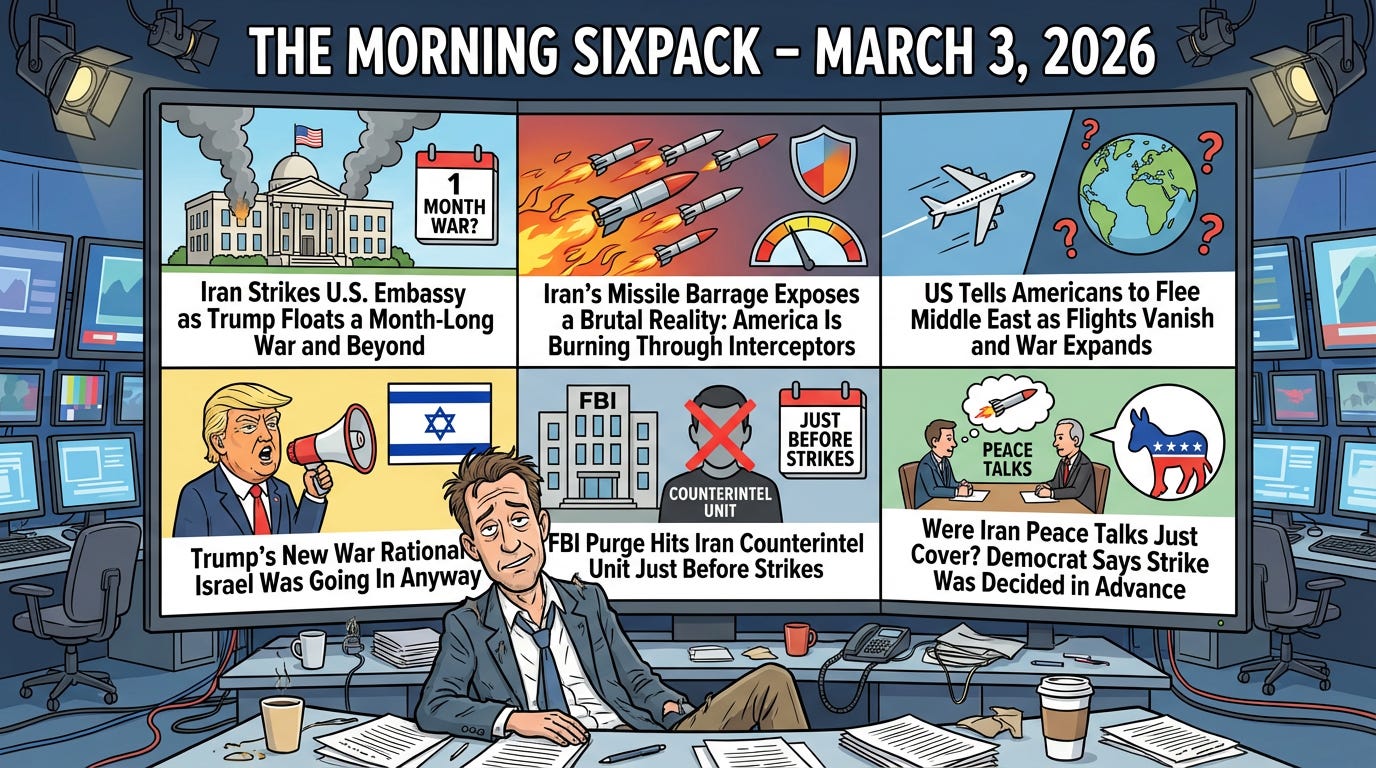
Iran just lit up a U.S. Embassy and the White House still can’t decide if it’s fighting a war or starting one.
Iran Strikes U.S. Embassy as Trump Floats a Month-Long War and Beyond
Iran expanded the battlefield Tuesday, hitting the U.S. Embassy in Saudi Arabia as Washington pulled staff across the Middle East and President Donald Trump signaled this fight could stretch for weeks—or longer.
This is no longer a shadow war—it’s a region-wide brawl with oil, embassies, and global shipping in the crosshairs.
Two drones slammed into the U.S. Embassy compound in Riyadh, sparking a “limited fire,” according to Saudi officials, while the U.S. Embassy in Kuwait shut down entirely. The State Department ordered non-emergency personnel and families out of Kuwait, Bahrain, Iraq, Qatar, Jordan and the UAE, urging Americans to leave more than a dozen countries—even as closed airspace left many stranded. Tehran’s message was clear: no American outpost in the region is untouchable.
The broader toll is mounting fast. Iranian authorities say at least 787 people have been killed in U.S.-Israeli strikes, while Israeli officials report 11 dead from Iranian missile attacks. The U.S. military confirmed six American service members killed. Hezbollah has entered the fray from Lebanon, and Israel responded with strikes that killed 52 there. Meanwhile, Israel and the U.S. targeted Iran’s nuclear infrastructure, including the Natanz enrichment site, which the International Atomic Energy Agency said suffered “some recent damage,” though with “no radiological consequence expected.” Israeli Prime Minister Benjamin Netanyahu defended the offensive bluntly: “We had to take the action now and we did.”
President Trump, for his part, is projecting stamina without spelling out an endgame. He said the war could last four to five weeks but that he’s prepared “to go far longer than that,” boasting of a “virtually unlimited supply” of munitions. “Wars can be fought ‘forever,’ and very successfully, using just these supplies,” he wrote on social media. That came after the initial strikes reportedly killed Iran’s Supreme Leader and Trump publicly urged Iranians to overthrow their government—though aides later insisted regime change isn’t the objective. So which is it?
As missiles fly, markets are rattled. Iran has struck energy facilities in Qatar and Saudi Arabia, targeted ships in the Strait of Hormuz and even hit Amazon data centers in the UAE and Bahrain. One Iranian commander declared, “The Strait of Hormuz is closed,” vowing ships passing through would be set on fire. With a fifth of the world’s traded oil moving through that narrow channel, even the threat is enough to spike prices and scramble supply chains. And now Israeli troops are moving in and out of southern Lebanon, opening yet another front in a war that seems to find a new gear every 24 hours.
Source: AP News
Editor: Four to five weeks, maybe forever—nothing says “clear strategy” like a war plan with a shrug emoji attached.
Iran can churn out missiles faster than the U.S. can churn out $15 million interceptors—and that math gets ugly fast.
Iran’s Missile Barrage Exposes a Brutal Reality: America Is Burning Through Interceptors
Iran’s relentless missile and drone attacks are testing whether the U.S. and its allies have enough interceptors left to keep the sky from cracking open.
Tehran’s playbook is volume. Ballistic missiles. Cruise missiles. Drones. Fire enough and something gets through. Military doctrine typically calls for launching two or three interceptors per incoming threat to improve the odds of a kill. That means a single wave can chew through stockpiles in hours. According to a person familiar with the matter, supplies could be running dangerously low within days if the current tempo holds.
“Missile interceptors are a big concern, particularly anti-ballistic interceptors,” said Kelly Grieco of the Stimson Center. “We are using these interceptors faster than we can make them.” On Saturday alone, dozens of Iranian missiles were intercepted across the region—but not all. And if Iran has more missiles than the U.S. and its partners have interceptors, the math eventually wins.
Last June’s 12-day war already drained reserves. The U.S. reportedly fired about 150 THAAD interceptors to defend Israel—each one costing around $15 million and built by Lockheed Martin. Only a few dozen were purchased last year. These are the crown jewels of missile defense, designed to smash ballistic threats beyond the atmosphere. They work. They’re also not cheap. Bloomberg previously estimated that repelling just a few hours of Iranian missile and drone attacks in 2024 cost roughly $1.1 billion.
Iran, meanwhile, is believed to have thousands of missiles and drones. “Magazine capacity was already low,” said William Alberque of the Pacific Forum. Another analyst, Eyal Pinko, put it bluntly: “A lot more attacks are coming…This is now an all-out war for their survival.” The U.S. and Israel will try to knock out launchers and commanders to slow the pace. But this conflict may hinge less on bravado and more on which side runs out of hardware first.
Source: Bloomberg
Editor: Wars used to be about territory. Now they’re about inventory management—and the receipts are terrifying.
When the State Department says “depart now,” that’s diplomat-speak for get on a plane if you can find one.
US Tells Americans to Flee Middle East as Flights Vanish and War Expands
The U.S. is urging Americans to immediately leave most of the Middle East as the widening U.S.-Israel war with Iran turns the region into a no-fly zone with live missiles.
The State Department warned U.S. nationals to get out of Bahrain, Egypt, Iran, Iraq, Israel, the occupied West Bank and Gaza, Jordan, Kuwait, Lebanon, Oman, Qatar, Saudi Arabia, Syria, the United Arab Emirates and Yemen, citing “serious safety risks.” No official evacuation plan is in place. That’s a problem, because flights across the region have been cancelled or suspended since U.S. and Israeli strikes on Iran began over the weekend.
Between 500,000 and one million Americans are believed to be in the Middle East, though exact figures are fuzzy since citizens aren’t required to register abroad. The U.S. Embassy in Jerusalem said it “is not in a position at this time to evacuate or directly assist Americans in departing Israel,” and will remain closed. It noted Israel has begun operating shuttles to the Taba border crossing with Egypt—but stopped short of recommending anyone use it.
Other Western governments are scrambling. France says it’s preparing flights—commercial and military—for citizens most at risk. The UK is urging Britons to register their presence so officials can provide “the best possible support,” with Foreign Secretary Yvette Cooper estimating roughly 300,000 British nationals are in the region. Many are tourists, business travelers or passengers transiting Gulf hubs now caught in the chaos.
The scale is unprecedented: multiple countries, hundreds of thousands of foreign nationals, and airspace closures stretching from Israel to the Gulf. As Iran fires missiles and drones at U.S.-allied nations and Israel expands operations, civilians are left refreshing airline apps and embassy websites, hoping a seat opens before the next siren.
Source: BBC News
Editor: If you’re relying on “commercial means” in a shooting war, you’d better hope Expedia has a defense policy.
The White House’s reason for war keeps evolving—and Congress just got the classified version.
Trump’s New War Rationale: Israel Was Going In Anyway
The Trump administration is offering a shifting new justification for striking Iran, arguing the U.S. had to act because Israel was prepared to attack “with or without American support.”
In other words: We jumped in because they were going to jump anyway.
After a classified Capitol Hill briefing, House Speaker Mike Johnson framed the U.S. strike as a “defensive operation,” saying the White House believed Iran would retaliate against American personnel and assets once Israel moved. “The commander in chief has said this is going to be an operation that is short in duration,” Johnson said. “We certainly hope that’s true.” That optimism comes as the joint U.S.-Israel campaign—Operation Epic Fury—has already killed Iran’s Supreme Leader and hundreds more, including at least six U.S. service members.
Secretary of State Marco Rubio said “the hardest hits are yet to come,” describing an “imminent threat” and arguing the U.S. needed to preempt Israel’s strike to avoid higher casualties. “We knew that there was going to be an Israeli action,” Rubio said. “And we knew that if we didn’t preemptively go after them before they launched those attacks, we would suffer higher casualties.” Still, he insisted regime change is not the mission: “The objective of this mission is to make sure they don’t have these weapons that can threaten us and our allies in the region.”
President Trump has since outlined four war aims: destroy Iran’s missile capability, wipe out its naval capacity, block any path to a nuclear weapon and stop Tehran from arming proxy forces abroad. “This was our last, best chance to strike,” Trump said, calling the Iranian leadership a “sick and sinister regime.” Yet critics note the rationale has shifted multiple times—from imminent threat, to backing Israel, to broader regional security goals.
Democrats are pushing a war powers resolution to rein in the president, arguing Congress—not the White House alone—holds the constitutional authority to declare war. “There was no imminent threat to the United States of America by the Iranians. There was a threat to Israel,” said Sen. Mark Warner. Rep. Adam Smith warned Trump “unilaterally decided to do this.” Even if a resolution passes, it would likely face a veto. And so the war rolls on—funding request coming soon.
Source: AP News
Editor: If the justification keeps changing, maybe it’s not the explanation that’s classified—it’s the strategy.
Days before bombing Iran, the FBI sidelined the very agents who track Iranian threats—because they once investigated Trump.
FBI Purge Hits Iran Counterintel Unit Just Before Strikes
Just before the U.S. launched Operation Epic Fury in Iran, FBI Director Kash Patel fired a dozen members of a key counterintelligence squad focused on Iranian threats—because they had worked on Trump’s classified documents case.
The Washington-based unit, known as CI-12, handles sensitive cases involving foreign spies and mishandling of classified material. According to sources familiar with the matter, every dismissed employee had been involved in investigating President Donald Trump’s alleged retention of classified documents at Mar-a-Lago. The move effectively thinned the ranks of the bureau’s Iran-focused counterintelligence bench at a moment of escalating conflict.
The firings come as U.S. officials brace for potential retaliation following strikes that killed Iran’s Supreme Leader. In Trump’s first term, CI-12 played a key role in monitoring threats tied to the 2020 drone strike that killed Gen. Qasem Soleimani. Since then, Iranian-backed operatives have been charged in alleged plots targeting American officials, including Trump, Mike Pompeo and John Bolton. A joint FBI and DHS report last year described Iran’s security services as “adaptable and opportunistic,” noting the use of biker gangs, drug traffickers, burner phones and cryptocurrency to mask operations.
While officials say there is no sign of activated sleeper cells since the latest U.S. strikes, law enforcement has heightened monitoring. Current and former Justice Department officials told CNN that waves of firings, resignations and reassignments have hollowed out the National Security Division, including offices dedicated to counterterrorism and counterintelligence. “If you lose half your capacity, you lose half your ability,” one former senior DOJ official said. “That in itself is a reason to be concerned.”
The FBI said it “maintains a robust counterintelligence operation” and remains prepared to mobilize assets nationwide. But critics argue the cumulative effect of dismissals tied to Trump-related investigations has cost the department decades of institutional experience—just as the U.S. enters a widening war with a country known for asymmetric retaliation.
Source: CNN
Editor: When you clean house in the middle of a firefight, you’d better be sure you didn’t toss out the people who know where the exits are.
An old-school Dem says the Iran talks were theater—and the bombing script was already written.
Were Iran Peace Talks Just Cover? Democrat Says Strike Was Decided in Advance
A longtime Democratic strategist says the Trump administration’s Iran peace talks were a smokescreen and that the decision to bomb had already been made.
If that’s true, diplomacy wasn’t failing—it was stalling for time.
Writing in The Hill, former California Democratic Party chair Bill Press argued that Tehran didn’t walk away from negotiations—the U.S. did. “Iran didn’t walk away from making a new deal. The U.S. did — and it started bombing the next morning,” Press wrote. “In fact, there is reason to believe that the entire Geneva operation was only a smokescreen, designed to fool Iran’s leaders into thinking the U.S. was negotiating in good faith.”
Press went further, claiming the call to strike may have been locked in even before President Donald Trump’s State of the Union address. “Clearly, the decision to bomb Iran had already been made before the State of the Union, while the Trump administration was still pretending to be seriously interested in diplomacy.” He also asserted that Israeli Prime Minister Benjamin Netanyahu and Saudi Crown Prince Mohammed bin Salman pushed Trump to act, writing, “Trump agreed to do their dirty work.”
The column disputes Trump’s claim that Iran “walked away from the table,” noting that talks moderated by Oman were still underway in Geneva days before the bombing, with public signals of progress. Meanwhile, Trump is projecting confidence about the conflict’s trajectory, saying the U.S. has a “virtually unlimited supply” of medium-grade munitions and that “Wars can be fought ‘forever,’ and very successfully, using just these supplies.” He also insisted America is “stocked, and ready to WIN, BIG!!!”
The White House has maintained that its objective is eliminating Iran’s weapons capabilities, not regime change. But critics argue the timeline matters—especially if negotiations were still active when the bombs fell. If talks were real, the strike marks a breakdown. If they were cover, it’s something else entirely.
Source: Raw Story
Editor: When peace talks double as stage props, don’t be shocked if the curtain comes down with an airstrike.