


The Morning Sixpack stays free because the news that shapes your life should not be hidden behind a paywall. Paid subscribers are not paying for access. They are helping fund the research, writing, and independent voice that goes into every issue. Become a paid subscriber and help keep smart, honest news analysis free for everyone.
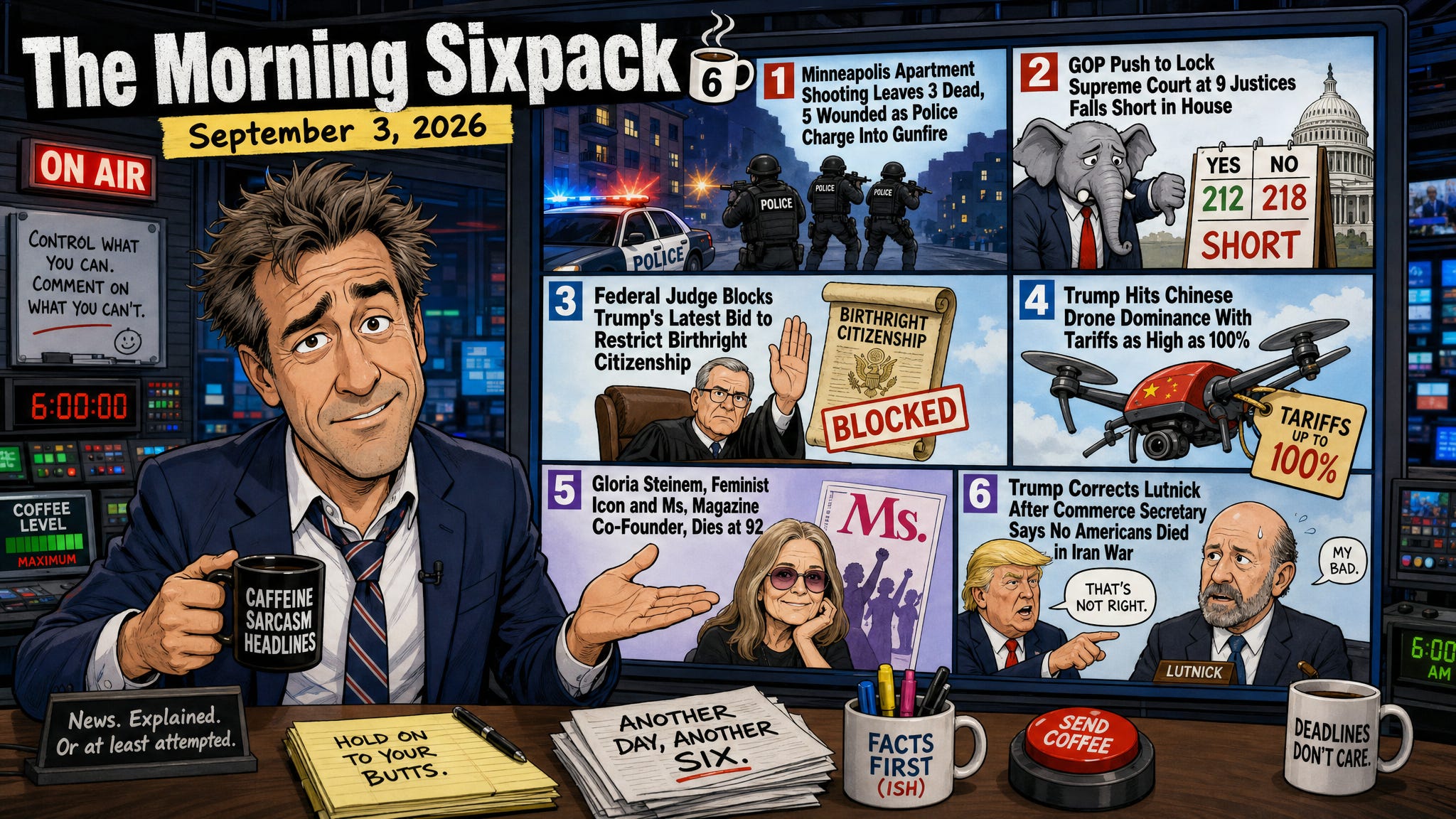
Three people are dead, including the suspected shooter, and five others were shot inside a downtown Minneapolis apartment building—another American afternoon turned into a crime scene before dinner.
Three people were killed, including the suspected gunman, and five others were wounded by gunfire Wednesday after a shooting erupted inside a downtown Minneapolis apartment building. Two Minneapolis police officers were among those shot, while a third officer suffered other injuries. All three officers were reported in stable condition and are expected to recover.
Police were inside the building less than two minutes after being dispatched—and soon found themselves following the sound of gunfire upstairs.
The 911 call came shortly after 4:30 p.m. Interim Police Chief Bill Peterson said officers quickly located victims, then heard additional shots from a higher floor. When they followed the gunfire, they encountered “a haze that significantly limited their visibility.” One officer was shot in the leg and another twice in the abdomen. One victim died at the scene and another after reaching the hospital; authorities said it was not immediately clear how the suspected shooter died.
Police did not identify the suspected gunman but said authorities were familiar with the person before Wednesday’s shooting. Residents described a frighteningly familiar warning sign. Julius Bailey said he recognized the armed man as a resident known for displaying his weapon, while another resident, Chris Miller, said he had encountered someone with a handgun in the hallway earlier in the week and reported the person to building management. “I could tell he was trouble,” Bailey said.
Peterson praised the officers who entered the building: “I’m truly sickened by this level of violence. That feeling is tempered only by the courageous actions of the Minneapolis police officers, who responded without hesitation, confronted an extraordinarily dangerous situation and worked to end the violence and restore safety.”
Minnesota Gov. Tim Walz said state officials were assisting local authorities, while FBI Director Kash Patel said the bureau would provide whatever resources were needed.
Editor: Just another day in Beirut, er, I mean, America. Gun violence is so easy and we’re all numb to it (mostly).
Source: AP News
House Republicans tried to lock the Supreme Court at nine justices through the Constitution, but 212 votes don’t magically become two-thirds just because midterms are coming.
House Republicans failed Wednesday to advance a constitutional amendment permanently limiting the U.S. Supreme Court to nine justices, with the measure receiving 212 votes in favor and 206 against. That sounds like a win until you remember constitutional amendments require a two-thirds House majority—not the simple majority needed for ordinary legislation.
The vote puts Democrats on the record over court expansion less than two months before the midterms, which was probably the political point all along.
The Supreme Court has had nine seats since 1869, but the Constitution itself doesn’t specify how many justices must serve. Congress has changed the court’s size several times throughout U.S. history. Calls to expand it resurfaced after President Donald Trump appointed three justices during his first term, helping establish the court’s conservative majority. In 2021, congressional Democrats introduced legislation proposing a 13-member court, arguing expansion would “restore balance to the nation’s highest court after four years of norm-breaking actions by Republicans.”
The Republican amendment arrived alongside another politically useful House vote: A resolution condemning socialism that passed 220-192, with eight Democrats joining Republicans. House Speaker Mike Johnson made the electoral message explicit afterward: “For members of Congress who swore an oath to support and defend the Constitution, condemning socialism and defending the integrity of the Supreme Court shouldn’t be a controversial vote. Sadly, for today’s Democrats, they are.”
Republicans now have two fresh roll calls to feature in campaign ads as control of Congress hangs in the balance.
Democratic interest in expanding the court hasn’t disappeared. The article reports that Sen. Jim Clyburn recently backed expansion and said, “Thirteen is a pretty good number. A baker’s dozen would be a good number to have on the court.” Former Vice President Kamala Harris has likewise called for a “real conversation” about expanding it to 13, while Republicans remain firmly opposed.
Editor: Nobody expected this amendment to clear the constitutional two-thirds hurdle. But Congress discovered something it can still produce efficiently: Campaign material.
Source: Al Jazeera
A federal judge has blocked President Trump’s latest attempt to restrict birthright citizenship after the Supreme Court already rejected his broader effort—apparently constitutional whack-a-mole is now an executive-branch strategy.
A federal judge blocked President Donald Trump’s latest executive orders restricting birthright citizenship Wednesday, concluding that the administration’s new approach is “almost certainly unconstitutional.” The ruling comes barely two months after the Supreme Court rejected Trump’s earlier attempt to deny automatic citizenship to children born in the United States to parents who aren’t U.S. citizens.
The administration changed the order, but the judge says it ran straight back into the same constitutional wall.
Trump signed two new executive orders on Aug. 6. One expanded the categories of noncitizens whose U.S.-born children would not automatically receive citizenship, including cases involving a parent deemed an “alien enemy” or employed by a foreign government. The second targeted so-called birth tourism. U.S. District Judge Deborah Boardman concluded that the new orders were likely unconstitutional “for the simple reason that the Supreme Court ... already decided that the children in the class are citizens at birth.”
Boardman wrote: “This Court must, once again, preliminarily enjoin enforcement of the President’s most recent attempt to strip the right to citizenship from them.” The constitutional issue centers on the 14th Amendment, which declares that people born or naturalized in the United States and subject to its jurisdiction are U.S. citizens. In June, the Supreme Court ruled 6-3 against Trump’s original executive order. Chief Justice John Roberts wrote that there was “scant evidence” supporting Trump’s interpretation of the amendment.
Trump criticized that Supreme Court decision as “too bad for our Country” and urged Congress to pass legislation restricting birthright citizenship. That may ultimately be where this fight has to go, because courts have now repeatedly rejected attempts to accomplish the change through presidential orders.
Editor: When the Supreme Court has already told you what the Constitution means, changing a few lines in the executive order isn’t exactly a constitutional cheat code.
Source: UPI
The U.S. has imposed tariffs as high as 100% on imported drones as Washington tries to loosen China’s grip on an industry that suddenly looks a lot less like a hobby and a lot more like national security.
New U.S. tariffs of up to 100% on drones and certain components took effect Thursday, targeting American dependence on a global market overwhelmingly dominated by China. President Donald Trump ordered the duties in August, with the White House citing national-security concerns and a need to build stronger domestic drone supply chains.
Washington has apparently decided that outsourcing the eyes in the sky to your biggest strategic competitor might not be the world’s greatest long-term plan.
The steepest tariff applies to drones weighing more than 25 kilograms, along with drones equipped with thermal-imaging capabilities and docking stations. Those products face a 100% duty, while smaller drones face a 25% tariff. Certain components deemed less sensitive will also face duties beginning Feb. 9, 2027.
The obvious target is China’s DJI, which has captured more than two-thirds of the global drone market in recent years, according to studies cited by Euronews. DJI has been on a U.S. list of Chinese companies linked to China’s military since 2022, though the company has fought that designation. China isn’t pleased with the new tariffs, either. A Commerce Ministry spokesman warned they would “disrupt the global drone supply chain and further undermine a fair and competitive market environment.”
The stakes go well beyond somebody paying more for a flying camera. Ukraine has demonstrated how drones can transform warfare, surveillance, and battlefield intelligence, and U.S. officials argue dependence on Chinese hardware could leave military and critical infrastructure vulnerable to disruption or espionage. The tariffs are therefore both trade policy and industrial policy, with Washington betting that making Chinese imports more expensive will encourage an American alternative.
Editor: America spent years discovering that cheap Chinese drones are incredibly useful. Now comes the considerably harder part: Figuring out how to make enough of them ourselves.
Source: Euronews
Gloria Steinem, the journalist and activist who helped push feminism from the margins into America’s mainstream conversation, has died at 92—after spending more than six decades making powerful people answer uncomfortable questions.

Gloria Steinem, the pioneering journalist, political organizer, and women’s rights activist whose name became synonymous with the modern feminist movement, died Wednesday at her New York City home at age 92. Her death was announced on her Instagram account, which said she “passed away peacefully at her home in New York City, surrounded by some of the many who loved her.” No cause of death was given.
Whatever you thought of her politics, Steinem didn’t merely participate in America’s argument over women’s rights—she helped write the agenda.
Steinem broke through as a journalist in an era when women reporters were routinely steered toward food, makeup, children, and celebrities. Her 1963 undercover investigation inside one of Hugh Hefner’s Playboy clubs exposed the sexism and low wages endured by its cocktail waitresses. She later became a founding editor of New York magazine and, in 1972, helped launch Ms. magazine, which tackled subjects including abortion, lesbianism, domestic abuse, sexual harassment, and traditional gender roles when much of the mainstream press preferred not to touch them.
Her activism extended far beyond journalism. Steinem helped establish the National Women’s Political Caucus in 1971 to recruit and elect more women to public office, and reproductive rights remained one of her defining causes. She had an illegal abortion at 22 and decades later dedicated her 2015 memoir, “My Life on the Road,” to the doctor who performed it.
After the Supreme Court appeared poised to overturn Roe v. Wade in 2022, Steinem told NPR: “It will not change the basic fact that we either have decision-making power over our own bodies—women and men—or there is no democracy.”
Steinem’s influence ultimately reached the White House. President Barack Obama awarded her the Presidential Medal of Freedom in 2013, saying, “Because of her work, across America and around the world, more women are afforded the respect and opportunities that they deserve.” He added: “She also changed how women thought about themselves.”
Steinem herself preferred to describe change from the ground up: “Too often we think the tree grows from the top, from Congress. Trees grow from the bottom.”
Editor: Steinem spent a lifetime proving that cultural arguments don’t stay cultural for long—they become political, legal, and personal. Agree with her or argue with her, but pretending she didn’t move the country isn’t much of an argument at all.
Source: NPR
Commerce Secretary Howard Lutnick said there had been no American deaths in the Iran war, prompting President Trump to publicly correct him: 18 U.S. service members have been killed. That’s one hell of a detail to misplace seven months into a war.
President Donald Trump publicly corrected Commerce Secretary Howard Lutnick Thursday after Lutnick claimed there “haven’t been American deaths” in the Iran war, despite 18 U.S. service members having been killed. Lutnick made the statement during a CNBC interview while arguing that the administration’s Iran strategy could ultimately benefit financial markets.
Eighteen dead Americans aren’t a rounding error, a footnote, or something the Commerce secretary should need the president to remind him about.
“I think the way the president is playing Iran, right, there’s not—there haven’t been American deaths,” Lutnick said. “It’s really just an economic choke out, which the administration is now executing more broadly, and I think it’ll be very effective.”
There is a reason many call him Nutlick. He licks Trump’s balls AND he’s fucking crazy.
Trump responded the following morning on Truth Social: “Sec. Lutnick had Venezuela on his mind when he said nobody was killed. 18 people were killed in Iran!”
But according to the report, Lutnick had explicitly referred to Iran and connected the administration’s handling of that conflict to his optimism about the bond market.
The casualty picture extends well beyond those 18 deaths. The Pentagon’s casualty database listed 757 U.S. service members wounded since the war began Feb. 28, according to CNN figures cited by Raw Story. The Intercept separately reported that the military added 60 injuries to its tally during a single week in late August, bringing the combined number of dead and wounded to 776. The war is now in its seventh month, and public support has reportedly fallen to 31%, according to a Reuters/Ipsos poll cited in the article.
The episode carries an extra political sting because Trump allies hammered President Joe Biden after he incorrectly claimed during the 2024 presidential debate that no U.S. troops had died during his presidency. Now one of Trump’s own Cabinet officials has made a similar mistake while discussing an ongoing war—and did it in the context of what that war could mean for investors and interest rates.
Editor: You can debate Iran strategy, casualties, markets, and whether this war is worth fighting. But if you’re going on television to explain how well it’s going, remembering the Americans who died seems like the minimum cover charge.
Source: Raw Story
OR—visit Amazon and if you buy something, I will get a tiny commission. Every little bit helps keep this newsletter free & informative!
Re: drones -- locking in Eric & Don Jr's investment in drone companies...