


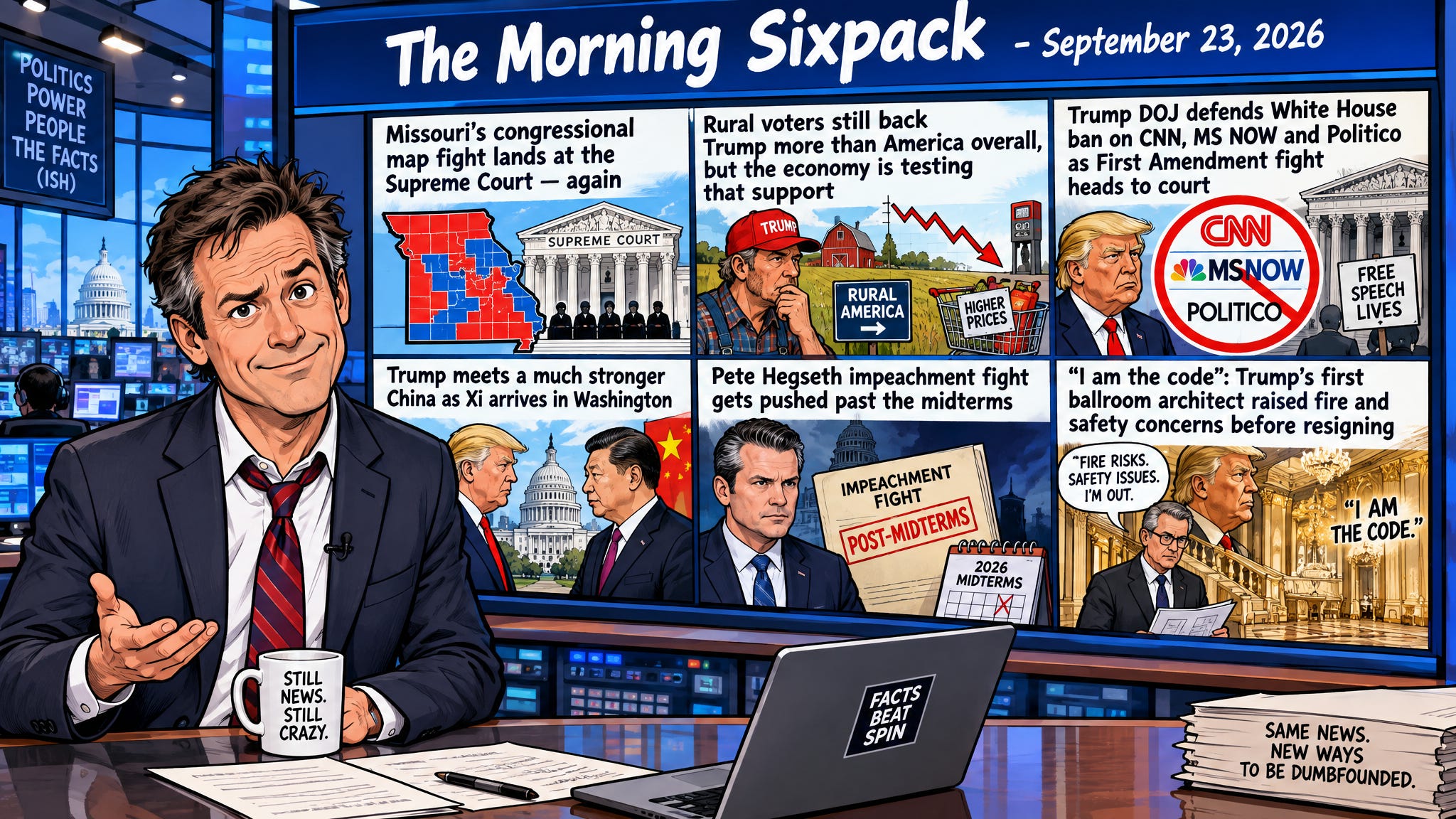
The Morning Sixpack stays free because the news that shapes your life should not be hidden behind a paywall. Paid subscribers are not paying for access. They are helping fund the research, writing, and independent voice that goes into every issue. Become a paid subscriber and help keep smart, honest news analysis free for everyone.
Missouri’s congressional map fight is back before the U.S. Supreme Court for round three, because apparently two trips to the justices weren’t enough to settle which lines voters will use in November.
Missouri’s Congressional Map Fight Lands at the Supreme Court—Again
Missouri’s redistricting battle returned to the Supreme Court Tuesday night, with opponents of the Republican-drawn congressional map asking the justices to block its use in the November midterms. The Supreme Court has already intervened twice this month, leaving the state’s 2022 congressional districts in place, including in a Sept. 10 order with no noted dissents.
And now ballots are already going out, turning a redistricting fight into an election-calendar mess.
The latest round follows an 8th Circuit ruling reviving the newer map, drawn by Missouri Republicans and reshaping Democratic Rep. Emanuel Cleaver’s Kansas City district. The challengers, People Not Politicians, argue that the appeals court effectively resurrected relief the Supreme Court had already stayed. Missouri officials have argued that switching maps after voters used the newer districts during the August primary creates administrative problems.
The challengers want the 2022 map used for the general election and say election officials are already operating under those districts.
Their lawyers put their argument bluntly: “This Court’s stays are not invitations for a lower court to repackage the same relief and try again.”
Election-law professor Justin Levitt said the timing has become even more difficult because voting has begun and ballots are already being distributed.
The underlying dispute began after Missouri lawmakers adopted new congressional districts in 2025. The Missouri Supreme Court later ruled that a referendum petition challenging the map was valid and that the new districts had not taken effect for the November 2026 general election unless voters approved them. The U.S. Supreme Court subsequently blocked a conflicting federal order requiring the newer map. Now the justices are being asked to intervene again while the election machinery is already moving.
Editor: Missouri has managed to turn “draw some district lines” into a Supreme Court trilogy—and the election calendar isn’t waiting around for the finale.
But guess what’s going to happen? Since ballots have already gone out using the maps SCOTUS prohibited, the Court will let them stand. Just. You. Watch.
Source: The Washington Sun
A new AP-KFF poll finds rural voters remain more approving of Trump than Americans overall, even as many give the economy poor marks and report pressure from groceries, gas, and healthcare costs—the political version of liking the driver while complaining about where the car is headed.
Rural Voters Still Back Trump More Than America Overall, but the Economy Is Testing That Support
About half of rural registered voters say the economy is worse than when President Donald Trump returned to office, while only about 4 in 10 approve of his handling of the economy, according to a new AP-KFF survey. At the same time, Trump’s overall job approval among rural voters stands at 48%, higher than his approval among U.S. adults overall in separate AP-NORC polling.
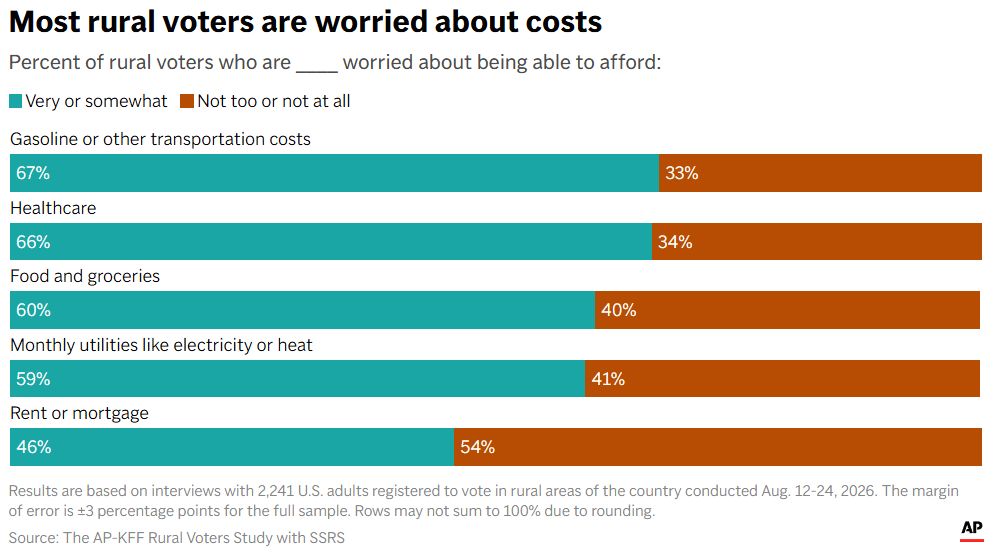
That gap is the story: Dissatisfaction with the economy has not translated neatly into dissatisfaction with Trump. Know why? It’s STILL Biden’s fault.
The poll of 2,241 registered voters living in rural areas was conducted Aug. 12-24 and has a margin of sampling error of plus or minus 3 percentage points. About three-quarters rated the cost of living in their communities as only fair or poor. Groceries, gasoline, and healthcare are prominent concerns, and about one-quarter of rural Republicans said there are fewer good-paying jobs where they live than five years ago.
Healthcare isn’t providing much relief in voters’ assessments, either. Just 17% said Trump administration healthcare policies have had a positive effect on their healthcare costs, while 41% said they had no effect and another 41% said they had a negative effect. Nine in 10 said it was extremely or very important for candidates to discuss healthcare costs.
The partisan picture remains complicated rather than simply shifting in one direction. About 6 in 10 rural Republican voters said Trump has improved the national economy (OMG), while 45% said he has improved their local economy. Rural voters also tended to trust their own party more on major issues. As Ohio teacher Nate Lawrence put it when talking about politicians’ promises to lower prices: “Trump said that, and it didn’t happen.”
Editor: Rural voters are delivering a fairly clear message on affordability: Party loyalty may remain durable, but the grocery receipt and gas pump still get a vote in how people judge the economy.
Source: Associated Press
The Trump administration says national security and journalistic standards justify barring CNN, MS NOW, and Politico from the White House; the three outlets say the government is punishing them for their coverage—and now a federal judge gets to referee the constitutional collision.
Trump DOJ Defends White House Ban on CNN, MS NOW, and Politico as First Amendment Fight Heads to Court
The Justice Department is defending President Donald Trump’s decision to revoke White House access for CNN, MS NOW, and Politico, arguing that the outlets published sensitive information or falsehoods and failed to meet standards of professionalism and decorum. The three organizations have sued, alleging that the ban violates their First Amendment rights and that revoking their credentials without adequate notice or process violates the Fifth Amendment.
Three newsrooms are locked out, the Justice Department says the president has the authority to do it, and the dispute is now squarely in federal court.
In its Tuesday filing, the Justice Department said Trump concluded that the organizations had failed to maintain “basic minimum standards of professionalism and decorum” and cited publication of sensitive or classified information. The White House pointed to coverage involving the East Wing bunker, U.S. ammunition stockpiles during the Iran war, Russia sanctions, and the Republican midterm convention. The government summed up its position this way: “After all, access to the White House is a privilege—not a right.”
The news organizations see the case very differently. Their lawsuit says the ban “could not be a more direct assault on the First Amendment nor a more blatant violation of our most fundamental constitutional principles.”
The dispute also includes a due-process question: The outlets say their journalists were initially denied entry and credentials deactivated before the White House sent letters detailing its allegations and provided a process to contest the decision.
The fight follows previous disputes over White House press access, including the 2018 revocation of CNN correspondent Jim Acosta’s credential, which a federal judge temporarily ordered restored. The current case asks the courts to determine whether the administration’s stated security and access-control interests justify its actions or whether the ban amounts to unconstitutional viewpoint discrimination or retaliation. A federal court hearing on the outlets’ request for emergency relief was scheduled for Wednesday.
Editor: The White House says this is about security and professional standards. The news organizations say it’s punishment for journalism the president dislikes. That’s no longer just another Washington argument—it’s a constitutional question with a judge holding the next microphone.
Source: NPR
Xi Jinping arrives in Washington with more economic and technological leverage than China had during his 2017 Mar-a-Lago meeting with Donald Trump, making this summit less about one side dictating terms and more about two powers testing how much pressure each can apply.
Trump Meets a Much Stronger China as Xi Arrives in Washington
Chinese President Xi Jinping comes to Washington this week leading a China that has expanded its technological capabilities, diversified trade, and gained leverage in critical supply chains since his first U.S. summit with President Donald Trump in 2017. The three-day visit comes with trade, technology, Taiwan, and Iran among the issues confronting the two governments.
Nine years later, Washington isn’t negotiating with the same China—and Beijing clearly knows it.
China remains the world’s second-largest economy while becoming a larger competitor in fields including artificial intelligence, electric vehicles, batteries, robotics, and advanced manufacturing. Its leverage also includes dominance in parts of the rare-earth supply chain, which has figured prominently in previous U.S.-China trade confrontations. Still, China’s economic picture is mixed: Weak consumption, local-government debt, property-sector problems, and elevated youth unemployment sit alongside its technological gains.
Xi is signaling limits as well as an interest in stability. Chinese Ambassador Xie Feng declared Taiwan, human rights, China’s political system, and its development path to be “red lines” that Beijing says cannot be challenged. Technology restrictions are another central issue, with Beijing seeking greater predictability while Washington continues weighing national-security concerns surrounding advanced technology.
China’s international standing is changing, too. A July Pew survey found China was viewed more favorably than the United States in most of the 36 countries surveyed, although views varied considerably by country. Meanwhile, both governments have incentives to preserve their trade truce rather than restart an escalation that carries costs for each side. As former U.S. diplomat Kurt Tong told CNN about their economic leverage: “In the economic space, there isn’t really any superior player.”
Editor: The symbolism of this summit may be almost as important as whatever gets signed—Xi is coming to Washington determined to demonstrate that China now negotiates from a different position than it did at Mar-a-Lago in 2017. The meetings will show where that confidence meets actual bargaining power.
Source: CNN
House Speaker Mike Johnson sent lawmakers home before they had to deal with Rep. Thomas Massie’s impeachment resolution against Defense Secretary Pete Hegseth, postponing the fight until Congress returns after the midterms—because sometimes the congressional solution to a ticking clock is to unplug it.
Pete Hegseth Impeachment Fight Gets Pushed Past the Midterms
A House impeachment push against Defense Secretary Pete Hegseth has been delayed until after the November elections after Speaker Mike Johnson ended the House’s September session before lawmakers were required to consider Rep. Thomas Massie’s eight articles of impeachment. Massie’s privileged resolution accuses Hegseth of abuses of power and other misconduct connected to the Iran war and alleged killings of suspected drug smugglers in international waters.
The impeachment fight didn’t disappear—it just got moved to the other side of Election Day.
Johnson said the shortened schedule was intended to give members additional time to campaign, while Massie argued the early adjournment avoided the impending Hegseth vote. Because Massie introduced the articles as a privileged resolution, House rules would have required lawmakers to address them within a limited period if the chamber remained in session. The House is scheduled to return Nov. 9, when Massie could revive the effort.
I bet you could have as much time off as your US House of Representatives do!
Democratic leaders have stopped short of committing their caucus to Massie’s resolution. House Judiciary Committee ranking Democrat Jamie Raskin said impeachment articles should go through the committee and receive scrutiny, saying, “I’m not a huge fan of pop-up impeachments.” Do-nothing Minority Leader Hakeem Jeffries has similarly said Democrats have neither ruled impeachment in nor ruled it out, while Democratic Caucus Chair Pete Aguilar has called for “oversight and accountability” conducted through a deliberative process.
That leaves the House facing essentially the same dispute when members return: Massie can again force attention to his allegations, Republicans can seek to table the resolution, and Democrats will have to decide individually how to respond to the specific measure before them. Whether the matter proceeds to an impeachment vote will depend on those procedural and political decisions after Congress reconvenes.
At least they’ll have a lot of time to “think about it.”
Editor: Congress didn’t settle the Hegseth impeachment question before the election. It settled the scheduling question. November gets the leftovers—and they’re going to be rotten.
Source: The Hill
The original architect of President Trump’s White House ballroom resigned after repeatedly raising fire and life-safety concerns about early designs, according to The Washington Post; Trump’s reported response to one warning was four words that tend to make architects reach for the aspirin: “I am the code.”
“I Am the Code”: Trump’s First Ballroom Architect Raised Fire and Safety Concerns Before Resigning
James McCrery II, the first architect chosen for President Donald Trump’s White House ballroom, resigned in October 2025 after repeatedly warning that preliminary designs sought by Trump did not provide adequate emergency exits or fire-containment measures, according to people familiar with the discussions and documents reviewed by The Washington Post. The White House disputes that account, saying it would be “factually false and totally inaccurate” to connect McCrery’s departure to code issues and that life-safety concerns have been addressed as the design evolved.
The most memorable detail is also the simplest: When McCrery reportedly raised the building-code problem, Trump replied, “I am the code.”
The Post reports that McCrery raised several specific concerns as Trump pushed for a larger ballroom capable of seating more than 1,300 guests. They included inadequate emergency exit routes, insufficient measures to prevent a kitchen fire from spreading into the event space, and too few restrooms for the proposed occupancy.
White House meeting notes from Sept. 30, 2025, reviewed by the newspaper reportedly included the words “Life safety—big concern.” McCrery resigned weeks later.
The regulatory setup is unusual. Federal law generally requires federal construction projects to comply with nationally recognized safety standards to the maximum extent feasible, but The Post reports that the ballroom project was routed through the White House Executive Residence (by the way, watch The Residence on Netflix—it’s SO GOOD) rather than agencies such as the General Services Administration. Washington, D.C., meanwhile, does not enforce its local building code on federal property. The general contractor, Clark Construction, told The Post that it follows applicable building codes and life-safety requirements. The White House says the current architects and consultants are likewise designing according to nationally recognized standards.
Documents reviewed by The Post indicate that life-safety discussions continued after McCrery left. Notes from a Nov. 6 meeting reportedly said, “Life safety—needs POTUS buy in.” The newspaper said it could not determine from the records it reviewed whether all of McCrery’s concerns were resolved in later designs.
Editor: “I am the code” is one hell of a sentence to emerge from a meeting about fire exits. The White House says safety requirements are being followed; The Post’s reporting says the architect who first raised those concerns walked away. Either way, somebody please keep the exits clearly marked.
Source: The Washington Post (no paywall)