

This article is Part 1 of a 3-part series on what really caused the 2008 financial crisis.
Today, we focus on how confidence in mortgage-based assets collapsed.
Part 2 will examine the role of credit rating agencies and derivatives in amplifying the damage.
Part 3 will look at why these dynamics still matter today.
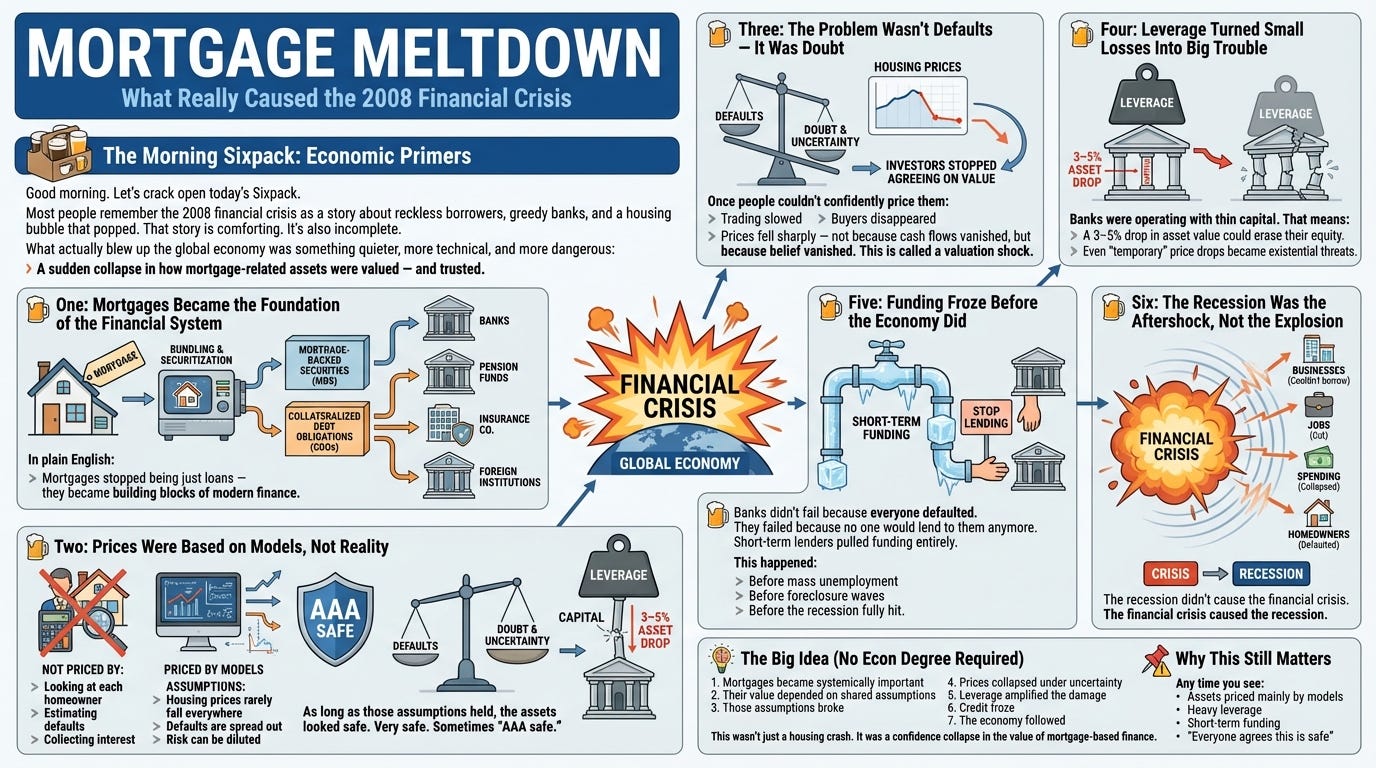
Most people remember the 2008 financial crisis as a story about reckless borrowers, greedy banks, and a housing bubble that popped.
That story is comforting. It’s also incomplete.
What actually blew up the global economy was something quieter, more technical, and more dangerous:
A sudden collapse in how mortgage-related assets were valued—and trusted.
Let’s break it down, Sixpack-style.
One: Mortgages Became the Foundation of the Financial System
Mortgages weren’t just loans between a homeowner and a bank anymore.
They had been:
Bundled together
Chopped into pieces
Repackaged into securities
Sold around the world
Used as collateral for borrowing
In plain English:
Mortgages stopped being just loans—they became building blocks of modern finance.
Banks, pension funds, insurance companies, and foreign institutions all depended on them. (This is how it became a global financial crisis, or GFC as it’s known.)
Two: Prices Were Based on Models, Not Reality
Here’s a key idea most people miss. Mortgage securities weren’t priced by:
Looking at each homeowner
Estimating who might default
Collecting interest and waiting it out
They were priced by models that assumed:
Housing prices rarely fall everywhere at once
Defaults are spread out
Risk can be diluted by mixing loans together
As long as those assumptions held, the assets looked safe. Very safe. Sometimes “AAA safe.” The bond rating agencies were instrumental in the takedown of the mortgage industry and all its derivatives.
Three: The Problem Wasn’t Defaults—It Was Doubt
When housing prices stopped rising in 2006–2007:
Defaults ticked up a little
Losses were still manageable
The system could have absorbed them
But something more important happened:
Investors stopped agreeing on what mortgage assets were worth.
Once people couldn’t confidently price them:
Trading slowed
Buyers disappeared
Prices fell sharply—not because cash flows vanished, but because belief vanished
This is called a valuation shock.
Four: Leverage Turned Small Losses into Big Trouble
Banks weren’t holding these assets with lots of cushion. They were:
Borrowing heavily
Operating with thin capital
Funding long-term assets with short-term money
That means:
A 3–5% drop in asset value could erase their equity
Even “temporary” price drops became existential threats
So when mortgage assets were marked down:
Balance sheets shrank
Capital ratios collapsed
Survival was questioned immediately
Five: Funding Froze Before the Economy Did
This part matters. Banks didn’t fail because everyone defaulted. They failed because no one would lend to them anymore.
Short-term lenders:
Demanded more collateral
Raised haircuts
Pulled funding entirely
This happened:
Before mass unemployment
Before foreclosure waves
Before the recession fully hit
The financial system seized first. The real economy followed. When businesses, many of whom operate on a week-by-week cashflow, can no longer borrow against accounts receivable, they fail.
Six: The Recession Was the Aftershock, Not the Explosion
Once banks were forced to:
Shrink balance sheets
Stop lending
Hoard cash
The rest was inevitable:
Businesses couldn’t borrow
Jobs were cut
Spending collapsed
Homeowners defaulted in larger numbers
This is the part people remember—but it was downstream.
The recession didn’t cause the financial crisis. The financial crisis caused the recession.
The Big Idea (No Econ Degree Required)
Here’s the clean takeaway:
Mortgages became systemically important
Their value depended on shared assumptions
Those assumptions broke
Prices collapsed under uncertainty
Leverage amplified the damage
Credit froze
The economy followed
This wasn’t just a housing crash. It was a confidence collapse in the value of mortgage-based finance, which had become a major component of the overall financial world.
Why This Still Matters
Any time you see:
Assets priced mainly by models
Heavy leverage
Short-term funding
“Everyone agrees this is safe”
You should ask:
What happens if we all stop agreeing at once?
That question—more than bad loans or bubbles—is the real lesson of 2008.
FUN FACT: I coined the term “Mortgage Meltdown” in April 2008. I wrote about it 93 times between 2008 and 2012. If you want to read any of the articles, click here.
Coming Next: Part 2
How credit rating agencies and derivatives didn’t just miss the risk — they multiplied it. Stay tuned!