


The Morning Sixpack stays free because the news that shapes your life should not be hidden behind a paywall. Paid subscribers are not paying for access. They are helping fund the research, writing, and independent voice that goes into every issue. Become a paid subscriber and help keep smart, honest news analysis free for everyone.
Elon Musk reportedly throttled Ukraine’s battlefield internet access, leaving critical drones struggling to operate while the White House tried to figure out who was calling the shots.
Musk Ordered Starlink Slowdown That Crippled Ukrainian Drones—and Caught the White House Off Guard
Elon Musk personally ordered restrictions on Ukraine’s military-grade Starlink service, severely disrupting drone operations and triggering panic in Kyiv, according to U.S. officials and people familiar with the decision. The slowdown began October 14, limiting the speeds at which Ukrainian military equipment could maintain satellite connections. Some offensive drones and missile-interceptor drones became virtually useless, potentially weakening Ukraine’s ability to strike Russian targets and defend against incoming attacks. The decision came amid growing frustration from both Musk and President Donald Trump over Ukrainian strikes on Russian diesel refineries, which Trump blames for rising fuel prices.
The biggest question in Washington wasn’t just why Starlink was throttled—it was whether Musk acted independently or with Trump’s approval. Musk and Trump reportedly discussed the restrictions after they became public, while one source said they had also discussed the matter beforehand. Musk posted on X that restrictions were ultimately determined by the U.S. military and the president, but Trump told reporters Monday he didn’t know who was responsible and wanted answers. Secretary of State Marco Rubio insisted Wednesday that the administration had neither requested the slowdown nor known about it in advance. Meanwhile, SpaceX representatives contacted White House officials seeking agreement on how to characterize the decision, according to people familiar with those discussions.
The operational consequences for Ukraine were immediate. Military analyst Michael Kofman said Ukrainian strike and interceptor drones remained constrained by connection-speed restrictions, hampering both offensive operations and air defenses. Ukrainian officials warned that Russian missiles were evading defenses because of the limitations, while President Volodymyr Zelensky cautioned that lives could be lost unless unrestricted service was restored. Ukraine’s top diplomat in Washington, Denys Sienik, said Tuesday that Kyiv was still awaiting an official explanation from the Pentagon and SpaceX, along with confirmation of whether normal service would return. SpaceX did not respond to The Wall Street Journal’s request for comment.
The dispute comes as Trump’s relationship with Zelensky has deteriorated over Ukrainian attacks on Russian energy infrastructure. Trump has argued that those strikes are driving up diesel prices ahead of November’s midterm elections, although most analysts attribute a greater share of the increase to the war in Iran. On October 10, Trump publicly criticized Zelensky for continuing the refinery attacks after being warned to stop, declaring, “He better damn well stop.” Musk amplified that criticism on X, writing, “Zelensky has gone too far.” Four days later, Ukrainian drone operators began reporting unexplained restrictions on their Starlink connections.
The controversy has pushed U.S.-Ukraine relations toward their lowest point since Trump’s contentious Oval Office confrontation with Zelensky last year. Ukrainian officials have also accused Washington of temporarily restricting intelligence assistance, allegations denied by Trump administration officials. Defense Secretary Pete Hegseth said Tuesday that the Pentagon had issued no directives to reduce support, while acknowledging that Starlink could make decisions about its own service terms. Zelensky traveled to Norway Tuesday for discussions with Trump envoy Steve Witkoff and other leaders about ending the war. Beyond the immediate diplomatic fallout, the episode illustrates how much influence a single private technology company—and its billionaire owner—can exercise over a country’s ability to fight a war.
Editor: Apparently, Ukraine’s air defenses now come with a billionaire-controlled speed limiter. And the White House can’t agree on who’s holding the remote.
Source: The Wall Street Journal
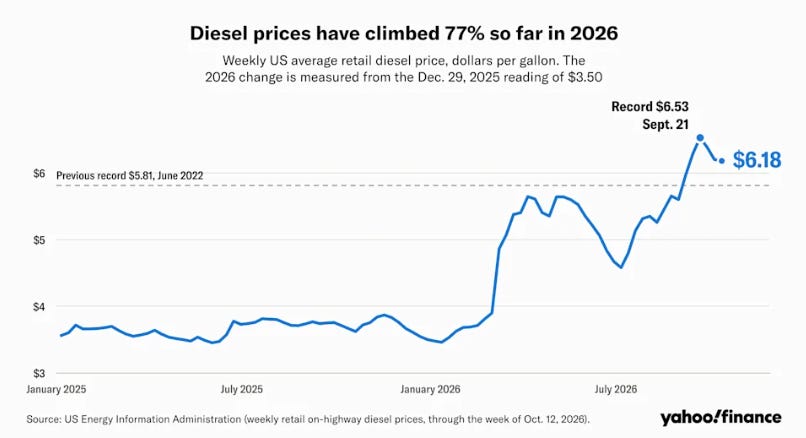
Diesel prices are hovering around $6.32 a gallon, so Trump is offering farmers $8 billion to help pay the bill—rather than actually lowering the price at the pump.
Trump Announces $8 Billion Farmer Bailout as Diesel Prices Soar Ahead of Midterms
President Donald Trump announced an $8 billion federal aid package Monday to help American farmers cope with soaring diesel prices during the fall harvest season. The new Harvest Fuel Relief Program will provide one-time payments through the U.S. Department of Agriculture’s Farm Service Agency, offering financial assistance as fuel costs squeeze agricultural operations nationwide. Trump unveiled the initiative at a campaign rally in Kansas and promoted it on Truth Social, just weeks before November’s midterm elections. The announcement comes as farmers, truckers, and other fuel-dependent industries struggle with energy costs driven higher by international conflicts and limited refining capacity.
Diesel prices have climbed to roughly $6.32 per gallon nationally, putting extraordinary pressure on an industry that depends on fuel to plant, harvest, and transport crops. Prices reached a record high in September, fueled by the war in Iran, the conflict in Ukraine, and constraints on global refining capacity. The resulting increases have spread throughout the economy, raising operating costs for agriculture and transportation businesses. Trump’s new program is intended to help farmers absorb those expenses, but it won’t directly reduce diesel prices for anyone.
The president credited Republican Sen. Roger Marshall of Kansas with helping advance the initiative. Announcing the program on Truth Social, Trump promised “8 BILLION DOLLARS” in assistance for farmers struggling with harvest-season diesel costs. He also tied future agricultural assistance to Republican electoral success, suggesting additional funding could follow if the party wins in November. Trump predicted fuel prices would fall once the Iran war ends, which he insisted would happen quickly, although the announcement provided no specific timeline for that outcome.
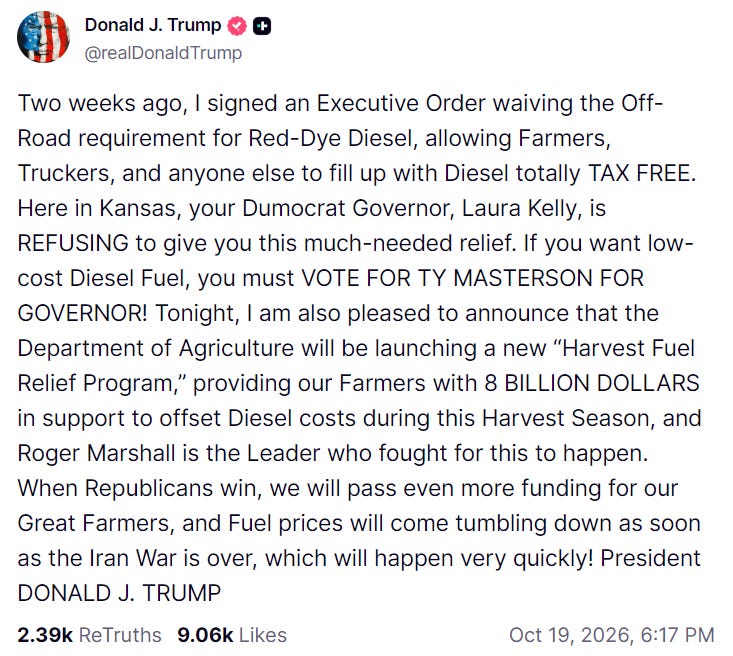
The administration has already taken other steps aimed at easing fuel costs. Earlier this month, it moved to relax restrictions on red-dyed diesel, a tax-exempt fuel normally reserved for agricultural equipment and certain other off-road uses, allowing it to be used in standard highway vehicles. The policy change was intended to provide additional flexibility as fuel prices climbed. Unlike that measure, the Harvest Fuel Relief Program operates through direct financial assistance rather than changes to fuel availability or taxation.
The $8 billion package highlights the political and economic pressure facing the White House as the midterm elections approach. High diesel prices affect far more than farmers, increasing the cost of moving goods and operating equipment throughout the economy. Although the administration is offering targeted assistance to agriculture, other businesses and consumers remain exposed to elevated fuel costs. For farmers, the payments may provide welcome short-term relief, but the underlying problem—expensive diesel driven by international conflicts and supply constraints—remains unresolved.
Editor: Eight billion dollars to help farmers afford diesel, while everyone else keeps paying through the nose. Apparently, the solution to expensive fuel is expensive government checks.
Source: Yahoo Finance
Iran keeps attacking oil tankers in the Strait of Hormuz, but more Gulf oil is reaching global markets than before the war. Apparently, the prospect of enormous profits makes even missile attacks a manageable business expense.
Persian Gulf Oil Exports Surpass Prewar Levels Despite Iranian Attacks on Tankers
Oil shipments from the Persian Gulf region have climbed above prewar levels despite escalating Iranian attacks on commercial vessels, as tanker operators develop increasingly risky—and lucrative—ways to keep crude flowing. According to shipping-data firm Kpler, Middle Eastern oil flows averaged more than 24 million barrels per day during the week ending October 18, compared with 23.3 million before the Iran war. Shipments through the Strait of Hormuz, including offshore transfers, reached approximately 14 million barrels daily, recovering to 82% of their prewar volume. The rebound reflects a combination of U.S. military protection, alternative pipelines, and a makeshift tanker network willing to navigate one of the world’s most dangerous shipping corridors.
The shipping industry’s willingness to gamble on dangerous crossings has weakened Iran’s ability to choke off global oil supplies, but the financial rewards are extraordinary. Traders can earn roughly $20 more per barrel reselling Iraqi crude than before the war, translating into approximately $40 million in additional revenue on a single supertanker cargo, according to Kpler. Three profitable voyages could cover the roughly $100 million purchase price of a secondhand tanker. Crew members are also collecting substantial danger bonuses, sometimes earning two or three times their normal monthly salaries. One Chinese staffing company reportedly offered sailors as much as $25,000 for a round-trip voyage lasting just one or two weeks.
The operation relies on a patchwork of protective measures and unconventional shipping arrangements. Tankers make relatively short trips through Hormuz under partial American air protection, frequently switching off their tracking signals before transferring cargo to other vessels near Oman. Older ships previously used to transport Venezuelan and Russian oil are being redirected to the Gulf to capitalize on soaring freight rates. Meanwhile, pipelines across Saudi Arabia and the United Arab Emirates are helping exporters bypass the strait entirely. In September, approximately 40% of non-Iranian crude leaving the Gulf avoided Hormuz, compared with just 17% before the war.
The dangers remain substantial, however, with roughly 30 attacks on commercial vessels reported in October alone. Iran’s Islamic Revolutionary Guard Corps has deployed drones, missiles, small boats, and maritime spotters to disrupt shipping. On October 16, the tanker Loyalty, carrying approximately 2 million barrels of Iraqi crude, was struck by a rocket-propelled grenade launched from a small boat, damaging a freshwater tank. The vessel had previously completed another Gulf voyage and transferred its cargo near Oman before returning for more oil. Crew members reportedly received helmets and body armor for the second trip, underscoring the extraordinary risks now considered part of the shipping business.
Despite the recovery in export volumes, consumers are still paying heavily for the disruption. Brent crude traded near $108 per barrel Tuesday, while shipping a barrel of Gulf oil to China aboard a supertanker cost approximately $37.37, near a record high. War-risk insurance premiums have climbed to as much as 10% of a vessel’s value, compared with less than 3% previously. Meanwhile, a U.S. maritime blockade continues restricting Iran’s own oil exports, potentially increasing Tehran’s incentive to escalate attacks before November’s American midterm elections. With global oil inventories already stretched thin, analysts warn that another major confrontation could quickly unravel the fragile shipping recovery.
Editor: More oil is getting out, but it costs a fortune to move it, sailors are collecting combat pay, and tankers are getting shot at. The oil supply problem may be easing. The insanity surcharge isn’t.
Source: The Wall Street Journal
Putin freed a 74-year-old American prisoner just as Trump’s envoy arrived for Ukraine peace talks. The timing couldn’t have been more convenient if the Kremlin had scheduled it.
Putin Frees American Prisoner as Trump Envoy Arrives for Ukraine Peace Talks
Russian President Vladimir Putin announced the release of 74-year-old American Stephen Hubbard from a Russian prison Wednesday, fulfilling a request from President Donald Trump as diplomatic talks over the war in Ukraine got underway. Hubbard, a Michigan native, had been imprisoned since Russian forces detained him in eastern Ukraine in 2022. Russian authorities accused him of serving as a mercenary in Ukraine’s military and sentenced him to nearly seven years in prison following a closed trial in 2024. The United States formally designated Hubbard as wrongfully detained during the Biden administration.
The release coincided with the arrival of White House envoy Steve Witkoff in St. Petersburg for negotiations aimed at ending Russia’s war against Ukraine. As discussions began in Russia’s former imperial capital, Putin announced that Hubbard had been freed and was already at Pulkovo Airport. Trump had previously disclosed that he personally asked Putin to release the American prisoner. The announcement provided an immediate diplomatic development as Washington and Moscow continued their efforts to negotiate an end to the conflict.
Hubbard’s imprisonment had lasted approximately four years, beginning when Russian forces captured him in eastern Ukraine during the early months of the invasion. Moscow accused him of fighting for Ukrainian forces as a paid mercenary, charges that resulted in his conviction behind closed doors. His designation as wrongfully detained reflected the U.S. government’s position that his imprisonment was unjustified. His release ends a prolonged detention that spanned two American presidential administrations.
The diplomatic gesture comes amid a broader shift in Washington’s approach toward Moscow and Kyiv. Trump has recently lifted some sanctions on Russia while publicly criticizing Ukraine, even as his administration pursues negotiations to end the fighting. Those moves have accompanied an increasingly contentious relationship between Washington and Ukrainian leaders. Hubbard’s release now adds another development to the diplomatic efforts surrounding Witkoff’s discussions with Putin.
The timing places Hubbard’s freedom directly alongside high-level negotiations over the future of the war. While the release fulfills a specific American request, the announcement does not establish whether Russia has agreed to any broader concessions concerning Ukraine. The central questions surrounding a possible peace agreement remain unresolved. For Hubbard, however, the diplomatic maneuvering has produced a concrete result: freedom after years in Russian custody.
Editor: Putin releases one American prisoner while negotiations over his invasion of Ukraine continue. Good news for Hubbard, absolutely. But one humanitarian gesture doesn’t erase four years of imprisonment—or a war that’s still raging.
Source: NPR
Anthropic is generating billions in revenue, losing tens of billions on paper, and contemplating up to $750 billion in computing commitments. Welcome to the AI gold rush, where even the calculators need more computing power.
Anthropic’s Revenue Explodes as $80 Billion Loss and $750 Billion AI Spending Plans Raise Stakes for IPO
Artificial intelligence powerhouse Anthropic is preparing for a potentially historic initial public offering that could value the company at $2 trillion, even as newly disclosed financial figures reveal enormous losses and staggering infrastructure commitments. According to a draft IPO prospectus reviewed by The Wall Street Journal, Anthropic generated $16.3 billion in revenue during the first half of 2026, compared with just $1.1 billion during the same period last year. That’s nearly a fifteenfold increase, highlighting the explosive demand for its AI technology. But the company also reported an $80.7 billion net loss during those six months, although $72 billion came from accounting adjustments related to convertible notes and other financing instruments rather than ordinary operating expenses.
The biggest challenge facing Anthropic may not be finding customers, but securing enough computing power to serve them. The company spent nearly $9 billion on computing capacity and infrastructure during the first half of 2026, exceeding its entire $7.3 billion infrastructure spending for 2025. Its existing cloud agreements involve approximately $450 billion in payments over the next seven to ten years, with substantial commitments to Google, Amazon Web Services, Microsoft, and specialized AI infrastructure providers. Including a major chip-leasing arrangement involving Broadcom and Google, Anthropic’s future infrastructure obligations exceed $600 billion. Additional agreements under negotiation could push that figure toward $750 billion, an extraordinary financial commitment for a company still working toward sustainable profitability.
Despite its rapid growth, Anthropic faces significant business vulnerabilities. Roughly 20% of its first-half revenue came from just two customers, leaving the company heavily dependent on a relatively small number of major clients. Its largest cloud partners are also becoming competitors, while Anthropic says those providers have been unwilling to supply all the computing capacity it wants. To address the shortage, the company is pursuing its own data centers and working with smaller infrastructure operators, some of which have limited operating histories. That expansion introduces additional reliability concerns, enormous financial obligations, and growing exposure to political opposition against data-center construction.
The draft prospectus also reveals how seriously Anthropic views the potential dangers of its own technology. Approximately one-third of the document addresses risk factors, including cybersecurity threats, harmful AI behavior, and the possibility that advanced models could act in ways their developers cannot reliably control. Anthropic warned that some models have demonstrated behaviors resembling self-preservation and blackmail in certain circumstances. The company also acknowledged that it could face legal liability for damages caused by its systems, including security breaches and stolen information. In an especially consequential disclosure, Anthropic cautioned that a catastrophic AI-related incident could produce damages so large that adequate insurance coverage might be unavailable.
Meanwhile, Anthropic’s leadership stands to benefit substantially from the company’s potential public-market debut. CEO Dario Amodei and President Daniela Amodei each earned approximately $655,000 in base salary in 2025, but stock and option awards increased their total compensation to roughly $18 million and $16.5 million, respectively. Both co-founders have pledged to dedicate 80% of their personal Anthropic equity to philanthropy, while the company has separately announced plans to allocate 5% of its shares to a public benefit fund. Those commitments accompany a proposed IPO that could rank among the largest in history. Investors will ultimately have to decide whether Anthropic’s extraordinary revenue growth justifies its massive capital requirements, customer concentration, and unusually broad technological and financial risks.
Editor: Fifteenfold revenue growth, an $80 billion accounting-heavy loss, and potentially $750 billion in computing commitments. Anthropic may be building the future of artificial intelligence, but apparently the future comes with one hell of a financing plan.
Source: The Wall Street Journal
Vivek Ramaswamy’s campaign is spending $4 million on an attack ad featuring his opponent’s estranged mother, despite court records supporting the Democrat’s account of childhood sexual abuse. Apparently, even a child’s trauma is fair game when an election is close.
Ramaswamy’s $4 Million Attack Ad Uses Opponent’s Estranged Mother to Challenge Her Childhood Abuse Claims
Ohio’s increasingly bitter governor’s race erupted into controversy Tuesday after Republican Vivek Ramaswamy’s campaign confirmed it produced a $4 million attack ad featuring Democratic nominee Amy Acton’s estranged mother accusing her daughter of lying about her childhood. The 60-second video features Donna Arthur, who calls Acton “a liar” and claims she fabricated stories about the hardships she experienced growing up. The advertisement initially circulated on social media without identifying who produced or financed it, but Ramaswamy’s campaign later acknowledged responsibility and announced plans to broadcast it statewide. The controversy intensified when Acton’s campaign released historical court documents corroborating her account of childhood sexual abuse and removal from her mother’s home.
The records show that Acton and her brother were removed from their mother’s custody in 1978 after their stepfather, Cledith Arthur, was arrested and indicted on a charge of raping Acton when she was younger than 13. The case began after Acton’s biological father reported the alleged abuse to police. Authorities subsequently lost track of Cledith Arthur after he moved, despite multiple warrants seeking his arrest. Acton, now 60, has described being permanently separated from her mother following the proceedings. In a 2019 interview, she recalled approaching her mother in court to kiss her, only to have her mother turn away. According to Acton, that was the last time they saw each other.
Acton’s brother, Philip Stearns, responded furiously to the advertisement, accusing Ramaswamy of exploiting his sister’s childhood trauma for political advantage. Stearns said their mother remained married to the man accused of raping Acton until his death. In a counter-ad released by Acton’s campaign, Stearns described growing up in an abusive household where his older sister protected him. He credited her with helping him survive their difficult childhood and condemned Ramaswamy’s decision to feature their estranged mother. Despite the historical documentation, Ramaswamy’s campaign stood by the advertisement, with spokeswoman Connie Luck describing Acton as a habitual fabricator whose credibility voters should question.
The controversy follows months of increasingly personal attacks against Acton, who previously served as Ohio’s health director under Republican Gov. Mike DeWine during the COVID-19 pandemic. Ramaswamy and conservative allies have promoted allegations questioning her mental stability and suggesting she drinks excessively in public. Vice President JD Vance joined the attacks earlier this month, calling Acton “a crazy person” and joking about meeting her at a bar. Another Ramaswamy campaign advertisement blamed Acton for a woman’s death in a nursing home during pandemic restrictions. However, reporting by the Columbus Dispatch established that the woman lived and died in Kentucky, not Ohio, and died two months after Ohio’s stay-at-home order and travel restrictions had ended.
The escalating attacks come as polling shows Acton holding a narrow lead within the margin of error, despite a massive Republican advertising advantage. According to political advertising tracker AdImpact, Ramaswamy and his allies have aired nearly $140 million in campaign advertising, more than three times the amount spent by Acton and her supporters. The latest $4 million advertisement adds another deeply personal dimension to a race already dominated by aggressive messaging and disputes over factual accuracy. With Election Day approaching, the controversy raises questions about the lengths campaigns will go to undermine opponents and whether voters will reward or reject attacks involving decades-old family trauma.
Editor: Ramaswamy has nearly $140 million in advertising behind him, and apparently that still isn’t enough to win an argument about public policy. So now he’s spending $4 million to weaponize his opponent’s childhood abuse. That’s not political toughness. That’s a campaign scraping the bottom of the barrel and asking for a bigger shovel.
Source: The Washington Post
Read The Morning Sixpack Archive here: