


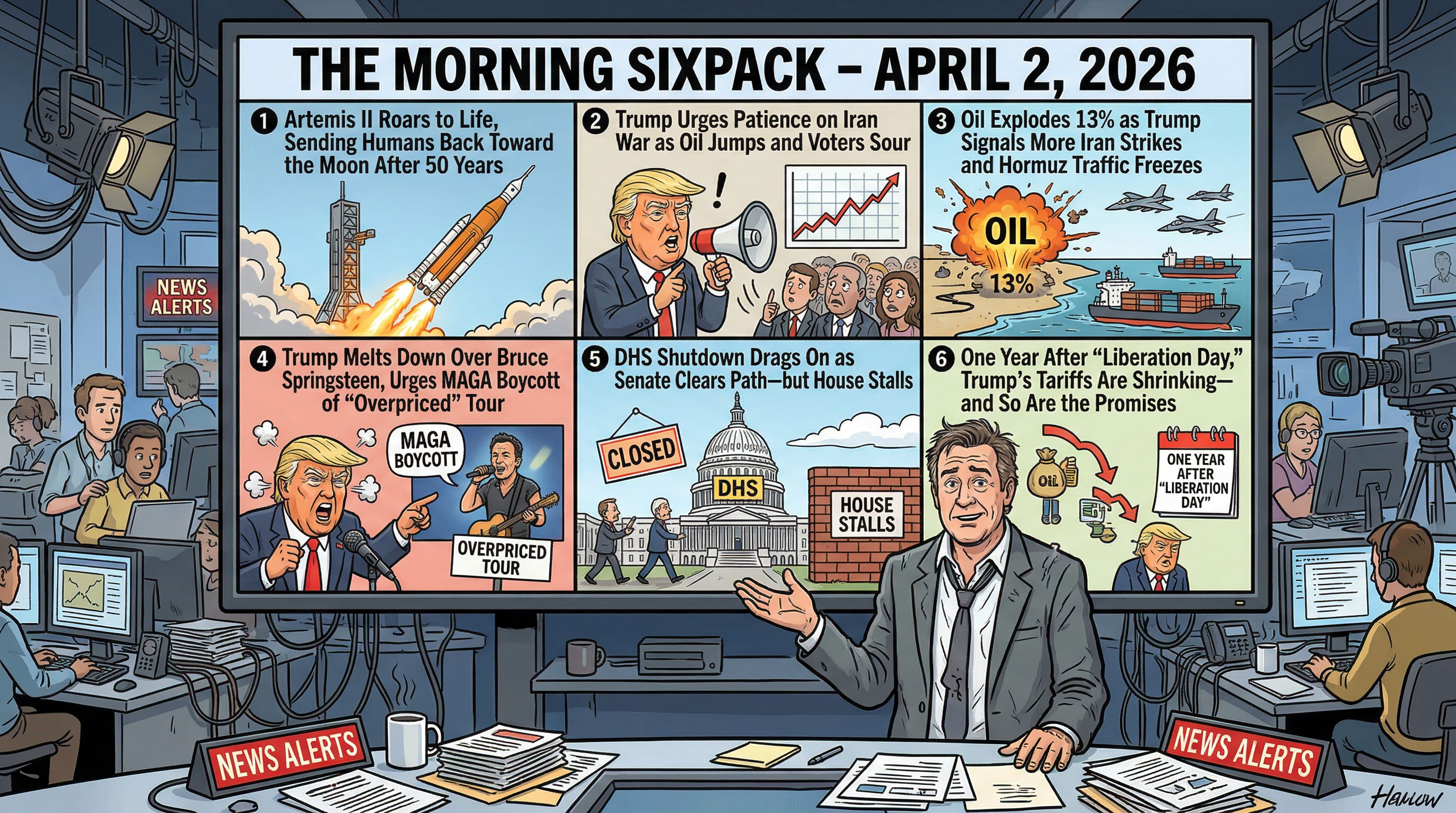
Artemis II Roars to Life, Sending Humans Back Toward the Moon After 50 Years
NASA launched the most powerful rocket in its history Wednesday night, sending four astronauts on a 10-day journey around the moon for the first crewed lunar mission in more than five decades.
For the first time since the Apollo era, Americans are headed back to deep space—and this time they’re just getting warmed up.
The Space Launch System thundered off the pad at 6:35 p.m. EDT from Kennedy Space Center in Florida, carrying the Artemis II crew aboard the Orion capsule. Within minutes, commander Reid Wiseman radioed down, “we have a beautiful moonrise, we’re headed right at it.”
The four-person crew—Wiseman, Victor Glover, Christina Koch, and Canadian Space Agency astronaut Jeremy Hansen—will orbit the moon but not land. About nine minutes after liftoff, they were already in Earth orbit, traveling roughly 15,000 mph. In about six days, they’re expected to reach lunar orbit, marking the farthest humans have traveled from Earth in more than half a century.
It wasn’t entirely smooth sailing before launch. Engineers worked through a problem with the rocket’s flight termination system and later addressed temperature concerns tied to a battery on Orion’s launch abort system. Both were resolved before liftoff. Artemis I flew the same route in 2022 without a crew. This time, there are four humans strapped in for the ride.
The 10-day mission is designed as a proving ground—testing systems, procedures and human endurance before NASA attempts a lunar landing on a future Artemis flight.
Source: UPI
Editor: Fifty years later and we’re finally back on the moon beat. Took a while—but at least this rocket showed up on time.
Trump asks Americans for “patience” as markets wobble, oil spikes, and most voters say the Iran war has already gone too far.
Trump Urges Patience on Iran War as Oil Jumps and Voters Sour
President Donald Trump told Americans the Iran conflict will be wrapped up “shortly,” even as oil prices climb and most voters say the military action has gone too far.
Markets flinched—and so did the public.
In a prime-time address, Donald Trump dialed down the chest-thumping but doubled down on staying the course, promising to “finish the job” while offering few specifics about negotiations or an exit strategy. He said the U.S. would continue hitting Iran “very hard” for the next two or three weeks, without clarifying what victory looks like—or when it arrives.
“We are in this military operation, so powerful, so brilliant, against one of the most powerful countries for 32 days, and the country has been eviscerated and essentially is really no longer a threat,” Trump said. “This is a true investment in your children and your grandchildren’s future. The whole world is watching, and they can’t believe the power, strength and brilliance.”
But an AP-NORC poll shows about 59% of Americans believe U.S. military action has been excessive. Nearly half say they’re extremely or very concerned about affording gas in the coming months—a jump from earlier this year. Trump, meanwhile, rattled off the timelines of past U.S. wars as if reciting baseball stats, arguing Americans have shown patience before.
Democrats weren’t buying it. Sen. Chris Murphy blasted the speech as detached from reality, warning the U.S. is “losing this war” and bleeding money while Iran tightens its grip on the Strait of Hormuz. Trump suggested allies should “buy oil from the United States of America” and help secure the critical waterway—but offered no new blueprint for how that happens.
Notably absent: any signal of ground troops. Trump said Iran’s enriched uranium is buried under rubble and under “intense satellite surveillance,” vowing missile strikes if Tehran makes a move. “We have all the cards. They have none,” he said.
Wall Street and the gas pump may beg to differ.
Source: AP News
Editor: When you have to remind voters how long Vietnam lasted, it’s not exactly a confidence-builder.
But wait, it gets worse…
Oil Explodes 13% as Trump Signals More Iran Strikes and Hormuz Traffic Freezes
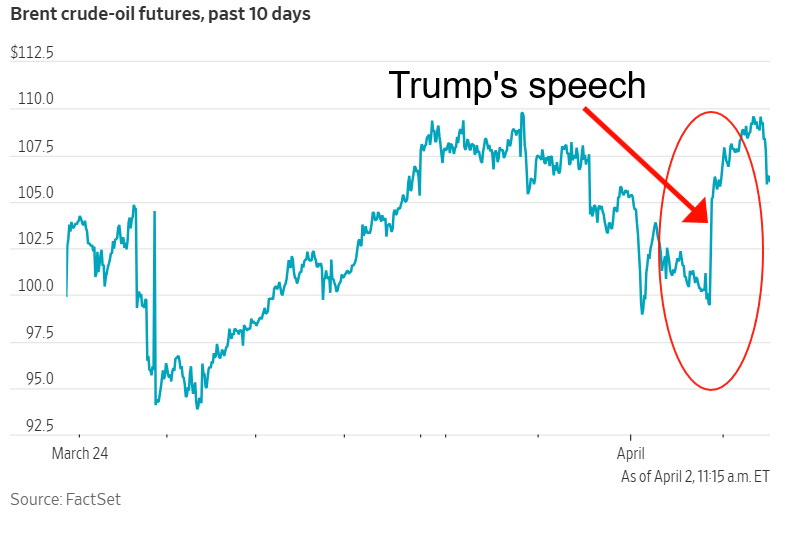
Oil prices surged as much as 13% after President Donald Trump warned the U.S. will hit Iran “extremely hard” for the next two to three weeks, crushing hopes for a quick end to the conflict.
Energy markets just got the message—this war isn’t cooling off.
U.S. West Texas Intermediate crude for May jumped 13% to $113.08 a barrel, while Brent crude for June climbed 8% to $109.29. The spike followed Trump’s national address in which he blamed rising oil prices on “the Iranian regime launching deranged terror attacks against commercial oil tankers and neighboring countries that have nothing to do with the conflict.”
Donald Trump insisted discussions with Tehran are “ongoing” and that the war won’t last long. “We are going to finish the job, and we’re going to finish it very fast,” he said. But traders heard something else: escalation without clarity.
Traffic through the Strait of Hormuz—the artery for roughly a fifth of the world’s oil and gas—has effectively ground to a halt since fighting began Feb. 28. A Liberia-flagged tanker managed to dock in Mumbai this week after running the gauntlet, but analysts say widespread traffic isn’t resuming anytime soon.
On CNBC, Fidelity’s George Efstathopoulos said markets were braced for a “binary outcome”—either a path to exit or deeper escalation. “Clearly we seem to be on the latter path right now.” Meanwhile, Iran denied Trump’s claim that it had requested a ceasefire, calling his remarks “absurd displays” and insisting the waterway remains under the control of the IRGC Navy.
Just days ago, Brent dipped below $100 after Trump suggested operations could wind down in “two or three weeks.” Now oil is ripping higher again. That’s what happens when diplomacy is a moving target and the world’s most important shipping lane is stuck in neutral.
Source: CNBC
Editor: If “two or three weeks” keeps resetting every 48 hours, traders are going to start pricing in two or three years.
Trump Melts Down Over Bruce Springsteen, Urges MAGA Boycott of “Overpriced” Tour
President Donald Trump tore into Bruce Springsteen on Truth Social, calling him a “total loser” and urging supporters to boycott his concerts after the rocker blasted the White House onstage.
When the Boss grabs the mic, Trump grabs his phone.
Donald Trump mocked Bruce Springsteen as a “bad, and very boring singer” who “looks like a dried up prune who has suffered greatly from the work of a really bad plastic surgeon,” accusing him of having “Trump Derangement Syndrome.”
He then pivoted to relitigating his 2024 win, boasting about carrying the popular vote, swing states and “86% of the Counties across America.”
“The guy is a total loser who spews hate against a President who won a Landslide Election,” Trump wrote. “MAGA SHOULD BOYCOTT HIS OVERPRICED CONCERTS, WHICH SUCK. SAVE YOUR HARD EARNED MONEY.”
Springsteen had opened a recent show in Minneapolis with a blistering critique of the administration’s mass deportation policies and America’s global standing. “This White House is destroying the American idea and our reputation around the world,” he told the crowd. “We are now, to many, America the reckless, unpredictable, predatory rogue nation. That is this administration’s and this president’s legacy. This is happening now.”
The rocker has long been an outspoken Democrat and earlier this year released “Streets of Minneapolis,” a song about the fatal shootings of Renee Good and Alex Pretti by federal immigration officials.
It’s not the first time politics and pop music have collided—but it may be the first time a sitting president critiqued a Hall of Famer like a cranky Yelp reviewer.
Source: Mediaite
Editor: Nothing says steady leadership like live-blogging your beef with a 76-year-old rock star before breakfast.
DHS Shutdown Drags On as Senate Clears Path—but House Stalls
Federal funding for the Department of Homeland Security is still stuck in limbo, even after the Senate cleared the way to end a nearly seven-week partial shutdown.
The Senate moved—now the House has to decide if it actually wants this over.
The Senate late last week killed a 60-day stopgap bill that had passed the House but had zero chance of clearing the upper chamber. Senate Majority Leader John Thune scrapped it outright, signaling the Senate’s opposition before heading into recess.
On Wednesday, Senate and House Republican leaders announced they’d reached a deal to finally end the Department of Homeland Security funding fight. But there’s a catch: it’s not clear House Republicans will support their own leadership’s agreement.
The House convened briefly Thursday and adjourned without acting on the Senate-passed legislation. Lawmakers aren’t scheduled to return until Monday. Speaker Mike Johnson was set to hold a call with rank-and-file members to figure out the next steps—and presumably count votes.
The bill does not provide additional funding for immigration enforcement, which is already heavily funded. If the House passes the Senate version, it heads to Donald Trump for signature. Until then, Homeland Security remains partially shuttered, and Washington remains very Washington.
Source: Reuters
Editor: Nothing screams “urgent national security” like lawmakers clocking out for the weekend mid-shutdown.
One Year After “Liberation Day,” Trump’s Tariffs Are Shrinking—and So Are the Promises
A year after President Donald Trump slapped double-digit tariffs on nearly everything America imports, many of those taxes have been struck down, billions must be refunded, and the manufacturing boom he promised hasn’t arrived.
The tariffs brought in cash—but not the comeback.
Last April 2, standing in the Rose Garden, Donald Trump declared it the day America would become wealthy again. Jobs would come “roaring back.” Prices would fall. Instead, the Supreme Court ruled six weeks ago that he overstepped his authority on some tariffs—forcing the government to refund roughly $166 billion in wrongly collected duties, about half the total haul.
To be sure, tariffs filled federal coffers. In the first five months of the fiscal year, Washington collected $151 billion—nearly four times more than the same stretch the year before. But much of that bill landed on U.S. importers, who often passed costs to consumers. Inflation in February stood at 2.4%, slightly higher than last April. Federal Reserve Chair Jerome Powell put it plainly: “These elevated readings largely reflect inflation in the goods sector, which has been boosted by the effects of tariffs.”
Manufacturing hasn’t surged. U.S. factories employed 89,000 fewer workers in February than when the global tariffs kicked in. Foreign direct investment totaled $288 billion last year—slightly below the prior year and under the 10-year average. Meanwhile, the average tariff rate, which briefly topped 21% and hit Chinese goods as high as 145%, has settled near 10%, according to the Tax Foundation. That’s lower than the peak—but still about four times higher than before Trump’s return to office.
Trade flows zigzagged as businesses scrambled to front-run tariff hikes. By year’s end, imports actually rose 4% to $3.4 trillion, while exports climbed 6% to $2.2 trillion. The goods trade deficit ticked up about 2% to $1.24 trillion. As Tax Foundation’s Erica York put it, tariffs changed more than 50 times in a year. “There was just no way for businesses to plan.”
So here we are, one year after “Liberation Day”—with fewer tariffs, pending refunds, persistent inflation and a manufacturing sector still waiting for the roar.
Source: NPR
Editor: When your signature policy needs a refund window and a flowchart, it’s not exactly the economic renaissance you advertised in the Rose Garden.