


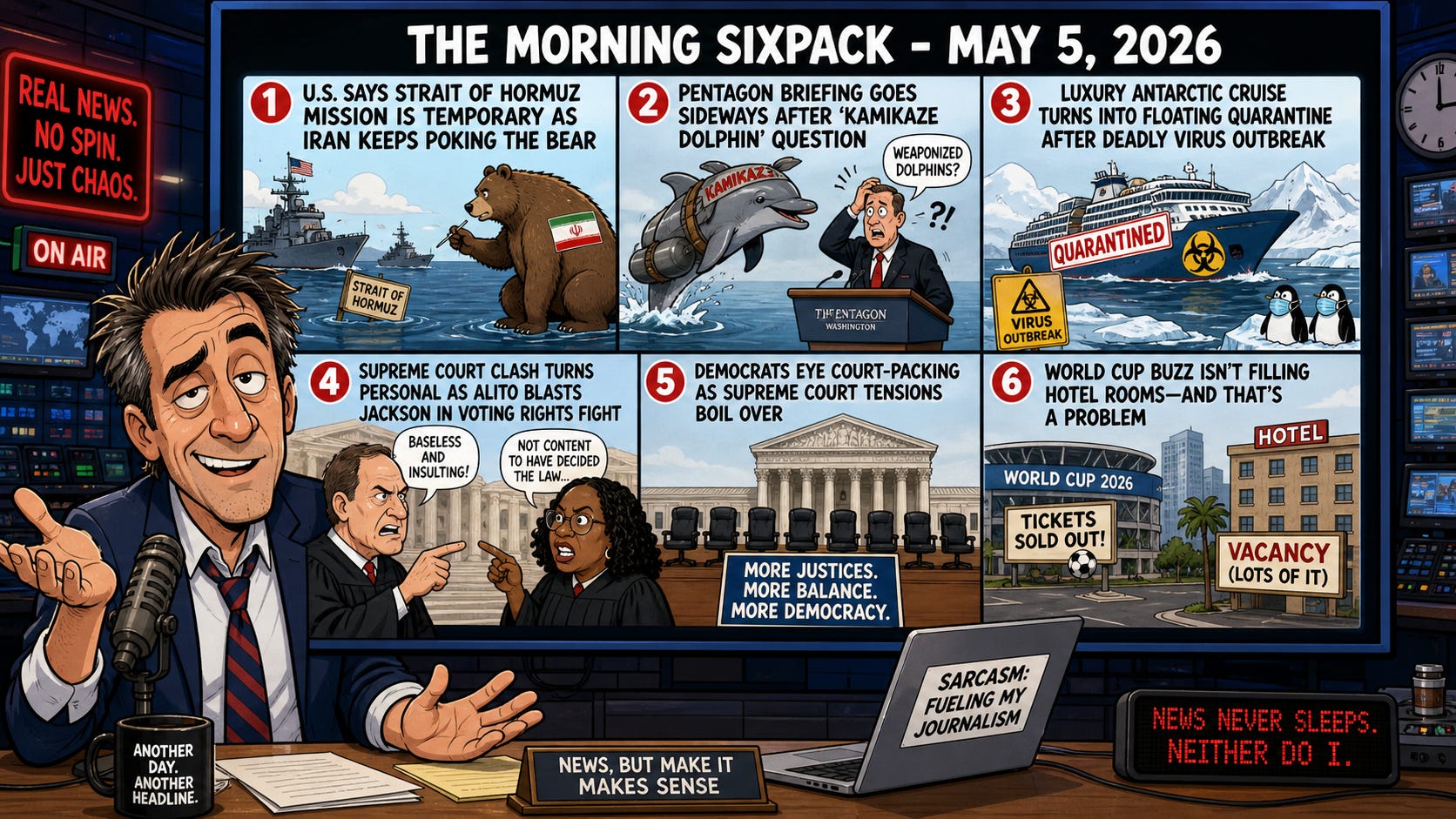
U.S. Says Strait of Hormuz Mission Is Temporary as Iran Keeps Poking the Bear
The U.S. is policing the world’s most critical oil chokepoint—for now—while Iran keeps testing the limits without triggering full-scale war. The setup is simple: America clears the lane, then expects everyone else to figure it out.
This is a ceasefire in name only—and everyone knows it.
Defense Secretary Pete Hegseth says the U.S. has thrown a “red, white, and blue dome” over the Strait of Hormuz to push commercial traffic through but made it clear this isn’t a long-term babysitting gig. More than 1,550 ships—and 22,500 mariners—are still waiting to pass through a waterway that handles roughly 20% of the world’s oil and gas (among other critical materials).
Meanwhile, Iran is doing just enough to stay annoying without blowing things up entirely—firing at ships, seizing vessels, and taking shots at U.S. forces, all “below the threshold” of reigniting full combat. As one U.S. commander put it, the military advantage is “crystal clear,” but that doesn’t stop the constant harassment.
Iran, for its part, is calling foul and warning the U.S. not to get stuck. Foreign Minister Abbas Araghchi didn’t mince words: “Project Freedom is Project Deadlock.” That’s diplomatic speak for: This thing could drag on and get messy fast.
President Donald Trump is framing the operation as humanitarian—helping “victims of circumstance”—while also making it clear that any interference will be met “forcefully.” Translation: We’re helping, but don’t push it. The problem? Both sides are still far apart on a real resolution, and this so-called ceasefire is looking more like a timeout than an ending.
Source: Washington Post (gift)
Editor: Nothing says “temporary mission” like deploying warships to guard a fifth of the planet’s energy supply while everyone else is told, “You’re up next.” Good luck with that handoff.
Pentagon Briefing Goes Sideways After ‘Kamikaze Dolphin’ Question
A routine Pentagon briefing on the Iran conflict veered off course when a reporter asked about weaponized dolphins—and officials didn’t exactly shut it down cleanly. For a moment, the war update sounded more like a rejected Bond villain pitch than a military briefing.
Yes, this actually happened in a room full of serious people.
During questioning, a reporter pressed Joint Chiefs Chairman Gen. Dan Caine and Defense Secretary Pete Hegseth about everything from combat thresholds to naval mines—before tossing in, “Can you kind of clarify these reports of kamikaze dolphins that we’ve heard about?”
Caine’s response landed somewhere between disbelief and comedy: “I haven’t heard the kamikaze dolphin thing. It’s like sharks with laser beams, right?” The room laughed, but the question hung there just long enough to make things awkward.
Hegseth didn’t exactly slam the door on it either, saying, “I can’t confirm or deny whether we have kamikaze dolphins, but I can confirm they don’t.” He quickly pivoted back to reality, noting the U.S. has secured a safe passage lane in the Strait of Hormuz and would address threats like mines if necessary.
The exchange comes as tensions with Iran remain high, with U.S. forces escorting commercial ships through one of the world’s most critical waterways. In other words, plenty of real problems—no aquatic suicide squads required.
Source: Raw Story
Editor: When your war briefing includes a punchline about suicidal dolphins, maybe it’s time to reconsider who’s getting a microphone in the room.
Luxury Antarctic Cruise Turns Into Floating Quarantine After Deadly Virus Outbreak
A high-end Antarctic cruise turned into a medical nightmare after multiple passengers died and a suspected hantavirus outbreak left more than 150 people stranded at sea. What started as a bucket-list expedition quickly became a floating quarantine no port wanted to touch.
They paid up to $25,000 for the trip—and ended up trapped with a deadly virus onboard.
The M/V Hondius was supposed to be showcasing some of the most remote and pristine վայր in the world—from Antarctica to Tristan da Cunha—but instead became ground zero for a growing health crisis. Three passengers—a Dutch couple and a German national—have died, while another infected traveler was evacuated to South Africa where hantavirus was confirmed.
One of the most jarring parts? The first victim had been dead for 21 days before the situation fully came into focus, with the body only disembarked weeks later. Meanwhile, life onboard appeared oddly normal in social media posts—passengers filming wildlife, crew swimming—right up until the reality hit.
Passenger Jake Rosmarin captured that shift in real time, going from posting scenic videos to a raw plea: “We’re not just headlines. We’re people with families… All we want is to feel safe and to get home.” The ship is now stuck off Cape Verde, with authorities refusing to let anyone disembark as health officials scramble to assess the risk.
Hantavirus, typically spread by rodents and only rarely between humans, has officials on edge—but both Cape Verde and South Africa say there’s no immediate risk to the public since the ship remains offshore. The operator is now weighing whether to sail elsewhere just to get passengers off and properly screened.
Source: Reuters
Editor: Nothing like an “exclusive expedition” that ends with you circling the ocean while governments argue over who has to deal with you. The luxury travel brochure probably left that part out. I, for one, will most likely NEVER take a cruise. Those places are nasty.
Supreme Court Clash Turns Personal as Alito Blasts Jackson in Voting Rights Fight
A Supreme Court ruling on Louisiana’s congressional map didn’t just reshape elections—it triggered a rare, open feud between two justices that spilled into public view. When the robes come off, it turns out the knives are pretty sharp.
This wasn’t legal disagreement—this was a bench slap fight in writing.
The 6-3 decision cleared the way for Louisiana to redraw its map and eliminate a majority-Black district, following a broader ruling weakening the Voting Rights Act. But the real fireworks came in the opinions, where Ketanji Brown Jackson accused the majority of stepping out of bounds to influence how the ruling gets implemented.
“Not content to have decided the law,” she wrote, “it now takes steps to influence its implementation,” calling the move a break from standard court practice and hinting at bias in timing.
That didn’t sit well with Samuel Alito, who fired back with his usual bluntness. He dismissed her dissent as “trivial at best” and went further, calling her accusations “baseless and insulting” and “utterly irresponsible.” Not exactly the tone of a polite legal seminar.
The stakes go well beyond courtroom drama. Louisiana has already halted its congressional primaries to redraw the map—likely reducing Black representation—and other Southern states are eyeing similar moves. Translation: This fight is about power, not just procedure. Read this (link) from Marc Elias for a better understanding of what’s going on.
Source: Raw Story
Editor: When Supreme Court opinions start reading like personal burn books, it’s a safe bet the “institutional norms” everyone loves to talk about are hanging by a thread.
Democrats Eye Court-Packing as Supreme Court Tensions Boil Over
A growing argument on the left says expanding the Supreme Court may be the only way to counter a decades-long conservative grip on the bench. The pitch isn’t subtle: If Democrats win big, change the Court—or accept it won’t change at all.
The message here is blunt—play by the old rules and lose, or rewrite them and deal with the fallout.
The core idea is simple: The Constitution doesn’t fix the number of justices, so Congress could add seats with a basic law and a president’s signature. That would instantly erase the current conservative majority—no waiting for retirements, no guessing games.
But even supporters admit the obvious downside: It’s an arms race. Expand the Court now, and the other party will do the same the next time they’re in power. Before long, the Supreme Court risks turning into exactly what critics already accuse it of being—a partisan super-legislature.
Alternatives exist, at least on paper. Term limits—like staggered 18-year terms—could lower the stakes and normalize turnover. There’s also “jurisdiction stripping,” where Congress limits what cases the Court can even hear. But those options require either bipartisan buy-in or political restraint, both of which are in short supply. And term limits require a Constitutional amendment; currently, all federal judges get lifetime appointments.
The underlying argument driving all of this is that the current system isn’t neutral anyway. One side sees a Court shaped by decades of strategic wins that now appears insulated from election outcomes—meaning waiting it out may not be a real strategy.
Source: Good Politics/Bad Politics
Editor: When “fixing the Court” starts sounding like a legislative demolition project, that’s usually a sign the trust in the institution is already long gone.
World Cup Buzz Isn’t Filling Hotel Rooms—and That’s a Problem
Despite millions of tickets sold, hotels across World Cup host cities are staring at empty rooms instead of the international surge they were promised. The crowds may be coming to the Cup—but they’re not booking the beds.
For an event billed as a tourism goldmine, the hotel numbers are telling a very different story.
With just weeks to go, nearly 80% of hotels in host cities say bookings are below expectations, according to an industry survey. In Kansas City—one of the showcase markets—up to 90% of hotels report softer demand than projected, with some even trailing normal summer levels.
The reason? Fewer international travelers than expected, plus large room block cancellations by FIFA. That’s left hotels scrambling to fill inventory they assumed would be long gone by now. And for an industry that depends heavily on big-spending foreign visitors, that’s not a small miss.
There are bright spots—Miami and Atlanta are holding up better—but the broader trend suggests the U.S. isn’t pulling in global fans like it thought. Industry officials point to visa delays, higher costs, and tighter entry policies creating friction for would-be travelers who might just decide it’s not worth the hassle.
All of this lands at an awkward moment: The U.S. is co-hosting the World Cup while also celebrating its 250th birthday, two events that were supposed to flood cities with visitors. Instead, hotels are watching a lot of that expected demand stay hypothetical.
Source: NPR
Editor: This was entirely foreseeable. Except by the Trump Regime. But then again, maybe he doesn’t care.