



The Morning Sixpack stays free because the news that shapes your life should not be hidden behind a paywall. Paid subscribers are not paying for access. They are helping fund the research, writing, and independent voice that goes into every issue. Become a paid subscriber and help keep smart, honest news analysis free for everyone.
Two Israeli soldiers are dead, Hamas is claiming responsibility, and Netanyahu is promising a West Bank military campaign of historic proportions—just days before voters decide whether to keep him in power. Convenient timing for a security-focused election campaign, though the violence is all too real.
Netanyahu Vows Massive West Bank Military Offensive After Hamas Attack Kills Two Israeli Soldiers
Two Israeli soldiers were killed and three others wounded Friday when Palestinian gunmen attacked a military checkpoint near Hebron in the occupied West Bank, prompting Prime Minister Benjamin Netanyahu to promise an unprecedented military response. Hamas claimed responsibility for the shooting, which Israeli authorities said was carried out by two militants who were killed at the scene. The slain soldiers were identified as Staff Sgt. Ron Yonatan Roytman and Sgt. Yuval Shai Svilem. Israeli security officials identified the attackers as Firas and Hamouda al-Ja’aba, both from Hebron and affiliated with Hamas. The military reported finding a substantial quantity of ammunition in their vehicle.
Netanyahu responded by ordering Israeli forces to surround Hebron, close checkpoints across the West Bank, and prepare for a sweeping military campaign he described as unlike anything seen since the 1967 Six-Day War. Visiting the attack site, he announced plans to evacuate residents from portions of Hebron and demolish buildings, following the model of previous Israeli operations in the Jenin and Tulkarm refugee camps. “We will act to destroy this place, to change it completely,” Netanyahu declared. By midday Friday, numerous checkpoints throughout the territory had already been closed, signaling that the promised crackdown was moving beyond political rhetoric.
The attack comes just days before Israel’s national elections, where Netanyahu’s handling of security has become a defining issue. The prime minister has repeatedly warned voters about potential attacks and portrayed himself as Israel’s strongest defender, even as critics blame his government for failing to prevent Hamas’s devastating October 7, 2023, assault. Opposition candidate Gadi Eisenkot, a former Israeli general who holds a narrow polling advantage, has criticized Netanyahu for failing to eliminate Hamas despite two years of war in Gaza. Eisenkot has pledged to remove Hamas from power in Gaza within 18 months, either through the American-led peace and reconstruction process or military action. Friday’s bloodshed has thrust national security back into the spotlight at the most politically consequential moment of the campaign.
Netanyahu’s far-right coalition partners wasted little time demanding even more aggressive action. Finance Minister Bezalel Smotrich called for dismantling the Palestinian Authority, confiscating weapons, and eliminating militants throughout the West Bank, while National Security Minister Itamar Ben Gvir warned that another October 7-style attack could originate there. Their demands target a Palestinian governing body that is actually a political rival of Hamas and frequently cooperates with Israeli security forces against the militant organization. Netanyahu also praised Jewish settlers for establishing 100 new communities and farms in the occupied territory, declaring that Israel would simultaneously destroy militant infrastructure and expand settlements. The statements underscore the political importance of West Bank settlers to Netanyahu’s governing coalition, whose members have repeatedly advocated annexing the territory.
Hamas defended Friday’s attack as retaliation for Israeli military operations, settler violence, and actions in Gaza and occupied East Jerusalem. The organization reiterated that it would not surrender its weapons while what it calls Israeli aggression continues. That position complicates President Donald Trump’s peace initiative, under which Hamas leaders tentatively agreed in July to demilitarize in Gaza, contingent on Israeli agreement. Trump celebrated that tentative agreement as a diplomatic breakthrough, but skeptics questioned whether Hamas would ever relinquish the weapons central to its political and military identity. With Israeli elections approaching, Netanyahu promising extensive destruction in the West Bank, and Hamas refusing to disarm unconditionally, the prospects for lasting stability remain deeply uncertain.
Editor: Netanyahu is promising the biggest West Bank military operation in nearly 60 years, while his coalition partners are demanding the dismantling of a Palestinian government that actually helps Israel fight Hamas. Apparently, when your election strategy is built around being tough on security, there’s always room to get tougher—even if the strategy itself deserves some scrutiny.
Source: The Washington Post
Trump’s Justice Department is investigating one of Trump’s closest allies for allegedly using his government position to make money. Apparently, the crackdown on government corruption has wandered a little too close to home.
Justice Department Investigates Trump Ally Corey Lewandowski Over Alleged DHS Contracting Fraud
The Justice Department is reviewing allegations that longtime Trump confidant Corey Lewandowski exploited his influential position at the Department of Homeland Security for personal financial gain. The inquiry follows a referral from the DHS inspector general, whose investigators uncovered evidence suggesting Lewandowski may have improperly influenced government contracts. According to The Wall Street Journal, the investigation focuses at least partly on contracting fraud and represents the first publicly known instance of President Donald Trump’s second-term Justice Department examining someone in his inner circle. Lewandowski, who served as a top adviser to former Homeland Security Secretary Kristi Noem, denies wrongdoing and says he has not been contacted by federal investigators.
Investigators are examining whether Lewandowski used his extraordinary influence over DHS spending decisions to benefit himself financially. During his tenure, Lewandowski or close associates reportedly reviewed nearly every department expenditure exceeding $100,000, giving him substantial leverage over government contractors and their agreements. The Journal previously reported that Lewandowski approached several Middle Eastern countries about hiring him privately to assist with visa matters and other issues while he was serving at DHS. Investigators also examined contracts he allegedly approved or personally signed, despite his unusual employment arrangement as an unpaid, part-time special government employee. Lewandowski has denied seeking foreign business opportunities while serving in government or participating in DHS contract approvals.
The investigation follows months of scrutiny surrounding Lewandowski and Noem, who were both removed from DHS in March amid controversies involving internal conflicts and questionable spending decisions. Department officials reportedly expressed surprise at Lewandowski’s extensive involvement in contracting, particularly because his special government employee designation was intended for temporary advisers rather than full-time decision-makers. The DHS inspector general had been considering a criminal referral for months before forwarding findings to the Justice Department. Current Homeland Security Secretary Markwayne Mullin has received briefings about the investigation, according to people familiar with the matter. The inspector general’s office declined to confirm or discuss specific investigative activities.
The inquiry presents an uncomfortable test for a Justice Department that has faced criticism for aggressively pursuing Trump’s political opponents while abandoning certain cases involving administration allies. The department has also significantly reduced its public-corruption enforcement capacity, with a unit previously staffed by roughly two dozen prosecutors now reportedly down to just two. Administration officials have defended the shift by arguing that corruption prosecutions have sometimes been weaponized for political purposes. Asked Thursday about the allegations against Lewandowski, Trump offered a straightforward response: “All I know is, I want my people to be honest, and if they’re not going to be honest, they have to be prosecuted.” Whether that standard will be applied consistently to someone with Lewandowski’s political connections remains an important question.
Lewandowski’s relationship with Trump stretches back to the president’s first presidential campaign in 2016, when he served as Trump’s original campaign manager. Despite controversies over the years, he has maintained the president’s trust and remained a prominent figure in Trump’s political orbit. The Journal previously reported that Lewandowski told associates he expected Trump would pardon him if criminal charges were ever filed, although his attorney disputed that characterization and denied that Lewandowski had discussed seeking or needing a pardon. His representative maintains that Lewandowski served the government honorably in a voluntary capacity and committed no wrongdoing. For now, the Justice Department’s review remains an inquiry into allegations, not a criminal charge or finding of guilt.
Editor: An unpaid government adviser allegedly wielding enormous influence over federal contracts while exploring private business opportunities? That’s quite a volunteer gig. The bigger question is whether Trump’s Justice Department will apply the same enthusiasm to investigating his friends that it has shown toward investigating his enemies.
Source: The Wall Street Journal
Kristi Noem’s six-month stint as a special envoy has ended, but she’s not leaving the Trump administration. She’s simply trading one State Department title for another. Apparently, Washington’s revolving door also has a loyalty rewards program.
Kristi Noem Lands New State Department Role After Special Envoy Appointment Expires
Former Homeland Security Secretary Kristi Noem has been named a senior adviser at the State Department after her six-month appointment as special envoy for the Shield of the Americas initiative expired. Noem will now advise Deputy Secretary of State Christopher Landau while continuing to work on the same regional security and economic cooperation program. The move keeps her in the Trump administration despite her departure from the Department of Homeland Security earlier this year. Noem confirmed in a Saturday social media post that her special envoy assignment “was always a six-month appointment.”
The new position allows Noem to continue working on Trump’s Shield of the Americas initiative, which coordinates U.S. efforts with Latin American and Caribbean governments on economic issues, combating drug cartels, and regional security. A State Department official confirmed that her responsibilities would remain focused on the coalition, according to CBS News. Trump originally appointed Noem special envoy in March, following her departure as Homeland Security secretary. Her appointment coincided with a five-country diplomatic tour through Latin America and the Caribbean aimed at strengthening regional partnerships. The transition to senior adviser preserves her involvement in the initiative without extending her original envoy designation.
During her six months as special envoy, Noem met with several regional leaders and diplomats to advance the administration’s priorities. On March 25, she traveled to Quito for discussions with Ecuadorian President Daniel Noboa. In September, she participated in meetings with Ecuadorian and Colombian diplomats in Washington and attended events surrounding the United Nations General Assembly. On September 22, she met again with Noboa and joined a gathering of Shield of the Americas leaders hosted by Trump. The president praised her work at that event, even though her special envoy appointment had already expired the previous month.
Noem’s latest assignment follows a political career spanning state government, Congress, and two senior positions in the Trump administration. She served two terms as South Dakota’s governor, becoming the first woman elected to that office, after previously representing the state in the U.S. House of Representatives and serving in its legislature. Trump selected her to lead the Department of Homeland Security at the beginning of his second administration, and she was confirmed in January 2025. Her tenure at DHS ended in March 2026, when she was reassigned to the Shield of the Americas initiative. Her continued presence in the administration demonstrates that her departure from DHS did not end her federal government career.
The latest personnel change comes as the administration continues emphasizing cooperation with Latin American and Caribbean countries on security, economic coordination, and efforts against drug trafficking organizations. The Shield of the Americas initiative remains the focus of Noem’s work, although she will now operate as an adviser to the deputy secretary rather than as a designated special envoy. The State Department has not detailed whether her new position carries additional responsibilities or how long the assignment will last. What is clear is that Noem’s original six-month appointment has ended, but her involvement in the administration’s regional diplomatic efforts has not. For a former Cabinet secretary, the transition represents another change in title rather than a departure from Washington.
Editor: Fired from DHS, reassigned as a special envoy, and now recycled into a senior adviser position. Kristi Noem may be collecting government job titles faster than most people collect frequent-flyer miles. In Washington, apparently, an expired appointment doesn’t necessarily mean an expired career.
Source: ExecutiveGov
A new investigation alleges Jared Kushner secretly gained access to roughly $2 billion in Gulf-state money while serving in Trump’s White House—and foreign spies reportedly uncovered part of the arrangement by hacking his iPhone. So much for keeping government business and personal finances separate.
Jared Kushner Accused of Secret $2 Billion Foreign Money Scheme Exposed by Hacked iPhone
Jared Kushner, President Donald Trump’s son-in-law and former senior White House adviser, allegedly gained access to roughly $2 billion in secret financial arrangements involving the United Arab Emirates and Saudi Arabia while helping shape American foreign policy. The allegations come from investigative journalist Matthew Cole’s book, Princes and Thieves, excerpted in Vanity Fair, which describes a covert financial network involving Gulf monarchies, Israeli officials, and Kushner during Trump’s first administration. According to Cole’s reporting, Dutch intelligence agents discovered evidence of the arrangements after gaining access to Kushner’s iPhone in early 2018. The money allegedly moved through accounts in the UAE and Israel, with some transfers routed through Azerbaijan to obscure their origins. Kushner’s attorneys categorically deny that the alleged accounts or arrangements existed and maintain that he complied with all applicable laws.
The investigation describes an extraordinary espionage operation in which Dutch intelligence officers reportedly exploited the same vulnerability Russian military hackers had used to penetrate Kushner’s iPhone X. According to Cole, Dutch intelligence recruited a Russian GRU operative in 2017 and subsequently discovered screenshots of Kushner’s phone on a Russian intelligence server. By early 2018, Dutch agents had developed their own method of monitoring his screen, allowing them to observe him accessing a UAE bank account that had received hundreds of millions of dollars through an Azerbaijani bank. Cole reports that the account, identified as Alpha, was held at First Abu Dhabi Bank and controlled by a UAE government-funded charity called the Watani Al Emarat Foundation. Approximately $750 million allegedly flowed into the account from Saudi and Emirati sources, with Kushner reportedly granted signatory authority despite having no formal role overseeing foreign government finances.
The alleged financial arrangements extended beyond the Dubai account. Cole reports that UAE ruler Mohamed bin Zayed and Saudi Crown Prince Mohammed bin Salman initially discussed contributing more than $10 billion to a secret fund supporting Trump administration priorities, including the proposed U.S.-Mexico border wall. That broader plan reportedly collapsed, but the Gulf leaders allegedly established smaller arrangements totaling at least $2 billion. A second account, identified as Beta, purportedly received approximately $1 billion routed through Azerbaijan into Israel’s central bank, with Israeli Prime Minister Benjamin Netanyahu allegedly involved in overseeing access to the funds. Cole’s sources claimed the money was intended for Kushner’s personal benefit and that some was subsequently transferred through Cyprus. Kushner’s attorneys denied any knowledge of such an account, while former U.S. Ambassador David Friedman rejected allegations that he helped facilitate communications about the money.
The reported arrangements raise serious questions about conflicts of interest, financial disclosure requirements, and potential violations of federal anti-bribery and foreign-agent laws. Kushner served as an unpaid but official White House adviser, a position requiring extensive financial disclosures and reporting of certain foreign financial interests. Cole alleges that Kushner’s access to the accounts was not properly disclosed and that Gulf leaders were effectively purchasing influence over American foreign policy. One former prosecutor involved in Robert Mueller’s Russia investigation told Cole that promises made in exchange for the money could potentially violate federal bribery statutes and foreign-agent registration requirements. Four senior former Trump administration officials reportedly knew of no presidential authorization for Kushner’s access to foreign government accounts, although Kushner’s counsel insisted that his foreign dealings were authorized by Trump and conducted in America’s interests. The allegations remain disputed and are not established findings of criminal wrongdoing.
The alleged financial network was intertwined with some of the Trump administration’s most consequential Middle East initiatives, including efforts to normalize relations between Israel and Arab governments, reshape regional alliances, and counter Iran. Cole reports that Kushner helped negotiate a separate arrangement under which Israel would provide emergency military assistance to the UAE in the event of a major Iranian attack, funded through another secret transfer to Israel’s central bank. According to the investigation, these arrangements effectively created a parallel foreign policy operation involving Kushner and powerful Middle Eastern leaders, outside normal government oversight. The central allegation is that foreign governments provided Kushner access to enormous financial resources while seeking favorable American policy decisions. Kushner’s legal team rejects the accusations, leaving a significant divide between Cole’s account of covert financial dealings and the categorical denials from those implicated.
Editor: Two billion dollars in alleged secret foreign financial arrangements, a hacked iPhone, and a presidential son-in-law conducting Middle East diplomacy. If even a fraction of these allegations holds up, we’re talking about a monumental conflict-of-interest scandal. But let’s be clear: these are serious, disputed allegations—not proven crimes. The obvious question is whether anyone with subpoena power intends to find out which version is true.
Source: Vanity Fair
Trump says Elon Musk has restored Ukraine’s military satellite access, but Ukrainian troops say the connection is still sputtering. Apparently, declaring a problem solved is easier than actually solving it—especially when the battlefield depends on one billionaire’s network.
Trump Claims Musk Restored Ukraine’s Starshield Access, but Soldiers Say Disruptions Continue
President Donald Trump says Elon Musk has restored Ukraine’s access to Starshield, the military-grade satellite communications network operated by SpaceX, but Ukrainian forces report that serious service interruptions continued Friday. The conflicting accounts follow a sudden slowdown in satellite connectivity last week that disrupted Ukraine’s ability to conduct midrange strikes against Russian-occupied territory. Trump told reporters Thursday that Musk had restored the service, while declining to address reports that he personally called the SpaceX chief executive to demand its reinstatement. Ukrainian military officials, however, say they have seen no evidence that the restrictions have been fully lifted.
Ukrainian commanders report that Starshield remains unreliable, even as the Trump administration insists the problem has been addressed. Andriy Klymenko, commander of Ukraine’s 414th Unmanned Systems Brigade, told The Washington Post that the network was operating with constant interruptions Friday, although speeds had improved compared with Thursday. Serhii Beskrestnov, an adviser to Ukraine’s Defense Ministry, said Ukrainian forces had not observed any meaningful lifting of the restrictions. The disruption has interfered with military operations that rely on secure satellite communications, particularly Ukraine’s strikes against targets in Russian-occupied territory. Neither the White House nor Musk immediately responded to requests for clarification about the continuing problems.
The controversy has intensified questions about who actually ordered the restrictions and why they were imposed. The Wall Street Journal reported that Musk initiated the slowdown and Trump subsequently called him to request that service be restored, although public statements from both men have left responsibility unclear. The restrictions followed Trump’s announcement of a diesel agreement with Russia and his demands that Ukraine stop attacking Russian oil refineries, part of his effort to address high energy prices before the U.S. midterm elections. Trump has also increased pressure on Ukrainian President Volodymyr Zelensky to negotiate an end to the war, called for his removal, and waived sanctions against Moscow. The timing has raised questions about whether the satellite restrictions were connected to the administration’s broader diplomatic and energy strategy, though no definitive explanation has been established.
Congressional lawmakers from both parties are now demanding answers about the disruption and the extraordinary influence SpaceX exercises over Ukraine’s military communications. Sen. Richard Blumenthal, the senior Democrat on the Senate’s permanent subcommittee on investigations, announced an inquiry Thursday and sent Defense Secretary Pete Hegseth a letter questioning who possesses the legal and technical authority to restrict Starshield access. He also asked whether the Pentagon has adequate alternatives if SpaceX services become unavailable. Republican Sen. Thom Tillis criticized the consequences for Ukrainian civilians and soldiers, saying “innocent Ukrainians have bore the murderous brunt” of the reduced access. Tillis also expressed frustration that officials had spent a week trying to determine who was responsible without anyone acknowledging the decision.
The satellite dispute unfolds as Washington and Moscow prepare for another round of negotiations over Russia’s war in Ukraine. Following discussions between U.S. envoy Steve Witkoff and Russian President Vladimir Putin, the Kremlin announced Friday that trilateral talks involving Ukraine are planned for the first half of November in Abu Dhabi. Vice President JD Vance defended Musk’s reluctance to become entangled in the conflict, arguing that it was understandable for a private business owner to have reservations about involvement in a war. Vance said the more fundamental issue was America’s policy toward Russia and Ukraine, rather than Musk’s personal decisions. Meanwhile, Ukrainian troops remain dependent on a communications system whose reliability—and ultimate control—has become a contentious issue in American foreign policy.
Editor: We’ve reached the point where a private billionaire can restrict communications used by an allied military, the president says he fixed it, and Congress can’t figure out who made the decision in the first place. That’s not exactly a reassuring chain of command. Ukraine needs reliable battlefield communications, not a customer-service dispute between Washington and SpaceX.
Source: The Washington Post
AND if this doesn’t piss you off, nothing will…
Oil Exports Recover, but Fuel Prices Stay High as Refiners Reap Record Profits
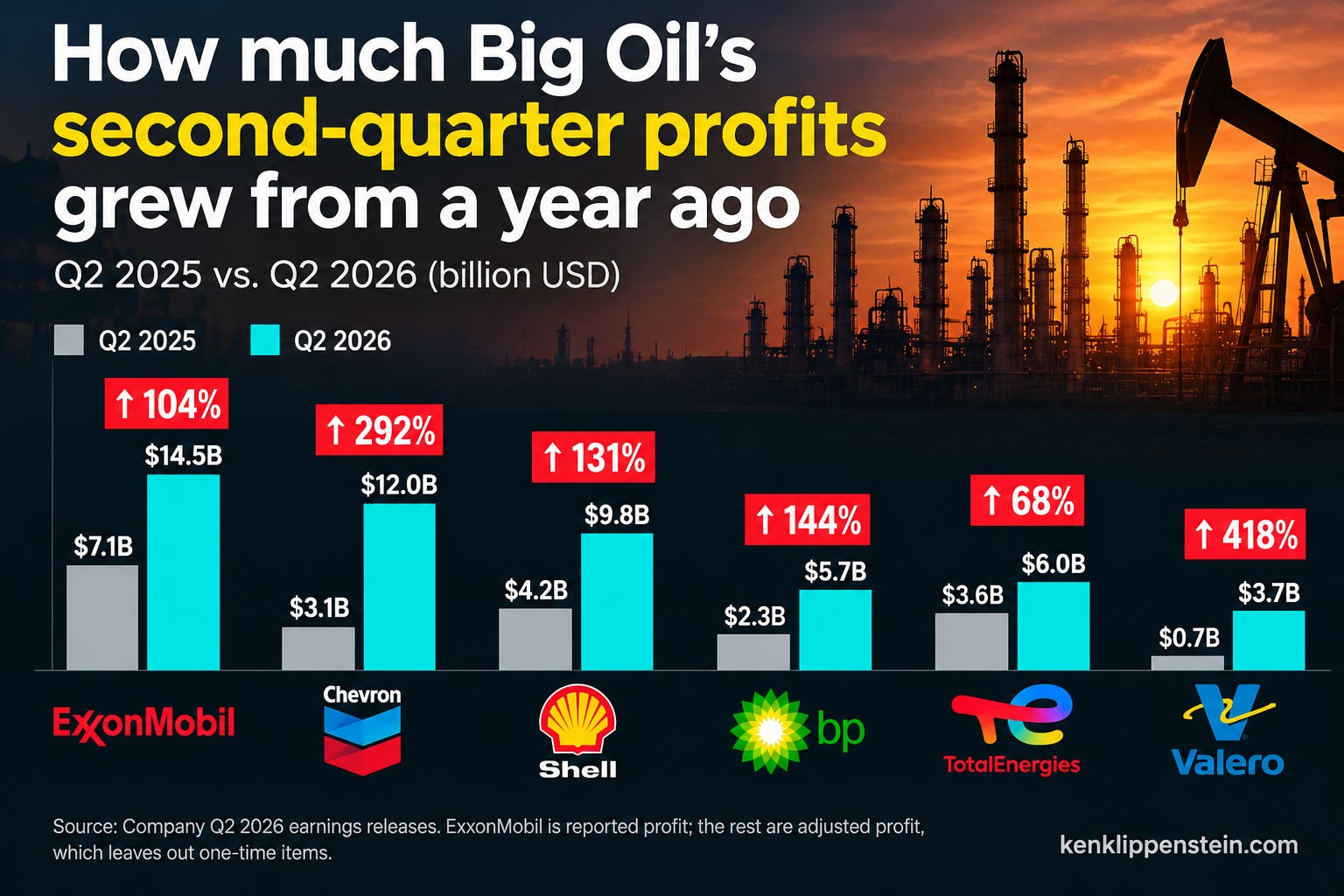
Middle Eastern oil exports have reportedly returned to prewar levels, yet American consumers continue paying elevated gasoline and diesel prices while oil refiners collect extraordinary profits. According to a Financial Times report cited by independent journalist Ken Klippenstein, regional oil exports have recovered despite the ongoing conflict with Iran and disruptions around the Strait of Hormuz. Gasoline prices remain above $4 per gallon in many areas and exceed $6 in parts of California, raising questions about why consumers are still facing such steep costs. Klippenstein argues that oil companies are exploiting wartime uncertainty to maintain inflated prices even as supply conditions improve. The recovery in exports does not necessarily mean transportation costs, refinery capacity, or global inventories have returned to normal, but it does challenge the assumption that shortages alone explain today’s fuel prices.
The clearest evidence behind the profiteering allegations is the dramatic increase in refining margins, particularly for diesel fuel. The industry’s so-called crack spread—the difference between the cost of crude oil and the market value of the fuels produced from it—has climbed to extraordinary levels. According to figures cited by Klippenstein, the diesel crack spread rose from $33 per barrel in February to $92 in August before exceeding $106 in early September, setting a record. Those margins help explain why refiners can report substantial earnings even while crude oil remains expensive. Chevron Chief Financial Officer Eimear Bonner acknowledged during a July earnings call that higher refining margins and favorable timing effects boosted downstream profits, with those timing effects contributing $1.4 billion during the quarter.
Oil executives have been candid about the financial opportunities created by current market conditions. PBF Energy CEO Matt Lucey told investors in July that the environment offered significant potential to generate value for shareholders. Meanwhile, consumers are absorbing the consequences through higher transportation expenses, shipping charges, and the prices of goods that depend on diesel-powered distribution networks. The situation is complicated by genuinely elevated crude prices, with Brent crude approaching $112 per barrel Thursday and shipping costs for supertankers traveling from the Persian Gulf to China reportedly exceeding ten times their prewar levels. Iranian attacks on tankers and the continuing threat to shipping routes remain legitimate cost pressures. However, Klippenstein argues that those disruptions do not fully explain the record refining margins or decisions to export fuel while domestic inventories remain unusually low.
President Donald Trump has acknowledged concerns about potential price gouging, directing the Justice Department to investigate whether energy companies are keeping fuel prices artificially high even as their crude acquisition costs decline. Yet the president has simultaneously celebrated the financial windfall associated with expensive oil. Speaking at an October 14 rally in Bullhead City, Arizona, Trump declared, “Our country is making more money than it’s ever made because of the fact that oil is so high.” The contradiction highlights the competing interests involved: high energy prices can benefit producers and refiners while imposing substantial costs on households and businesses. Whether companies have engaged in unlawful price manipulation remains an open question, and unusually high profit margins alone do not establish illegal price gouging.
Klippenstein’s broader argument is that the language of national security has helped shield the energy industry from scrutiny over its pricing practices. Discussions about the Strait of Hormuz, maritime insurance, Iranian military threats, and international shipping disruptions can make elevated fuel prices appear unavoidable, even when some of the industry’s profit margins are reaching historic highs. The distinction matters because crude oil prices are largely determined by global markets, while refining capacity, fuel inventories, export decisions, and wholesale pricing also influence what consumers ultimately pay. Restored export volumes do not automatically eliminate wartime costs, but they strengthen the case for examining how much of the price increase reflects genuine market pressures versus unusually lucrative margins. For consumers, the central question is straightforward: if more oil is flowing again, when will the benefits show up at the pump?
Editor: Oil companies say the war explains high prices, then tell shareholders how wonderful those high prices are for business. Both things can be true, but record refining margins deserve a lot more scrutiny than they’re getting. When the supply recovers but the pain at the pump doesn’t, consumers have every right to ask who’s pocketing the difference.
Source: Ken Klippenstein
Read The Morning Sixpack Archives here: