


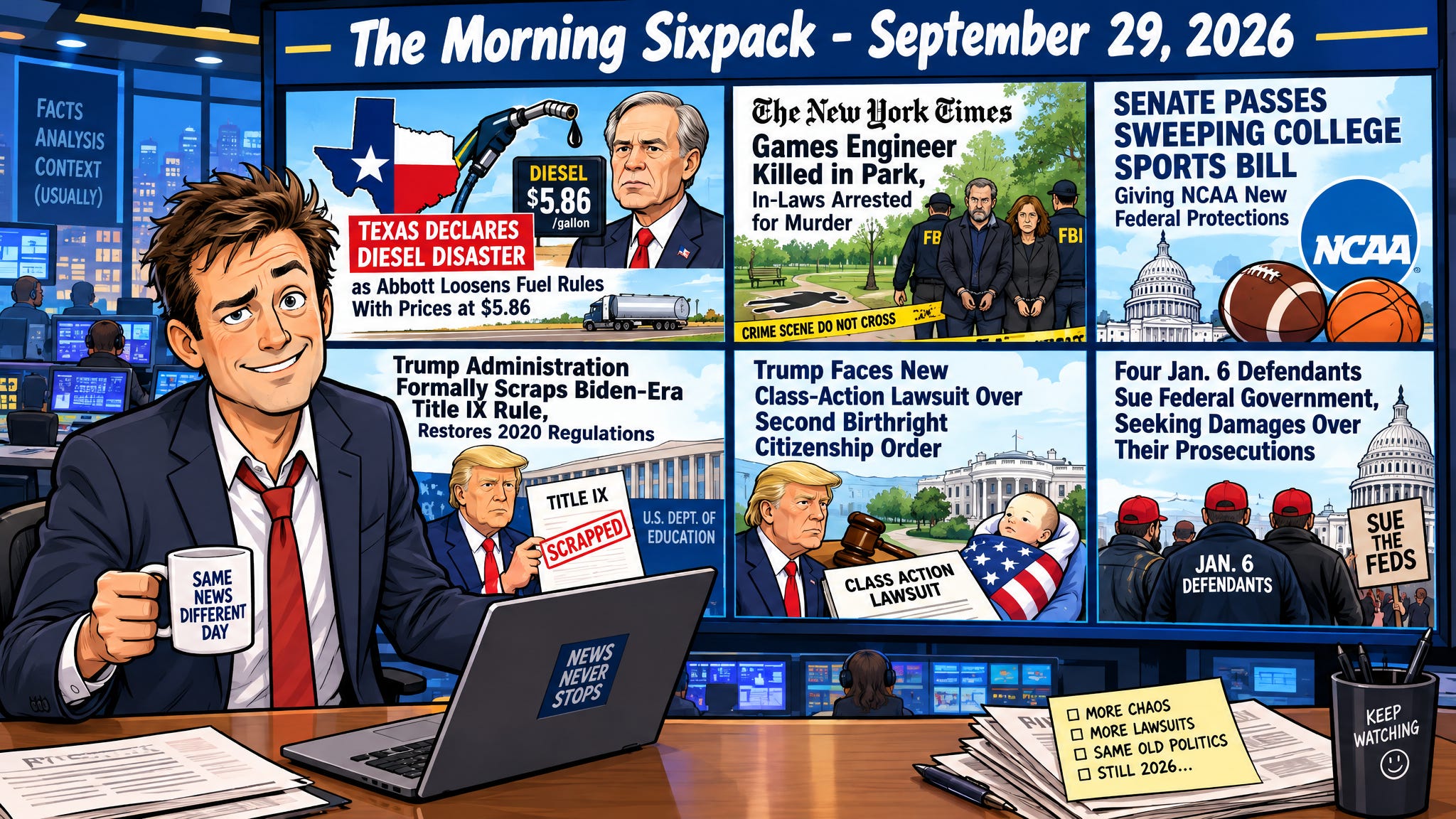
The Morning Sixpack stays free because the news that shapes your life should not be hidden behind a paywall. Paid subscribers are not paying for access. They are helping fund the research, writing, and independent voice that goes into every issue. Become a paid subscriber and help keep smart, honest news analysis free for everyone.
Texas just declared a disaster over diesel prices, proving that when fuel gets expensive enough, even dyed farm diesel gets promoted to highway duty.
Texas Declares Diesel Disaster as Abbott Loosens Fuel Rules With Prices at $5.86
Texas Gov. Greg Abbott declared a statewide disaster Monday as diesel prices hit an average $5.86 a gallon, temporarily loosening fuel and trucking rules in an effort to cut costs for farmers, freight operators and consumers. The order expands the use of dyed diesel on public roads, raises allowable weights for certain truckloads and seeks relief from some diesel-emissions requirements.
When diesel is expensive enough to qualify as a disaster, you know the gas pump has officially entered public-policy territory.
Dyed diesel is normally reserved for off-road agricultural and construction equipment and sold without motor-fuel taxes. Abbott’s proclamation suspends restrictions that normally keep it off public roads while also allowing heavier fuel, agricultural, and timber loads.
“Texas agriculture and freight run on diesel. Record prices put both industries at risk and raise costs for every Texas family,” Abbott said. “… These steps cut costs on the farm, on the road, and at the store.” The order does not waive the underlying 20-cent-per-gallon Texas fuel tax, which Democrats have called on Abbott to suspend.
The fuel fight also lands squarely in election season. Abbott is running against Democratic state Rep. Gina Hinojosa, while Democratic U.S. Senate candidate James Talarico and Republican opponent Ken Paxton have both called for changes to federal gasoline taxes.
Editor: Nothing concentrates a politician’s attention quite like watching the price board at a truck stop turn into an opposition campaign ad.
Source: The Washington Post
A New York Times Games engineering director was shot to death in a busy California park, and police arrested his 76-year-old in-laws as a bitter family history now hangs over a case with no publicly established motive. Family court was apparently not the final venue for this dispute.
New York Times Games Engineer Killed in Park, In-Laws Arrested for Murder
Jonathan McKinsey, 40, a director of engineering for New York Times Games, was shot multiple times Saturday afternoon at Dublin Sports Grounds in California, with police arresting his mother- and father-in-law, Shouyong Zhang and Shili Chen, shortly afterward on suspicion of murder. Witnesses told KTVU the couple took turns shooting McKinsey in the parking lot of the popular park, where families and children were nearby.
And somehow, the shooting may not be the darkest chapter in this family’s story.
McKinsey had been charged in 2025 with two misdemeanor counts of child abuse and pleaded not guilty. Court records cited by KTVU say his wife accused him of striking her 6-year-old son in the face and described an earlier domestic-violence incident. Deputies also alleged McKinsey left a 2-year-old girl home alone for more than an hour.
McKinsey’s wife later sought a restraining order against him, while McKinsey subsequently sought one against her. The couple was divorcing after 14 years of marriage and had been fighting over custody of their three children. None of that establishes a motive for the killing, and authorities have not publicly said what prompted the shooting.
The two in-laws were being held without bail ahead of a scheduled Wednesday arraignment. Witness Kevin Stein described just how public the killing was: “There were kids and families, just like you see now.”
Editor: Whatever happened inside this family, two grandparents allegedly bringing gunfire into a crowded park turned a private nightmare into a public homicide case—and left three children with consequences no court order can fix.
Source: KTVU FOX 2
The Senate just voted 77-22 to put Washington deeper into the business of college sports, with new national rules for NIL, transfers and NCAA enforcement. Apparently the transfer portal finally became complicated enough to require Congress.
Senate Passes Sweeping College Sports Bill, Giving NCAA New Federal Protections
The Senate passed the bipartisan Protect College Sports Act 77-22 Monday, advancing a major overhaul that would establish federal rules governing athlete compensation, NIL deals, transfers and NCAA enforcement. The legislation, sponsored by Sens. Ted Cruz and Maria Cantwell, now heads to the House, where its future is less certain.
College sports wanted national rules instead of courtroom chaos—and the Senate just handed the NCAA a very large rulebook.
Among its major provisions, the bill would give the NCAA federal antitrust protections for enforcing certain rules, limit agent fees to 5 percent, and school spending on athletes to $50 million annually. It also guarantees scholarships for 10 years after eligibility, allows athletes to transfer once without sitting out a year, and addresses conference realignment and revenue sharing.
But the bipartisan vote doesn’t mean everyone is cheering. Critics including Sens. Cory Booker and Chris Murphy argue the legislation gives too much power to the NCAA and major schools while restricting athletes’ economic leverage. “This is a bill not about student athletes, it’s about wealthy coaches and wealthy institutions and an NCAA who has enjoyed unbridled power for decades,” Booker said.
Supporters argue national rules are needed to replace conflicting state laws and years of litigation. Cruz put it this way: “It would be nice if college sports could somehow magically fix itself, but this is a matter of law, federal law, and only Congress can fix it.” The bill now heads to the House, where previous attempts at regulating college sports have stalled.
Editor: College football spent decades insisting these were students who happened to play sports. Now the money, lawyers, and federal legislation have arrived, and everybody can probably stop pretending this is intramurals with nicer stadiums.
Source: The Hill
The Trump administration has formally erased the Biden-era Title IX rewrite from the federal rulebook, restoring 2020 regulations and ending explicit federal regulatory protections for gender identity under Title IX. Washington has changed the rulebook again—and schools get another round of compliance whiplash.
Trump Administration Formally Scraps Biden-Era Title IX Rule, Restores 2020 Regulations
The Trump administration formally rescinded the Biden administration’s Title IX regulations Monday, restoring the first Trump administration’s 2020 rules and removing the Biden rule’s explicit protections against discrimination based on gender identity. The Education Department says the action follows federal court decisions that had already blocked and ultimately vacated the Biden-era regulations.
Title IX hasn’t changed—the federal government’s definition of what it requires has.
The Biden administration’s regulations had expanded Title IX’s regulatory definition of sex discrimination to include discrimination based on gender identity and established related protections for transgender students. The policy also affected how schools handled sexual harassment and misconduct complaints. Federal courts subsequently blocked the rule, with a district court vacating it nationwide.
Education Secretary Linda McMahon said, “Thanks to today’s action, the published Title IX regulations faithfully reflect court orders and Congressional intent—reducing confusion for parents, students, and educational institutions.” The administration says the restored framework better reflects Title IX’s statutory prohibition on sex discrimination.
LGBTQ advocates and other critics argue that eliminating the Biden regulations leaves transgender students with fewer explicit federal protections and could narrow avenues available to students alleging discrimination. Title IX itself remains federal law prohibiting sex discrimination in federally funded education programs; the fight is over how that law is interpreted and enforced.
Editor: Nothing says “reducing confusion” quite like having America’s schools rewrite their Title IX policies every time Washington changes administrations—or a federal judge reaches for a red pen.
Source: UPI
President Trump’s second attempt to narrow birthright citizenship is headed back to court, this time over U.S.-born children of certain international-organization workers, surrogacy arrangements and other categories. The 14th Amendment is getting another very expensive day in court.
Trump Faces New Class-Action Lawsuit Over Second Birthright Citizenship Order
Immigrant parents filed a class-action lawsuit Monday challenging President Donald Trump’s August executive order restricting birthright citizenship for several categories of U.S.-born children, arguing that the policy violates the 14th Amendment and Supreme Court precedent. The order targets specified circumstances involving children born through surrogacy, children of certain international-organization workers, and other categories.
Trump lost the broader birthright-citizenship fight at the Supreme Court, and now his administration is testing where the constitutional boundary actually sits.
The new lawsuit focuses on families who say the August order puts their children’s citizenship at risk. One plaintiff is the mother of a child born in Washington, D.C., whose parents work for international organizations; another is an Australian father expecting a child through a U.S. surrogate.
The plaintiffs also challenge new documentation requirements they say could prevent some parents from obtaining passports and other proof of citizenship for their children. A federal judge in Maryland has already blocked enforcement of the August order against children covered by an earlier class-action lawsuit, calling its application to that group “almost certainly unconstitutional.” The latest case seeks protection for a broader class.
“The Constitution is clear, and the Supreme Court has been clear: Birthright citizenship is the law of the land,” ACLU attorney Cody Wofsy said. The administration’s latest executive order remains subject to litigation, so the ultimate reach of the restrictions is unresolved.
Editor: When your first attempt at rewriting birthright citizenship loses and the sequel immediately produces another class-action lawsuit, you haven’t settled constitutional law—you’ve ordered another season.
Source: The Washington Sun
Four people convicted in Jan. 6 cases are now suing the federal government for damages, alleging misconduct ranging from malicious prosecution to constitutional violations. The criminal cases may be over, but the lawyers have apparently just reached halftime.
Four Jan. 6 Defendants Sue Federal Government, Seeking Damages Over Their Prosecutions
Four people prosecuted and convicted in connection with the Jan. 6, 2021, Capitol attack filed separate federal lawsuits Friday seeking damages from the government and former officials over how their cases were handled. Lisa Eisenhart, Lynnwood Nester, Peter Schwartz and Kenneth Harrelson filed their cases in federal court in Washington, with allegations including malicious prosecution, false imprisonment, and constitutional violations.
Now they’re asking the government that prosecuted them to pay them.
Eisenhart, who was sentenced to 30 months in prison, alleges officials including former Attorney General Merrick Garland and former U.S. Attorney Matthew Graves improperly targeted her and violated her First and Fifth Amendment rights. Nester, sentenced to 10 months, similarly alleges he was singled out because of his political views and Jan. 6 involvement. Those allegations have not been adjudicated in the new civil cases.
Schwartz’s lawsuit takes a different route, alleging FBI agents violated his Fifth Amendment rights by compelling him to unlock his cellphone with his fingerprint while handcuffed. The D.C. Circuit later ruled that the compelled unlocking violated his Fifth Amendment rights. Harrelson alleges malicious prosecution and false imprisonment after spending more than two years in federal custody.
All four plaintiffs received clemency under President Trump’s Jan. 20, 2025, proclamation. That clemency does not itself establish that their prosecutions were unlawful, and their new civil allegations remain to be tested in court. The lawsuits do not specify how much money they are seeking.
Editor: Jan. 6 has gone from riot to prosecution to clemency to damages claims—a five-year legal relay race in which the courthouse keeps getting the baton.
Source: The Washington Sun