

Iran’s war is squeezing global oil supply, pushing U.S. gas toward $4 (over that in the West) and threatening higher prices from groceries to flights—just as Trump promised relief.
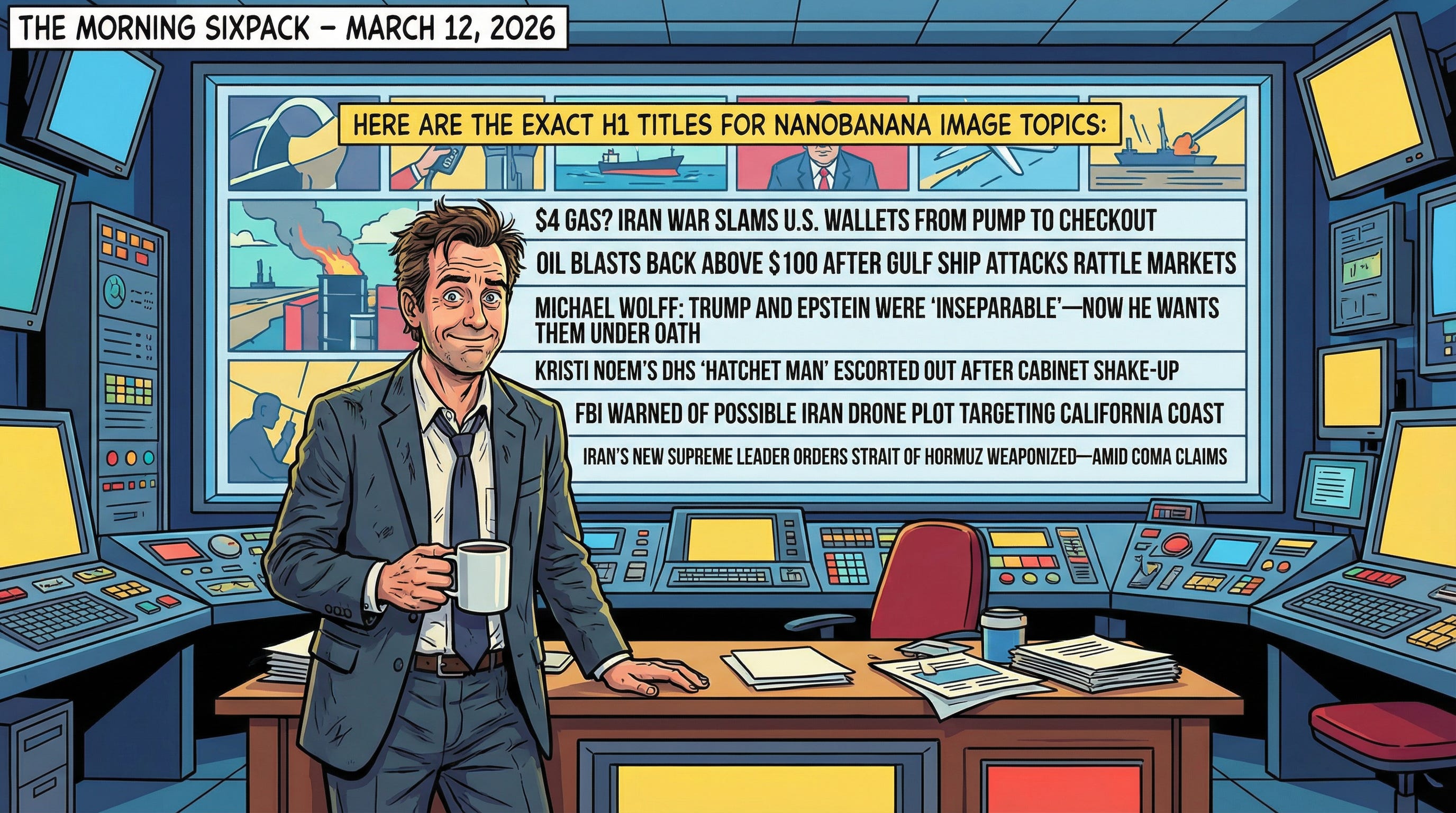
$4 Gas? Iran War Slams U.S. Wallets From Pump to Checkout
The Iran war is already pushing U.S. gas prices toward $4 $5 a gallon, and that’s just the opening act.
If the Strait of Hormuz stays shut, your summer just got a lot more expensive.
Oil ripped past $100 a barrel when fighting broke out, and the national average for gas has jumped to nearly $3.58 a gallon—up 22 percent in a month, according to AAA. Experts say $4 gas is in sight. Yes, America pumps plenty of its own oil. No, that doesn’t mean we’re immune when one-fifth of the world’s supply gets bottlenecked in the Persian Gulf.
The choke point is the Strait of Hormuz, where ships hauling oil have been stuck for more than a week under threat of Iranian attacks. As long as tankers are stalled and supply is squeezed, global prices climb—and U.S. drivers feel it. The International Energy Agency is trying to calm markets with a record 400 million barrel release from emergency reserves. That may help. It may not be enough.
And it’s not just the pump. Cargo traffic through the strait has slowed to a crawl, with ships rerouted and airfreight disrupted across the region. “The container rates are off the charts,” transportation expert John Haber said. “It’s almost like when covid hit in the region there.” Translation: higher costs for electronics, pharmaceuticals, fertilizer—and eventually groceries.
Airlines are next. Jet fuel prices are climbing fast, and airfare tends to follow with a lag. United Airlines CEO Scott Kirby warned that ticket prices could rise quickly as carriers absorb higher fuel bills. Add in shaky consumer confidence and a softening labor market, and inflation—which had been cooling—could tick back up in the coming months. As Nationwide chief economist Kathy Bostjancic put it: “The longer the conflict and disruptions continue, the larger the possible negative hit to business and consumer confidence from increased uncertainty that would inflict further drag on economic activity.”
President Donald Trump has made falling prices a centerpiece of his pitch to voters. This crisis complicates that narrative in a hurry.
Source: WaPo (free)
Editor: So much for the ‘don’t worry, we’re energy independent’ talking point. Global markets don’t care about campaign slogans. But Trump is an idiot and doesn’t know how any of this works.
Six ships hit in two days sent Brent back over $100 a barrel—even after a record 400 million barrel reserve release tried to cool things down.
Oil Blasts Back Above $100 After Gulf Ship Attacks Rattle Markets
Oil just punched back above $100 a barrel after fresh attacks on commercial ships in the Persian Gulf reignited fears of a global supply squeeze.
Six vessels targeted in 48 hours—and suddenly the energy market is on edge again.
Brent crude, the international benchmark, jumped more than 9 percent Thursday to around $100 a barrel. U.S. benchmark West Texas Intermediate climbed into the mid-$90s. The surge followed reports that three more ships were struck by projectiles in the Gulf, adding to a string of attacks tied to escalating tensions involving Iran.
According to the United Kingdom Maritime Trade Operations, a container ship was hit off Jebel Ali in the United Arab Emirates, sparking a small fire. Two tankers were also struck near Al Basrah, Iraq, and set ablaze. All crew members were reported safe. That brings the total number of vessels targeted to six in just two days—right in the shadow of the Strait of Hormuz, where roughly one-fifth of the world’s crude oil and LNG supply moves.
Markets were already jumpy after U.S. and Israeli airstrikes on Iranian targets late last month. Iranian officials have warned that shipping through the strait could be disrupted, and traffic has already dropped sharply. In response, the International Energy Agency announced a coordinated release of 400 million barrels from emergency reserves—the largest in its history. “The oil market challenges we are facing are unprecedented in scale, therefore I am very glad that IEA Member countries have responded with an emergency collective action of unprecedented size,” IEA Executive Director Fatih Birol said.
It helped—for a minute. Brent had spiked to nearly $120 earlier this week before easing back. Now it’s climbing again. And if the Strait of Hormuz becomes more than a pressure point, $100 oil could start looking like the floor, not the ceiling.
Source: UPI
Editor: Energy markets don’t need a full-blown blockade to panic—just a few burning tankers and a narrow strait.
Michael Wolff says Trump and Epstein were inseparable for 15 years—and now he wants both Trumps under oath while the White House scrambles.
Michael Wolff: Trump and Epstein Were ‘Inseparable’—Now He Wants Them Under Oath
Michael Wolff claims Donald Trump’s closest relationship was with Jeffrey Epstein—and he’s raising cash to force the Trumps to testify about it.
After four Trump books and 100 hours of Epstein tapes, Wolff says this fight is just getting started.
The veteran writer—best known for Fire and Fury—has known Donald Trump since 1980s New York and insists the former president has never been fully honest about his ties to Jeffrey Epstein. “I believe the closest relationship each of them has had in life was Trump with Epstein, Epstein with Trump,” Wolff says. “This went on for 15 years. They were involved in all aspects of each other’s lives, during the period in which Epstein’s crimes took place. This spans the arc of the behaviour everybody is focused on. Trump was right in the middle of this.”
Wolff is now locked in a legal war with Melania Trump after she threatened to sue him for $1 billion over what she called “malicious and defamatory falsehoods.” He countersued, arguing it’s an attempt to intimidate him out of reporting on Epstein’s links to the Trumps. He’s raised more than $800,000 to fund the fight—and hopes to put both Trumps on the stand. “If you’re in power, you can’t go around threatening writers and journalists just because they’re saying something you don’t want to be said about yourself. F--- that.”
The so-called Epstein files—millions of Justice Department documents—have revived scrutiny of everyone who ever orbited the financier. Wolff’s own emails surfaced, including one in which Epstein asked for advice on handling Trump. Wolff replied: “I think you should let him hang himself.” Critics say that’s cozy. Wolff shrugs. “The sausage is the sausage,” he says, arguing access is how you get the story.
He also dismisses what he sees as a simplistic narrative. “In almost every Epstein story, there is an obligatory reference to his ‘heinous crimes’,” Wolff says. “The word heinous has never had so much use.” He insists the bigger, unanswered question is how Epstein built such a vast network of elites—and why so many powerful people were drawn to him.
Meanwhile, Wolff says Trump is juggling the Epstein fallout with a volatile Iran war and shaky polling ahead of the midterms. “Trump is in a very difficult position now,” he says. “I can’t see any good news.” In Trumpland, every day brings a new twist. For Wolff, that just means more material—and maybe a fifth book.
Source: Telegraph
Editor: When your biographer says your best friend was Jeffrey Epstein, that’s not a character reference—it’s a problem.
Kristi Noem’s top DHS enforcer was reportedly escorted out after her Cabinet reshuffle—because loyalty shifts fast in Trumpworld.
Kristi Noem’s DHS ‘Hatchet Man’ Escorted Out After Cabinet Shake-Up
A top aide to Kristi Noem was reportedly walked out of the Department of Homeland Security after she left her post—another reminder that loyalty in Trump’s orbit has an expiration date.
One insider put it bluntly: once Noem was gone, the knives came out.
According to The Daily Beast, Joseph Mazzara—installed during Noem’s tenure at DHS—“emptied his office” and was escorted from the building. An internal memo had confirmed his appointment just months ago. Now? Sources say he’s out, or about to be. One insider claimed, “Mazzara was very much in the Noem camp, and Rodney Scott can’t stand him. So perhaps Scott was able to get him booted.”
Noem, now serving in the newly created role of Special Envoy for the Shield of the Americas under Donald Trump, had stocked DHS with close allies, including Corey Lewandowski and Mazzara. Insiders described Mazzara as “Corey’s #1” and even his “henchman,” alleging he pushed out more than a dozen senior career officials—some dating back to the Reagan administration—and replaced them with Trump loyalists.
A Customs and Border Protection source told the outlet: “With Noem gone, Scott was able to fire him. He had the opening and he took it.” Another added that Mazzara showed little interest in the department’s core mission, focusing instead on “owning the libs.”
The Department of Homeland Security denied that Mazzara had been formally removed. But one unnamed source countered: “He will be fired soon if it didn’t happen today.” In Washington, that’s what passes for clarity.
For a department tasked with national security, the churn looks less like strategy and more like score-settling. When political muscle replaces institutional memory, don’t be shocked if the mission gets lost in the shuffle.
Source: Raw Story
Editor: In this town, yesterday’s enforcer is today’s escorted guest. The revolving door isn’t spinning—it’s flinging people out.
The FBI quietly warned California cops that Iran once aspired to launch surprise drones from a vessel off the West Coast—just as Trump’s strikes escalated the fight.
FBI Warned of Possible Iran Drone Plot Targeting California Coast
The FBI alerted California law enforcement that Iran had allegedly explored launching surprise drone attacks from a vessel off the West Coast.
No targets. No timeline. But enough concern to put police on heightened alert.
In a bulletin reviewed by ABC News, the FBI said it had obtained information that as of early February 2026, Iran “aspired to conduct a surprise attack using unmanned aerial vehicles from an unidentified vessel off the coast of the United State Homeland, specifically against unspecified targets in California, in the event that the US conducted strikes against Iran.” The notice added: “We have no additional information on the timing, method, target, or perpetrators of this alleged attack.”
The warning circulated just as the Trump administration began its assault on Iran. U.S. officials now believe the 12-day bombardment has significantly degraded Tehran’s ability to carry out such an operation. Still, authorities aren’t shrugging it off. The Los Angeles County Sheriff’s Department said it has maintained an “elevated level of readiness,” increasing patrols around places of worship and other prominent locations. Gavin Newsom’s office said state emergency officials are coordinating with federal and local partners to protect communities.
The concern isn’t limited to Iran. A separate 2025 bulletin warned that Mexican drug cartels had allegedly authorized potential drone attacks carrying explosives against U.S. law enforcement along the southern border—an unprecedented move if carried out. Officials stress that report was uncorroborated, but the technology is spreading fast.
ABC News contributor John Cohen, a former DHS intelligence chief, said the risk is real. “We know Iran has an extensive presence in Mexico and South America, they have relationships, they have the drones and now they have the incentive to conduct attacks,” he said. “The FBI is smart for putting this warning out so that state and locals can be better able to prepare and respond to these types of threats.”
For now, there’s no evidence of an imminent strike. But the idea that drones could be pre-positioned offshore—or moved quietly across borders—has clearly gotten Washington’s attention. In an era of cheap UAVs and global grudges, the ocean doesn’t feel quite as wide as it used to.
Source: ABC News
Editor: When the phrase “unidentified vessel off the coast of California” shows up in an FBI bulletin, that’s not background noise—that’s a wake-up call.
Iran’s new Supreme Leader ordered the Strait of Hormuz weaponized—even as reports swirl he’s in a coma after airstrikes killed his father.
Iran’s New Supreme Leader Orders Strait of Hormuz Weaponized—Amid Coma Claims
Iran’s newly installed Supreme Leader has called for weaponizing the Strait of Hormuz and shutting down U.S. bases in the region—even as reports claim he’s in intensive care with catastrophic injuries.
A nation at war may now be led by a man who hasn’t been seen—and may not be conscious.
Mojtaba Khamenei, 56, succeeded his father Ali Khamenei after the elder ayatollah was killed in airstrikes on February 28. In a written statement read on Iranian state TV, Mojtaba vowed Iran would avenge the “blood of its martyrs,” called for American bases in the region to close immediately, and warned that Tehran would seek compensation from its enemies—or destroy their assets.
But while the rhetoric escalates, so do questions about his condition. Sources in Tehran claim Mojtaba is in intensive care at Sina University Hospital, with part of the facility sealed off by security. One report alleges he lost a leg, suffered internal injuries and has been in a coma. Iranian officials have referred to him as a “wounded war veteran,” but have offered no direct proof of his status. Internet blackouts make independent verification impossible.
Exiled former Iranian official Jaber Rajabi, who studied with Mojtaba in Qom, described him as “obsessed with the end of days” and more calculating than his father. “Mojtaba can lie in a much better way and knows how to play,” Rajabi told the Jerusalem Post. He warned that Mojtaba’s ambitions would not be curbed by airstrikes and suggested the nuclear program remains central to regime survival.
Meanwhile, regional commanders of the Islamic Revolutionary Guard Corps are believed to be directing operations as Iran continues strikes across the Gulf. Oil and gas prices have surged as tensions threaten the Strait of Hormuz, the artery for roughly one-fifth of global energy supplies.
President Donald Trump has escalated his own rhetoric, warning Iran’s leadership they will not “live in peace” and telling Tehran to brace for “death, fire, and fury.” Yet Mojtaba has not delivered a public address since taking power. Some speculation even suggests he may not be fully aware of the war’s developments.
If true, that leaves the world staring at a volatile possibility: a regional conflict steered by hardliners while the supposed supreme authority lies out of sight. In Tehran, power has always been opaque. Right now, it may also be incapacitated.
Source: Daily Mail
Editor: When your war cabinet might be taking orders from a hospital room—or a rumor mill—that’s not strength. That’s instability with rockets.