


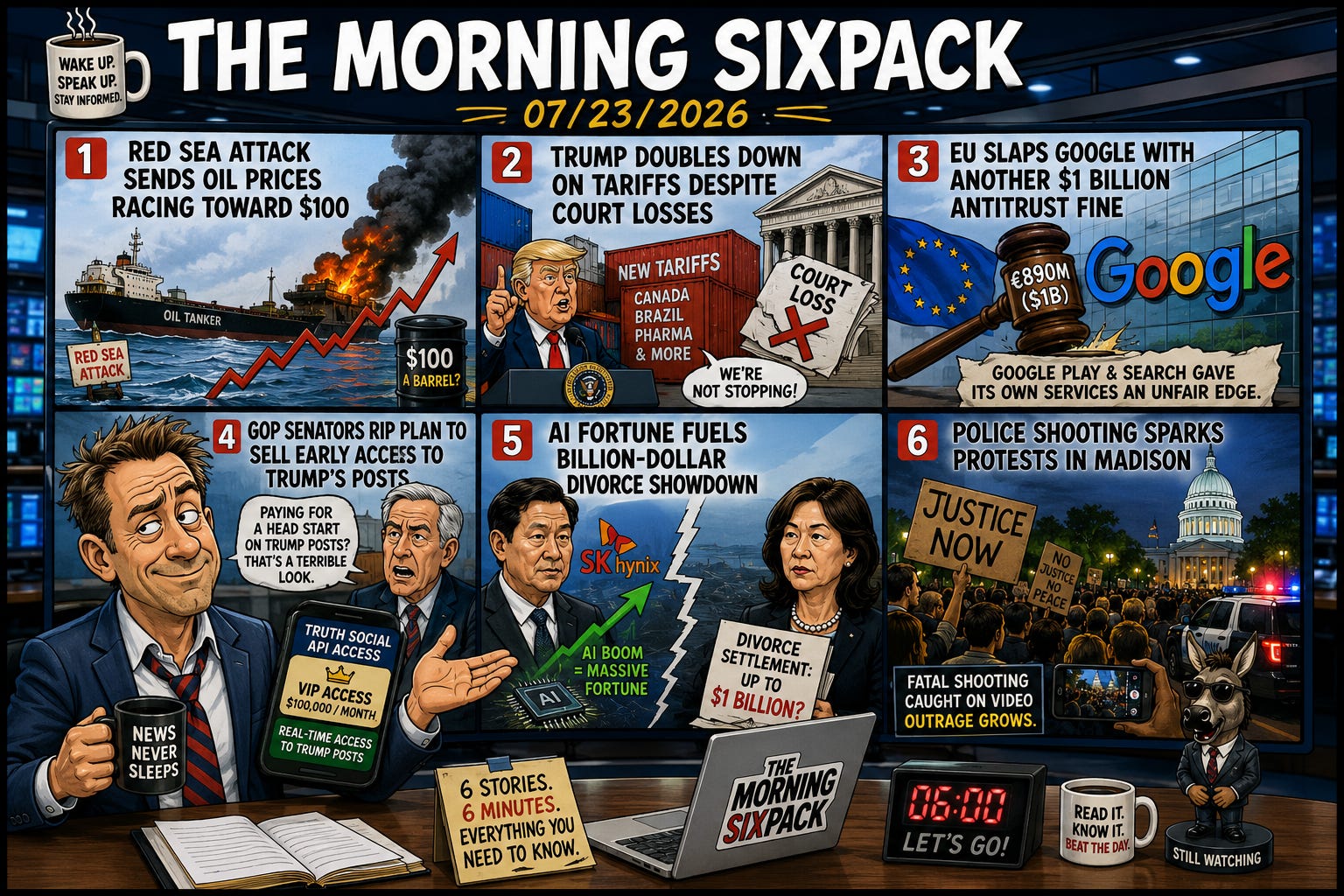
The Iran conflict just expanded beyond the Strait of Hormuz, and now the Red Sea is becoming another choke point for global oil—with drivers everywhere likely to pick up the tab.
Red Sea Attack Sends Oil Prices Racing Toward $100
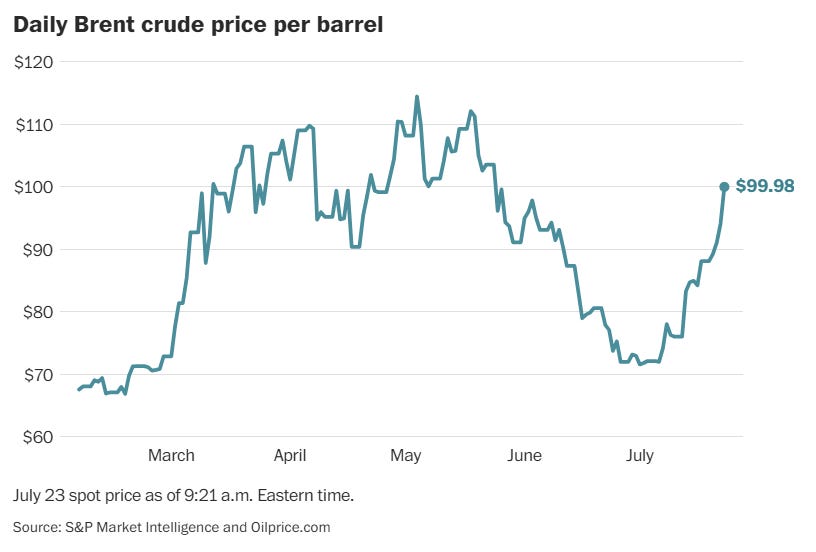
A Saudi oil tanker attack in the Red Sea has pushed Brent crude above $99 a barrel, raising fears that another vital shipping lane is being dragged into the Iran conflict.
The world doesn’t need a second oil choke point, but that’s exactly where this is headed.
The Iran-backed Houthis claimed responsibility for attacks on two Saudi tankers, saying they were enforcing a new maritime blockade against Saudi Arabia. So far, Saudi officials have confirmed one vessel caught fire after being struck, though the crew escaped safely. Reports of a second successful attack remain unconfirmed.
President Donald Trump responded by warning Iran that it would be held responsible for any additional Houthi attacks.
“Major military punishment will be inflicted upon Iran and, of course, the Houthis, themselves, who I am very disappointed with in that they have, until now, acted very professionally and smart,” Trump wrote on Truth Social.
Editor: Can I just say it? That statement came from a 2nd-grader trying to explain something to his mom.
Secretary of State Marco Rubio said the Houthis had been “smart” to stay out of the broader conflict until now but warned they risk escalating a crisis that is already squeezing global energy supplies. The attacks threaten the Bab el-Mandeb Strait just as shipping through the Strait of Hormuz remains severely disrupted, creating the possibility of two major bottlenecks for the world’s oil trade at the same time.
Asian economies could be hit especially hard if both shipping routes remain under pressure, while traders are already reacting by driving oil prices sharply higher. If these attacks continue, consumers should expect the pain to show up at the gas pump before long—AGAIN.
Source: The Washington Post
Editor: Energy markets don’t care about political talking points. When tankers start burning in two of the world’s most important shipping lanes, the price tag eventually lands where it always does—on everyone filling up their tank.
Trump’s tariff strategy keeps changing legal lanes, but the destination hasn’t changed—higher tariffs, bigger trade fights, and more uncertainty for consumers.
Trump Doubles Down on Tariffs Despite Court Losses
President Trump is pressing ahead with sweeping new tariffs even after major court rulings forced his administration to change the legal playbook.
The legal setbacks didn’t stop the tariff war—they just changed the paperwork.
U.S. Trade Representative Jamieson Greer told lawmakers the administration remains fully committed to using tariffs to rebuild American manufacturing, shrink the trade deficit, and pressure trading partners. After the Supreme Court blocked Trump’s emergency tariff authority earlier this year, the White House shifted to other sections of federal trade law to keep imposing new duties.
That strategy is already hitting Canada and Brazil. New tariffs on Brazilian goods are now in effect, while Canada faces additional duties on selected exports, prompting Prime Minister Mark Carney to accuse Washington of violating the U.S.-Mexico-Canada Agreement. The dispute has already derailed joint events between the two countries and raised fresh doubts about the future of the trade pact.
Meanwhile, Trump is also warning imported generic drugs could face 100 percent tariffs beginning in 2028 unless manufacturers move production to the United States. Polls show more than 70 percent of Americans believe tariffs are driving up prices, and even some Republican lawmakers are openly expressing concern about higher costs for consumers.
“The specific authorities this administration is using have changed, but the trade strategy has not,” Greer told the Senate Finance Committee.
Source: The Hill
Editor: If your toolbox gets taken away but you keep finding new hammers, eventually everything starts looking like another tariff.
Now we have a stupid war fueling higher fuel prices (which has multiple downstream impacts) AND stupid tariffs that raise prices on many things even higher. You get the sense that Trump doesn’t give a shit about the American people.
Europe isn’t easing up on Big Tech. Google just got handed another billion-dollar reminder that Brussels still calls the shots inside its borders.
EU Slaps Google with Another $1 Billion Antitrust Fine
The European Union has fined Google nearly $1 billion after regulators concluded the company unfairly steered users toward its own services through Google Play and its dominant ad-addled search engine.
Brussels keeps proving that if you’re Big Tech, there’s always another investigation waiting.
European regulators said Google violated the Digital Markets Act by using its control over Google Play and its search engine to give its own apps and services an unfair advantage over competitors. The European Commission said consumers deserve to see the best products—not just Google’s—and developers should be free to direct customers to better offers outside Google’s app store.
The latest penalty comes after Google recently lost its appeal of a separate $4.5 billion antitrust case involving Android, underscoring that Europe’s crackdown on Silicon Valley remains very much alive. The EU has made policing the world’s biggest technology companies a top priority, even as President Trump has criticized Europe’s digital regulations and previously warned of retaliation against penalties targeting American firms.
Google blasted the decision, arguing the rules force the company to remove popular search features and weaken security protections in Google Play, ultimately hurting consumers and European businesses.
“The best products should succeed because they’re better, not because they’re owned by the company running the search engine,” European Commission Executive Vice President Teresa Ribera said.
Source: Associated Press
Editor: Europe’s regulators don’t seem interested in breaking up Big Tech—they just keep sending invoices with a lot of zeroes attached.
Even some Republicans are saying selling faster access to a president’s market-moving posts looks less like innovation and more like Wall Street’s newest VIP lane.
GOP Senators Rip Plan to Sell Early Access to Trump’s Posts
Republican senators are openly criticizing a proposal by Trump Media to charge Wall Street firms up to $100,000 a month for faster access to President Trump’s Truth Social posts.
When lawmakers in your own party start asking, “What are we doing here?” you’ve got a political problem.
Trump Media’s proposed “Truth API” would give paying investment firms real-time access to posts from high-profile Truth Social accounts, allowing traders to react to market-moving statements milliseconds before everyone else. Reports say subscription prices could reach $100,000 a month, with discounts for long-term contracts.
Several Republican senators questioned both the ethics and the optics. Sen. Bill Cassidy called it “a form of buying access,” while Sen. Susan Collins said the proposal “does not sound appropriate.” (Editor: I bet she’s “very concerned.”)
Sen. Lisa Murkowski warned that giving wealthy traders an advantage on presidential statements raises serious conflict-of-interest concerns, calling the idea “wild.”
The company defended the proposal, arguing it simply meets market demand and accused critics of trying to undermine a publicly traded business. Democrats, meanwhile, blasted the plan as another example of conflicts between public office and private business, while some Republicans warned it hands political opponents fresh ammunition heading into the midterms.
“I think that’s wrong. It’s a form of buying access,” Sen. Bill Cassidy said.
Source: The Hill
Editor: Wall Street has always paid for better data. Selling premium access to a sitting president’s posts? That’s the kind of idea that practically writes attack ads by itself.
AI made SK Hynix’s chairman much richer, but now a South Korean court has to decide just how much of that fortune belongs to his ex-wife.
AI Fortune Fuels Billion-Dollar Divorce Showdown
The billionaire chairman of SK Hynix is headed into what South Korea calls the “divorce of the century,” with as much as $1 billion on the line after his AI-driven fortune exploded in value.
When artificial intelligence sends your wealth soaring, divorce court suddenly gets a whole lot more expensive.
SK Group Chairman Chey Tae-won, whose company supplies the advanced memory chips powering Nvidia’s AI boom, is awaiting a court ruling that could award his former wife, Roh Soh-yeong, a massive share of his fortune. The couple’s highly public split followed Chey’s public admission a decade ago that he was in love with another woman and had fathered a child outside the marriage.
Chey’s wealth has surged alongside SK Hynix’s rise as one of the biggest winners of the AI revolution. His close ties to Nvidia CEO Jensen Huang and other tech leaders have helped make him one of South Korea’s most prominent business figures, even as his personal life has remained front-page news.
Roh argues she deserves a much larger settlement because the family’s wealth was built during their nearly three decades of marriage, while Chey contends the company’s recent AI-fueled gains came long after their relationship had effectively ended. A ruling could reshape control of one of South Korea’s largest business empires if the payout reaches the upper end of expectations.
“Happy families are all alike; every unhappy family is unhappy in its own way.”1
Source: The Wall Street Journal (free)
Editor: It’s one thing to strike it rich from the AI boom. It’s another to discover the biggest valuation model you’ll face is the one sitting in divorce court.
A police shooting captured on video has reignited tensions in Madison, with investigators now facing intense scrutiny over exactly what happened in the final seconds.
Police Shooting Sparks Protests In Madison
A fatal police shooting in Madison, Wisconsin, has triggered protests after graphic bystander video showed officers struggling with a man moments before he was shot.
The video is already shaping public opinion, but investigators say it doesn’t tell the whole story.
Madison police said officers were trying to arrest a man suspected of checking vehicle door handles when he fled on a bicycle before a confrontation turned violent. Police Chief John Patterson said the man pulled a knife during the struggle and injured one officer. That officer then fired the fatal shots after another officer unsuccessfully deployed a Taser.
The bystander video spread rapidly online, showing multiple officers wrestling with the man before three shots were fired at close range. Witnesses questioned whether deadly force was necessary after the Taser had been used, while police emphasized that the video captures only one angle of a fast-moving encounter.
All four officers involved have been placed on administrative leave while Wisconsin’s Division of Criminal Investigation conducts an independent review. Officials promised a transparent investigation as demonstrators marched through downtown Madison and held vigils demanding accountability.
“We’re going to do our darndest to communicate as proactively as we can,” Police Chief John Patterson said.
Source: The Washington Post
Editor: Viral video can answer some questions in seconds—and create a hundred more just as fast. That’s why investigations still matter, even after millions of people think they’ve already reached a verdict. But let’s also be real: Cops kill a lot of people and are almost never held to account.
In the letter, Chey acknowledged he loved another woman and had a child with her. In court papers cited by local media, he said he didn’t believe his 27-year marriage could be saved and quoted the opening of Leo Tolstoy’s novel “Anna Karenina,” a tragedy that plots its own love triangle: “Happy families are all alike; every unhappy family is unhappy in its own way.”