


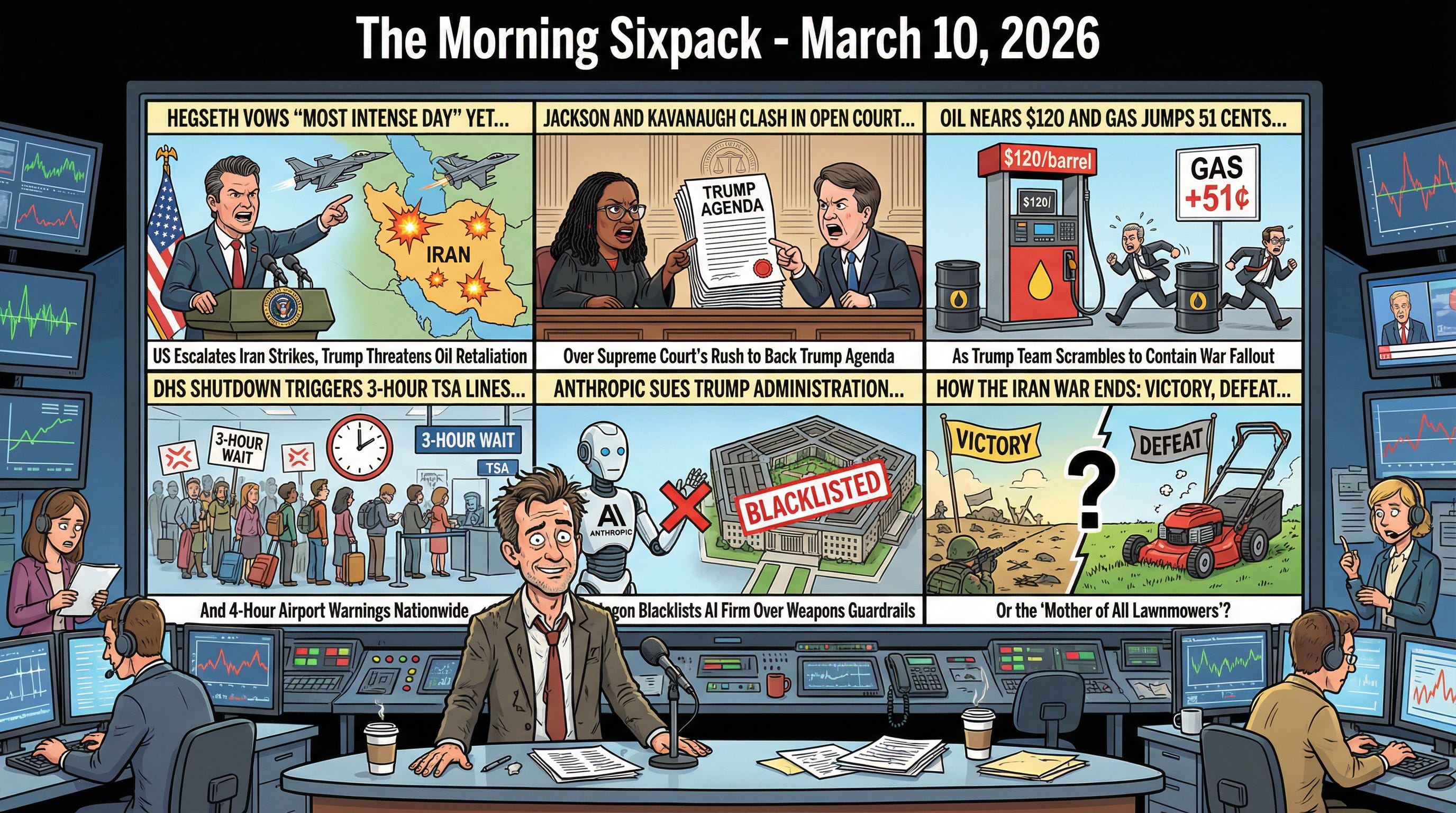
On Day 10 of Operation Epic Fury, Hegseth promises the heaviest strikes yet while Trump warns Iran over oil and flirts with diplomacy—because subtlety is overrated.
Hegseth Vows “Most Intense Day” Yet as U.S. Escalates Iran Strikes and Trump Threatens Oil Retaliation
Defense Secretary Pete Hegseth says Tuesday will mark the heaviest U.S. assault yet inside Iran as Operation Epic Fury enters its tenth day. The Pentagon is betting overwhelming force will finish the job fast.
“Today will be, yet again, our most intense day of strikes inside Iran.”
Standing beside Joint Chiefs Chairman Gen. Dan “Raisin’” Caine, Hegseth (Secredtary of War or SOW) declared that Iran is “badly losing” and firing fewer missiles than it’s capable of. He vowed to send “the most fighters, the most bombers, the most strikes” to accomplish three goals: wipe out Iran’s missile stockpiles and production, “destroy their Navy,” and “permanently deny Iran nuclear weapons forever.” His message was blunt: “We’re crushing the enemy in an overwhelming display of technical skill and military force. We will not relent until the enemy is totally and decisively defeated.”
Editor: How does he propose we “permanently deny Iran nuclear weapons forever”? Seems… stupid, short-sighted, and just outright impossible.
President Donald Trump struck a similar tone a day earlier, predicting the war would end “very soon” because Iranian military assets are being destroyed faster than expected since strikes began Feb. 28. But he paired optimism with a warning shot—if Tehran chokes off oil traffic through the Strait of Hormuz, “they will be hit by the United States of America TWENTY TIMES HARDER than they have been hit thus far.”
The conflict edged closer to global energy markets Tuesday as authorities in Abu Dhabi confirmed an Iranian drone attack ignited a fire at the Ruwais Industrial Complex refinery. No injuries were reported. Meanwhile, Trump signaled mixed intentions about diplomacy, saying he is “not happy” that Mojtaba Khamenei replaced his father as supreme leader and adding, “I don’t believe he can live in peace”—while also conceding “it’s possible” he would talk because “I’m hearing they want to talk badly.”
Hegseth, who previously estimated the war could last three to eight weeks, made clear the timeline now rests with Trump. “He gets to control the throttle,” Hegseth said. “And so it’s not for me to posit whether it’s the beginning, the middle, or the end.” Translation: the president decides when enough is enough.
Source: CNBC
Editor: We’re ten days in, the throttle is wide open, and the oil markets are holding their breath. Nothing calms global nerves like promises of TWENTY TIMES HARDER.
Jackson and Kavanaugh publicly spar over the Supreme Court’s rush to greenlight Trump policies—awkward venue, even more awkward applause lines.
Jackson and Kavanaugh Clash in Open Court Over Supreme Court’s Rush to Back Trump Agenda
Two sitting Supreme Court justices went toe-to-toe in a packed federal courtroom over whether the high court is fast-tracking President Trump’s agenda at the expense of the legal process. It was civics class with a live wire.
“This uptick in the court’s willingness to get involved in cases on the emergency docket is a real unfortunate problem.”
That was Justice Ketanji Brown Jackson, taking direct aim at the conservative majority—including Justice Brett Kavanaugh—over a string of emergency orders allowing Trump policies to take effect while legal challenges grind on. Sharing a stage at a Washington courthouse lecture, Jackson argued the court is “creating a kind of warped” process by effectively predicting outcomes before cases are fully argued. The applause in the room said she wasn’t alone.
Kavanaugh didn’t flinch. He countered that administrations of both parties push legal limits when Congress stalls. “As enacting legislation through Congress gets harder, administrations push the envelope in regulations. Some are lawful, some are not,” he said. He also suggested critics had little issue when similar emergency relief benefited Biden-era policies. Translation: spare me the selective outrage.
The backdrop made it all the more pointed. In the audience sat U.S. District Judge James Boasberg—recently targeted by Trump after blocking part of the administration’s immigration crackdown—and Judge Royce Lamberth, who just ruled that Kari Lake lacked authority to dismantle Voice of America. No names were mentioned from the stage, but everyone knew the subtext.
Kavanaugh, who joined the court in 2018 via Trump, and Jackson, elevated in 2022 by President Biden, once served on the same D.C. appeals court. Now they’re separated by a few feet. “None of us enjoys this,” Kavanaugh said of the emergency appeals. Maybe not—but they’re clearly not avoiding it either.
Source: AP News
Editor: Nothing spices up a judicial lecture series like two justices debating whether their own court is cutting corners. Popcorn, anyone?
Oil rockets toward $120 as the Strait of Hormuz goes quiet, and suddenly the White House is eyeing the Strategic Petroleum Reserve it once mocked—funny how $5 gas clarifies priorities.
Oil Nears $120 and Gas Jumps 51 Cents as Trump Team Scrambles to Contain War Fallout
The Trump administration is racing to contain a spike in oil and gas prices that’s threatening to undercut its economic message just days into war with Iran. Markets don’t salute—they react.
“It’s hard to see anything but continued upward pressure on prices.”
That blunt warning from longtime energy analyst Neil Atkinson captures the mood inside the White House. After U.S. and Israeli strikes on Iran, shipping through the Strait of Hormuz has effectively stalled—choking off roughly 20% of global oil supply. Crude briefly flirted with $120 a barrel Monday before easing, and the national average for gas has surged 51 cents in a single week.
Behind closed doors, aides who expected only a brief price bump are now scrambling. Energy Secretary Chris Wright, Treasury Secretary Scott Bessent, and Interior Secretary Doug Burgum are weighing everything from easing Jones Act restrictions to loosening domestic oil regulations. More aggressive ideas—export limits, price controls, even Treasury intervention in futures markets—have also surfaced. And yes, after days of ruling it out, officials have broached tapping the Strategic Petroleum Reserve, the same tool Trump blasted Joe Biden for using in 2022.
Editor: Trump’s own orders made this happen. He continually fucks himself and the rest of us literally have to pay for his fuckups.
Publicly, the tone is calmer. Wright insists tanker traffic will resume in weeks, not months. Trump has brushed off higher gas prices as a “very small price to pay” and declared “ONLY FOOLS WOULD THINK DIFFERENTLY!”
Editor: If gas prices directly affect your personal budget (they do), you’re a fool, according to the Fool in Chief.
But privately, aides know midterm voters care less about geopolitical muscle and more about the number blinking at the pump.
One proposal to offer up to $20 billion in insurance for tankers willing to brave the Strait has gone nowhere. As one analyst put it: even insured ships don’t want to be sunk. Military escorts are under discussion, and Trump even floated the idea of “thinking” about taking over the Strait. Still, the hard truth looms—ending the war may be the only lever big enough to truly calm the oil market.
Source: CNN
Editor: When oil jumps 51 cents in a week, voters don’t grade on a geopolitical curve. They grade at the gas station. Of course, if Trump were to go full scorched earth, Iran would crumble and nobody would be there to close the Strait.
So, there’s that.
DHS funding lapse sidelines TSA staff and its own website, leaving travelers staring at 3-hour lines and 4-hour arrival warnings—nothing says “efficient government” like guessing your wait time. DOGE, where are you?
DHS Shutdown Triggers 3-Hour TSA Lines and 4-Hour Airport Warnings Nationwide
A funding lapse at the Department of Homeland Security has crippled TSA staffing, shut down its wait-time tools, and left travelers facing security lines stretching for hours. The clock is ticking—and so are departure boards.
Travelers are reporting waits of up to 3.5 hours at major airports as unpaid TSA officers struggle to keep lines moving.
With partial paychecks now and empty ones looming if the shutdown drags on, TSA agents are working under strain. The agency’s website and app were paused Feb. 17 and “will not be updated until after funding is enacted,” according to the site—meaning real-time wait times are gone. A TSA spokesperson said the staff who manage those platforms have been furloughed.
Airports are adjusting in real time. At Louis Armstrong New Orleans International Airport, officials urged passengers to arrive three hours early. In Houston, William P. Hobby Airport told travelers to show up four hours before departure. JetBlue echoed the warning, advising at least three hours for domestic flights and four for international routes, even for TSA PreCheck customers.
Lauren Bis, DHS deputy assistant secretary for public affairs, called the delays the “severe fallout” of what she labeled a “Democrat shutdown.” “These political stunts force patriotic TSA officers, who protect our skies from serious threats, to work without pay,” she said. Meanwhile, TSA says transactions and inquiries may not be processed until appropriations are restored.
For now, TSA Cares assistance remains operational, but standard screening lines are only expected to grow as staffing constraints continue. The bottom line: arrive early—or prepare to test your patience before you even board.
Source: Fox News
Editor: When the security line spills into the parking garage, it’s not a travel delay—it’s a policy choice with carry-on consequences.
Anthropic is suing after the Pentagon blacklisted it for refusing to loosen AI guardrails on weapons and surveillance—turns out “all lawful uses” is doing a lot of heavy lifting.
Anthropic Sues Trump Administration After Pentagon Blacklists AI Firm Over Weapons Guardrails
Anthropic has gone to federal court to block the Pentagon from labeling it a national security supply-chain risk after it refused to remove limits on military uses of its AI. Silicon Valley just took its fight over war and code straight to a judge.
“The Constitution does not allow the government to wield its enormous power to punish a company for its protected speech.”
That’s Anthropic’s blunt claim in a lawsuit filed in California, asking a judge to undo the Defense Department’s designation and stop federal agencies from enforcing it. The Pentagon slapped the label on Thursday after the company declined to strip guardrails preventing its chatbot, Claude, from being used for fully autonomous weapons or mass domestic surveillance.
Defense Secretary Pete Hegseth ordered a six-month phase-out and insisted the military must retain flexibility for “any lawful use” of AI. The designation—traditionally aimed at foreign adversaries—marks the first known time it’s been used against a U.S. company. Anthropic argues the move violates its free speech and due process rights and sets a dangerous precedent for firms negotiating with Washington.
The clash has rippled across the AI industry. OpenAI struck its own Pentagon deal hours after Anthropic was punished, underscoring how high the stakes are in defining AI’s role in warfare. Anthropic CEO Dario Amodei has said the designation has “a narrow scope,” but with most of the company’s projected $14 billion in revenue coming from enterprise and government clients, even a narrow penalty carries weight.
Anthropic maintains current AI systems aren’t reliable enough for fully autonomous weapons and that using them as such would be dangerous. The Pentagon counters that private companies don’t get to dictate national defense policy. For now, the battle over who sets the rules for AI in war—coders or commanders—has moved from the briefing room to the courtroom.
Source: Al Jazeera
Editor: When your chatbot won’t build killer robots and that gets you blacklisted, you know the tech-policy honeymoon is officially over. Prediction: Anthropic wins. Hey, private companies have a right to NOT do business with the federal government OR anybody (gay cakes, anyone?). So the government is going to lose.
Walter Russell Mead says the most likely endgame is the U.S. reopening the Gulf while Iran’s regime survives—call it victory lite with a side of déjà vu.
How the Iran War Ends: Victory, Defeat—or the “Mother of All Lawnmowers”?
The likeliest outcome of the Iran war isn’t regime change or American humiliation—but a tense reset where the Gulf reopens and Tehran survives. That’s not triumph. It’s maintenance.
If the Strait of Hormuz stays choked, the world faces its biggest energy shock since the 1970s. Remember how that ended? The DOW started the ‘70s near 1000. It ended the ‘70s near 1000. LOL.
Writing in The Wall Street Journal, Walter Russell Mead argues that early gloom about America’s position may be premature—but so is any chest-thumping about quick victory. Iran’s missile and drone campaign has effectively blocked traffic through the Strait of Hormuz, squeezing global oil, fertilizer and even helium exports. Markets have wobbled, energy prices have jumped and analysts warn that Tehran has demonstrated a painful truth: it can impose real economic costs without winning on the battlefield.
Mead lays out three possible endings. First, a damaging American defeat—Washington caves under market panic and political pressure before fully reopening Gulf trade, leaving Iran with an implicit veto over global energy flows. Second, a sweeping U.S. win—shipping resumes and a new Iranian government pivots away from confrontation. Third—and most likely—the U.S. clears the Gulf but the regime survives, its power dented but intact.
That third path, Mead suggests, would make Operation Epic Fury “the Mother of All Lawnmowers,” trimming back threats without uprooting them. The mullahs would live to fight another day. The balance of power would hold—fragile, tense, and unresolved.
The larger lesson, he argues, is that Iran’s nuclear program is only part of the threat. Even without nukes, missiles and drones can shut down trade and hold global markets hostage. Ending the war short of breaking that capability would leave a permanent pressure point in the world economy.
Trump, Mead writes, is now taking an exam in the “school of war.” Passing means restoring trade without handing Tehran leverage. Failing means markets—and history—handing down a harsh grade.
Source: The Wall Street Journal (free)
Editor: If this ends with the same regime and a slightly wider shipping lane, don’t call it a grand strategy—call it yard work with cruise missiles.
IOW, it was all just very expensive masturbation.