


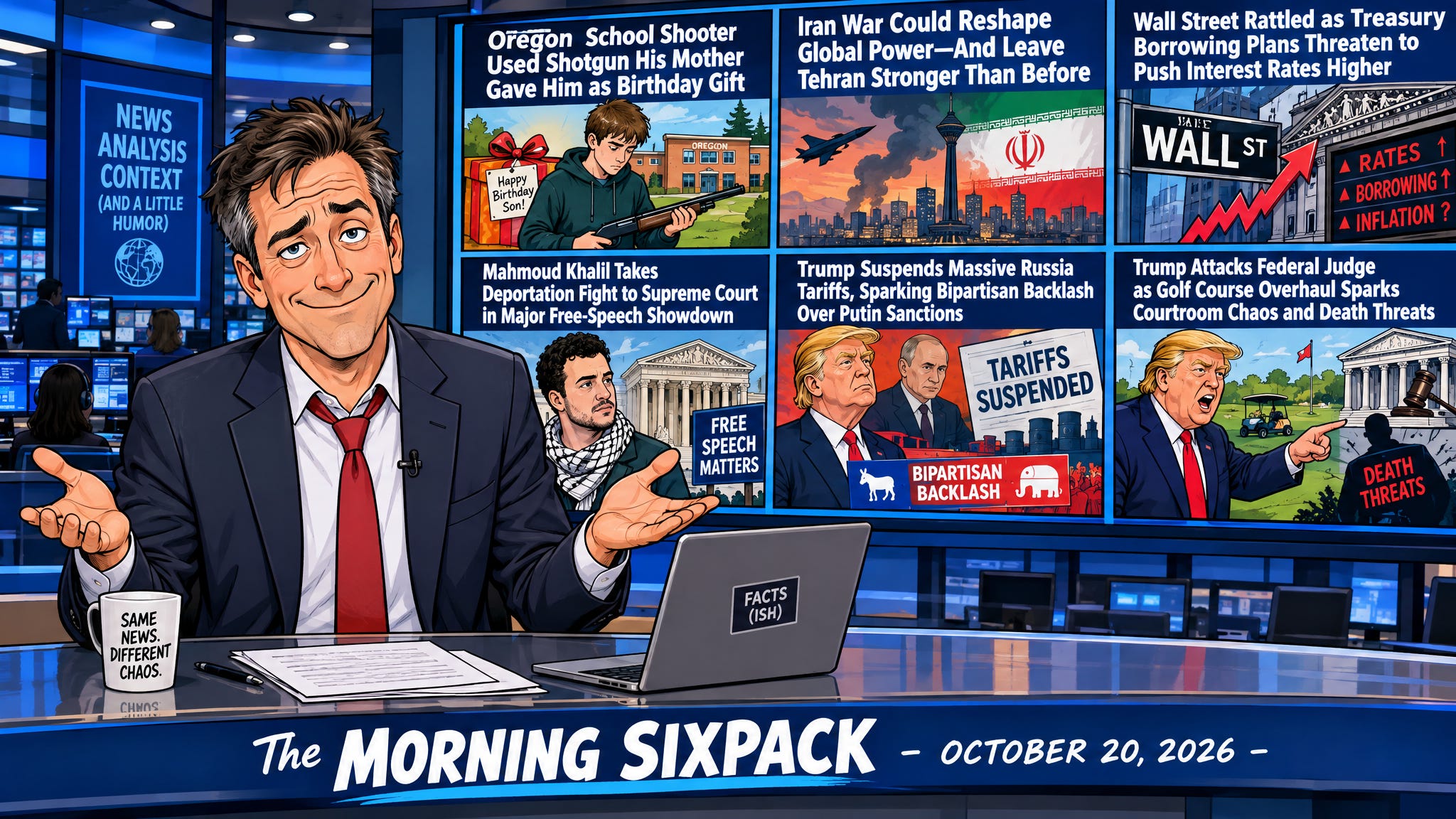
The Morning Sixpack stays free because the news that shapes your life should not be hidden behind a paywall. Paid subscribers are not paying for access. They are helping fund the research, writing, and independent voice that goes into every issue. Become a paid subscriber and help keep smart, honest news analysis free for everyone.
A 16-year-old killed four people at an Oregon elementary school with a shotgun his mother reportedly gave him for his birthday. The weapon was purchased legally. The consequences were devastating.
Oregon School Shooter Used Shotgun His Mother Gave Him as Birthday Gift
The shotgun used in last week’s deadly shooting at Silver Rail Elementary School in Bend, Oregon, was a birthday gift from the 16-year-old attacker’s mother, according to sources who spoke with CBS News. The weapon, a Maverick 88 pump-action 12-gauge shotgun, was legally purchased in August 2026 by Shauntai Nickerson, mother of Griffin J. John II. Sources said she gave the gun to her son for recreational use. The teenager subsequently used it to kill three children and a teacher and wound two others.
Investigators say the attack began when John fired at a passing pickup truck before shooting his way into the elementary school. The truck’s driver made the initial 911 call. Police said the teenager shattered the glass panes of a set of double doors, entered the building and proceeded into the first classroom on the left. Inside, he killed four people and wounded two others. Police confirmed Monday that nine people—four adults and five children—were in the classroom when the shooting occurred.
The victims included three children, ages 5, 8 and 11, and 25-year-old teacher Megan Lambert. Authorities identified the youngest victim as 5-year-old Rhoam Summer, while the families of the other two children have not publicly released their names. A 7-year-old girl and a 54-year-old teacher were wounded. The shooting ended when 36-year-old Bend resident Kaylub Giamanco, who witnessed the initial attack involving the pickup truck, followed the gunman into the school and fatally shot him. Giamanco has two daughters who attend Silver Rail Elementary.
The gunman was a former student of Silver Rail Elementary, although police have not identified a motive for the attack. In a 2020 interview with local television station KTVZ, Nickerson discussed her son’s difficulties with remote learning during the COVID-19 pandemic. She said her then-10-year-old son had special needs and was struggling without in-person educational support. “It’ll be great for my son to get back in there and get the help that he needs with the skilled teachers that he needs to get it from,” she told the station. Authorities have not established any connection between those educational challenges and the shooting.
Investigators continue examining the attacker’s computer, phone, social media accounts, search history, and other online activity for clues about his actions and possible motive. The Bend Police Department said Monday that evidence collection at Silver Rail Elementary was expected to conclude by the end of the day, after which the building would be returned to the school district. Meanwhile, a makeshift memorial of flowers and candles has grown outside the school. The investigation now includes the circumstances surrounding how a legally purchased shotgun, reportedly given to a teenager as a birthday present, became the weapon used to kill four people inside an elementary school.
Editor: A shotgun for a teenager’s birthday. Four people dead, two wounded, and families shattered. Whatever investigators ultimately uncover about the motive, the question of how that gun ended up in his hands deserves serious scrutiny.
Source: CBS News
The war with Iran was supposed to weaken Tehran and make the Middle East safer. Instead, it may be fueling a regional arms race, pushing China toward military expansion, and giving Iran more leverage than it had before. That’s quite a return on an investment nobody wanted.
Iran War Could Reshape Global Power—and Leave Tehran Stronger Than Before
The U.S.-Israeli war against Iran could fundamentally reshape the Middle East and the global balance of power, potentially producing consequences far beyond the battlefield. An analysis published by Foreign Policy argues that the conflict is accelerating four major geopolitical shifts: a Gulf Arab arms race, possible Chinese military expansion, Israel’s embrace of prolonged border warfare, and Iran’s emergence as a potentially more influential regional power. The war has already exposed vulnerabilities in missile defenses, global energy transportation, and American weapons stockpiles. But its most consequential effects may take years or even decades to become clear.
Persian Gulf nations are increasingly concluding that American protection alone cannot guarantee their security, prompting them to develop offensive military capabilities of their own. Although Western air defenses have reportedly intercepted roughly 90% of Iranian missiles and drones, the remaining attacks have inflicted enough damage to undermine confidence in the Gulf’s reputation as a safe destination for business, investment, energy production, and tourism. Saudi Arabia, the United Arab Emirates, Qatar, Kuwait, and Bahrain are pursuing or considering expanded drone capabilities, including partnerships with Turkey, Israel, China, Ukraine, and American manufacturers. The concern is that these new arsenals could encourage repeated military confrontations rather than prevent them. Instead of creating stability through deterrence, the region could enter an era in which rival governments routinely exchange missiles and drones to demonstrate their strength.
China faces a different problem: It has enormous economic interests in the Middle East but limited ability to protect them militarily. Beijing relies on the Gulf for as much as half its imported oil, while annual trade with Gulf countries exceeds $500 billion and could reach $800 billion by 2030. For decades, China benefited from American military involvement without assuming comparable responsibility for regional security. The Iran war has exposed the limitations of that arrangement, potentially encouraging Beijing to develop the ability to project military power into the Persian Gulf and surrounding waters. Meanwhile, Israel is pursuing a security strategy built around buffer zones and continuing military operations beyond its borders, particularly in Gaza, Lebanon, and Syria. The analysis warns that maintaining this approach could strain Israeli society, weaken its technology-driven economy, and further damage relations with important international partners, including the United States.
Iran, meanwhile, may emerge from the conflict with greater strategic leverage despite suffering significant military losses. American and Israeli strikes killed Supreme Leader Ali Khamenei and other senior officials, damaged Iran’s missile and drone production capabilities, and weakened its conventional air and naval forces. But the regime survived, and its new leadership is described as more aggressive and less concerned about escalation than Khamenei had been. Tehran has also demonstrated its ability to threaten commercial shipping through the Strait of Hormuz and disrupt Gulf economies with comparatively inexpensive missile and drone attacks. The analysis argues that these capabilities could give Iran substantial influence even without conventional military superiority. Complicating matters further, Russia and China have reportedly expanded their material and intelligence assistance to Tehran, helping rebuild and improve its weapons capabilities.
The central warning is that military victories do not necessarily translate into strategic success. A war intended to reduce Iran’s influence could instead leave Washington confronting a more confrontational Iranian government, increasingly militarized Gulf allies, a China considering a larger military presence, and an Israel committed to prolonged regional operations. The analysis also raises the possibility that Iran’s new leadership will become more determined to acquire nuclear weapons, particularly if it concludes that a nuclear deterrent is necessary to prevent future American or Israeli attacks. None of these outcomes is inevitable, and the long-term consequences remain uncertain. But the author argues that Washington must recognize these emerging risks before they become permanent features of the international order.
Editor: Washington went to war to weaken Iran. Now its Gulf allies are shopping for offensive weapons, China may decide it needs a bigger navy in the neighborhood, and Tehran could emerge with more leverage than before. Winning battles is one thing. Winning the peace—or even finding one—is apparently a different department.
Source: Foreign Policy
Wall Street is getting nervous about how Washington plans to finance its $40 trillion debt. Apparently, borrowing trillions gets a little more complicated when lenders start demanding higher interest rates.
Wall Street Rattled as Treasury Borrowing Plans Threaten to Push Interest Rates Higher
Wall Street investors are growing increasingly anxious about how the U.S. Treasury plans to finance the government’s enormous borrowing needs as bond yields climb and federal debt reaches $40 trillion. Yields on 10-year and 30-year Treasury securities rose Monday, reversing some of last week’s declines and renewing concerns about borrowing costs across the economy. The benchmark 10-year Treasury yield reached a 24-year high of 5.31% earlier in October before retreating to approximately 5.14% Monday. Investors are now looking to Treasury Secretary Scott Bessent for signs that Washington might reduce the supply of longer-term government bonds to help stabilize the market.
The immediate concern is whether the Treasury will scale back auctions of 20-year and 30-year bonds, which have struggled to attract consistent investor demand. Market participants had hoped a recent questionnaire sent to primary dealers would signal changes ahead of the Treasury’s November 4 quarterly refunding announcement. Instead, the document offered little clarity, leaving investors concerned that any meaningful adjustments could be delayed for another quarter or two. Citigroup strategists anticipate that the Treasury could reduce both 20-year and 30-year auction sizes by $3 billion, bringing new-issue auctions to $13 billion and $22 billion, respectively. Such a shift would likely push more government borrowing toward shorter-term Treasury bills, where interest rates are currently lower.
The financial stakes are substantial. With the national debt reaching $40 trillion this summer and the federal budget deficit approaching $2 trillion, Washington faces enormous and persistent financing demands. One-year Treasury bills have been yielding roughly 4.2%, compared with nearly 5.5% for some longer-term bonds, making shorter-term borrowing less expensive for taxpayers at current rates. But relying more heavily on short-term debt also means refinancing that borrowing more frequently, potentially exposing the government to future interest-rate increases. Meanwhile, elevated Treasury yields ripple throughout the economy, influencing mortgage rates, business loans, consumer borrowing costs, and investment decisions.
The bond market’s problems extend beyond government borrowing. September inflation figures came in hotter than expected, complicating the Federal Reserve’s efforts to bring inflation back toward its 2% target. Investors are also watching signs of financial stress among heavily leveraged artificial-intelligence infrastructure companies, particularly newer cloud-computing businesses spending aggressively to compete in the AI boom. Some analysts believe those credit risks may now be more important than Treasury auction sizes alone. Expectations for another Federal Reserve rate increase have also shifted dramatically: The probability of a hike at next week’s meeting fell below 20% Monday, compared with nearly 60% a month earlier, according to CME FedWatch data.
The Treasury’s November 4 announcement could provide important clues about how the government intends to manage its borrowing through the end of 2027. Some investors expect smaller long-term bond auctions, while others anticipate guidance about future issuance rather than immediate reductions. Portfolio managers are also weighing what persistent deficits and inflation could mean during the next economic downturn, particularly whether Washington would have the political or financial flexibility to respond with another major spending package. If fiscal stimulus is constrained, the Federal Reserve could face greater pressure to cut interest rates or resume purchasing longer-term government debt. For now, Wall Street is confronting an uncomfortable combination of massive federal borrowing, stubborn inflation, uncertain monetary policy, and growing concerns about credit-market stability.
Editor: Washington has $40 trillion in debt, a nearly $2 trillion annual deficit, and investors increasingly demanding premium interest rates to lend it money. The Treasury’s solution may be to borrow more short-term because it’s cheaper today. That’s not exactly fixing the problem—it’s hoping tomorrow’s refinancing bill looks better than today’s.
Source: MarketWatch
A green-card holder arrested over his pro-Palestinian activism is asking the Supreme Court to protect his free-speech rights. The bigger question: Can the government use immigration enforcement to punish speech it doesn’t like?
Mahmoud Khalil Takes Deportation Fight to Supreme Court in Major Free-Speech Showdown
Pro-Palestinian activist Mahmoud Khalil has asked the U.S. Supreme Court to intervene in his deportation case, challenging a federal appeals court ruling that could allow the Trump administration to detain him again and remove him from the country. Khalil’s attorneys filed an emergency application Monday seeking to block a decision by the Philadelphia-based 3rd U.S. Circuit Court of Appeals. The ruling found that federal immigration law prevented a district court from ordering Khalil’s release from detention in June 2025. His lawyers argue that the case raises a fundamental constitutional question: whether the government can imprison or deport a lawful permanent resident in retaliation for political speech protected by the First Amendment.
At the heart of the dispute is whether federal courts can intervene when immigration authorities allegedly use detention to punish constitutionally protected expression. The appeals court ruled that Khalil’s detention should have been challenged first through the immigration court system, which operates under the executive branch, rather than through a federal district court. Khalil’s attorneys want the Supreme Court to affirm that noncitizens can challenge retaliatory detention in federal court when their free-speech rights are threatened. The Trump administration maintains that pro-Palestinian activism can threaten American foreign policy interests and argues that immigration law gives it authority to deport noncitizens who engage in such activities. The case could establish an important precedent for how constitutional protections apply to lawful permanent residents facing immigration enforcement.
Khalil, a former Columbia University graduate student and permanent U.S. resident, became one of the first prominent targets of the administration’s crackdown on pro-Palestinian campus activism. Born in a Palestinian refugee camp in Syria, he served as a spokesperson for protest groups at Columbia, which became a center of demonstrations following the outbreak of the Israel-Gaza war in 2023. Federal immigration agents arrested him in March 2025 at the university housing complex where he lived with his American-citizen wife. He was transferred through detention facilities in New Jersey and Louisiana and remained in custody for more than three months before a federal judge ordered his release. His arrest quickly became a national flashpoint in debates over immigration enforcement, academic freedom, and political dissent.
Khalil continues fighting deportation through both the immigration court system and federal courts. In April, the Board of Immigration Appeals rejected his appeal and issued a final removal order, potentially sending him to Algeria or Syria. In May, the 3rd Circuit voted 6-5 against reconsidering its earlier ruling, although that decision will not take effect until Khalil exhausts his remaining appeals. His separate federal habeas corpus challenge also remains active. Speaking at a news conference Monday, Khalil warned that the implications extend far beyond pro-Palestinian activism: “If the Trump administration can punish someone for their pro-Palestine speech, this or any future administration can punish anyone for any speech.”
The Supreme Court application comes amid continuing protests over the administration’s treatment of international students and other noncitizens involved in campus demonstrations. On Monday, Columbia University faculty and staff held a silent vigil outside a campus entrance, carrying portraits of Khalil and fellow activist Mohsen Mahdawi. Demonstrators criticized Immigration and Customs Enforcement’s actions and called for solidarity with students facing deportation. The administration has defended its broader crackdown as an exercise of its immigration and foreign policy authority, while critics contend that it targets people for expressing unpopular political views. The Supreme Court must now decide whether to intervene in Khalil’s case, potentially setting the stage for a consequential ruling on the limits of executive power and the First Amendment rights of noncitizens.
Editor: The First Amendment isn’t supposed to come with a political loyalty test. The government has broad immigration powers, but whether it can use those powers to punish protected political speech is exactly the kind of question federal courts ought to be able to examine. Otherwise, free speech starts looking less like a constitutional right and more like a privilege granted by whoever occupies the White House.
Source: Al Jazeera
Trump calls himself the “Tariff King,” but when Congress handed him tariffs of up to 500% to punish Russia, he put them on hold. Apparently, some countries get the royal treatment.
Trump Suspends Massive Russia Tariffs, Sparking Bipartisan Backlash Over Putin Sanctions
President Donald Trump has suspended sweeping new sanctions and tariffs targeting Russia, triggering bipartisan criticism and raising questions about his willingness to use economic pressure against Moscow. On Friday, Trump signed an executive order waiving penalties just two days before they were scheduled to take effect under legislation he signed in September. The law, named for the late Republican Sen. Lindsey Graham, authorized tariffs of up to 500% on U.S. imports from Russia and 100% on the five largest importers of Russian oil and natural gas. The decision stands in sharp contrast to Trump’s enthusiastic use of tariffs against numerous other countries, including longtime American allies. After previously branding himself “Tariff Man,” “Mister Tariff,” and “The Tariff King,” Trump has now declined to deploy one of Congress’s most aggressive economic weapons against Russia.
The decision effectively puts a major congressional effort to pressure Russian President Vladimir Putin over the war in Ukraine on hold, at least temporarily. Ed Mills, a Washington policy analyst at Raymond James, said the waiver undermines meaningful enforcement of the Graham sanctions legislation and fits a broader pattern of Trump treating Russia differently from other trading partners. He also questioned the timing of the Friday announcement, just weeks before the midterm elections. Several Republicans publicly criticized the decision, including South Carolina Sen. Darline Graham, who succeeded her late brother, and outgoing Sen. Thom Tillis. Graham argued that maintaining pressure on Moscow was necessary to end the war and reduce energy prices, while Tillis condemned the move as irresponsible and accused Trump of yielding to Putin.
The administration defended the suspension as a necessary opportunity to assess the potential economic fallout from imposing massive new trade penalties. Secretary of State Marco Rubio said Trump wanted a 60-day period to study how the sanctions would affect the global economy and American consumers. The proposed tariffs would not only target Russia but also major purchasers of Russian energy, including India, potentially creating significant disruptions in international trade. Energy markets responded cautiously to the announcement, with oil futures dipping Monday morning on expectations that Russian crude could reach more buyers. However, Brent crude remained near five-month highs of approximately $110 per barrel, suggesting that the waiver offered little immediate relief from elevated energy prices.
Russia welcomed the decision. Kirill Dmitriev, head of Russia’s sovereign wealth fund, praised Trump’s executive order as “an important and truly historic moment.” Energy analysts cautioned that suspending sanctions does not necessarily mean more oil will reach global markets, since Russia already sells crude to China, India, Turkey, and other countries. Andy Lipow of Lipow Oil Associates said the waiver could expand Russia’s potential customer base, but actual increases in supply remain uncertain. The administration’s move also surprised some Wall Street analysts who expected Trump might enforce the sanctions selectively rather than suspend them outright. The distinction matters because the legislation was intended to make continued Russian aggression economically painful, particularly by targeting the countries helping finance Moscow’s war through energy purchases.
The controversy highlights a central contradiction in Trump’s trade policy. During his second term, he dramatically increased tariffs on imports from numerous countries, pushing American tariff levels to heights not seen since the Great Depression. Although some of those duties have subsequently been reduced through negotiations, legal challenges, and temporary agreements, overall U.S. tariffs remain higher than at any point between the 1940s and 2024, according to Yale University’s Budget Lab. Trump has justified tariffs as tools for rebuilding American manufacturing, combating illegal drug trafficking, and pursuing broader diplomatic objectives. Yet when Congress authorized exceptionally steep tariffs specifically designed to weaken Russia’s war economy, the president chose to delay them. Whether the administration eventually imposes those penalties after its 60-day review remains an open question.
Editor: Trump has slapped tariffs on allies, rivals, and practically anyone with a shipping container. But when Congress authorized tariffs of up to 500% against Russia, suddenly we needed a 60-day economic impact study. Apparently, the Tariff King has discovered restraint—and Putin is among the first to benefit.
Source: CNN
Trump wants to remake a historic public golf course, but his own officials can’t agree on what the plan is—or whether one even exists. Meanwhile, more than 400 trees are already gone, and the judge asking questions says she’s receiving death threats. All this over golf.
Trump Attacks Federal Judge as Golf Course Overhaul Sparks Courtroom Chaos and Death Threats
A federal judge overseeing President Donald Trump’s controversial plan to overhaul a historic Washington, D.C., public golf course faced personal attacks from the president and reports of death threats Monday as government officials offered conflicting accounts of the project. U.S. District Judge Ana C. Reyes spent nearly seven hours questioning Justice Department attorneys and Interior Department officials about the proposed redevelopment of East Potomac Golf Links. Earlier that morning, Trump had called Reyes a “crazed lunatic” and suggested she “may be insane” after she rejected the administration’s request that she remove herself from the case. By the end of the hearing, Reyes said family members had alerted her to reports of threats against her life, adding that she had also received disturbing emails and voicemails. “A federal judge is getting death threats over a golf course. I really don’t think that’s what the founders envisioned,” she told the courtroom.
The hearing exposed significant contradictions between Trump’s public announcements and what senior administration officials testified they actually knew about the redevelopment. Trump announced Sunday that his administration and prominent golf architect Tom Fazio had developed a plan to transform East Potomac into a championship course, with the existing facility scheduled to close November 15. By Monday morning, Trump declared that work would begin immediately. But Gregory Wischer, a senior Interior Department official, testified that he learned of the closing date from Trump’s social media post and had only recently seen the proposed design on his personal cellphone. Acting National Park Service Director Jessica Bowron said she knew of no plan to close the course, while Justice Department attorneys insisted that no final redevelopment plan existed. Reyes questioned how construction could begin immediately when the government maintained that the project was still being developed.
The dispute intensified after National Park Service crews and contractors removed more than 400 trees from East Potomac on October 10, prompting Reyes to temporarily prohibit additional cutting. The administration insisted that the removals were unrelated to Trump’s redevelopment proposal and instead followed recommendations from a 2019 report intended to restore the property’s historic links-style landscape. However, both Wischer and Bowron testified that they became familiar with that report only in late September, shortly before officials drafted and approved a tree-management plan. Reyes expressed deep skepticism that the timing was coincidental and indicated she was prepared to find that the tree removal was connected to the broader redevelopment. The judge also challenged government attorneys over their filings, ordering them to identify which lawyers were willing to stand behind the administration’s statements. Associate Attorney General Stanley Woodward Jr. objected and instructed the attorneys not to respond.
The proposed redesign could dramatically alter one of Washington’s most heavily used public recreation areas. A rendering attributed to Fazio would replace East Potomac’s existing 36 golf holes with a single 18-hole championship course. The design also appears to eliminate Ohio Drive, a historic miniature golf course, and a century-old grove of Japanese cherry trees, potentially affecting thousands of golfers, runners, cyclists, and other visitors to Hains Point. Bowron testified that the Park Service was working to preserve the property’s historic landscape, even as the proposed design suggested an entirely new facility. Trump, meanwhile, dismissed the existing course as old, deteriorated, and commercially unsuccessful, arguing that the federal government had every right to improve its own property. The conflicting explanations left Reyes openly questioning which version of the administration’s intentions she should believe.
Despite the heated exchanges, Reyes did not issue a final ruling Monday and indicated she was unlikely to block the entire redevelopment project. Instead, she appeared focused on preventing additional irreversible changes before the government completes the environmental and historic-preservation reviews that Park Service officials acknowledged would be required for a major renovation. She also considered requiring advance notice before the administration undertakes further work that could permanently alter the site. The hearing followed an unsuccessful Justice Department effort to remove Reyes from the case by accusing her of hostility toward the administration. With hundreds of trees already removed, the project’s scope still disputed, and the president publicly attacking the judge overseeing the case, the controversy has expanded well beyond golf course design into questions about government accountability, judicial independence, and the preservation of public land.
Editor: Trump says construction starts immediately. His own officials say they’re not ready, don’t know the closing date, and haven’t finalized a plan. Yet somehow more than 400 trees have been cut down. Apparently, the one part of this project that didn’t require a plan was the chainsaws.
Source: The Washington Post
Read The Morning Sixpack Archives here: