


The Morning Sixpack stays free because the news that shapes your life should not be hidden behind a paywall. Paid subscribers are not paying for access. They are helping fund the research, writing, and independent voice that goes into every issue. Become a paid subscriber and help keep smart, honest news analysis free for everyone.
Three children and a teacher are dead after a teenager attacked an Oregon elementary school. Once again, families are left facing a nightmare no parent should have to imagine.
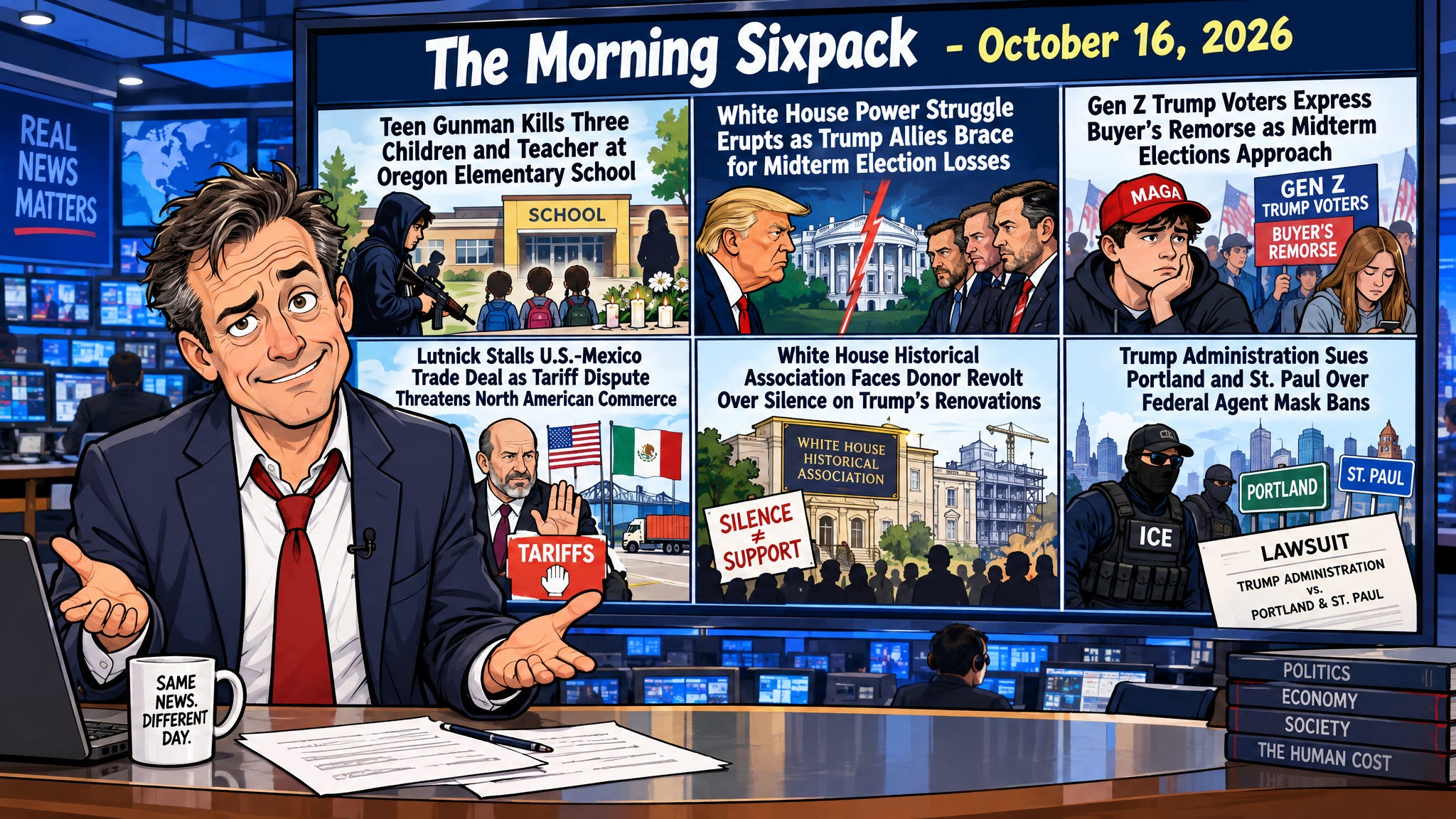
Teen Gunman Kills Three Children and Teacher at Oregon Elementary School
A 16-year-old gunman killed three children and a teacher Thursday after shooting through locked doors to enter Silver Rail Elementary School in Bend, Oregon. The children killed were 5, 8, and 11 years old. Two others—a 7-year-old child and a 54-year-old teacher—were critically injured and hospitalized. The teenage attacker was shot by a civilian who followed him into the school and was found dead inside the building minutes after the first emergency call.
The attack began shortly before 1 p.m. when someone outside the school called 911 to report being shot at by a person carrying a long gun. Additional calls quickly followed from inside the building. Officers arrived within minutes, according to police spokesperson Sheila Miller. Investigators were still determining whether the suspect, a Bend resident, had any connection to the school.
The attacker used a pump-action shotgun purchased by his mother, according to a law enforcement official briefed on the investigation. The official spoke anonymously because they were not authorized to discuss the case publicly. Authorities have not established a motive. Oregon Gov. Tina Kotek praised the civilian who intervened, acknowledging the emotional burden of confronting such violence.
Terrified families gathered at a nearby church designated as a reunification center as children were transported there by bus. Parents embraced their children, held their hands, and escorted them to waiting vehicles. Some brought stuffed animals and other familiar belongings to provide comfort. Silver Rail Elementary serves kindergarten through fifth grade and had 459 students enrolled last year.
The shooting marked the 28th mass killing in the United States this year, according to a database maintained by The Associated Press, USA Today and Northeastern University. Bend, a high-desert city about 125 miles southeast of Portland, is better known as an outdoor recreation destination. The Bend-La Pine school district canceled Friday classes, sports, and extracurricular activities across all 32 schools. Kotek described herself as “absolutely broken” by the tragedy and offered support to the civilian who stopped the attacker.
Editor: Three children and a teacher went to school Thursday and never came home. A civilian helped stop the attacker, but four lives were already lost. We can praise the courage it took to intervene without pretending that needing such courage inside an elementary school is anything resembling normal.
Source: Associated Press
With Republicans bracing for a potentially brutal midterm election, Trump’s aides are maneuvering for jobs that aren’t even vacant. The West Wing has rediscovered its favorite contact sport: backstabbing.
White House Power Struggle Erupts as Trump Allies Brace for Midterm Election Losses
Senior White House aides are increasingly jockeying for power as Republicans prepare for potentially devastating midterm election losses. Interviews with 20 administration staffers, advisers and Trump associates reveal growing tensions reminiscent of President Donald Trump’s first term. Deputy Chief of Staff Stephen Miller, housing official Bill Pulte, and EPA Administrator Lee Zeldin are reportedly positioning themselves as potential replacements for Chief of Staff Susie Wiles. There’s just one complication: Wiles hasn’t indicated she’s planning to leave.
The infighting intensified after Trump approached Katie Zacharia about becoming White House press secretary without consulting Wiles, a move insiders viewed as undermining her authority. One Trump ally described the past week as “the new Wild Wild West.” Trump has reportedly grown frustrated that advisers aren’t defending him aggressively enough and has begun calling friends and outside confidants directly. Those conversations suggest concern that important information isn’t reaching him through normal White House channels.
Internal Republican polling has shown declining support following the party’s September convention in Dallas, with voters increasingly frustrated over high prices and economic concerns. Many Trump advisers expect Republicans to lose control of the House, while the Senate remains a toss-up. Even traditionally Republican states such as Kansas and Texas are reportedly competitive. The prospect of electoral losses has intensified speculation about leadership changes inside the administration.
The competition for Trump’s attention has produced some unusual tactics, particularly from Pulte, who frequently presents the president with elaborate poster boards promoting policy ideas. The displays cover subjects ranging from Federal Reserve interest rates to Kennedy Center renovations, sometimes featuring flattering images of Trump. According to people familiar with the situation, Trump has complained that the presentations are cluttering the White House residence. The episode illustrates how officials are competing for influence as uncertainty grows over Wiles’s future.
Wiles has also faced political headaches involving two close allies, James Blair and Chris LaCivita, whose consulting work for the pro-Russian government of Republika Srpska reportedly angered Trump. Her daughter Katie works for a lobbying firm representing the same government and was photographed visiting the territory. Although Blair and LaCivita remain involved in Republican midterm strategy, the controversy has reportedly weakened their influence and provided ammunition to Wiles’s rivals. White House spokesperson Danielle Alvarez rejected accounts of infighting, insisting the administration remains united and focused on Trump’s agenda.
Editor: Nothing screams stable leadership quite like senior officials auditioning for a job nobody has resigned from while the president complains about too many poster boards in his house. Republicans may be worried about losing Congress, but inside the White House, the campaign to win the next office down the hall is already underway.
Source: The Washington Post
Some young Trump voters are experiencing buyer’s remorse as rising prices and unfulfilled promises collide with reality. Unfortunately for Democrats, being disappointed in Republicans doesn’t automatically mean anyone trusts them, either.
Gen Z Trump Voters Express Buyer’s Remorse as Midterm Elections Approach
Some young Americans who supported Donald Trump in 2024 are questioning their decision as economic frustrations and political disillusionment grow. A focus group of eight Generation Z Trump voters conducted by the left-leaning Navigator Research revealed widespread disappointment with the president’s performance. Six participants gave Trump a D or F grade, while the remaining two assigned him a C. Several expressed regret over their votes, citing rising costs, broken promises, and dissatisfaction with the country’s direction.
The frustration could complicate Republican efforts to maintain support among younger voters in competitive congressional races. The focus group included participants ages 20 to 29 from Florida, Mississippi, Ohio, Texas, and South Carolina. John, a 29-year-old Florida Republican who has supported Trump since 2016, gave the president an F and said he now intends to vote for Democrats. “I just feel like nothing went correctly. I just feel like everything got worse,” he explained. Although the small group isn’t nationally representative, Navigator’s August polling found that nearly one-third of Gen Z Trump voters regretted their choice.
But dissatisfaction doesn’t necessarily translate into Democratic support. Four participants still planned to vote Republican, three intended to support Democrats, and one remained undecided. Matthew, a 25-year-old Texas voter, praised Trump’s immigration enforcement and diplomatic efforts while criticizing his handling of the Iran war. He gave Trump a C and argued that larger Republican congressional majorities would help the president accomplish more of his agenda.
Foreign policy has become another source of frustration among younger conservatives who expected Trump to avoid costly overseas conflicts. Courtney, a 20-year-old South Carolina voter, said she doesn’t regret supporting Trump but has become increasingly distrustful of both parties. She criticized American assistance to Israel and the war with Iran, arguing that domestic priorities suffer when Washington spends money overseas. Her comments reflect political alienation that extends beyond traditional party loyalties.
Navigator Research managing director Melissa Toufanian warned that declining Republican support isn’t producing an equivalent increase in confidence in Democrats. The organization’s polling suggests many younger voters are moving toward distrust of both parties rather than switching allegiances. Similar erosion among independents and Latino voters has weakened portions of Trump’s 2024 coalition. Republicans must motivate disappointed supporters, while Democrats face the challenge of convincing skeptical voters that they offer a meaningful alternative.
Editor: Six out of eight young Trump voters gave him a D or F, yet half still plan to vote Republican. That’s not exactly a ringing endorsement of either party. When voters start treating elections like choosing which disappointment they can tolerate, Washington might want to reconsider its customer-service strategy.
Source: NPR
Washington and Mexico were closing in on a trade agreement until Howard Lutnick reportedly stepped on the brakes. For businesses trying to navigate the tariff maze, the only thing moving freely across the border may be uncertainty.
Lutnick Stalls U.S.-Mexico Trade Deal as Tariff Dispute Threatens North American Commerce
Commerce Secretary Howard Lutnick has reportedly complicated U.S.-Mexico trade negotiations by opposing significant reductions in tariffs on Mexican automobiles, steel, and aluminum. Negotiators had been approaching an agreement that would ease American tariffs in exchange for concessions from Mexico, potentially clearing the way for broader discussions about renewing the United States-Mexico-Canada Agreement (USMCA). Progress has slowed as Lutnick resists lowering the 25% tariff on Mexican vehicles and 50% duties on steel and aluminum. The disagreement threatens months of negotiations between two major trading partners.
Lutnick’s intervention marks the second time he has reportedly disrupted advanced trade negotiations with a North American ally. Similar objections contributed to the breakdown of U.S.-Canada talks in August, triggering retaliatory tariffs. Trump has since threatened to double tariffs on Canadian automobiles to 50% in January if the countries fail to reach an agreement. Mexico has avoided retaliation while continuing negotiations despite frustration with Washington’s changing demands.
The dispute exposes competing priorities over protecting American industries and maintaining competitive North American manufacturing. Domestic aluminum producers warn that reducing tariffs could undermine U.S. companies and eliminate jobs. Automakers, meanwhile, complain that obtaining tariff rebates for American-made components requires excessive paperwork and complicated approvals. Combined with higher tariffs than those imposed on Japanese and South Korean vehicles, those burdens have reportedly encouraged some manufacturers to shift production toward Asia.
Mexico wants automobile tariffs of 15% or less, along with expanded rebates recognizing components manufactured throughout the USMCA trading bloc. Its officials argue that Mexico deserves better treatment than countries outside the agreement, particularly when Washington demands additional purchases of American goods and potentially higher Mexican tariffs on Chinese imports. Mexican President Claudia Sheinbaum said negotiations had reduced an initial list of 54 American trade concerns to roughly a dozen unresolved issues. Nevertheless, a senior Mexican official complained that Washington repeatedly introduces new demands whenever an agreement appears close.
The standoff also reflects shifting influence within Trump’s trade team. U.S. Trade Representative Jamieson Greer had led much of the negotiating process, partly because foreign governments preferred his measured approach to Lutnick’s more confrontational style. Lutnick’s renewed involvement has complicated efforts to finalize an agreement before the midterms. Officials from both governments insist discussions remain constructive, but disagreements over tariffs continue to cloud the future of North American trade.
Editor: Nothing says “strengthening American manufacturing” quite like a tariff system so complicated that automakers consider moving production to Asia to escape the paperwork. Washington says it wants more North American trade, but apparently only after making North American trade as difficult as humanly possible.
Source: The Wall Street Journal
An organization founded to preserve White House history is losing longtime donors while courting the president who’s dramatically remaking it. Apparently, historic preservation now comes with a presidential approval requirement.
White House Historical Association Faces Donor Revolt Over Silence on Trump’s Renovations
The White House Historical Association is facing backlash from longtime supporters who accuse the nonprofit of abandoning its preservation mission while cultivating a close relationship with President Donald Trump. Founded by Jacqueline Kennedy in 1961, the organization has remained largely silent as Trump demolished the East Wing and altered the White House grounds. Four donors representing more than $500,000 in contributions have stopped giving, while other philanthropists responsible for millions in potential donations are reconsidering their support. Critics say the association has prioritized access to powerful benefactors over defending the historic property it was created to preserve.
The controversy intensified after businessman Vance Patterson pledged $2.5 million believing his donation would help demolish the East Wing and document its contents before construction of Trump’s ballroom. Patterson said he negotiated the arrangement with association president Stewart McLaurin and received a tour before the building’s destruction. The association maintains that his contribution funded historical documentation, including detailed 3D photography, and that none of the money paid for demolition or construction. After the East Wing was torn down in October 2025, association leaders reportedly instructed employees not to disclose the donation or photographic records to concerned supporters.
Association leaders argue that the organization lacks authority to prevent presidential changes to the White House, although preservation experts suggest it might have grounds to challenge some modifications legally. Instead, McLaurin has cultivated a relationship with Trump, who has hosted fundraising dinners and promoted the organization’s activities. Critics cite the destruction of the Jacqueline Kennedy Garden as another example of a change that deserved public opposition. Former association historian Ed Lengel condemned the organization’s retreat from architectural preservation, calling its apparent narrowing of responsibilities “outrageous and cowardly.”
The dispute has also revived concerns about McLaurin’s leadership and the association’s expanding fundraising operation. Annual revenue increased from $12 million in fiscal 2015 to $73 million in fiscal 2024, driven largely by fundraising for the People’s House visitor center. McLaurin’s compensation rose from approximately $295,000 to $521,000 during that period. Supporters credit him with revitalizing the nonprofit, but critics question spending on elaborate events, international travel, promotional campaigns, and merchandise. Former employees have also alleged a difficult workplace culture involving disparaging remarks and frequent turnover.
The association’s silence contrasts with its willingness to influence White House decisions under previous administrations. Former staff and officials say McLaurin objected to a modern painting by Cuban American artist Carmen Herrera displayed during the Biden administration, arguing that Jacqueline Kennedy would have disapproved. The painting was subsequently removed before its addition to the presidential collection was publicly announced. As Trump’s ballroom plans advanced through federal review, however, McLaurin avoided public criticism and instead promoted international meetings and educational initiatives. The donor revolt raises questions about whether the association can maintain its historical mission while depending on the goodwill of the administration whose actions critics believe it should scrutinize.
Editor: Jacqueline Kennedy created an organization to protect the People’s House, not serve as its gift shop and presidential fan club. When a historical preservation group stays silent about demolishing a historic wing but finds time to sell Scottish tartan mugs, you have to wonder whether someone misplaced the mission statement.
Source: The Washington Post
Police routinely tell citizens to identify themselves. Now the Justice Department is fighting to keep federal agents from having to do the same. The legal arguments may be complicated, but the irony is remarkably straightforward.
Trump Administration Sues Portland and St. Paul Over Federal Agent Mask Bans
The Trump administration has filed lawsuits against Portland, Oregon, and St. Paul, Minnesota, challenging local laws that prohibit federal law enforcement officers from concealing their faces and require them to identify themselves. The Justice Department filed both complaints Thursday, bringing its total number of challenges against similar restrictions to 11. Federal attorneys argue that the ordinances violate the Constitution’s Supremacy Clause, which establishes federal law’s precedence over conflicting state and local laws. The administration maintains that cities cannot regulate federal operations or impose restrictions that could endanger officers and their families.
The lawsuits escalate a nationwide dispute over masked federal immigration agents conducting arrests during the administration’s immigration crackdown. At least eight states and nine local jurisdictions have adopted measures restricting officers from concealing their identities. Supporters argue that residents have a right to know whether the people detaining them are legitimate law enforcement officers. Federal officials counter that exposing agents’ identities could make them and their families targets for harassment, intimidation, or retaliation.
Portland City Councilor Sameer Kanal proposed the city’s mask ban and identification requirements in September 2025. St. Paul officials announced similar plans on January 21, following the fatal shooting of U.S. citizen Renée Good by a masked Immigration and Customs Enforcement agent in Minneapolis. When St. Paul Mayor Kaohly Her signed the ordinance in February, she accused ICE of creating confusion and damaging public trust in local police by obscuring agents’ faces. Both cities argue that visible identification is essential to accountability during enforcement operations.
The ordinances establish different penalties for violations. Portland allows civil enforcement actions, while St. Paul makes noncompliance a misdemeanor punishable by fines, imprisonment, or both. Associate Attorney General Stanley Woodward Jr. argued that local governments cannot interfere with federally authorized operations. U.S. Attorney Scott Bradford in Oregon defended federal officers, emphasizing that they live and raise families in the communities they serve and should not be vilified for political reasons.
The latest filings follow a similar Justice Department lawsuit against Denver last week. The central legal question is whether municipalities can require federal agents to remain visibly identifiable or whether those requirements unlawfully interfere with federal authority. Supporters of the ordinances maintain that transparency protects residents and strengthens public trust, while the administration insists that officer safety and federal supremacy must prevail. The outcome could have significant implications for immigration enforcement practices across the country.
Editor: The government insists that people should cooperate with law enforcement while simultaneously fighting to let officers conceal their faces and identities. Officer safety matters, but so does knowing whether the masked person approaching you with a weapon actually works for the government. That’s not an unreasonable question in a country supposedly governed by the rule of law.
Source: UPI
Read The Morning Sixpack Archives here: