


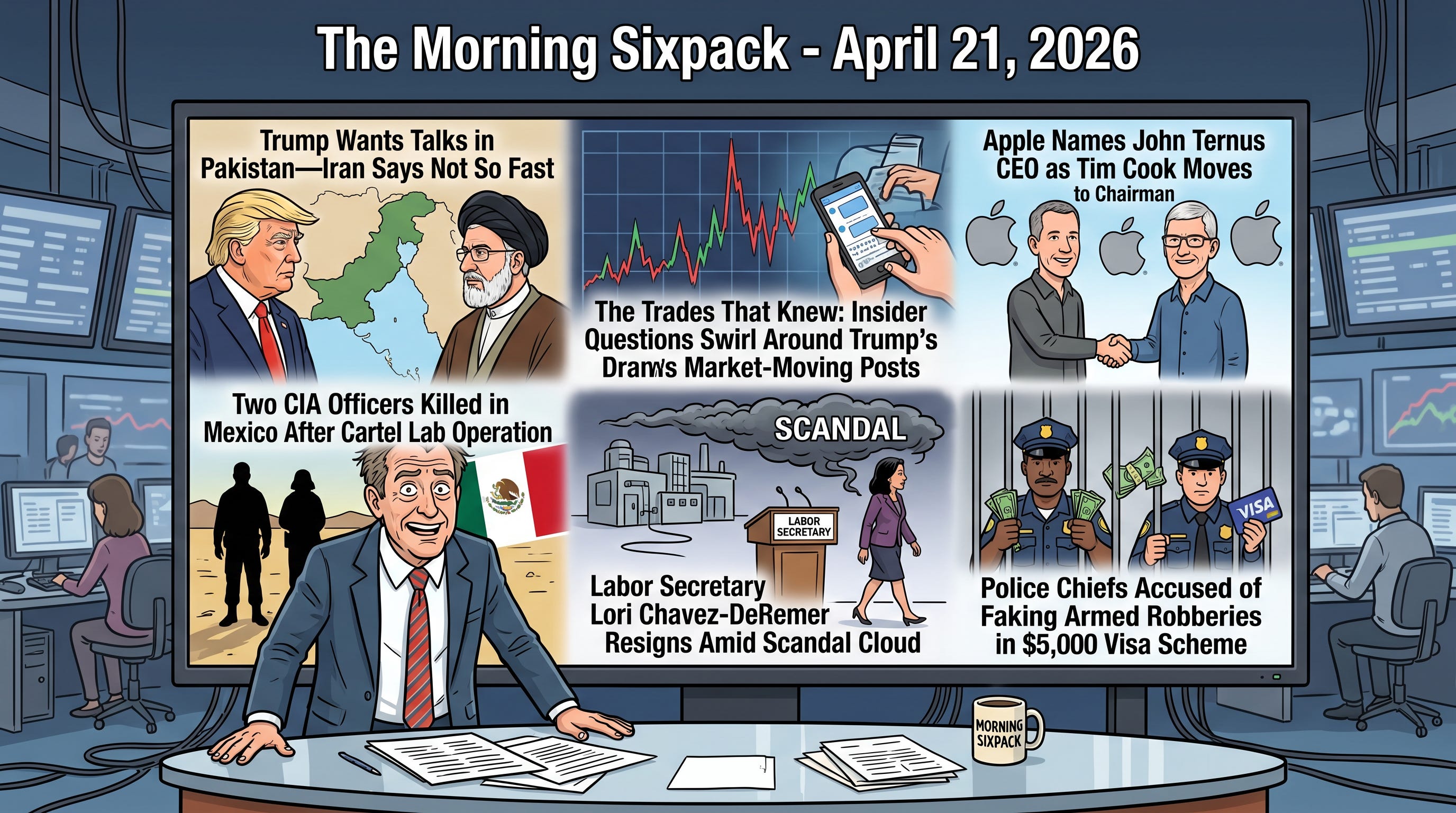
Trump Wants Talks in Pakistan—Iran Says Not So Fast
Pakistan is ready to host multi-day U.S.-Iran peace talks, but Tehran is openly questioning whether it will even show up.
And with the ceasefire clock ticking, Washington just seized an Iranian ship and revived threats to bomb power plants.
Islamabad has rolled out the red carpet and the razor wire. Hotels cleared. Roads sealed. Security surged. Prime Minister Shehbaz Sharif is betting Pakistan can lock both sides in a room long enough to hammer out at least a ceasefire extension—maybe even a temporary memorandum of understanding that buys 60 more days. That’s the plan.
Tehran, however, is playing hard to get. Iranian officials say U.S. actions—including a naval blockade of the Strait of Hormuz and the overnight seizure of an Iranian cargo ship—amount to violations of the very ceasefire Washington claims to support. Foreign Ministry spokesman Esmaeil Baghaei didn’t mince words: “The US is not learning its lessons from experience, and this will never lead to good results.”
Then there’s Donald Trump, who announced his team was heading to Islamabad while simultaneously threatening to “knock out every single Power Plant, and every single Bridge, in Iran” if Tehran doesn’t take what he calls a “very fair and reasonable DEAL.” He added, for emphasis: “NO MORE MR. NICE GUY!” Subtle.
Behind the public chest-thumping, analysts see a familiar dance—hardline rhetoric at home, quieter flexibility behind closed doors. One diplomat summed it up perfectly: “It appeared as if the Americans brought a stopwatch, whereas the Iranians came armed with a calendar.” Translation: Washington wants this wrapped yesterday; Tehran is fine dragging it out.
Bottom line: even if Iran sends a delegation, nobody expects a grand bargain this week. The most realistic outcome? A modest ceasefire extension. The big fights—nuclear limits, control of Hormuz, regional leverage—are still very much on the table.
Source: Al Jazeera
Editor: Nothing accelerates diplomacy quite like a naval blockade and a hole in your engine room. But sure—let’s call it confidence-building.
The Trades that Knew: Insider Questions Swirl Around Trump’s Market-Moving Posts
A new BBC analysis found repeated spikes in trading activity just minutes before some of Donald Trump’s biggest market-moving announcements.
In several cases, millions were wagered before the public had any idea what was coming.
The pattern is hard to ignore. On March 9, just before Trump told CBS the Iran war was “very complete, pretty much,” oil futures trading surged 47 minutes before the interview became public. When the comments hit, oil plunged 25%. The traders who placed those early bets? They likely walked away with millions. Donald Trump
Two weeks later, on March 23, Trump posted on Truth Social about “VERY GOOD AND PRODUCTIVE CONVERSATIONS” with Tehran and a “COMPLETE AND TOTAL RESOLUTION” to hostilities. Oil dropped 11% almost instantly. But once again, there was an unusual spike in oil bets 14 minutes before the post went live. One analyst told the BBC the trades appeared “abnormal, for sure.”
It’s not just oil. Last year’s so-called “Liberation Day” tariff pause sent the S&P 500 soaring 9.5% in a single day. Yet massive bets on the market rising were placed minutes before the announcement. Some traders reportedly risked $2m and may have pocketed nearly $20m in profit. Senate Democrats urged the SEC to investigate whether insiders were enriched. The SEC declined to comment.
Then there’s the wild west of prediction markets like Polymarket and Kalshi. A user betting on Venezuelan leader Nicolás Maduro being ousted turned $32,500 into $436,000—one day before US special forces seized him. Six separate accounts bet on US strikes against Iran in February and collectively won $1.2m when the attacks were confirmed. Five of those accounts went dark afterward.
Proving insider trading is another matter. It’s illegal—and has been for government officials since 2012—but enforcement is notoriously difficult. As one finance law professor put it, “You can have massive trades…that clearly show that someone was privy…Yet there is a strong chance that no-one will be prosecuted.”
The White House calls any implication “baseless and irresponsible.” Regulators say they have “zero tolerance.” Meanwhile, the trading spikes keep lining up neatly with presidential posts.
Coincidence? Maybe. But if this is guesswork, someone on Wall Street has developed psychic powers.
Source: BBC
Editor: Either a handful of traders can read the president’s mind—or someone’s getting tomorrow’s headlines today. Place your bets.
Apple Names John Ternus CEO as Tim Cook Moves to Chairman
Apple is handing the CEO reins to hardware chief John Ternus, with Tim Cook stepping into the executive chairman role on Sept. 1.
It’s the first leadership shake-up at Apple since Cook replaced Steve Jobs in 2011.
Apple announced Monday that John Ternus, its senior vice president of hardware engineering, will become the company’s eighth CEO. Cook, 65, will stay on through the summer to oversee what the company calls a “smooth transition,” before moving upstairs as executive chairman. Tim Cook has run Apple for nearly 15 years.
“It has been the greatest privilege of my life to be the CEO of Apple and to have been trusted to lead such an extraordinary company,” Cook said in a statement. “I love Apple with all of my being…”
Under Cook, Apple’s market cap ballooned more than 20-fold to $4 trillion. Revenue nearly quadrupled to over $400 billion annually. He turned Apple into a supply-chain machine, expanded into wearables like the Apple Watch and AirPods, and navigated trade wars, privacy fights and a very public dance with President Donald Trump.
Ternus, 50, is no outsider. He’s spent roughly half his life at Apple and currently oversees the hardware engineering teams behind the iPhone, iPad, Mac, Apple Watch, AirPods and Vision Pro. He joined in 2001 and has long been viewed as the heir apparent. He’ll also join Apple’s board.
The timing is interesting. Apple is facing tariff headaches, geopolitical tension, supply chain strain and—most notably—mounting criticism that it’s lagging in artificial intelligence. The company has promised a revamped Siri powered by Google’s Gemini AI model later this year, after delays dented investor confidence.
Cook exits the CEO suite with compensation last year of $74.6 million and an estimated net worth near $3 billion. Not bad for the guy once nicknamed “Tim Apple.”
As for Ternus? He inherits the crown at a moment when Apple’s next act—AI, services growth and navigating global politics—may prove tougher than building the iPhone empire in the first place.
Source: CNBC
Editor: When you’ve turned a near-bankrupt company into a $4 trillion behemoth, you don’t retire—you just change the title on the business card. Good luck, John. No pressure.
Two CIA Officers Killed in Mexico After Cartel Lab Operation
Two U.S. embassy officials who died in a car crash in northern Mexico were CIA officers returning from a counternarcotics mission.
The accident comes as the CIA dramatically expands its footprint in Latin America under President Trump.
The deadly crash in Chihuahua also killed two Mexican officials. According to Mexican authorities, the vehicle skidded off the road, plunged into a ravine, and exploded. The Americans had just met with Mexican officials following a massive drug lab seizure described as “perhaps one of the largest ever located.”
The Central Intelligence Agency declined to comment, but U.S. officials confirmed the two embassy personnel worked for the agency. Under CIA Director John Ratcliffe, the spy agency has taken a far more aggressive role in counter-drug operations—sharing intelligence, training Mexican units, and flying unarmed drones to track cartel leaders.
The ramp-up aligns with President Donald Trump’s intense pressure campaign on Mexico to crack down on cartels. The administration has even carried out military actions in the Caribbean and Pacific targeting suspected drug-running vessels, drawing criticism from legal experts who question the international law implications.
Mexico’s President Claudia Sheinbaum said she will investigate whether proper protocols were followed, emphasizing that “There are no joint operations on land or in the air” between Mexican and U.S. forces—only intelligence sharing within a “well-established” legal framework.
The incident is politically explosive in Mexico, where U.S. intervention carries deep historical baggage. Officially, the Americans were not directly involved in the lab raid itself but were conducting training elsewhere before meeting with local officials. Hours later, they were dead.
The broader picture? U.S. involvement in Mexico’s drug war is intensifying—quietly in some cases, forcefully in others. And now it has cost American intelligence officers their lives.
Source: The Washington Post (gift)
Editor: When covert missions start ending in fiery ravines, it’s safe to say the “partnership” phase of the drug war is getting a lot more complicated.
Labor Secretary Lori Chavez-DeRemer Resigns Amid Scandal Cloud
Labor Secretary Lori Chavez-DeRemer stepped down Monday as investigations into alleged misconduct swirled inside the department.
Her resignation makes her the third Cabinet official out since January—and all three have been women.
According to multiple sources, Chavez-DeRemer’s tenure had been overshadowed by allegations of an extramarital affair with a member of her security detail and claims of inappropriate behavior, including drinking on the job. Several staffers reportedly resigned amid the internal probe.
A Labor Department spokesperson declined to comment. But White House Communications Director Steven Cheung confirmed the departure, saying Chavez-DeRemer “will be leaving the Administration to take a position in the private sector” and praising her for “protecting American workers” and advancing workforce policy.
Keith Sonderling will serve as acting secretary. It’s unclear who Donald Trump will nominate to permanently fill the role.
Chavez-DeRemer, a former one-term congresswoman from Oregon, was sworn in last March. Insiders say the White House had grown wary of the steady drumbeat of controversy—and anticipated Democrats would hammer her during a scheduled congressional hearing this week.
Instead, she’s out before the questioning even began.
Source: NOTUS
Editor: When the phrase “position in the private sector” shows up mid-investigation, you know the résumé update wasn’t entirely voluntary.
Police Chiefs Accused of Faking Armed Robberies in $5,000 Visa Scheme
Federal prosecutors say Louisiana lawmen fabricated armed robberies for nearly 10 years to help foreign nationals secure special U visas.
The “crime wave” never happened—but the money allegedly did.
According to a sweeping 62-count indictment, three current or former police chiefs, an elected marshal and a local Subway owner in Oakdale and neighboring towns manufactured bogus police reports claiming immigrants were victims of armed robberies. Each name allegedly brought in $5,000.
Then-acting U.S. Attorney Alexander Van Hook put it bluntly: “In fact, the armed robberies never took place.”
At the center of the scheme, prosecutors say, was Chandrakant “Lala” Patel, a local businessman who allegedly connected would-be visa applicants with cooperative law enforcement officials. Those officials—including Oakdale Police Chief Chad Doyle and others—are accused of generating false crime reports to support U visa applications, which allow certain crime victims to remain in the U.S.
Investigators with U.S. Citizenship and Immigration Services reportedly uncovered patterns of inconsistencies in applications in 2024, triggering a multiagency probe. Hundreds may have obtained visas through the alleged operation. All defendants have pleaded not guilty, though plea hearings are now scheduled for two of them.
The fallout has rattled the small Louisiana towns along U.S. Route 165. Residents describe disbelief and embarrassment. One local business owner said, “I think it hurt the reputation of our town.”
The alleged scheme also lands amid a broader immigration crackdown under President Donald Trump, who has focused heavily on border enforcement—while this operation, prosecutors say, unfolded far from any border, inside local police departments.
The case is still winding through court. A trial date has been delayed.
For nearly a decade, officials say, paperwork replaced patrol work—and phantom crimes funded real paydays.
Source: The Wall Street Journal (gift)
Editor: Small-town policing is supposed to be about keeping the peace—not inventing crime scenes as a side hustle. “Shop With a Cop” hits differently when the paperwork’s fictional.