


The Morning Sixpack stays free because the news that shapes your life should not be hidden behind a paywall. Paid subscribers are not paying for access. They are helping fund the research, writing, and independent voice that goes into every issue. Become a paid subscriber and help keep smart, honest news analysis free for everyone.
U.S. military leaders have been warning Pete Hegseth that keeping the Iran war machine running at this pace is draining forces, ships, and weapons needed elsewhere—apparently “all options are on the table” except giving the Pentagon a breather.
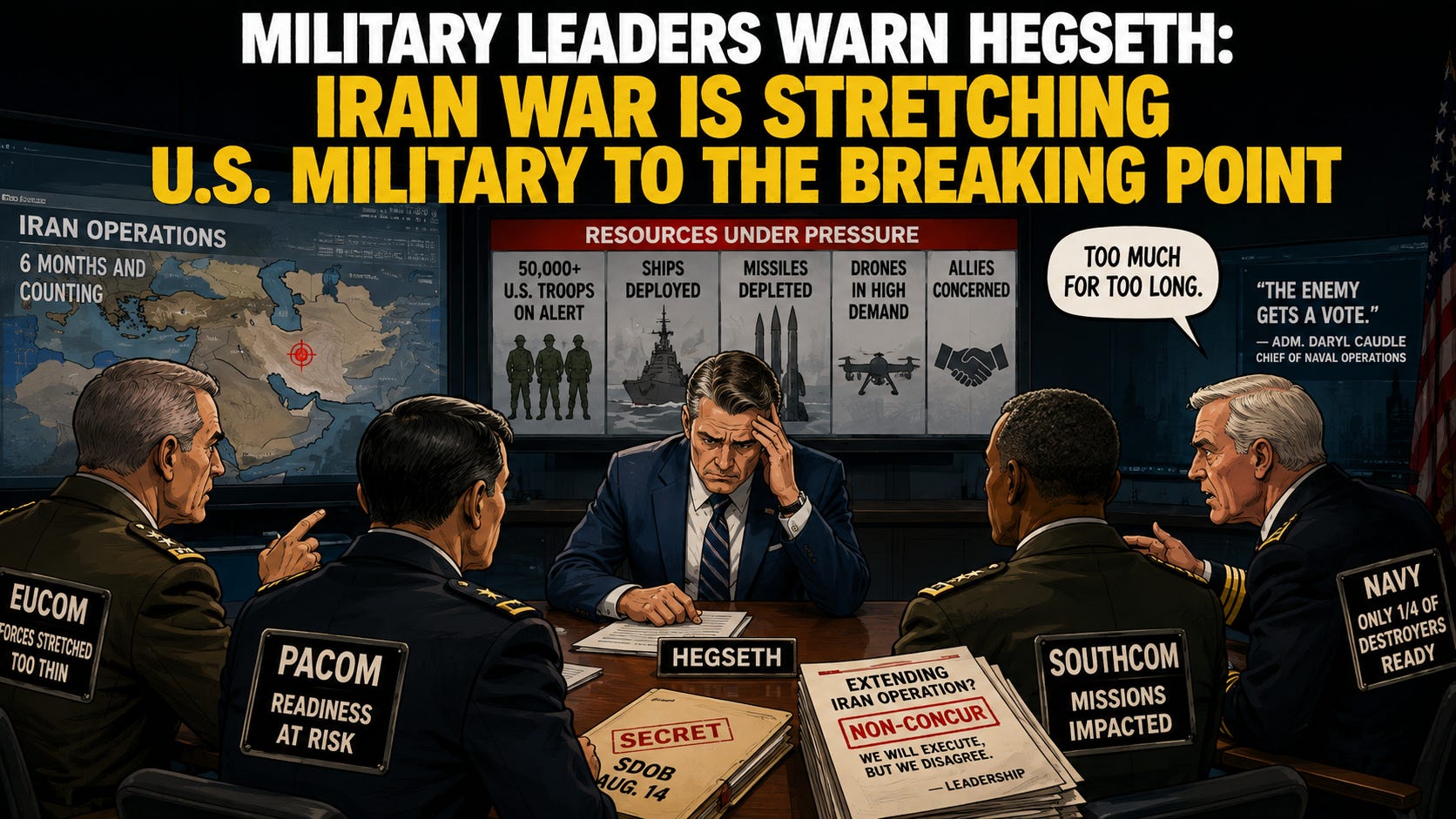
Senior U.S. military leaders have warned Defense Secretary Pete Hegseth that extending large-scale operations against Iran is becoming unsustainable and could leave America less prepared for threats elsewhere—including threats to the homeland. The classified Aug. 14 assessment reportedly includes objections from commanders responsible for Europe, the Pacific, and Latin America, as well as the Navy’s top admiral.
Six months into the Iran war, America’s military isn’t merely getting tired—it’s burning through readiness.
More than 50,000 U.S. troops have remained on alert in the region while President Trump presses Tehran to reopen the Strait of Hormuz and accept U.S. conditions for ending the conflict. Some deployments now stretch through September, others into 2027, and elements of the Army’s 82nd Airborne Division are facing year-long deployments. Several senior commanders formally registered a “non-concur” with extending forces, meaning they oppose the orders but will carry them out anyway. One person familiar with the assessment summed up the military leadership’s mood as “too much for too long.”
The Navy appears to be flashing the brightest warning light. Adm. Daryl Caudle reportedly told Hegseth that the service cannot indefinitely sustain its current support because there’s no anticipated end date, with barely one-fourth of the destroyer fleet ready to deploy. This sounds… BAD.
Ships and surveillance aircraft diverted from Europe, Asia, and Latin America have degraded other commands’ ability to fulfill missions, while Patriot and THAAD interceptors, Tomahawk missiles, and Reaper drones have all taken hits from the campaign’s demands.
Admiral Caudle put the human cost plainly: “I typically am not a big fan of extensions, and I push back hard on that, but the enemy gets a vote.”
The Pentagon says force commitments are determined by threats, presidential priorities, and advice from senior commanders, while declining to discuss classified deliberations. But this warning didn’t materialize from nowhere: Military leaders had raised concerns about munitions and allied support before the war began, and Pacific allies are now worried depleted U.S. missile and air-defense stocks could weaken deterrence against China & Russia.
Washington can debate how long to keep squeezing Iran, but ammunition inventories, maintenance schedules, and exhausted crews don’t participate in political messaging.
Editor: When admirals start putting “we’ll do it, but this is a bad idea” into the official paperwork, that’s less a staffing disagreement and more the dashboard lighting up like a Christmas tree.
Source: The Washington Post