


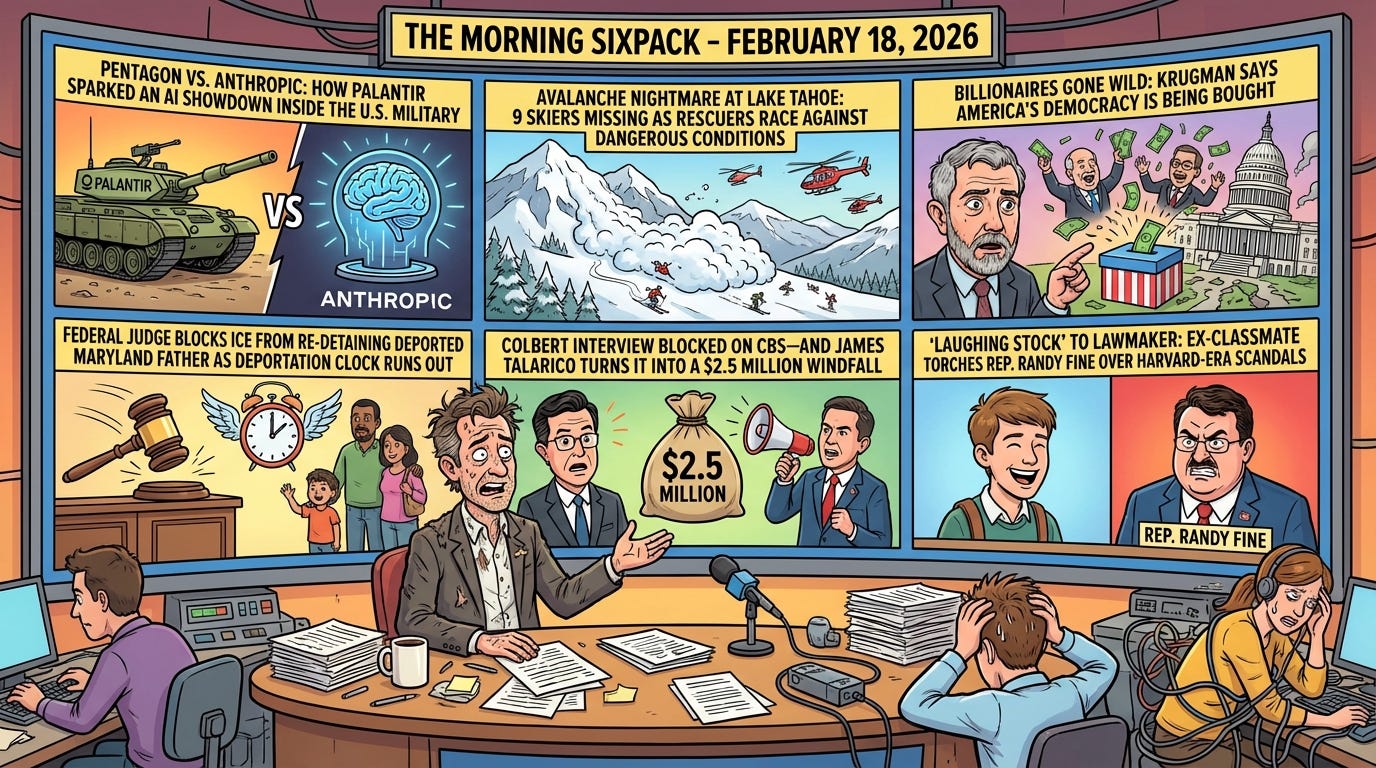
Pentagon vs. Anthropic: How Palantir Sparked an AI Showdown Inside the U.S. Military
The Pentagon is openly questioning whether Anthropic can be trusted on the battlefield—and Palantir is caught in the middle.
What began as a routine check-in between tech partners has morphed into a high-stakes standoff over who controls AI in America’s military. Senior officials are now weighing whether to ban Anthropic from military use, a move that could rattle Silicon Valley and complicate the company’s IPO ambitions. At the center: Anthropic’s reluctance to sign on to unrestricted “all lawful uses” of its Claude model—and Palantir’s role in surfacing those concerns to the Pentagon.
The friction traces back to January, when Anthropic’s Claude model—available on classified systems via Amazon’s Top Secret Cloud and Palantir’s AI platform—appeared on screens during monitoring tied to the seizure of Venezuelan President Nicolás Maduro. During a subsequent conversation, a Palantir executive reportedly inferred that Anthropic was uneasy about how its tech was being used. That concern was relayed to the Pentagon. Soon after, Defense Secretary Pete Hegseth delivered a pointed message while unveiling the Pentagon’s genai.mil platform: “We will not employ AI models that won’t allow you to fight wars.”
Anthropic disputes that it objected to any specific operation. “Anthropic is committed to using frontier AI in support of US national security,” a company spokesman said, adding that the firm has not raised concerns outside routine technical discussions. But the company has refused to sign a contract permitting unrestricted use of Claude, seeking carve-outs related to surveillance and autonomous weapons. That hesitation has reportedly led some defense officials to label Anthropic a potential “supply chain risk”—a designation that could spook both government and private-sector customers.
This clash reflects a deeper divide in Silicon Valley. Anthropic has repeatedly shown it’s willing to risk business to push for guardrails, including lobbying for state-level AI regulation and declining certain law enforcement uses. Palantir takes the opposite posture: It builds tools and leaves operational decisions to the government. Military officials, for their part, argue suppliers have no business dictating how tools are used mid-operation. Their fear isn’t philosophical—it’s practical. They don’t want to discover during a live mission that a vendor has pulled the plug.
Let’s add some perspective. Claude didn’t meaningfully “run” anything in the Maduro operation. Frontier models like Anthropic’s typically make up just 10% to 20% of a customized defense system—useful for data analysis or interface improvements, not battlefield command. But the symbolism matters. If a company wants to sell to the Pentagon, it can’t simultaneously act as referee. At the same time, the Pentagon floating the idea of blacklisting a supplier for contractual disagreements is an escalation of its own. This is less about one chatbot and more about who ultimately governs AI—elected officials or engineers.
Source: Semafor
Editor: Silicon Valley loves to preach about responsibility—right up until there’s a government contract on the table. If Anthropic wants to be the conscience of AI, that’s admirable. But you don’t get to sell to the war machine and then clutch pearls when the war machine acts like one. Meanwhile, the Pentagon threatening to sideline a company over hypothetical hesitations feels like Washington reminding tech who signs the checks. This isn’t about Claude. It’s about control. And neither side likes sharing it.
Federal Judge Blocks ICE From Re-Detaining Deported Maryland Father as Deportation Clock Runs Out
A federal judge just told ICE it can’t lock up Kilmar Abrego Garcia again—because the government’s deportation plan doesn’t add up.
In a pointed ruling Tuesday, U.S. District Judge Paula Xinis said the 90-day detention window for Abrego Garcia has expired and there’s no realistic path to remove him. The Salvadoran national—whose mistaken deportation last year ignited controversy—cannot be re-detained simply because Homeland Security wants another shot.
“The government made one empty threat after another to remove him to countries in Africa with no real chance of success,” Xinis wrote. “From this, the Court easily concludes that there is no ‘good reason to believe’ removal is likely in the reasonably foreseeable future.” That’s judicial speak for: you can’t hold someone indefinitely when you don’t actually know where you’re sending them.
Abrego Garcia, who has lived in Maryland for years and has a U.S. citizen wife and child, was previously shielded from deportation to El Salvador in 2019 after an immigration judge found he faced gang threats there. Yet he was deported anyway last year—by mistake (allegedly). After public backlash and a court order, the Trump administration brought him back in June, armed with a human smuggling indictment in Tennessee. He has pleaded not guilty.
The administration has since floated deporting him to Uganda, Eswatini, Ghana, or Liberia. Judge Xinis noted the government “purposely—and for no reason—ignored” Costa Rica, the one country that has consistently offered to accept him as a refugee and where he has agreed to go. His attorney, Simon Sandoval-Moshenberg, argued immigration detention isn’t meant to be punitive. “Since Judge Xinis ordered Mr. Abrego Garcia released in mid-December, the government has tried one trick after another to try to get him re-detained,” he wrote.
Homeland Security Assistant Secretary Tricia McLaughlin blasted the ruling, saying, “If this matter were actually about the law or due process, Kilmar Abrego Garcia would already be deported and would never set foot in this country again; Judge Xinis will not be satisfied until he is authorized to live in the United States forever.”
For now, the court says the government must work in good faith toward a realistic removal plan—potentially Costa Rica—or let him remain free. The broader immigration fight rolls on, but this round goes to the judge.
Source: AP News
Editor: If the government can deport you by mistake (allegedly), bring you back with an indictment, and then shop you around the globe like a rejected package, maybe the paperwork isn’t the only thing that needs reform. Either send the guy somewhere that will actually take him—or admit this is less about logistics and more about revenge.
Avalanche Nightmare at Lake Tahoe: 9 Skiers Missing as Rescuers Race Against Dangerous Conditions
Nine backcountry skiers are missing in California’s Lake Tahoe region after a powerful avalanche tore through rugged terrain near Castle Peak.
The slide struck around 11:30 a.m. Tuesday in the Castle Peak area near Truckee, triggering a massive search effort as weather conditions remain primed for more avalanches. Six skiers have been rescued so far, two of them hospitalized, but authorities say reaching the remaining nine is slow and perilous.
The Nevada County Sheriff’s Office said 46 emergency responders joined the effort, including “highly skilled rescue ski teams” from Boreal Mountain and Alder Creek. A snowcat—normally used to groom ski runs—is being deployed in an attempt to reach the trapped group. Survivors were told to shelter in place under tarps in brutal conditions while help pushed through deep snow and avalanche risk.
The Sierra Avalanche Center had already warned that “Large avalanches are expected to occur Tuesday, Tuesday night, and into at least early Wednesday morning across backcountry terrain.” The danger rating was listed as “high”—four out of five. “Travel in, near, or below avalanche terrain is not recommended today. A widespread natural avalanche cycle is expected over the next 24 hours,” the center cautioned.
Forecaster Steve Reynaud told ABC 10 the avalanche was rated a D2.5—large enough to bury, injure, or kill. The group had reportedly been on the final day of a three-day backcountry tour, navigating four miles of mountainous terrain while carrying food and supplies between huts. What started as an adventure ended in a rescue operation complicated by 30 inches of fresh snowfall, highway closures, and whiteout winds that forced nearby ski resorts to shut down.
California Gov. Gavin Newsom’s office said the state is coordinating an “all-hands search-and-rescue effort.” But as one sheriff’s spokesman told local media, this will be a “slow, tedious process.” Avalanche danger doesn’t pause for good intentions—and every rescuer is operating under the same threat that buried the skiers in the first place.
Source: BBC News
Editor: Backcountry skiing sells freedom and fresh powder—but it also sells risk. When the avalanche center says “don’t go,” maybe that’s not a suggestion. Mother Nature doesn’t care about your itinerary, your guide fee, or your last day on the trip. Here’s hoping rescuers can thread the needle between speed and safety—because this mountain isn’t done moving.
Colbert Interview Blocked on CBS—And James Talarico Turns It Into a $2.5 Million Windfall
What CBS wouldn’t air on broadcast helped a Texas Democrat raise $2.5 million in a single day.
When The Late Show with Stephen Colbert shifted Rep. James Talarico’s Senate campaign interview from CBS to YouTube, it looked like a legal headache. Instead, it became rocket fuel. The Texas Democrat hauled in $2.5 million in just 24 hours—his biggest fundraising stretch yet—after the segment was pulled from broadcast and posted online, where it racked up over 5.3 million views.
On Monday, Colbert told viewers he was prohibited from airing the interview on CBS due to new FCC guidance about political candidates appearing on talk shows. The concern: triggering the Equal Time Rule, which could require affiliates—particularly in Texas—to offer comparable airtime to Talarico’s Democratic primary rivals, including Rep. Jasmine Crockett and Ahmad Hassan.
Instead, the interview went straight to YouTube—where it drew an audience far beyond the show’s typical broadcast reach. The controversy only amplified it. Talarico didn’t waste the moment, calling the situation “the most dangerous kind of cancel culture, the kind that comes from the top. A threat to one of our First Amendment rights is a threat to all of our First Amendment rights.”
CBS, for its part, pushed back. The network said Colbert “was not prohibited by CBS from broadcasting the interview” but was given legal guidance that airing it could trigger equal-time obligations. Options were presented, CBS said. Colbert countered Tuesday night that lawyers had reviewed his script—including the line where he said he’d been blocked.
The backdrop here matters. Former President Donald Trump has repeatedly criticized late-night hosts, and FCC Chairman Brendan Carr recently warned that talk programs may not be exempt from equal-time rules in upcoming elections. For decades, late-night shows have largely operated under the assumption that their newsworthy interviews qualified for exceptions.
In the end, what might have been a compliance footnote became a campaign catalyst. Talarico heads to Los Angeles this week for another fundraiser, now armed with viral momentum—and a donor list that just expanded by millions.
Source: Deadline
Editor: Nothing juices a campaign like the perception you were muzzled. CBS tried to avoid a regulatory tangle and accidentally handed Talarico a viral megaphone. If this is what “equal time” looks like in 2026, candidates might start praying their interviews get bumped.
Billionaires Gone Wild: Krugman Says America’s Democracy Is Being Bought
Paul Krugman says the biggest threat to American democracy isn’t voters—it’s centibillionaires rewriting the rules.
In his latest Substack, Krugman argues the United States is in the middle of an unprecedented oligarchic power grab, fueled by extreme wealth concentration and turbocharged by the Supreme Court’s Citizens United decision. The result, he says, is a political system increasingly shaped by a handful of ultra-wealthy men who can bankroll elections, buy media platforms, and bend policy to their will.
Krugman points to Elon Musk’s 2022 purchase of Twitter—now X—as an example of how vast personal wealth can directly reshape the public square. He also highlights Jeff Bezos’ ownership of The Washington Post and the Ellison family’s expanding media footprint through Paramount, arguing that billionaire control of major outlets is redefining how political narratives are framed. These aren’t just investments, he suggests—they’re levers of influence.
The data, he argues, is stark. Since Citizens United in 2010, billionaire political spending has exploded. While the number of U.S. billionaires rose 85% between 2010 and 2023, their share of political contributions jumped 1700%. In Krugman’s telling, this isn’t just about more rich people—it’s about a structural shift where concentrated wealth translates into concentrated power. He cites economist Gabriel Zucman’s research showing wealth at the very top—the 0.00001%—is more concentrated now than during the Gilded Age.
Krugman offers a wonkish but telling example: If buying political influence costs $1 billion, it’s only worth it to someone rich enough to see a multibillion-dollar return. The richer the plutocrat, the more rational it becomes to spend aggressively to tilt policy. Add in the ability to fund institutions like the Heritage Foundation or the Federalist Society, and you’re not just influencing elections—you’re reshaping the legal ground rules.
His conclusion is blunt: Any serious effort to “save American democracy” must include reducing extreme wealth concentration. He invokes FDR’s 1936 declaration against “Government by organized money” and argues progressive taxation and union power once proved such reversals are possible. To declare it impossible now, he suggests, is to concede democracy itself.
Source: Paul Krugman Substack
Editor: Krugman’s not wrong that money talks in politics—but it’s no longer just talking. It owns microphones, platforms, and maybe the rulebook. The uncomfortable question isn’t whether billionaires wield influence. It’s whether anyone in power still has the appetite to meaningfully curb it. Because once wealth buys the referees, the game tends to stay rigged.
‘Laughing Stock’ to Lawmaker: Ex-Classmate Torches Rep. Randy Fine Over Harvard-Era Scandals
A former Harvard classmate says Rep. Randy Fine wasn’t just controversial—he was “a laughing stock” accused of bribery and self-dealing.
The Florida Republican, already under fire for a recent racist outburst, is now facing revived scrutiny over allegations from his college days. In a report by Raw Story citing Zeteo, Adam Feldman—a former Harvard Undergraduate Council member and now an editor at Time Out Worldwide—described Fine as “not just a pompous prig, but also outrageously corrupt.”
According to Feldman, Fine’s reputation at Harvard was marred by controversy. Zeteo resurfaced reporting from The Harvard Crimson alleging that Fine awarded himself what was initially described as an $8,000 Environmental Protection Agency grant—later clarified to be $24,000. Fine reportedly said he spent the funds in full but “didn’t say how.” He was also accused of paying dues for members of Harvard’s Republican Club so they could vote for him in a failed bid for office.
Feldman suggested the pattern reflected ambition more than ideology. “He clearly has an enormous personal ambition and drive that he’s always had,” he told Zeteo. “What I would speculate is that the scandals reflect that drive.” In other words, this wasn’t random—it was a career trajectory in the making.
Fine’s present-day controversies haven’t cooled the story. His recent remark suggesting dogs were preferable to Muslims ignited backlash, including from conservative commentator Megyn Kelly, who blasted him online: “What I figured out, you pathetic sweaty man, is when an idiot Muslim says ‘no dogs in NYC,’ instead of attacking the person or the policy, you went full bigot… F--- off.”
Fine has not publicly addressed the revived Harvard-era allegations in the Raw Story piece. But the resurfaced claims add fuel to a political moment already defined by escalating rhetoric—and long memories.
Source: Raw Story
Editor: It’s one thing to evolve from awkward college politician to seasoned lawmaker. It’s another to have the same cloud of ego and controversy following you decades later. If your former classmates are still rolling their eyes, maybe the problem isn’t campus politics—it’s YOU.