


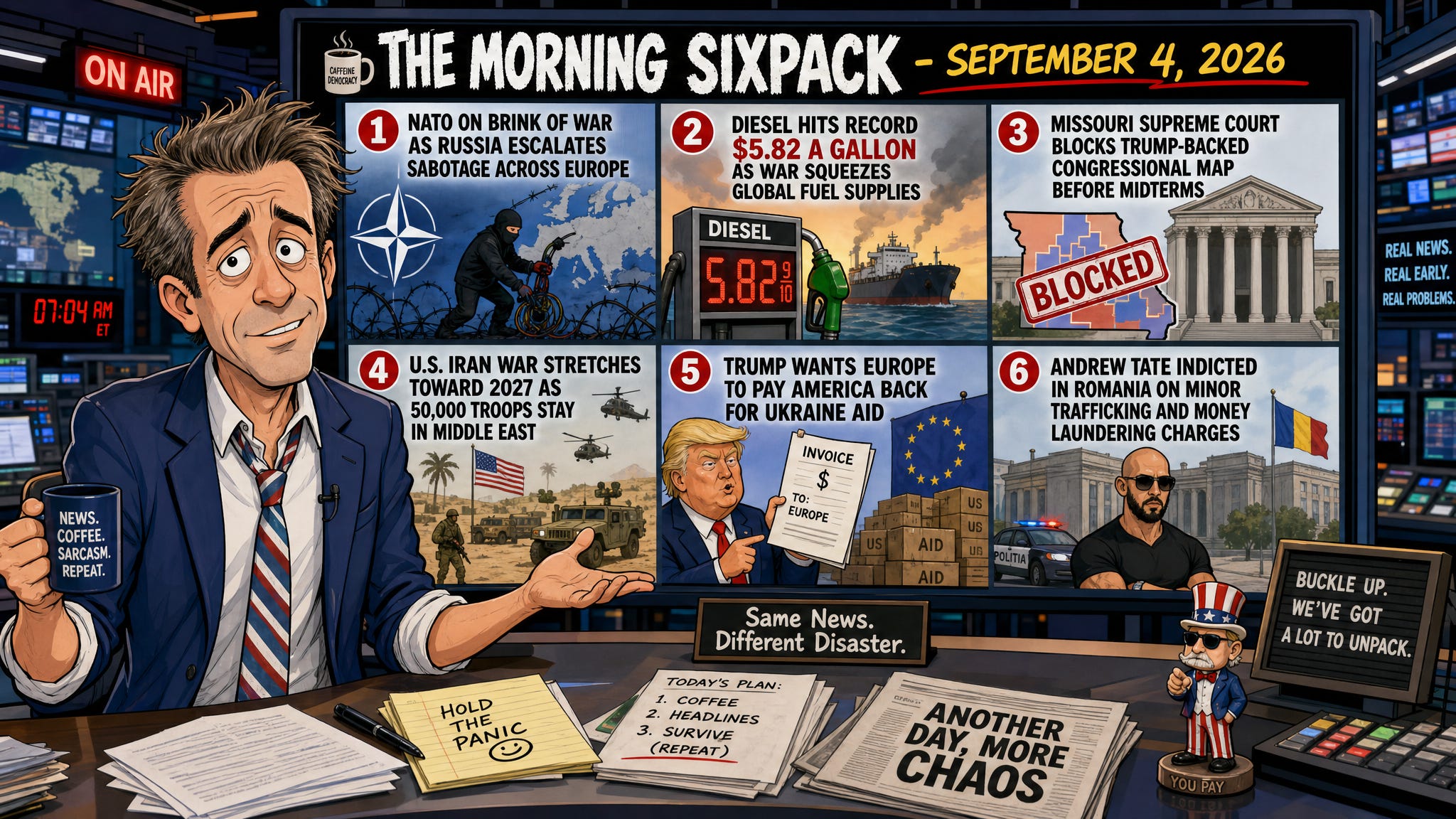
The Morning Sixpack stays free because the news that shapes your life should not be hidden behind a paywall. Paid subscribers are not paying for access. They are helping fund the research, writing, and independent voice that goes into every issue. Become a paid subscriber and help keep smart, honest news analysis free for everyone.
Russia’s sabotage campaign is creeping closer to the line NATO was built to defend—and Moscow keeps nudging it to see who blinks first.
Russia’s sabotage campaign across Europe is escalating in frequency and danger, raising the risk that one botched drone strike, warehouse fire, or rail attack could leave NATO confronting something far bigger than another round of sanctions.
So far, Vladimir Putin has been lucky: Nobody has been killed. NATO may not get that luxury forever.
German officials say Russia was behind a failed explosive-drone attack at Leipzig/Halle Airport, where one drone struck a parked Ukrainian cargo plane and another apparently collided with a departing aircraft—but neither exploded. The incident joins a growing list of alleged Russian operations across Europe, including plots involving incendiary devices aboard DHL cargo planes, railroad sabotage in Poland, and attacks targeting warehouses, shopping centers, defense companies, and infrastructure. Western officials say the tempo and intensity are increasing as Russia seeks ways to pressure the countries supplying Ukraine.
That leaves NATO wrestling with an ugly problem: Its collective-defense machinery was designed to deter armies crossing borders, not a murky campaign of drones, fires, and sabotage calibrated to remain below the threshold of open war.
Former U.S. ambassador to NATO Julianne Smith put the danger plainly: “At some point, it is going to go off the rails and somebody is going to get hurt and it’s going to present a different dilemma for the alliance.”
The question then becomes whether an attack killing NATO citizens triggers a meaningful collective response—or simply another carefully worded communiqué.
And that ambiguity may be exactly what Putin is testing. NATO officials continue to argue that Moscow understands the consequences of directly challenging Article 5, but Russia can learn plenty by repeatedly approaching the line without crossing it.
Estonia’s intelligence chief Kaupo Rosin framed the longer-term problem: “We have to ensure that six months, one year, or five years from now, Russia still has the same understanding that NATO deterrence works.”
Deterrence only works when the other guy believes you mean it—and Putin appears increasingly interested in checking the warranty.
Source: The New York Times
Editor: NATO has spent decades explaining what happens when Russia crosses the line. Putin’s latest strategy appears to be finding out exactly how close he can get before anybody admits there is one.
Diesel just hit an all-time U.S. high, and the timing could hardly be worse: harvest season is arriving with inventories scraping historic lows.
The average U.S. diesel price reached a record $5.820 a gallon Thursday, surpassing the previous peak set after Russia invaded Ukraine in 2022 as conflicts involving Iran and Russia tighten global fuel supplies.
And because virtually everything Americans buy spends some time on a truck, this particular record has a nasty habit of showing up everywhere else.
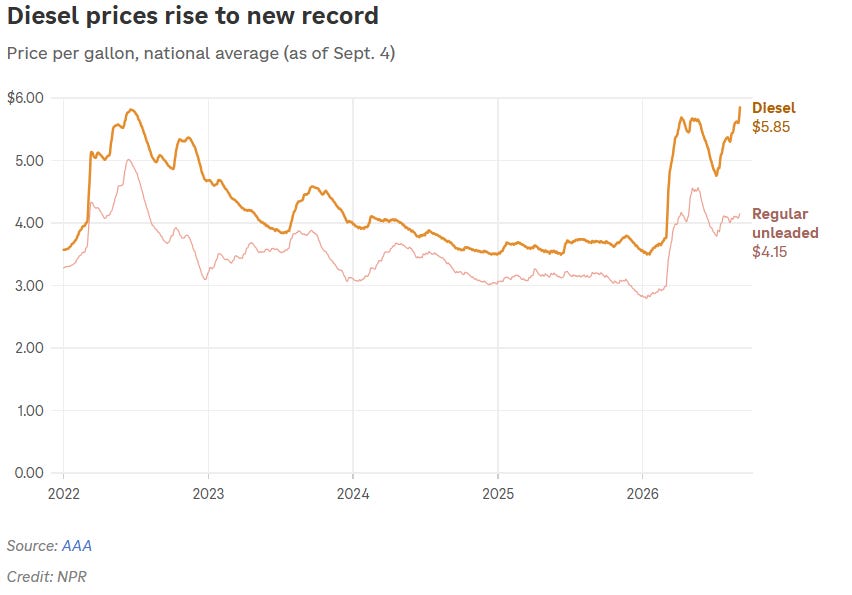
Diesel has remained above $5 a gallon since July 15 and is up 55% since the U.S.-Israeli war with Iran began February 28, according to Reuters. The supply picture has also been hit by Ukrainian drone attacks on Russian refineries, prompting Moscow to ban diesel exports through September 30. Before the Iran conflict, roughly 900,000 barrels of diesel per day moved through the Gulf—about 10% of global seaborne supply.
Now comes the seasonal squeeze. Farmers and truckers typically burn more diesel during the autumn harvest, while heating-oil demand increases heading into winter. Yet U.S. distillate inventories averaged their lowest August level for that time of year since 1982.
“We’re entering a key period for diesel consumption with the lowest inventories on record for early September,” TradeStation’s David Russell said. Higher transportation and production expenses can eventually work their way into grocery prices and other consumer goods.
The East Coast looks particularly vulnerable, with distillate inventories falling to a record-low 19.3 million barrels for the week ending August 28, based on government data going back to 1990. Refiners are running hard to cash in on unusually strong margins, but disruptions elsewhere continue constraining supply. In other words, America isn’t entering autumn with much of a fuel cushion—and geopolitical events aren’t exactly cooperating.
Source: Reuters via U.S. News & World Report
Editor: Your Amazon package, your groceries, and the tractor harvesting dinner all have one thing in common: None of them cares that economists prefer to call this a “distillate supply crunch.”
Missouri Republicans redrew the congressional map hoping to gain a House seat; the state Supreme Court just said voters get the final word.
The Missouri Supreme Court unanimously blocked the state’s new Republican-backed congressional districts from being used in November, ruling that a voter referendum legally put the map on hold. The decision means Missouri will use its previous congressional boundaries for the 2026 general election unless and until voters approve the replacement map.
The August primaries were held under one congressional map, but November’s general election will be held under another.
The dispute began after Missouri’s Republican-led Legislature approved new districts following President Donald Trump’s push for mid-decade redistricting that could improve Republican prospects in the U.S. House. The biggest change targeted the Kansas City-based 5th Congressional District, represented by Democrat Emanuel Cleaver, by extending it into more Republican rural territory. Missouri currently sends six Republicans and two Democrats to the House.
Opponents submitted more than 300,000 petition signatures seeking a statewide referendum on the new map. Republican Secretary of State Denny Hoskins rejected the petition, arguing that Missouri’s referendum process could not be used for congressional redistricting.
The state Supreme Court disagreed, ruling: “The referendum petition was legal, sufficient, and timely, and the secretary incorrectly concluded otherwise.”
Missouri Attorney General Catherine Hanaway said she would appeal to the U.S. Supreme Court.
The ruling drops another complication into a national redistricting fight that has spread well beyond Missouri, with both parties pursuing congressional maps that could improve their chances of controlling the House. In Missouri, however, the immediate result is straightforward: The post-2020 census map remains in force for November while voters get their say on the replacement.
Source: Associated Press
Editor: Missouri managed to turn drawing congressional districts into a choose-your-own-map election year. The judges have ruled; now the voters get the pencil.
A campaign sold as quick and decisive now has 50,000 American troops and 19 warships positioned across the Middle East—with some deployments stretching into 2027.
Defense Secretary Pete Hegseth is extending some U.S. military deployments in the Middle East into 2027 as the six-month conflict with Iran drags on, leaving tens of thousands of American troops committed to a war originally presented as a short campaign.
Six months, 50,000 troops and 19 warships later, “quick and decisive” has officially misplaced the calendar.
The U.S. military presence includes two aircraft carriers, 13 guided-missile destroyers, fighter squadrons, air-defense units, and paratroopers. Some Army air-defense deployments have reportedly grown from nine months to 12, while elements of the 82nd Airborne Division could remain in the region well into 2027. CENTCOM separately confirmed this week that more than 50,000 U.S. service members are operating across the Middle East.
The extended commitment is taking a toll. Ship crews are spending longer stretches at sea, maintenance is piling up, and some units diverted from Europe and the Pacific have already been deployed for more than a year. The USS Gerald R. Ford completed an 11-month deployment, while analysts warn that maintaining this level of firepower around Iran inevitably means having fewer forces available elsewhere.
Former Navy official Bryan Clark summed it up: “They’re setting it up to be sustained over the long haul, meaning well into next year.”
Meanwhile, President Trump has privately discussed declaring the Iran war over while keeping military options available and betting that economic pressure will eventually force Tehran to change course, according to the Journal. Fighting clearly hasn’t disappeared: CENTCOM said U.S. forces struck Iranian Revolutionary Guard targets on September 1 after attempted attacks on commercial shipping and American service members. So Washington may be debating what to call this conflict, but 50,000 deployed Americans probably don’t need a vocabulary lesson.
Source: The Wall Street Journal (free)
Editor: Washington has a remarkable talent for discovering that the quickest way out of a Middle East war somehow requires another year of deployments.
Trump says Europe owes America for past Ukraine aid while Washington temporarily keeps more of its munitions for itself—a geopolitical invoice apparently marked “better late than never.”
President Donald Trump says he will seek repayment from European nations for U.S. military aid and munitions previously supplied to Ukraine, while signaling that Washington is temporarily prioritizing rebuilding its own weapons stockpiles over sales to allies.
After hundreds of billions in American support for Ukraine, Trump says Europe is about to get a very large—and very late—bill.
Trump tied the demand to concerns about U.S. weapons inventories after months of fighting with Iran. “We are taking them for ourselves, the USA, rather than selling them to others, but the sales to Allies will soon again, begin,” Trump wrote on social media. He also blamed the Biden administration for providing aid that he argued European countries should have financed. Reuters reported last month that the U.S. Army had depleted much of its inventory of certain precision long-range missiles during the Iran war.
The announcement comes after the U.S. and NATO established the Prioritized Ukraine Requirements List, an arrangement under which European countries finance purchases of American weapons for Ukraine. Trump is now talking about going considerably further by seeking money for assistance already delivered. His remarks also arrive as the wars involving Ukraine and Iran increasingly collide with another problem back home: Energy prices, with oil hitting six-week highs amid renewed Middle East fighting.
Treasury Secretary Scott Bessent said the U.S. is experiencing an “energy shock,” attributing pressure both to the Iran war and Ukrainian attacks on Russian energy infrastructure. Add depleted weapons inventories, expensive fuel, and two wars consuming military resources, and Washington’s foreign-policy problems are increasingly arriving with domestic price tags attached. Whether Europe actually agrees to reimburse the United States for previously provided Ukraine assistance is another question entirely—the president has announced his intention to ask.
Source: Channel NewsAsia / Reuters
Editor: Apparently the Ukraine aid package came with retroactive billing. Europe might want to check whether Washington accepts Visa.
Andrew Tate now faces a new Romanian indictment alleging trafficking of minors, money laundering, sex with a minor, and witness tampering, while he and his brother remain jailed in the U.S. awaiting a decision on extradition to Britain.
Romanian prosecutors formally indicted Andrew Tate on September 4 on charges including trafficking minors, money laundering, sex with a minor, and witness tampering, adding another criminal case to the international legal battles surrounding Tate and his brother Tristan.
For two men already sitting in a U.S. jail while Britain seeks their extradition, Romania just added considerably more paperwork to the itinerary.
Romanian authorities have investigated the brothers since 2022, alleging that they recruited victims by seducing them and falsely promising relationships or marriage before coercing them into producing pornographic webcam content. Tristan Tate was indicted for complicity, according to Reuters. Both brothers deny wrongdoing, and their Romanian lawyer said: “Our clients continue to reject the allegations against them.”
The brothers, dual U.S.-British citizens who have lived primarily in Romania since 2017, were arrested in Miami in July after Britain requested their extradition on rape charges. They remain jailed in the United States while a judge considers that request. Romania’s DIICOT anti-organized crime unit has not yet determined whether it will also seek their extradition from the U.S.
A Romanian trial isn’t imminent. The indictment must first pass through a preliminary court chamber, where a judge reviews the case for legal and procedural compliance—a process that can extend well beyond the nominal 60-day period. Romania can ultimately try the Tates in absentia. For Andrew Tate, who once publicly said he chose Romania because he believed its law enforcement was more lax, that assessment has aged about as gracefully as warm milk.
Source: The Straits Times / Reuters
Editor: Tate built an online empire selling young men an image of swagger, wealth, and control. At the moment, prosecutors in three countries seem considerably more interested in who was actually controlling whom.
Check out Amazon’s Labor Day Sale.