


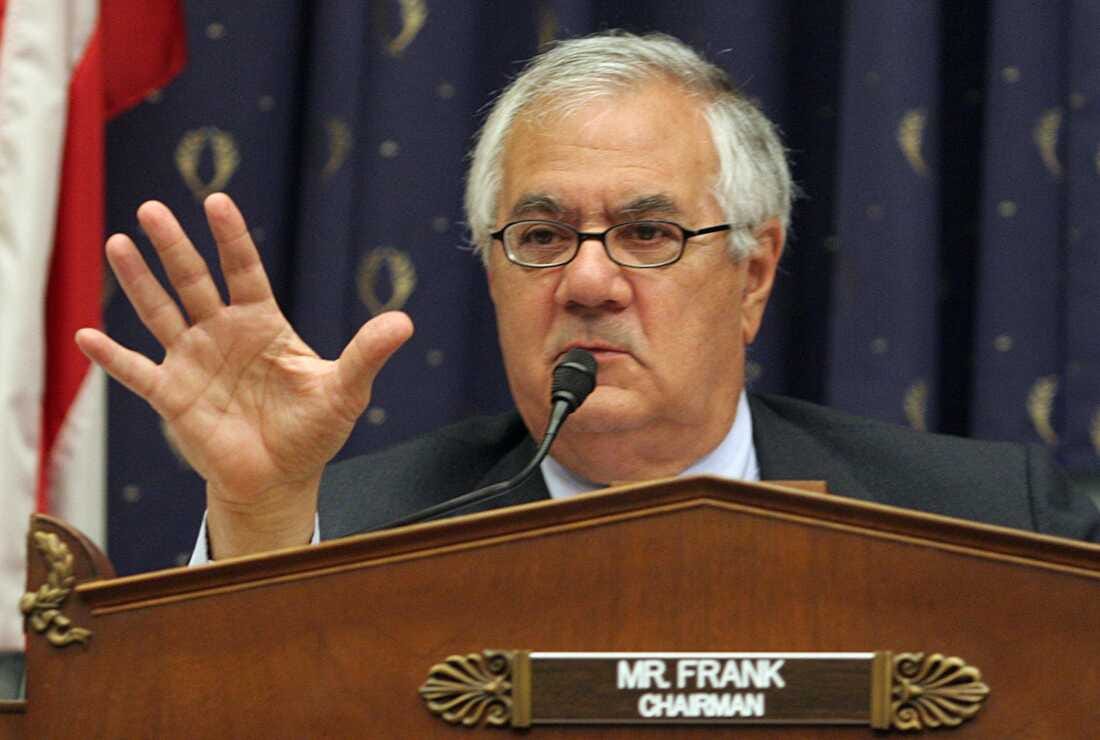
Barney Frank died on May 19, 2026, from congestive heart failure, after having been in hospice care since April. While I didn’t agree with him on a lot of things, I always admired how he presented himself, made strong arguments, and was as well-spoken as any person I’ve ever known or known of.
Barney Frank in 5 bullets
Barney Frank was one of the most consequential House liberals of the late 20th and early 21st centuries: a Massachusetts Democrat who served in Congress from 1981 to 2013 after earlier service in the Massachusetts House. (bioguideretro.congress.gov)
He was a landmark figure in LGBTQ+ political history: in 1987 he became the first member of Congress to voluntarily come out as gay, and in 2012 he became the first sitting member of Congress to marry a same-sex partner, Jim Ready. (AP News)
His biggest legislative legacy is Dodd-Frank, the 2010 financial-regulation law written after the 2008 crisis with Sen. Chris Dodd; it strengthened oversight, stress testing, derivatives regulation, and consumer protections, including the Consumer Financial Protection Bureau. (Reuters)
He was a pragmatic progressive: strongly liberal on civil rights, housing, financial regulation, and gay rights, but skeptical of symbolic politics and litmus tests that he thought alienated voters. He warned Democrats not to make “the most unpopular parts” of their agenda into purity tests, which, of course, they have.
He was also controversial: Republicans blamed him for parts of pre-crisis housing policy and criticized Dodd-Frank as burdensome; he was reprimanded by the House in 1990 after a personal scandal involving a male escort, but he survived politically and later became a major committee chair. (The Washington Post)
Who he was
Barnett “Barney” Frank was born in Bayonne, New Jersey, in 1940, studied at Harvard, worked in Boston politics, served in the Massachusetts legislature, and then represented a Boston-area district in the U.S. House for 32 years. (bioguideretro.congress.gov) He died in Maine after entering hospice care for congestive heart failure; he had recently moved to Ogunquit with his husband, Jim Ready, and died at home.
He combined three identities that shaped his career: liberal policy wonk, legislative tactician, and cultural trailblazer. He was not merely “the gay congressman,” although that was historically important. He was also one of the House’s sharpest institutional players, especially on banking, housing, and consumer finance.
What he did
Frank’s congressional career had two central arcs.
The first was civil rights and LGBTQ+ equality. Coming out voluntarily in 1987 was politically risky at the time, and it changed what was imaginable for gay politicians in national office. Later, he was associated with major LGBTQ+ advances, including repeal of “Don’t Ask, Don’t Tell” and hate-crimes protections, and his 2012 marriage to Jim Ready became another milestone in public representation. (National Center for LGBTQ Rights)
The second was financial regulation and housing policy. As chair of the House Financial Services Committee from 2007 to 2011, Frank was at the center of the federal response to the financial crisis. He helped pass emergency bank-rescue measures and then co-authored Dodd-Frank, which remains his signature law. (Reuters)
Major accomplishments
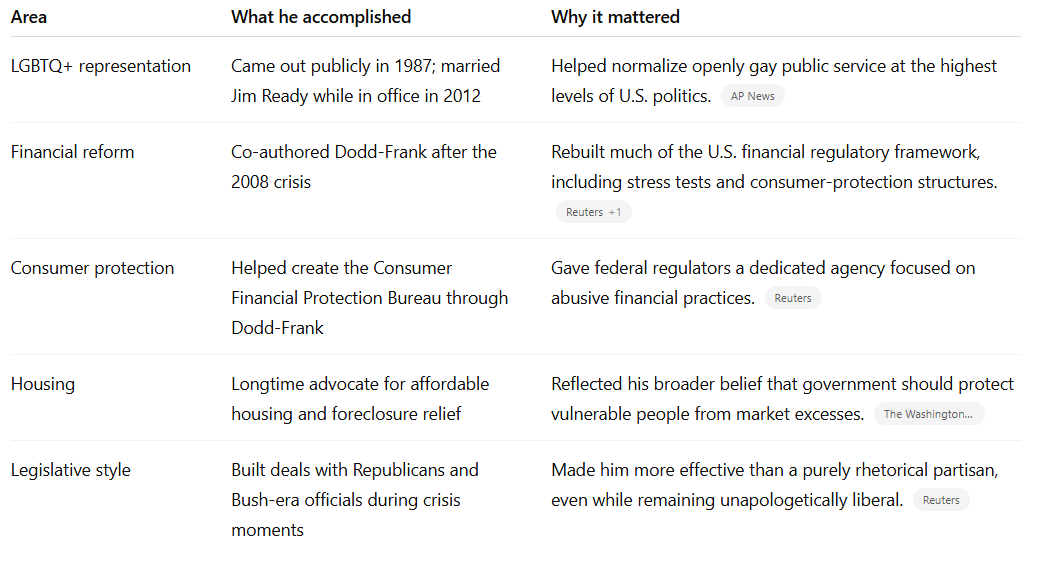
(Reuters)
The type of politician he was
Frank was a combat liberal, but not a movement purist. He believed in government intervention, civil rights, market regulation, and redistribution through housing and social policy. Yet he also believed politics was about counting votes, timing, and not letting the perfect defeat the possible.
His style was famously caustic. He could be funny, cutting, impatient, and intellectually intimidating. Admirers saw that as honesty and brilliance; critics saw arrogance. But even many opponents acknowledged that he understood legislation, committees, and policy details unusually well.
In modern terms, he was not a “vibes” politician. He was a process politician: committees, amendments, agency rules, coalition management, and the machinery of government.
Regrets and late-life reflections
The clearest late-life regret reported after his death was political: He said he was sorry he would not live to vote in the next presidential election after Donald Trump. (People.com) More broadly, he worried that Democrats were becoming too inclined to elevate unpopular progressive positions into litmus tests: “You should not take the most unpopular parts of your agenda and make them litmus tests.”
That comment captures a lot about Frank: He was deeply progressive, but he believed progress had to be sequenced. Push too far ahead of voters, he thought, and you risk losing the power needed to govern.
Controversies and criticisms
Frank’s career was not spotless. In 1990, the House reprimanded him over his relationship with a male escort and related misuse of congressional privilege; politically, he survived, partly because voters distinguished the scandal from his public work. (The Washington Post)
On policy, conservatives long criticized him over housing finance, Fannie Mae and Freddie Mac, and what they saw as excessive regulation after the financial crisis. Dodd-Frank’s defenders say it made the financial system safer; critics say it imposed burdens, especially on smaller and regional banks. Parts of the law were later rolled back, though Reuters notes much of its framework remains influential. (Reuters)
Bottom line
Barney Frank’s legacy is that of a historic barrier-breaker and an unusually effective legislative liberal. He helped make openly gay national political leadership possible, and he left his name on the most important U.S. financial-reform law since the New Deal era. His tradeoff was that his sharpness, his crisis-era compromises, and his regulatory philosophy made him a polarizing figure. But measured by durable impact—law, representation, and political memory—he was one of the most important members of Congress of his generation.