


For almost a century and a half, the Posse Comitatus Act (PCA) has been the American “don’t bring troops into civilian life” rule of thumb. Born in 1878 after the end of Reconstruction, it drew a hard line: The federal military doesn’t enforce domestic law unless Congress or the Constitution clearly says it can. Over time, Congress updated the edges—adding the Air Force to the ban and, through Defense rules, extending the spirit of the law to the Navy and Marines—but the core idea stayed the same: Soldiers fight wars; cops police streets. (FAS Project on Government Secrecy)
That bright line never meant “no help, ever.” In 1981, Congress passed a set of statutes that let the military support civilian law enforcement—sharing information, lending equipment, and training—while still forbidding troops from actually doing the arresting and policing.
That cooperation framework—created in the drug-war era—has been the legal scaffolding for most “troops at home” headlines you’ve seen since.
If you want the modern history in three beats, here it is.
Beat one: When presidents of either party needed a heavy hand, they reached for tools outside the PCA—most notably the Insurrection Act, which does allow federal troops to enforce law in extreme cases. After the post-Katrina fiasco, Congress briefly broadened the Insurrection Act in 2006, then rolled that expansion back by 2008 under political blowback. Net-net: Washington has jealously guarded the PCA norm even while keeping a glass-box “break in case of emergency” option.
Beat two: The last 25 years turned PCA into a constant Rorschach test. Under Bush and Obama, National Guard deployments to the border were packaged as “support only”—monitoring, aerial surveillance, logistics—precisely to avoid crossing the PCA line. Obama’s 2010 Operation Phalanx is a textbook example: Guard units backed Border Patrol while scrupulously avoiding law-enforcement roles. The messaging wasn’t a nicety; it was legal risk management.
Beat three: Trump’s first term pushed the envelope without quite tearing it to shreds. He sent active-duty units to the border in 2018, again framed as support tasks to stay on the right side of PCA, and publicly flirted with the Insurrection Act during the 2020 protests without ultimately invoking it. The point is the pattern: Even the norm-breakers still nodded to the norm.
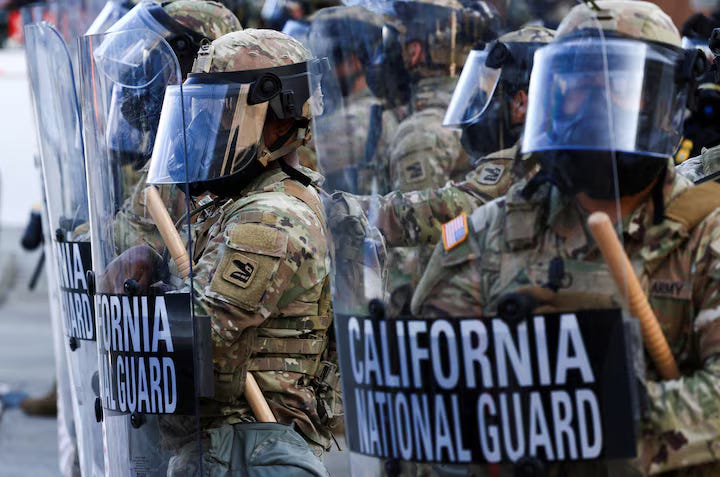
Which brings us to now—and why this matters. In 2025, Trump escalated from “support” to policing, deploying Marines and federalized Guard to Los Angeles for crowd-control and crime-fighting missions. A federal judge reviewed the record and called it what it was: a Posse Comitatus violation. The court blocked further use of troops for law enforcement in California, and in doing so, knocked down the legal fig leaves the administration tried to wave—arguments that a different statute quietly overrode PCA, or that labeling the missions something other than “enforcement” made them lawful. It didn’t. Substance beat spin. (Reuters)
Politically, the reaction told the real story. Many of the same Republican leaders who spent the Obama and Biden years reciting the PCA catechism suddenly treated that line as optional. They praised deployments into blue cities, framed the military as the fix for urban crime, and shrugged off the court’s ruling as if legality were a partisan vibe, not a boundary.
This isn’t a new legal theory; it’s a new incentive structure. To Republicans, when the other party holds the White House, PCA is a guardrail. When your party does, it’s an onramp to authoritarianism.
Recent reporting has documented that shift in posture among congressional Republicans and allied governors, even as legal analysts have warned the policy crosses the line. (AP News)
Here’s the practical danger beneath the hypocrisy: Once one side treats PCA as optional, the culture that sustains it erodes. The law has always relied as much on professional norms and political self-restraint as on case law. If leaders normalize soldiers doing police work because it polls well or looks “strong,” they’re not just winning a news cycle; they’re rewriting the operating manual of American civil-military life. And the precedent won’t stay red or blue for long. The next administration—of any party—will pick up what this one leaves behind. That is, IF there is a “next administration.”
So yes, the origin story still matters: PCA came out of a hard lesson that domestic militarization corrodes liberty. The last quarter-century shows how to get needed support without crossing the line. And the present moment shows exactly what crossing it looks like—and why a federal court just slammed the brakes in Los Angeles. If we blow past that, on purpose, we’re not “getting tough.” We’re torching a boundary that kept American democratic muscle from turning on its own body.
Bottom line: the law didn’t change—only the jerseys did. If PCA becomes a partisan prop instead of a national norm, don’t act surprised when troops on U.S. streets stops being an exception and starts being a habit.