


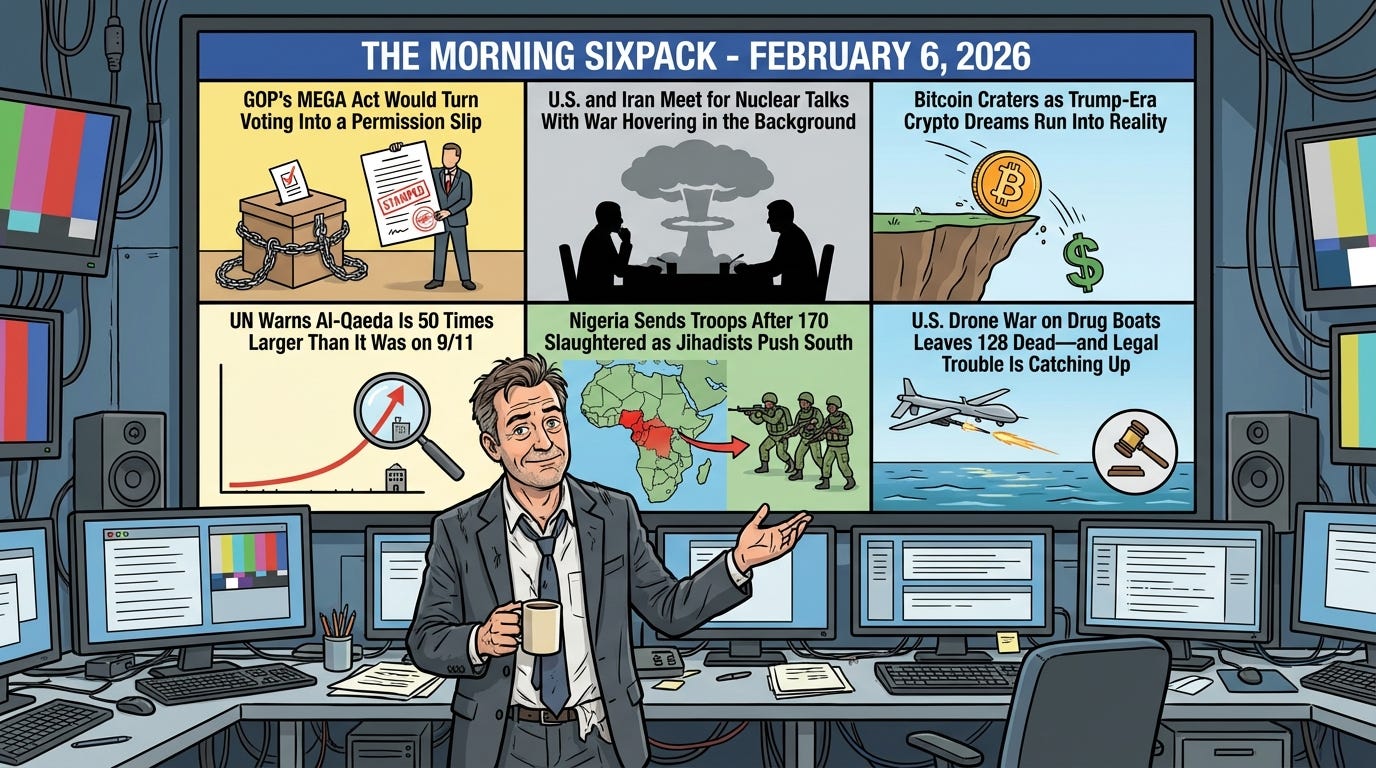
GOP’s MEGA Act Would Turn Voting into a Permission Slip
Republicans just dropped a federal voting bill that would flip the right to vote into a surveillance-heavy, paperwork-first obstacle course—and they named it after Trump.
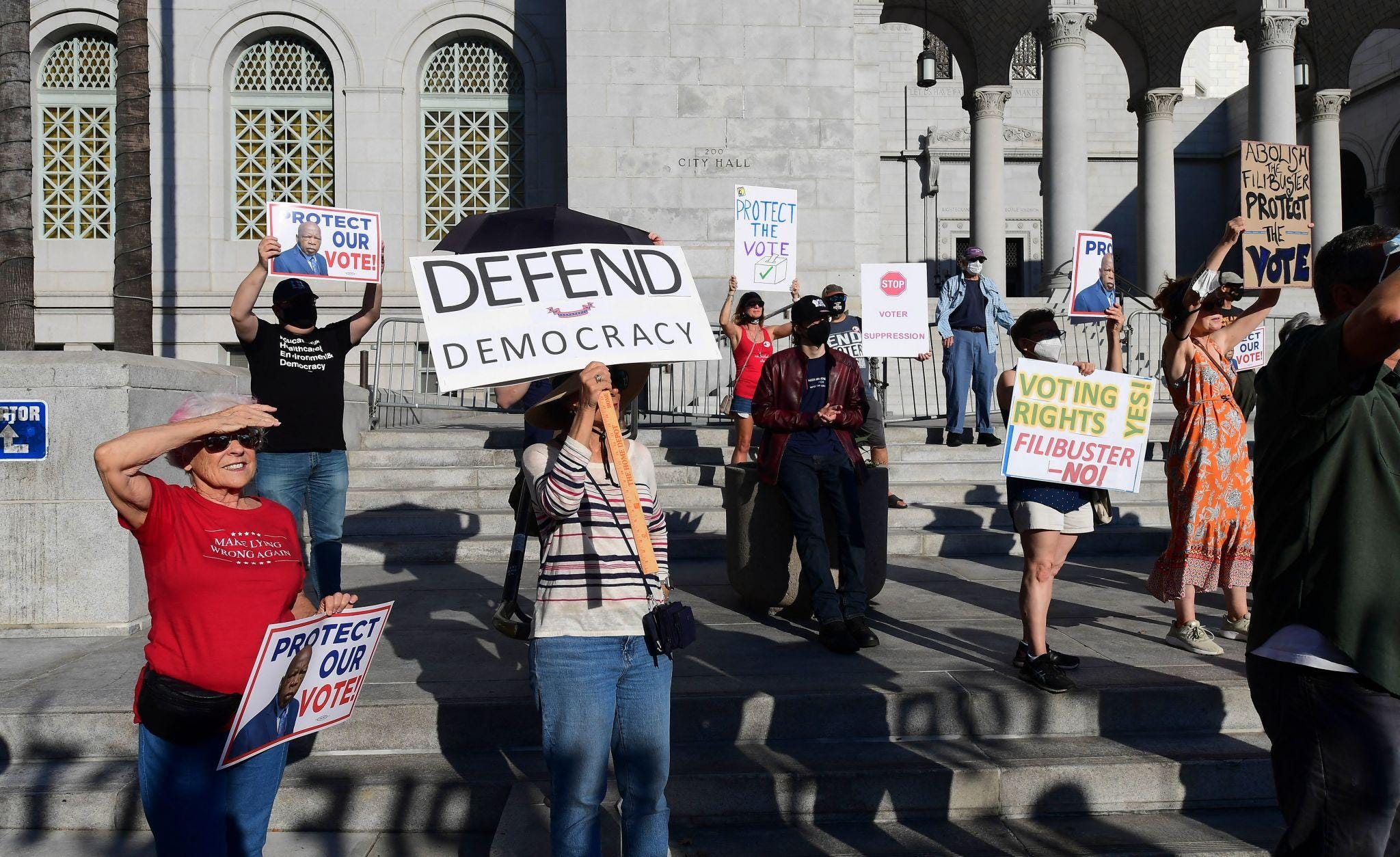
The proposal, introduced by Bryan Steil, is called the Make Elections Great Again Act, or MEGA Act, and it makes last year’s SAVE Act look like a warm-up. While SAVE focused on proof of citizenship at registration, MEGA stacks the deck across the entire voting process—registration, roll maintenance, ballot counting, mail voting, and lawsuits—at once.
MEGA would mandate strict photo ID to vote, require documentary proof of citizenship to register, force states into constant voter-roll purges every 30 days, ban counting ballots that arrive after Election Day, kill universal vote-by-mail, bar federal funding for third-party voter registration, and green-light a flood of lawsuits against election officials. It also guts the Motor Voter law and centralizes control through a single statewide voter database that assigns every voter a unique identifier.
That database is the bill’s quiet power grab. States would be required to run a “single, uniform, official, centralized” system synced with error-prone government records—felonies, deaths, addresses, immigration—and anyone flagged could be placed on a publicly available list while they scramble to prove eligibility. Miss a beat, and your vote is gone.
Democrats didn’t mince words. Joe Morelle warned, “President Trump and House Republicans are terrified of the American people. They are desperate to rig the system so they can choose their voters… This bill is their latest attempt to block millions of Americans from exercising their right to vote.” Alex Padilla called it a deliberate escalation after SAVE stalled, driven by “baseless conspiracy theories.”
Republicans are pressing ahead anyway. Senate Majority Leader John Thune said a more restrictive version is coming to the floor—“At some point, we’ll have that vote…I’m for it.” Translation: the plan is to keep tightening the screws. And yes, the branding mirrors Donald Trump for a reason.
Source: Democracy Docket
Editor: When a party can’t broaden its appeal, it tries to narrow the electorate. MEGA isn’t about election integrity—it’s about turning a constitutional right into a recurring background check and hoping enough people give up along the way.
U.S. and Iran Meet for Nuclear Talks with War Hovering in the Background
The U.S. and Iran are back at the table in Oman, but this time the talks come with aircraft carriers nearby and strike threats on standby.
Senior officials from Washington and Tehran convened in Muscat for high-stakes nuclear talks as the Trump administration ramps up military pressure and openly weighs options beyond diplomacy. It’s the first direct engagement since last summer’s brief but violent war with Israel, which ended with U.S. airstrikes on Iranian nuclear sites and left the relationship hanging by a thread.
President Donald Trump is testing whether a deal is still possible, but the White House made clear diplomacy is only one tool in the box. “This is the most dangerous time in the bilateral relationship in the 40-plus years I’ve been following Iran,” warned former U.S. diplomat Alan Eyre. “The possible downsides to a wrong move are commensurately high.”
The U.S. delegation includes envoy Steve Witkoff, Trump adviser Jared Kushner, and—unusually—the head of U.S. Central Command, Adm. Brad Cooper, underscoring just how closely diplomacy and military force are now intertwined. Iran is represented by Foreign Minister Abbas Araghchi.
Washington wants Iran to end uranium enrichment, scrap its missile program, and stop backing regional militias. Tehran says nuclear issues are the only topic on the table. Iran arrives weakened—its enrichment infrastructure damaged, its economy collapsing, and internal unrest simmering—but its leadership is signaling defiance, not compromise.
Expectations are low. Even getting the meeting scheduled required last-minute maneuvering after Iran harassed U.S. assets earlier this week. As Eyre put it bluntly, the best-case scenario may simply be agreeing to meet again—because the alternative looks increasingly like another strike.
Source: The Wall Street Journal (free)
Editor: When generals sit at the negotiating table, it’s not diplomacy—it’s a warning label. These talks aren’t about trust or breakthroughs; they’re about seeing who blinks first before someone decides the talking is over.
Bitcoin Craters as Trump-Era Crypto Dreams Run into Reality
Bitcoin has sunk to its lowest level in a year, wiping out half its value and puncturing the fantasy of a crypto-friendly second Trump term.
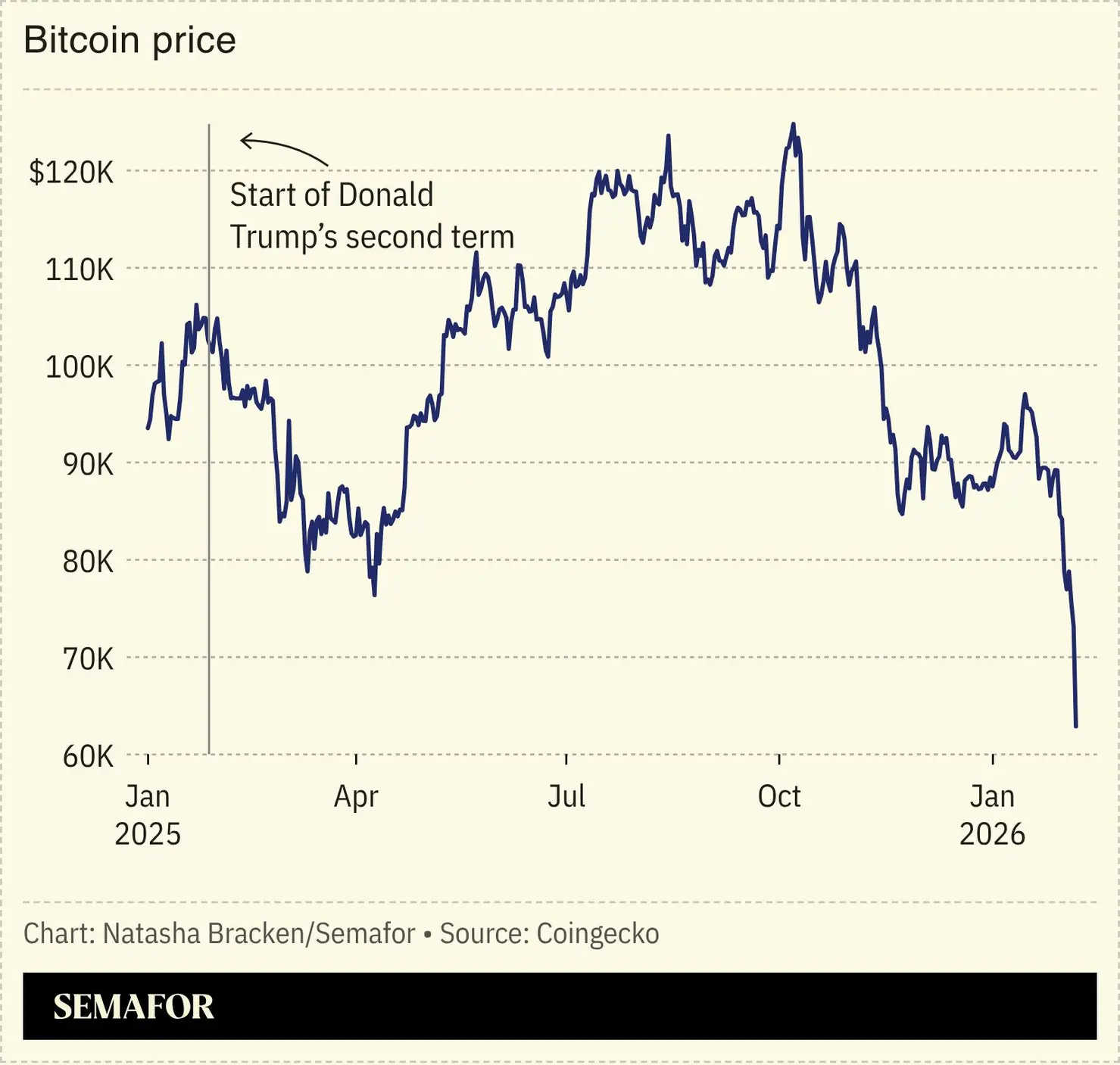
The world’s largest cryptocurrency is trading around $65,000, down sharply from an October high above $126,000 and marking its weakest point since Donald Trump began his second term. Other major digital coins are sliding too, along with the stock prices of companies tied to the crypto industry.
The downturn is being described as existential. The New York Times called it “one of the worst crises in the crypto industry” since the 2022 FTX collapse, a brutal comparison that underscores how quickly confidence has evaporated across the sector.
Trump once promised to make the U.S. “the crypto capital of the planet,” but reality has intervened. A broader market selloff has dragged down both speculative assets and traditional stocks, reminding investors that crypto isn’t immune when risk appetite disappears.
There may be more pain ahead. One analyst told Forbes the market is now in “full capitulation mode,” warning that a sustained drop below the psychologically important $70,000 level could unleash another wave of selling.
In other words, the floor is shaky—and the exits are crowded.
Source: Semafor
Editor: Turns out declaring yourself the global crypto capital doesn’t stop gravity—or fear. When the hype evaporates, all that’s left is a very expensive reminder that volatility cuts both ways.
UN Warns Al-Qaeda Is 50 Times Larger Than It Was on 9/11
Al-Qaeda is now vastly bigger, more dispersed, and still actively plotting attacks against the West—and the world is kidding itself if it thinks the threat faded away.
According to new findings from a UN monitoring team, Al-Qaeda and its affiliates now have roughly 25,000 fighters worldwide, compared with about 500 at the time of the September 11 attacks. The intelligence, compiled with help from agencies including MI6, paints a picture of a movement that has survived pressure by mutating rather than surrendering.
The figures were shared ahead of the UN Security Council’s annual terrorism report during a briefing at Royal United Services Institute, where officials warned that jihadist groups are now “multipolar”—spread across the Middle East and Africa with no single command hub. “They have not laid down their weapons,” said Colin Smith, the monitoring team’s coordinator. “They are still planning attacks against us…we overlook it at our peril.”
Unlike the ideologically driven core of 2001, many newer recruits are drawn in through local grievances, poverty, and financial incentives. Groups linked to al-Qaeda—including Somalia’s al Shabaab—are increasingly targeting young people, sometimes recruiting children as young as 11, while sharing sophisticated online guides for drones and explosives.
The report also flags rising ransom payments, renewed funding streams, and the growing use of artificial intelligence to speed up recruitment and operations. At the same time, escaped or released Islamic State prisoners from camps in Syria are adding fuel to an already volatile landscape.
Even as global attention is consumed by Ukraine, Gaza, and China, counterterrorism experts warn the old threats never really left—they just learned how to wait.
Source: The Times
Editor: For two decades, leaders declared victory and moved on. Terror groups didn’t—they adapted, decentralized, and kept recruiting. Ignoring that reality doesn’t make us safer; it just makes the next wake-up call louder.
Nigeria Sends Troops After 170 Slaughtered as Jihadists Push South
One hundred seventy people were massacred in a single night in central Nigeria, forcing the government to rush troops into a region that’s rapidly becoming the next jihadist frontline.
Nigeria’s military deployed an army battalion to Kaiama district in Kwara state after suspected jihadist fighters overran Woro village, the deadliest attack of the year in the area. President Bola Tinubu ordered the response as fears grow that militant groups are expanding beyond their traditional northern strongholds.
The attack highlights an accelerating threat from groups including Islamic State West Africa Province, which have intensified village raids and mass kidnappings along the Niger–Kwara axis. Security analysts warn the nearby Kainji forest could soon become a new operational base—bringing extremist violence deeper into Nigeria’s heartland.
Nigeria’s security failures are also drawing international attention. Donald Trump accused Abuja last year of failing to protect Christian communities amid rising Islamist attacks, a charge that helped set the stage for U.S. strikes on what Washington called terrorist targets in December.
For residents of Kwara, the geopolitics are beside the point. Entire families were wiped out, survivors were left digging mass graves, and the message from the attackers was unmistakable: no region is off-limits anymore.
Source: Reuters
Editor: This isn’t a “spillover” anymore—it’s a spread. When militants move south faster than the state can respond, troop deployments start to look less like deterrence and more like damage control after the fact.
U.S. Drone War on Drug Boats Leaves 128 Dead—and Legal Trouble Is Catching Up
The Trump administration’s quiet naval war on alleged drug traffickers just killed two more people—and the body count, now at 128, is starting to collide with the law.

The U.S. military confirmed another strike on a vessel accused of narco-trafficking in the eastern Pacific, saying the boat was moving along known smuggling routes when it was hit. Video released by U.S. Southern Command shows the craft erupting into flames. Two people were killed, according to the military.
The strike came just hours after Defense Secretary Pete Hegseth claimed that “some top cartel drug-traffickers” had halted operations indefinitely because of recent U.S. attacks. The Pentagon, however, declined to provide evidence—or even basic details—to support the assertion.
Since September, the Trump administration has dramatically expanded what it calls “kinetic strikes” against suspected drug boats in the Caribbean and eastern Pacific. While the pace has slowed since January, more than three dozen attacks have already been carried out. Of the 128 deaths attributed to the campaign, at least 116 were killed instantly, with others presumed dead after being lost at sea. In at least one case, the US military did a “double tap” and killed some fishermen after their boat had been blown up.
Now the strategy is facing its first courtroom test. Families of two Trinidadian nationals killed in an October strike have sued the federal government, calling the campaign a war crime and an “unprecedented and manifestly unlawful” use of military force. Legal experts say the case could challenge whether these attacks violate the laws of armed conflict.
President Donald Trump insists the U.S. is in an “armed conflict” with Latin American cartels and says the strikes are necessary to choke off drug flows. What’s still missing is proof that those being killed are, in fact, the “narcoterrorists” the administration claims they are.
Source: AP News
Editor: Calling it a war doesn’t magically make it one. When missiles replace indictments and evidence comes with a shrug, the real question isn’t whether this is effective—it’s how long before the courts decide it’s illegal.