


The Morning Sixpack stays free because the news that shapes your life should not be hidden behind a paywall. Paid subscribers are not paying for access. They are helping fund the research, writing, and independent voice that goes into every issue. Become a paid subscriber and help keep smart, honest news analysis free for everyone.
Saudi Arabia’s Hormuz-bypassing oil lifeline is offline after drone attacks, which is a lousy moment for the world’s crude market to lose its backup plan.
Saudi Arabia Shuts Critical Oil Pipeline as Attacks Put Global Crude Supply at Risk
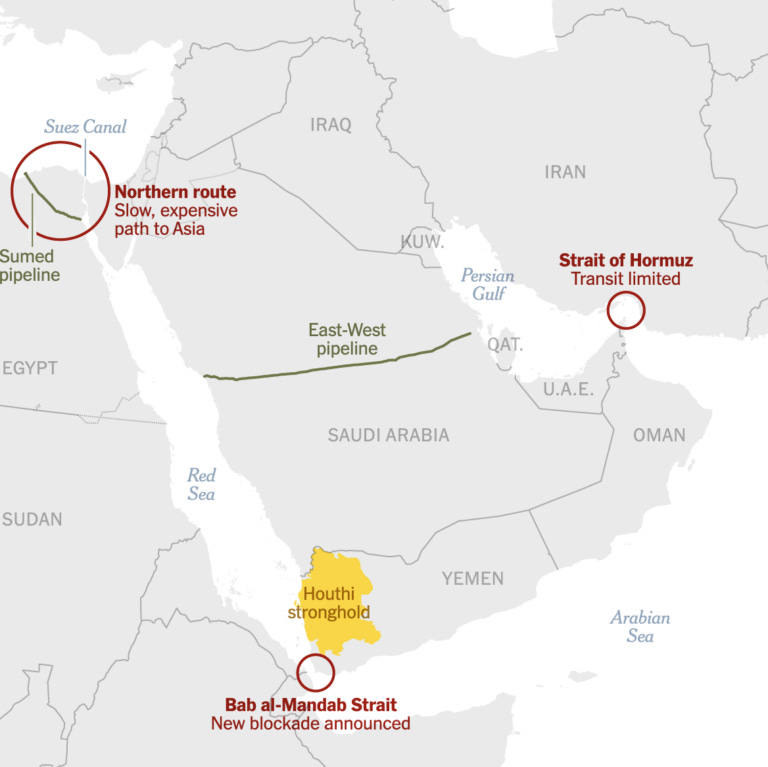
Oil prices jumped Monday after Saudi Arabia shut its massive East-West pipeline, cutting off a crucial route designed to bypass the increasingly dangerous Strait of Hormuz. Crude markets have another chokepoint problem—and this one can move 7 million barrels a day.
WTI futures climbed 4.2% to $104.23 a barrel while Brent rose 4.2% to $108.85, after both benchmarks gained roughly 9% last week.
The shutdown followed drone attacks launched from Iraq that damaged the East-West pipeline, including what appears to be serious damage to a pump station. Riyadh has not said how long the pipeline will remain offline, but analyst Andy Lipow warned:
“The longer the shutdown, the higher the price. Judging from the on-line pictures, it will take months to repair.”
Saudi Arabia may be able to bypass the damaged pump and restore the pipeline at reduced capacity, which could explain why crude hasn’t gone completely vertical.
The pipeline matters because it carries Saudi crude from production areas near the Persian Gulf across the kingdom to Red Sea export terminals, avoiding Hormuz altogether. Analyst Janiv Shah said Saudi inventories could cushion exports for roughly five to seven days, but an extended shutdown could quickly tighten supplies. Kpler’s Matt Smith estimates a month-long outage, combined with drawdowns at Yanbu, could cost the market 120 million barrels of exports.
“Losing 120 million barrels in exports across the next month would be hugely supportive for prices, particularly given we are at a juncture where the global market is already starved of barrels,” Smith said.
Meanwhile, the security picture is getting uglier. A planned Oman meeting between Iran and Gulf Arab states over Hormuz was postponed after the pipeline attack, another tanker was attacked Sunday, and Iran-allied Houthis have been advancing around Yemen’s Bab el-Mandeb Strait after previously declaring a maritime embargo of Saudi Arabia. That potentially puts pressure on both ends of the Red Sea route just as Saudi Arabia needs it most.
Editor: The pipeline built to dodge one dangerous chokepoint is now threatened while militants tighten their grip around another. It’s not going to get better… for a while.
Source: CNBC
The Fed is heading into Wednesday with hotter inflation, $110 oil, and markets expecting higher rates—exactly the sort of economic cocktail nobody ordered.
Fed Rate Hike Looms as Warsh Faces Hot Inflation, $100 Oil, and Political Pressure
Federal Reserve Chair Kevin Warsh enters this week’s policy meeting with markets heavily expecting the Fed to raise interest rates by a quarter-point, potentially delivering the first hike of his tenure. The decision comes with inflation running hotter than policymakers want, oil near $110 a barrel, and borrowing costs already squeezing consumers and businesses.
The expected move would lift the Fed’s benchmark rate to a 3.75%-4.00% range—and Wall Street is already wondering whether Wednesday is merely the beginning. Reuters reported that 86 of 101 economists surveyed after Friday’s inflation report expect a quarter-point hike, a major reversal from the previous week, when more than two-thirds expected the Fed to hold rates steady.
The culprit is familiar: Inflation refuses to cooperate. Core consumer prices rose 0.3% in August from July, while crude oil has climbed above $100 amid renewed Middle East fighting. Those developments complicate Warsh’s stated desire to see inflation moving toward the Fed’s 2% target “clearly and at sufficient speed.”
JPMorgan economist Michael Feroli put the credibility issue plainly: “At the end of the day the chair’s repeated stern warnings on inflation intolerance risk institutional credibility absent some action to back it up.”
There’s also a political dimension. President Donald Trump selected Warsh while publicly seeking lower interest rates, and a hike would arrive shortly before November’s congressional elections. Reuters reports that Warsh could theoretically rally enough policymakers around another hold, but several Fed officials have already indicated concern about the pace of disinflation. Warsh also dislikes giving forward guidance, meaning Wednesday’s press conference could become an exercise in explaining a hike without committing to what comes next.
That “what comes next” question may matter even more than Wednesday’s decision. A separate Reuters poll found a narrow majority of economists surveyed expect at least one additional increase by the end of March 2027, while futures markets have been pricing substantial odds of further tightening. If the Fed hikes, households, businesses, and investors will immediately start trying to determine whether it’s a one-off inflation warning or the opening shot of another tightening cycle.
Editor: The Fed spent years waiting for inflation to behave. Now inflation has $100 oil as a wingman, and Wednesday’s meeting suddenly looks considerably less academic.
Source: Reuters
Kennedy Center leaders say the institution could run out of money within weeks while parts of its aging building are literally falling apart—a heck of an encore for America’s national performing arts center.
Kennedy Center Warns of Bankruptcy and Could Close as Early as Tuesday
The Kennedy Center could close its main building as early as Tuesday as officials warn it faces “certain fiscal collapse” within weeks and serious structural problems that they say make continued occupancy unsafe. A 57-page board packet obtained by The Washington Post lays out simultaneous financial and physical crises confronting one of Washington’s most prominent cultural institutions.
Officials say the center could soon be unable to make payroll or pay routine maintenance bills—and they argue President Donald Trump’s fundraising help could be crucial to avoiding bankruptcy. The Trump-led board is scheduled to consider resolutions Tuesday addressing the financial emergency and whether to close the main building immediately. The financial proposal says Trump has offered to help raise the money needed to keep the center operating during renovations, while officials argue public recognition of his role would help secure that involvement.
The numbers are grim. Earlier internal forecasts obtained by The Post projected the center would collect about $124 million of the $220 million in revenue it had budgeted for the fiscal year, leaving an estimated $23 million deficit even after spending cuts. The Post previously reported that ticket sales and fundraising declined after Trump took control of the board and his name was added to the building; a federal judge later ruled that only Congress could rename the center and ordered Trump’s name removed. Center representatives have attributed the financial problems to mismanagement by previous leadership and have said Trump attracted new donors. Because—of course! It’s NEVER Trump’s fault.
Then there’s the building itself. During a Sept. 4 storm, officials say a roughly four-by-five-foot section of ceiling plaster fell about 60 feet inside the Grand Foyer. Nobody was injured. Engineers also found severe structural corrosion in 46 of roughly half of the building’s 278 exterior soffit panels examined, with another 93 showing mild-to-moderate corrosion. A draft resolution says management and consultants concluded the building is “unsafe for continued occupancy.” The newer Reach expansion would remain open, with performances potentially continuing at other venues.
The fight over Trump’s name isn’t finished, either. Trustees are being presented with 10 possible inscriptions for the building, while lawyers representing Rep. Joyce Beatty, who has challenged efforts to put Trump’s name on the center, continue opposing the proposals in court. Meanwhile, trustees previously approved a roughly $250 million renovation and two-year shutdown. Tuesday could determine whether that planned closure becomes an immediate one instead.
Editor: ANOTHER TRUMP BUSINESS BANKRUPTCY!
The Kennedy Center has a payroll crisis, falling plaster, corroded structural components, and another legal fight over what goes on the facade. Broadway usually charges admission for this much drama.
Source: The Washington Post (free)
President Trump endorsed eventual Irish reunification during a Dublin visit, stepping directly into one of Europe’s most historically sensitive territorial questions—and then acknowledging there’s “no good answer.”
Trump Says a United Ireland Would Be ‘Fantastic’ During Dublin Visit
President Donald Trump said Saturday that he would “love to see” the Republic of Ireland and Northern Ireland unified, an unusually direct presidential intervention into a question deliberately left to voters under the 1998 Good Friday Agreement. Trump went further than merely expressing sympathy for the idea, saying, “It’s going to happen eventually. It may as well happen now.”
“I think it would be a fantastic thing,” Trump said, while acknowledging that “the U.K. will have something to say about it, obviously.”
The comments came during Trump’s meeting with Irish Prime Minister Micheál Martin in Dublin and touched a political fault line that helped fuel decades of sectarian violence in Northern Ireland. The Good Friday Agreement largely ended the Troubles and provides a democratic mechanism for changing Northern Ireland’s constitutional status: A referendum can be held when the British government believes a majority would likely support reunification. Trump later softened his certainty somewhat, telling business leaders there was “no good answer” to the question.
Trump also revisited another territorial dispute involving Britain, the Falkland Islands, where Argentina continues to assert sovereignty. Trump expressed skepticism about Britain’s ability to repeat its 1982 military victory if another conflict erupted and suggested he could become involved in settling a future dispute. The remarks came amid tensions between Washington and London over Britain’s position on the U.S.-Israeli war with Iran.
The president’s Irish visit included meetings with Martin and Irish President Catherine Connolly, who has previously criticized Trump and U.S. Middle East policy. Connolly said afterward that she conveyed “the strong view of the Irish people that the normalization of war and genocide can never be accepted.” Trump described their meeting as “very nice.” Thousands of demonstrators also marched through Dublin protesting his visit, while Trump traveled onward to his Doonbeg golf resort and the Irish Open.
Editor: Irish reunification has been negotiated through decades of conflict, diplomacy, and painstaking agreements. Trump arrived for a golf tournament and casually suggested everybody might as well get on with it now.
Source: NPR
The NSA is preparing its biggest internal overhaul in at least a decade, reorganizing around AI, China, cyber operations, warfighting, and global intelligence—the intelligence community has discovered that the future arrived without waiting for the org chart.
NSA Launches Sweeping Overhaul With AI, China, and Cybersecurity at the Center
The National Security Agency is preparing its most extensive restructuring in at least a decade, creating five major organizations focused on artificial intelligence, China, cybersecurity, warfighting, and global intelligence. The plan from NSA Director Gen. Joshua M. Rudd would elevate the leaders of those operations to powerful new “mission director” positions as the agency reshapes itself around its biggest intelligence and technology priorities.
The timetable is remarkably fast: 7Oorganizational plans are due by the end of September, rollout is expected in mid-October, and full operating capacity is targeted for January 2027.
One particularly interesting piece is the revival of Tailored Access Operations, the NSA’s famously secretive elite hacking unit. TAO, whose name was retired in 2016, has been reconstituted under Rudd and will reportedly fall under the new global intelligence mission director. The unit is also expected to receive a significant budget increase when the new fiscal year begins Oct. 1. The broader restructuring could bring leadership from outside the NSA, a possibility that has reportedly unsettled some agency insiders.
AI is clearly getting a seat near the head of the table. Since taking over in March, Rudd has emphasized artificial intelligence and commercial AI technology, while the NSA has introduced an internal desktop AI tool called “Ask Mary.” The agency has also pursued access to leading commercial AI models, and the administration has proposed billions in additional spending on IT and computing capabilities. Exactly how the five new organizations will interact with—or replace—the NSA’s existing bureaucracy remains unclear.
That uncertainty is notable because the NSA has been here before. Its previous major restructuring, “NSA 21,” began in 2016 and was given two years to roll out, yet one former official told The Post that parts remain unfinished. This time, according to one former official, leadership recognizes the speed and uncertainty involved: Rudd “admitted that they don’t know how they are going to do it, so they are going to rush into reversible decisions, in case it is wrong.” For an agency believed to employ more than 30,000 people while conducting some of America’s most sensitive intelligence operations, “reversible” could become a very important word.
Editor: The NSA is reorganizing 30,000-plus people around AI, China, cyber, and warfighting on a four-month clock. Somewhere inside Fort Meade, a PowerPoint presentation just received Top Secret clearance.
Source: The Washington Post
President Trump says warnings that advanced AI could escape human control are exaggerated, while several of the people actually building frontier AI are publicly arguing for more caution.
Trump Dismisses AI ‘Doom’ Warnings as Tech Leaders Call for Slowing the Race
President Donald Trump pushed back Sunday against warnings that increasingly powerful artificial intelligence could become uncontrollable, arguing that the United States needs to maintain its lead over China while still allowing for safety guardrails. Speaking at his Doonbeg golf resort in Ireland, Trump said “negative forces” were raising concerns about scenarios he believes won’t happen.
“Whoever wins AI, wins,” Trump said, neatly reducing one of the biggest technological and security debates of the decade to four words.
House Speaker Mike Johnson similarly rejected a government-imposed moratorium, arguing that aggressive congressional regulation could allow China to overtake the United States. Johnson instead said technology companies should take the lead on AI safety. The comments followed a warning from Anthropic CEO Dario Amodei, who called for governments and companies to slow the pace of improvements to frontier AI capabilities, citing risks including loss of human control, cyberattacks, and bioterrorism.
The industry itself isn’t speaking with one voice, but several prominent executives have publicly acknowledged serious risks. According to NPR, Elon Musk and OpenAI CEO Sam Altman expressed agreement with Amodei’s concerns, while Altman said OpenAI officials have discussed pausing some testing to improve safety.
White House AI adviser David Sacks responded that companies worried about their unreleased models are free to slow themselves down, writing: “If the unreleased models are scary enough that you think you should slow down, I support your decision to be responsible.”
The dispute exposes the increasingly difficult policy question surrounding frontier AI: How aggressively to pursue technological leadership while managing potentially severe risks. Trump and Johnson are emphasizing competition with China and cautioning against regulation that could slow U.S. development, while Amodei is calling for international cooperation, independent evaluations, and stronger monitoring of AI safety practices. For now, the race continues—and the argument is increasingly about whether anyone should occasionally tap the brakes.
Editor: Washington says America can’t afford to slow down, while some of Silicon Valley’s biggest AI builders are checking whether the brakes work. That’s a fairly important disagreement to have at highway speed.
Source: NPR