


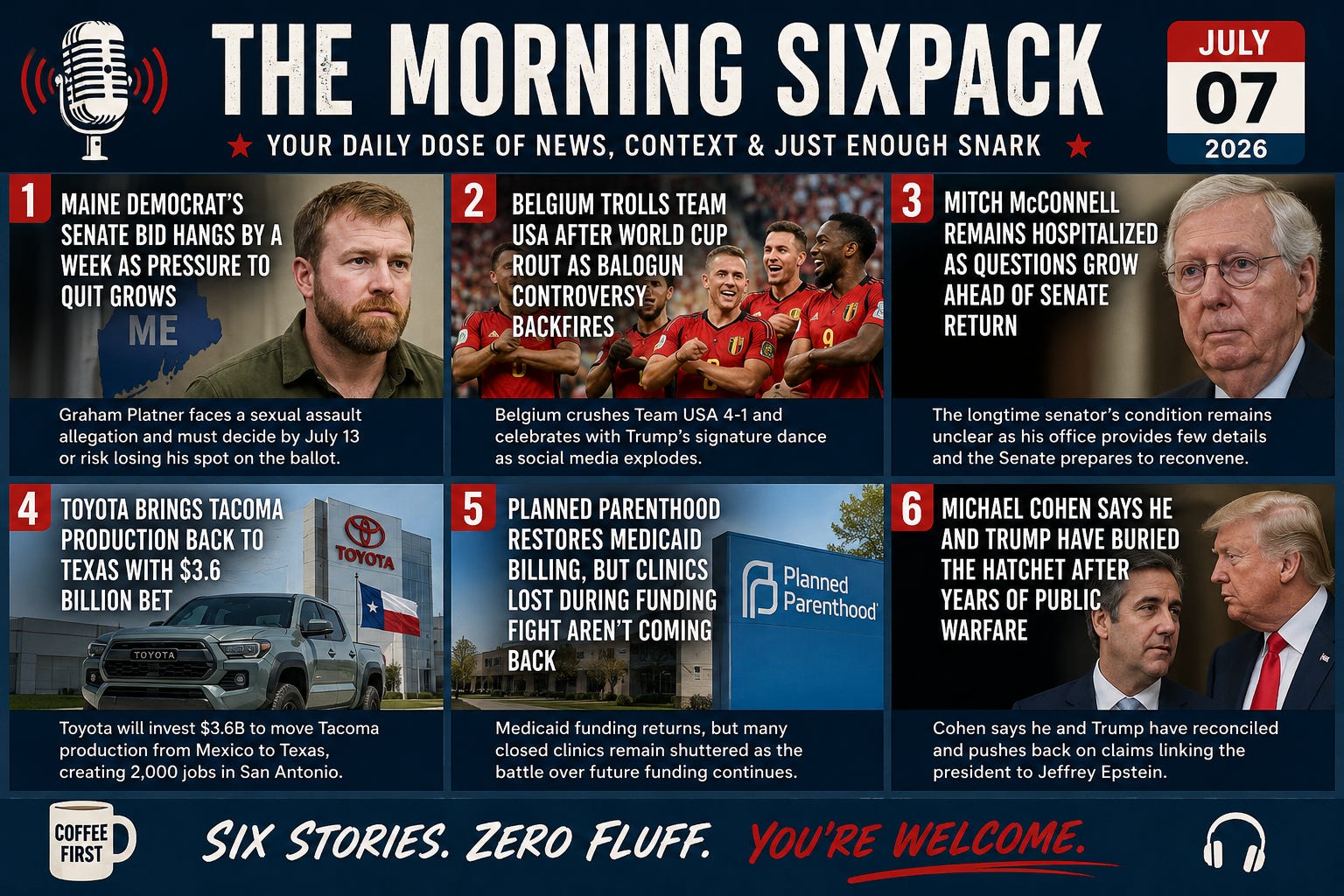
If he doesn’t step aside by July 13, Democrats lose their only window to put a different nominee on the November ballot.
Maine Democrat’s Senate Bid Hangs by a Week as Pressure to Quit Grows
A sexual assault allegation has left Maine Democratic Senate candidate Graham Platner with just days to decide whether he’ll stay in the race or hand Democrats a chance to replace him.
Platner, an oyster farmer challenging Republican Sen. Susan Collins, said Monday he was “taking the time to reflect on the best path forward” after a former girlfriend accused him of sexually assaulting her in 2021 (Editor: It was rape.). He denies the allegation but acknowledged the political damage the reporting has caused as support from top Democrats quickly evaporated.
The pressure is coming from nearly every corner of the party. Democratic leaders say they won’t financially support his campaign if he remains on the ballot, while current and former party officials are openly urging him to withdraw before the state deadline expires. Under Maine law, Democrats can only choose a replacement candidate if Platner exits by July 13.
The latest allegation adds to a growing list of controversies that have dogged Platner’s campaign, including old social media posts dismissing sexual assault, a tattoo resembling a Nazi symbol that he later covered, sexually explicit text messages sent after his marriage, and allegations of physical violence from former girlfriends.
“I remember saying, ‘Hey, I’m not into this,’ and, like, ‘Don’t do that. Don’t touch me.’ Like saying every way that I could think to say ‘No.’”
Potential replacement names are already circulating, including former state Senate President Troy Jackson, former Maine health official Nirav Shah, and Maine Secretary of State Shenna Bellows, as Democrats scramble to preserve what they view as a key Senate race.
Source: Washington Post
Editor: When a campaign spends more time discussing ballot deadlines than policy, it’s usually a sign the political life raft has already sprung a leak. Why in hell can’t anybody beat Susan “I’m Concerned” Collins? She’s about as swift as a wet piece of burnt toast.
Instead of sparking a miracle run, the overturned suspension became the backdrop for one of Team USA’s most lopsided World Cup exits in decades.
Belgium Trolls Team USA After World Cup Rout as Balogun Controversy Backfires
Belgium crushed the United States 4-1, then twisted the knife with a social media jab after FIFA’s controversial decision to reinstate Folarin Balogun failed to change the outcome.
Charles De Ketelaere scored twice as Belgium stormed into the World Cup quarterfinals, while Hans Vanaken and Romelu Lukaku added goals to send the host nation packing. After Lukaku’s late strike, Belgian players celebrated with a dance that social media users quickly compared to one of President Donald Trump’s trademark moves.
Moments later, Belgium’s official account piled on with a simple message: “Overturn this.”
The match was overshadowed by FIFA’s decision to suspend Balogun’s one-game ban just before kickoff following pressure sparked by Trump’s public intervention. The move drew criticism from around the soccer world, with Belgium supporters chanting “FIFA Mafia” before the match and many fans questioning whether the governing body had bent its own rules.
“Let’s be honest: We held a meeting when we heard the news. We told ourselves we needed to do our talking on the pitch. That’s what we did today. I’m very proud of the team.”
Belgium midfielder Nicolas Raskin called the victory “justice,” while coach Rudi Garcia took a more measured approach, saying Balogun wasn’t to blame for the controversy. Belgium now advances to face Spain for a spot in the World Cup semifinals, while the United States is left wondering how a tournament filled with hope ended in a performance that became social media’s favorite punchline.
Source: Al Jazeera
Editor: Nothing motivates an opponent quite like giving them a grievance before kickoff. Belgium didn’t just answer the controversy—they put it on the scoreboard.
As the Senate prepares to reconvene, one of its longest-serving members is still absent—and Washington is left guessing. Speculation is he’s (brain) dead.
Mitch McConnell Remains Hospitalized as Questions Grow Ahead of Senate Return
Former Senate Republican leader Mitch McConnell remains hospitalized nearly a month after being admitted, with his office offering few details about his condition or when he’ll return to Capitol Hill.
McConnell, 84, has been in the hospital since June 14, with his staff saying only that he is “continuing his recovery” and “receiving excellent care.” His office has not disclosed the nature of his illness or whether he’ll be back when senators return to Washington next week. A request for additional information has gone unanswered.
The Kentucky Republican is serving his final Senate term after stepping down as GOP leader last year. His latest hospitalization follows several high-profile health incidents in recent years, including a concussion from a 2023 fall, two episodes where he froze during press conferences, and a wrist injury after another fall in 2024. McConnell also has lived with the effects of childhood polio throughout his adult life.
“Continues to improve” and “appreciates the outpouring of support he’s receiving while he continues his recovery in the hospital.”
With Republicans holding a narrow Senate majority heading into the midterm election season, McConnell’s prolonged absence has drawn increasing attention. While he no longer leads the conference, he remains an influential voice and has continued serving as a rank-and-file senator throughout his final term.
Source: Associated Press
Editor: Washington runs on rumors when facts are scarce. Until McConnell’s office offers more than a few carefully chosen sentences, the speculation machine isn’t taking a day off.
Toyota will invest $3.6 billion to shift much of its Tacoma pickup production from Mexico to Texas, creating 2,000 jobs in Texas and destroying 2,000 jobs in Mexico and dramatically expanding its San Antonio manufacturing plant.
Toyota Brings Tacoma Production Back to Texas with $3.6 Billion Bet
The move comes as trade policy shifts and automakers rethink where they build America’s best-selling trucks.
Toyota said the investment will add a second assembly line, nearly double the size of its San Antonio campus by 2030 and boost annual production capacity from about 200,000 to 350,000 vehicles. The automaker says it will continue operating in Mexico, with Tacoma production remaining at its Guanajuato plant even as assembly is phased out at its Tijuana facility over the next four years.
“Toyota’s continued investment in North America is a testament to our confidence in the region’s workforce, innovation and long-term growth potential.”
The announcement follows the Trump administration’s decision not to extend its trade agreement with Canada and Mexico without annual reviews, adding another layer to the changing manufacturing landscape. Toyota says the investment is part of a broader plan to spend up to $10 billion more than previously planned in the United States through 2030.
The expansion also positions Toyota to keep closing the sales gap with General Motors in the U.S. As demand for hybrid vehicles continues to outpace expectations and EV growth cools, Toyota’s long-running hybrid strategy is paying dividends while competitors continue adjusting their product mix.
Source: CNBC
Editor: Funny how “build it where you sell it” suddenly looks like a much better business plan. Global supply chains are great—right up until politics starts charging tolls.
Planned Parenthood and two regional abortion providers have resumed billing Medicaid for non-abortion care, but many of the clinics closed during last year’s funding cuts are gone for good.
Planned Parenthood Restores Medicaid Billing, But Clinics Lost During Funding Fight Aren’t Coming Back
The money is flowing again, but rebuilding a healthcare network is a lot harder than flipping a government switch.
Medicaid billing resumed Sunday after nearly a year of cuts imposed under President Donald Trump’s tax and spending law. Planned Parenthood says the loss of funding forced nearly 30 clinic closures, reduced breast cancer screenings by about 20 percent, and cut birth control distribution by roughly 25 percent. The organization argues many low-income patients simply went without care.
“When you close something down and you lose positions, it’s very difficult to bring that back and build it back up again.”
The impact wasn’t limited to Planned Parenthood. Maine Family Planning permanently closed three primary care clinics serving about 1,000 patients, while some providers in states like Massachusetts stayed afloat only because state governments and private donors stepped in to replace lost federal funding. Other affiliates are restoring expanded hours and telehealth services now that Medicaid reimbursements have resumed.
The political fight, however, is far from settled. Abortion-rights advocates say the restored funding helps rebuild access to preventive healthcare, while anti-abortion groups are already urging Congress to cut Medicaid reimbursements again. That uncertainty has some providers reluctant to reopen shuttered clinics, fearing another round of funding battles could leave them right back where they started.
Source: The Independent
Editor: Healthcare providers can adapt to changing policies. They just can’t reopen a clinic overnight after the staff, patients, and lease have all moved on.
Michael Cohen says he and President Donald Trump have reconciled, ending one of the most bitter political feuds in recent memory after years of courtroom drama and public attacks.
Michael Cohen Says He and Trump Have Buried the Hatchet After Years of Public Warfare
The man once hailed as Trump’s fiercest insider-turned-critic now says the feud is over—and he’s blaming the political left for driving him back.
Cohen said the reconciliation began about six months ago after receiving a message from a mutual friend describing Trump’s concern over what Cohen called the “hell” he was enduring. Cohen said he texted the president to thank him and expressed hope they could finally end their long-running dispute. According to Cohen, Trump responded almost immediately and suggested the two meet.
“We both knew the cost of this war. In that moment the ice between us, it didn’t just melt, it broke.”
During the interview, Cohen also pushed back on claims linking Trump to convicted sex offender Jeffrey Epstein, saying he never saw Epstein in Trump’s office or witnessed the two interacting there. He argued that abandoning what he described as the political left’s preferred narrative led many of his former supporters to turn against him.
The turnaround marks a remarkable reversal for Trump’s former attorney, who served prison time after pleading guilty to campaign finance violations, tax evasion, and lying to Congress before becoming the star witness in multiple legal cases against his former boss. Not long ago, Cohen publicly said he would leave the country if Trump returned to the White House. Politics, it seems, remains one of the few places where yesterday’s sworn enemy can become today’s ally.
Source: The Hill
Editor: In Washington, “never again” often lasts until somebody picks up the phone. Alliances change fast, but the internet never forgets the old interviews.