


When Power Trips, Data Slips, and Guardrails Barely Hold
This episode of The Morning Sixpack moves fast—from Silicon Valley’s moral shortcuts to nuclear diplomacy held together with duct tape. The throughline: institutions under pressure revealing exactly who they’re willing to protect, and what they’re willing to ignore, to keep the system humming.
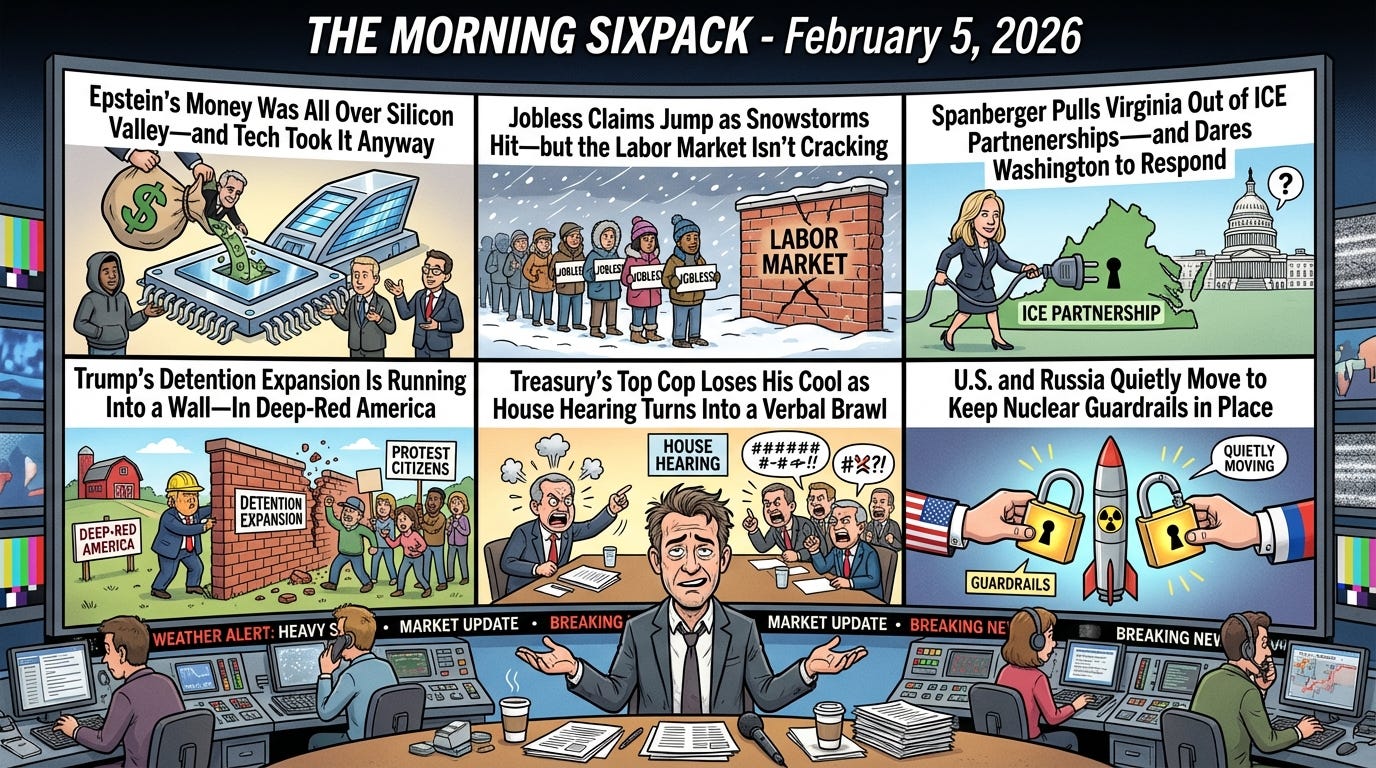
Silicon Valley didn’t accidentally take Jeffrey Epstein’s money—it knowingly welcomed it. New disclosures show how Epstein embedded himself in elite tech circles, cashing in on Coinbase and courting influence with venture capital royalty long after his crimes were public, exposing just how elastic “values” become when upside is involved.
A jump in jobless claims looks scary until you zoom out. Snowstorms distorted the latest data, but the labor market remains stuck in a low-hire, low-fire holding pattern, with businesses paralyzed by tariffs, AI uncertainty, and a wait-and-see economy that refuses to either boom or break.
Virginia’s new governor just drew a hard line between state law enforcement and ICE. Abigail Spanberger ordered an end to 287(g) partnerships, arguing that civil immigration enforcement belongs to the feds—not state police—and daring Washington to test how serious it is about federalism.
Trump’s detention-center expansion is triggering backlash where he should be safest. From Virginia to Oklahoma to New Jersey, MAGA voters are revolting against warehouse-style ICE facilities in their towns, proving that “law and order” collapses fast when it comes with floodlights and razor wire next door.
A Treasury oversight hearing turned into a verbal street fight. Treasury Secretary Scott Bessent ditched technocratic restraint for insults and taunts, alarming former officials and raising deeper concerns about the erosion of institutional independence—especially when the Fed gets dragged into the brawl.
And quietly, the world’s nuclear adults hit the panic button. With New START expiring, the U.S. and Russia are scrambling to keep basic nuclear guardrails in place, because even minimal restraint beats stumbling blind with 85% of the world’s warheads.
From tech money to nuclear math, this week’s stories all point to the same truth: when pressure hits, systems don’t bend—they show you exactly who’s in charge, and what they’re willing to risk.


