


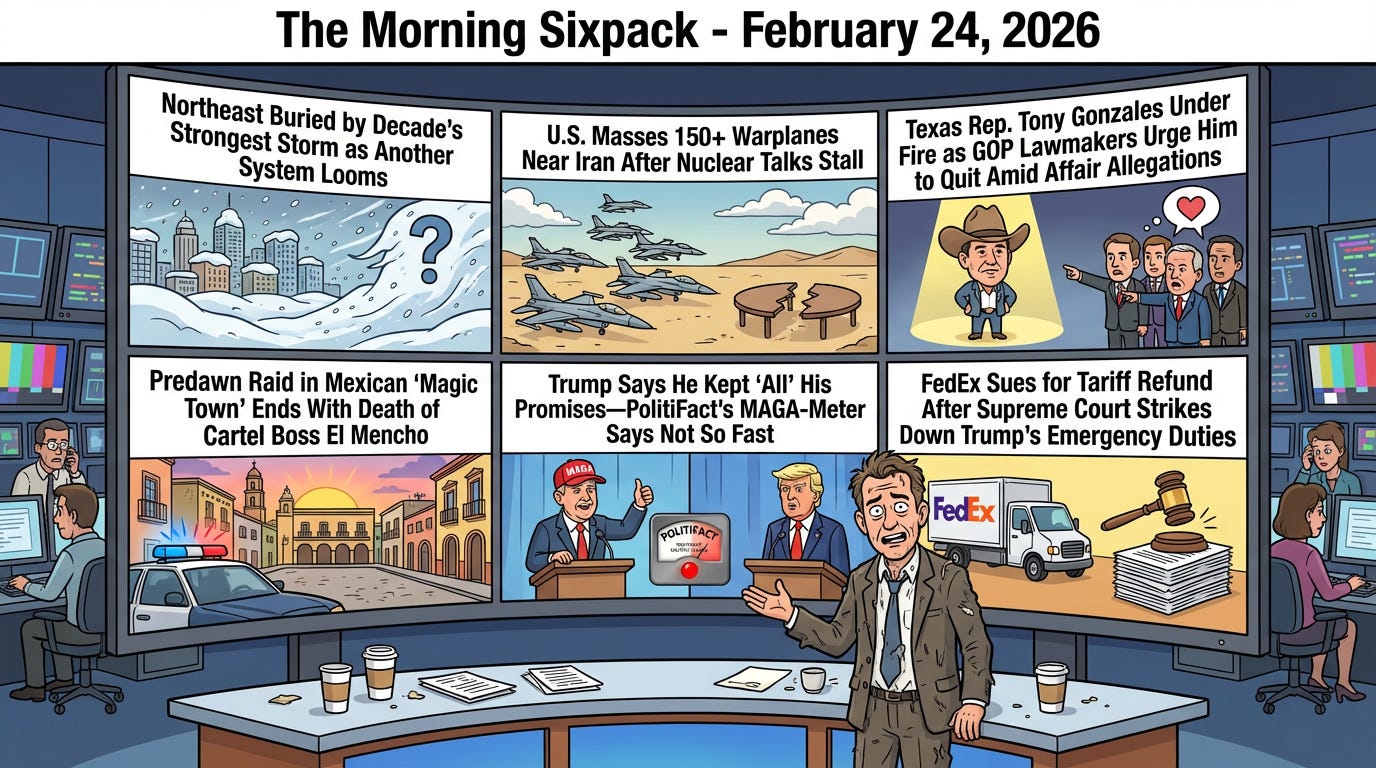
Northeast Buried by Decade’s Strongest Storm as Another System Looms
The Northeast just got walloped by the fiercest winter storm in a decade—and forecasters say round two could already be lining up.
More than 2 feet of snow smothered wide swaths of the region Monday, with parts of Rhode Island topping 3 feet and shattering records that had stood since the Blizzard of 1978. Airports shut down, more than 2,000 flights were canceled, and hundreds of thousands lost power as what meteorologists called a “classic bomb cyclone/nor’easter” churned off the coast. The cleanup effort has ranged from neighbors with shovels to a hulking railroad snowblower nicknamed “Darth Vader.”
By Tuesday morning, roads were slowly reopening and some transit systems were sputtering back to life. Central Park logged 19 inches, Warwick, Rhode Island led the pack with more than 3 feet, and wind gusts in Montauk Point hit 84 mph. Amtrak scrapped service between Boston and New York and between New York and Philadelphia, while Rhode Island’s T.F. Green International Airport remained paused after nearly 38 inches buried the runways.
Schools became the next battleground. New York City Mayor Zohran Mamdani pushed to reopen classrooms Tuesday, even as snowbanks crowded sidewalks. Staten Island Borough President Vito Fossella argued for keeping them closed.
Michael Mulgrew, president of the United Federation of Teachers, called it “a big mess,” warning: “There’s going to be low attendance of students. You’re going to have low attendance of staff because people don’t know if they can travel, if they can get to schools.”
And just as the region digs out, meteorologists are eyeing another system that could bring a messy mix of rain and snow by midweek. It’s not expected to rival Monday’s blast, but even a few inches on top of record totals could gum up recovery. As National Weather Service meteorologist Frank Pereira put it, “Any additional snow at this point is probably not going to be welcome.”
For now, emergency declarations remain in place across multiple states, utility crews are racing to restore power, and residents are clearing paths the old-fashioned way. “We’re just making a path for this car,” Brooklyn resident Christa Prince said while shoveling. “It’s not our car but you know, we’re just doing our neighbor a kind deed.”
Source: AP News
Editor: Three feet of snow, 2,000 canceled flights, and we’re debating whether it’s a good day for in-person learning. Nothing tests civic optimism like a bomb cyclone and a snowbank taller than your third grader. Stay safe, shovel smart, and maybe keep the Zoom link handy.
U.S. Masses 150+ Warplanes Near Iran After Nuclear Talks Stall
The Pentagon has quietly surged more than 150 aircraft toward Iran in one of the largest regional buildups since before the Iraq War.
Satellite imagery and flight-tracking data reviewed by The Washington Post show U.S. forces shifting planes into Europe and the Middle East after nuclear talks with Tehran ended Feb. 17 without a deal. The scale now rivals—and by some accounts surpasses—the posture seen before last year’s strikes on Iranian nuclear facilities. President Trump has threatened military action if a deal to restrict Iran’s nuclear program isn’t reached, though he hasn’t outlined what that would look like.
Two aircraft carriers—the USS Gerald R. Ford near Crete and the USS Abraham Lincoln off Oman—anchor the show of force, with guided missile destroyers carrying Tomahawks in tow. Roughly a third of active U.S. naval ships are now in the region.
“The massive level of force amassed means the U.S. military can execute on whatever Trump decides — anything from a sustained, highly kinetic campaign to more targeted, limited strikes,” said Dana Stroul, a former deputy assistant secretary of defense for the Middle East.
The buildup isn’t just fighter jets. Cargo planes and refueling tankers dominate flight logs, while combat aircraft often fly dark. Satellite imagery shows F-35s lined up in Jordan, F-22 Raptors in the United Kingdom, and additional aircraft landing in the Azores and on Crete. The U.S. has also deployed more than a third of its E-3G Sentry early-warning fleet, expanding surveillance and command capabilities across the theater.
Experts say the positioning—especially parking assets in Eastern Europe rather than directly in the Gulf—reduces vulnerability to Iranian missiles while keeping options open. As Iran signals a deal is still possible but slow-moving, Washington appears to be building leverage the old-fashioned way: hardware, hulls, and high-altitude patrols.
Source: The Washington Post (free)
Editor: When you move 150 aircraft and park two carriers within striking distance, you’re not sending a Hallmark card. Maybe it’s leverage. Maybe it’s deterrence. Maybe it’s both. But if this is “diplomacy,” it’s the kind that roars at 30,000 feet and comes with Tomahawks attached.
Texas Rep. Tony Gonzales Under Fire as GOP Lawmakers Urge Him to Quit Amid Affair Allegations
A sitting Republican congressman is facing calls to resign from members of his own party as explicit texts and an ethics probe collide with a razor-thin House majority.
Rep. Tony Gonzales, a three-term Republican representing Texas’ 23rd District, is under mounting pressure after allegations surfaced of an affair with a former staffer, Regina Santos-Aviles, who later died by suicide. At least four House Republicans have publicly urged Gonzales to either resign or drop his reelection bid as explicit text messages—allegedly sent by Gonzales—circulate. NPR reports it has not independently reviewed the messages, and Gonzales has previously denied the allegations.
The backlash has been swift. Rep. Brandon Gill, R-Texas, posted: “America deserves better. Tony should drop out of the race.” Rep. Anna Paulina Luna, R-Fla., echoed that sentiment. Reps. Lauren Boebert of Colorado and Nancy Mace of South Carolina have gone further, calling on Gonzales to resign outright. Meanwhile, Gonzales’ office has not responded to requests for comment.
Behind the scenes, the Office of Congressional Conduct is investigating the alleged relationship and is expected to forward findings to the House Ethics Committee in the coming weeks. House Speaker Mike Johnson called the allegations “very serious” but cautioned against rushing to judgment.
“As in every case like this, you have to allow the investigations to play out and all the facts to come out,” Johnson said. With Republicans holding just a four-seat majority, any resignation would tighten the math even further.
The political timing couldn’t be worse for Gonzales. He’s already facing a competitive March 3 primary and narrowly survived a 2024 runoff against conservative YouTuber Brandon Herrera—known online as “the AK guy”—by roughly 350 votes. On Monday, the House Freedom Caucus’ political arm endorsed Herrera, praising him as “a bold, unapologetic defender of the Second Amendment,” while sidestepping the allegations entirely.
This race was already going to be bruising. Now it’s radioactive.
Source: NPR
Editor: When members of your own party are tweeting “drop out” before the Ethics Committee even weighs in, that’s not a minor headache—that’s a five-alarm political fire. And with a four-seat majority, every resignation isn’t just personal drama, it’s arithmetic. Stay tuned—this one’s not cooling off anytime soon.
Predawn Raid in Mexican ‘Magic Town’ Ends with Death of Cartel Boss El Mencho
Mexico’s most-wanted drug lord was tracked to a mountain love nest—and killed in a five-hour firefight that shook a tourist town awake before dawn.
Nemesio “El Mencho” Oseguera, the feared leader of the Jalisco New Generation Cartel, died Sunday after Mexican special forces stormed a cabin complex outside Tapalpa, a picturesque “pueblo mágico” in Jalisco state. Backed by U.S. intelligence, authorities zeroed in on Oseguera’s weekend hideaway and unleashed a coordinated assault involving helicopters, elite troops, and drones. By the time the shooting stopped, one of the world’s most powerful traffickers was dead.
“It was truly a very violent attack,” Defense Secretary Gen. Ricardo Trevilla said, describing a battle that lasted roughly five hours. Oseguera’s heavily armed security detail fought back, even striking a military helicopter that was forced into an emergency landing. When it ended, five cartel gunmen were dead at the scene, while Oseguera and two bodyguards later died of their wounds. Mexican forces reported two injured soldiers and no fatalities.
The operation marked the climax of more than a year of intensified cartel crackdowns under President Claudia Sheinbaum, who has resisted direct U.S. military involvement while expanding intelligence sharing. According to a person familiar with the matter, information from the CIA helped pinpoint Oseguera’s exact location.
“There was no participation of U.S. forces in the operation,” Sheinbaum said. “What there is is a great deal of information sharing.”
Authorities seized a trove of heavy weapons, including rocket launchers, mortar grenades, and a high-caliber Barrett rifle. Within hours of Oseguera’s death, the cartel retaliated nationwide—torching vehicles, blocking highways, and attacking businesses. More than 50 people were reported killed in the fallout, including members of Mexico’s National Guard and alleged gunmen. A top cartel financial operator was later killed in a separate clash while allegedly offering cash bounties for soldiers’ deaths.
Tapalpa’s mayor now worries the tranquil mountain retreat—famous for pine forests and weekend tourism—will pay the price. “We have to find a way to turn around this situation and move forward,” he said, as residents cautiously emerged after lockdowns and roadblocks. The kingpin is gone. The power vacuum he leaves behind may prove just as dangerous.
Source: The Wall Street Journal (free)
Editor: El Mencho picked the wrong Airbnb. When your romantic getaway requires rocket launchers and armored convoys, subtlety isn’t your brand. The bigger question now isn’t whether Mexico can take down a kingpin—it’s whether it can contain what comes next. History says the sequel is usually bloodier.
Trump Says He Kept ‘All’ His Promises—PolitiFact’s MAGA-Meter Says Not So Fast
President Trump insists he’s delivered on every campaign pledge—but an independent tracker shows barely one in five promises fully kept.
At a January rally in Detroit, Trump declared, “I’ve kept all my promises, and much more,” pointing to pledges like no tax on tips, no tax on Social Security, and tariffs on foreign cars. But PolitiFact’s MAGA-Meter, which tracks 75 second-term promises, paints a more complicated picture: about 19% are rated “Promise Kept,” while nearly a third are stalled and only one is officially marked broken.
Among the promises fulfilled: pardoning Jan. 6 defendants on his first day back in office and extending his 2017 tax cuts through new legislation. Trump also touted saving TikTok, which announced a new venture involving U.S. investors. On taxes for Social Security, however, PolitiFact rated his effort a “Compromise”—the 2025 tax law created a break for many seniors but didn’t eliminate the tax entirely and sunsets in 2028.
Roughly 45% of Trump’s pledges fall under “In the Works,” including efforts to enforce concealed carry reciprocity nationwide and roll back diversity, equity, and inclusion initiatives across federal agencies and universities. Some executive actions have been blocked or narrowed in court, including rulings from the Supreme Court affecting his tariff powers. Other big-ticket items—like shutting down the Education Department or capping credit card interest rates—remain unfinished.
Only one promise is labeled “Broken”: Trump’s repeated vow to end the Ukraine-Russia war within 24 hours. Despite meetings with Russian President Vladimir Putin and Ukrainian President Volodymyr Zelenskyy, no peace deal has materialized. Meanwhile, about 31% of promises are considered “Stalled,” including requiring proof of citizenship to vote and bringing down everyday prices. Gas and some groceries have dipped, but housing, electricity, and health care costs remain elevated compared with when he took office.
PolitiFact stresses it measures outcomes, not intent. Whether voters see the glass as half full or half empty likely depends on whether they’re grading effort—or results.
Source: PBS NewsHour
Editor: “I kept all my promises” sounds great on a bumper sticker. It’s less persuasive when the spreadsheet says 19%. Campaign slogans are poetry; governing is accounting. And math, as always, has no party affiliation. Unless, of course, you believe in “alternative facts.”
FedEx Sues for Tariff Refund After Supreme Court Strikes Down Trump’s Emergency Duties
FedEx is heading to court to claw back tariff payments after the Supreme Court ruled President Trump’s emergency duties were unlawful.
The shipping giant filed suit Monday in the U.S. Court of International Trade, demanding that Customs and Border Protection refund tariffs it paid under the emergency powers program Trump launched last year. Analysts estimate the now-invalidated tariffs generated as much as $175 billion for the federal government—meaning FedEx and other importers could be chasing serious money.
FedEx didn’t put a dollar figure on its claim, but economists say the stakes are high.
“It was totally expected that they would do this, because there’s probably millions and millions of dollars on the line here for them,” said Scott Lincicome of the Cato Institute. The Trump administration had previously indicated it would comply with refund orders if the tariffs were deemed unlawful, though Trump suggested last week that any repayments could spark further legal fights.
As an “importer of record,” FedEx often pays customs duties upfront and then passes those costs along to customers. In a statement, the company said it “has taken necessary action to protect the company’s rights as an importer of record to seek duty refunds.” If the refunds come through, customers—especially large corporate shippers—will likely expect to see that money flow back to them.
FedEx is unlikely to be alone. Dozens of companies challenged the tariffs before the Supreme Court’s decision, and more lawsuits are expected in the coming weeks. The trade court could soon become the busiest room in Washington as businesses line up to get their checks.
The bottom line: what was once a revenue stream for Washington may now turn into a massive repayment tab—with interest, political fallout, and plenty of lawyers involved. Remember, everything Trump touches dies.
Source: The New York Times
Editor: When you collect up to $175 billion in tariffs and the court says “never mind,” someone’s cutting a very awkward check. Trade policy is easy to announce at a rally. Refunding it? That’s a logistics problem even FedEx can’t overnight.