


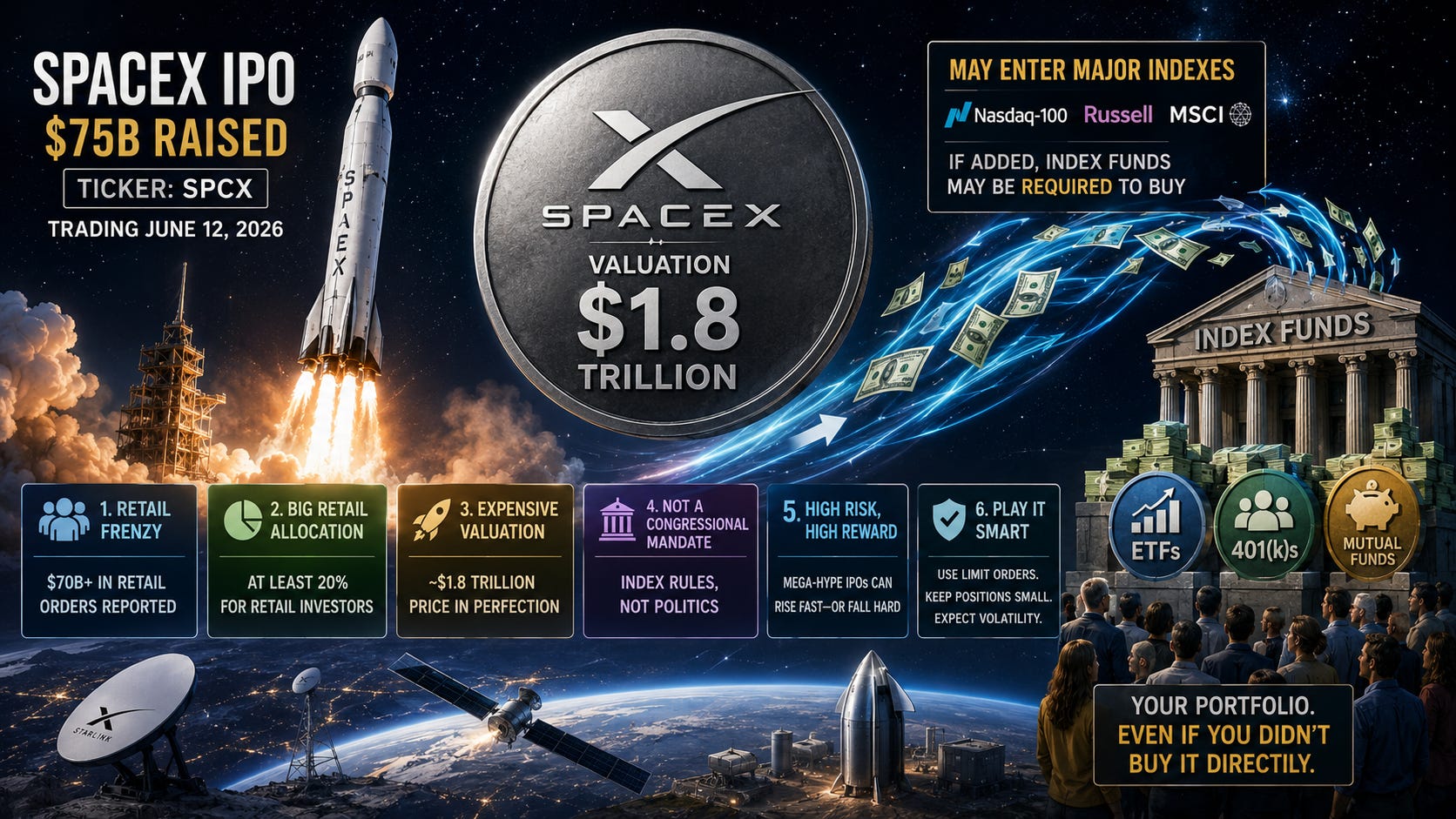
SpaceX’s IPO isn’t a government plot—it’s a reminder that when indexes change, trillions of dollars move on autopilot, whether investors notice or not.
SpaceX is expected to debut at a valuation approaching $1.8 trillion, instantly becoming one of the largest and most closely watched IPOs in market history. Wall Street sees rockets, Starlink, defense contracts, and a potential infrastructure giant rolled into one ticker symbol.
The real story is that millions of investors may end up owning SpaceX indirectly as major index funds eventually make room for it.
Retail investors have reportedly piled into the offering, with demand reaching levels normally reserved for the biggest market debuts. That enthusiasm may create fireworks on opening day, but history is full of IPOs that launched hot and then spent months reminding investors that gravity works in markets, too.
The chatter about Congress somehow forcing funds to buy SpaceX is nonsense. What is real is the mechanics of index investing. If benchmark providers decide SpaceX belongs in their indexes, funds that track those benchmarks generally have to buy shares to stay aligned with the index they promised to follow.
That makes this IPO bigger than a simple bet on rockets. Bulls see the backbone of future communications, launches, and space infrastructure. Bears see a company priced as if much of that future is already guaranteed. Both sides have a point, which is exactly why this debut will be watched so closely.
For most investors, patience may be the better strategy than chasing the first-day frenzy. SpaceX could become a generational company. That does not automatically make the opening trade a generational bargain.
Source: Reuters report on SpaceX IPO pricing and valuation
Editor: Wall Street has spent years begging for a company like SpaceX to go public. Now that it’s here, investors seem eager to prove that fear of missing out remains the most powerful force in finance—possibly even stronger than rocket fuel.