


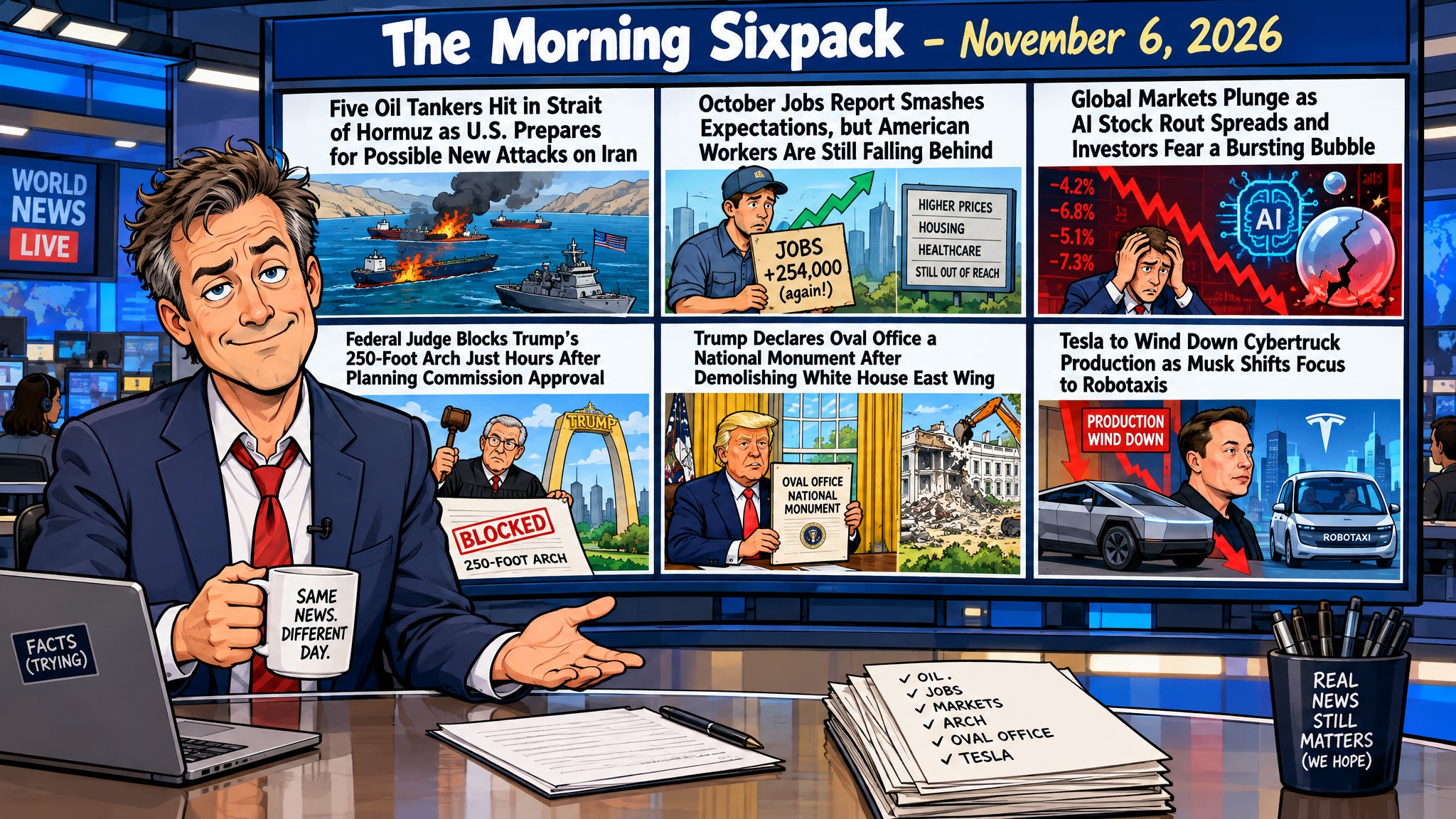
The Morning Sixpack stays free because the news that shapes your life should not be hidden behind a paywall. Paid subscribers are not paying for access. They are helping fund the research, writing, and independent voice that goes into every issue. Become a paid subscriber and help keep smart, honest news analysis free for everyone.
Five oil tankers and a tugboat reportedly caught fire near the Strait of Hormuz, while U.S. forces prepare for possible renewed attacks on Iran. The world’s most important oil chokepoint remains a dangerous place to do business.
Five Oil Tankers Hit in Strait of Hormuz as U.S. Prepares for Possible New Attacks on Iran
At least five oil tankers have been damaged by fires and reported naval mine strikes in the Strait of Hormuz, according to Iranian military officials, raising fresh concerns about shipping safety as the United States considers renewed military action against Iran. Iran’s Islamic Revolutionary Guard Corps reported that two large tankers caught fire in separate incidents, including one that allegedly struck a mine while attempting to navigate what Tehran described as an illegal shipping route. A tugboat responding to one of the burning vessels also caught fire. Iran’s regular military subsequently reported three additional tankers striking naval mines in waters east of the strait. The incidents underscore the continuing danger in a waterway that normally handles approximately one-fifth of global oil consumption.
The latest attacks come as tensions between Washington and Tehran intensify, with thousands of American military personnel reportedly positioned for possible renewed combat operations. According to unnamed Pentagon officials and military commanders cited by The New York Times, U.S. air and naval forces aboard more than a dozen ships and at bases across the Middle East and the United States are prepared to launch major strikes if President Donald Trump gives the order. Iranian leaders have warned that additional American or Israeli military action would bring serious consequences. Since the U.S.-Israeli war against Iran began in late February, Tehran has severely restricted commercial shipping through the Strait of Hormuz, disrupting one of the world’s most important energy transportation routes.
British maritime authorities also reported a separate attack involving a tanker approximately 50 nautical miles north of Qatar’s Madinat ash-Shamal. The United Kingdom Maritime Trade Operations agency said the vessel was struck by two unidentified projectiles late Wednesday, although it did not identify the ship, its nationality, or who was responsible. The incident followed an October 30 attack on the Qatari liquefied natural gas carrier Al Mayeda, which was struck by unidentified objects while sailing in the Gulf. The vessel’s operator reported no injuries or environmental damage and said the ship remained operational. Maritime officials have warned that attacks are occurring at a pace approaching previous records, with many ship operators now reluctant to report incidents, making the true scale of the danger difficult to assess.
Diplomatic efforts to contain the conflict are continuing, although the military situation remains volatile. Qatar has intensified mediation efforts aimed at restarting negotiations between Washington and Tehran, with officials reporting that both sides are reviewing proposals submitted by mediators. Iranian Supreme Leader Mojtaba Khamenei, however, rejected the idea of yielding to American pressure, declaring that Iran should not show “even the slightest inclination towards submission.” He also argued that American hostility toward Iran would continue regardless of which political party controlled Washington. Meanwhile, senior Iranian military commanders warned that continued attacks by their adversaries would strengthen Iran’s determination to confront foreign military forces in the region.
The growing confrontation leaves international shipping companies facing enormous uncertainty about the safety of their vessels and crews. Iran’s restrictions on the Strait of Hormuz have already disrupted the movement of oil and liquefied natural gas, while repeated attacks have demonstrated how vulnerable commercial ships remain. The possibility of another major American military offensive threatens to complicate diplomatic negotiations and prolong disruptions to global energy supplies. Even as Qatar attempts to bring the opposing sides back to the negotiating table, both Washington and Tehran continue signaling their willingness to use military force. For the global economy, the stakes extend far beyond the Persian Gulf, with a prolonged shipping crisis threatening energy markets and international trade.
Editor: Five tankers reportedly hit, a tugboat burning, and thousands of American troops positioned for another round of fighting. Meanwhile, diplomats are trying to negotiate an end to a war that’s already disrupted a fifth of the world’s oil supply routes. Every new attack makes the Strait of Hormuz more dangerous, and the economic consequences won’t stay confined to the Middle East.
Source: Al Jazeera
The economy added 165,000 jobs in October, crushing expectations. Unfortunately, a growing economy doesn’t mean much to workers whose paychecks keep losing ground to inflation.
October Jobs Report Smashes Expectations, but American Workers Are Still Falling Behind
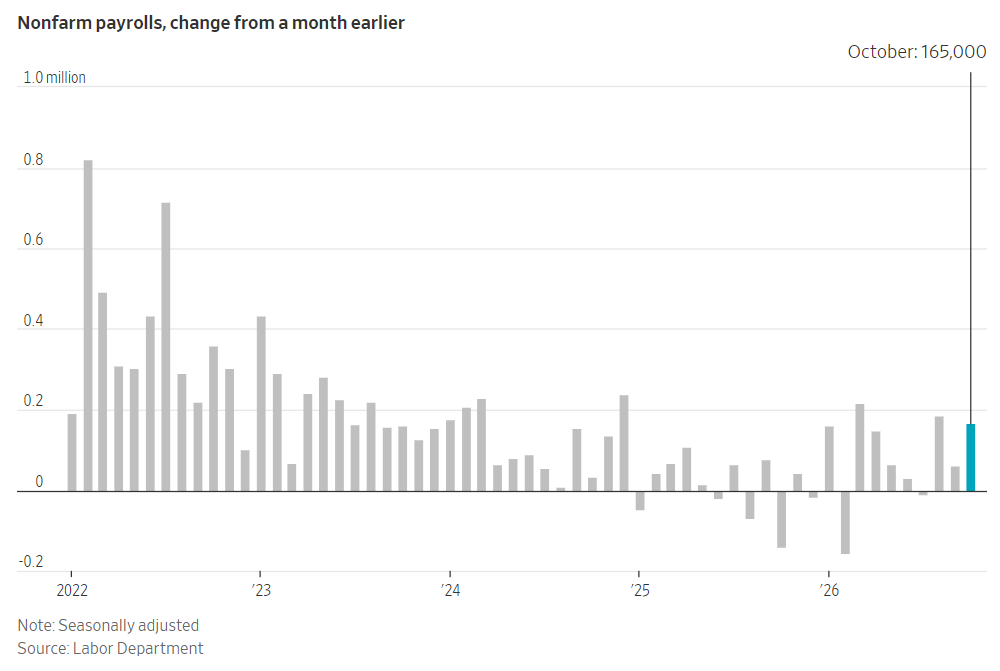
The U.S. economy added 165,000 jobs in October, nearly tripling economists’ expectations and signaling that the labor market may finally be emerging from its midyear slump. Economists surveyed by The Wall Street Journal had predicted just 59,000 new jobs, while the unemployment rate unexpectedly fell to 4.1%, beating forecasts of 4.2%. The Labor Department also revised August and September employment figures upward by a combined 84,000 jobs. Over the past three months, employers have added an average of 137,000 jobs monthly, suggesting the improvement may be more than a temporary rebound.
Professional and business services led October’s hiring surge, adding 70,000 jobs—nearly five times the sector’s average monthly gain over the previous year. The strong performance suggests artificial intelligence hasn’t yet devastated white-collar employment to the extent some analysts have feared. Healthcare added another 42,000 positions, while manufacturing gained 19,000 jobs, particularly in industries benefiting from AI-related investment. Construction was a notable exception, losing 3,000 jobs, including positions in nonresidential projects such as data centers. Gregory Daco, chief economist at EY-Parthenon, described the overall report enthusiastically: “It’s as good as can be, really.”
But the encouraging hiring numbers conceal a troubling reality for American workers. Average hourly earnings increased just 3.1% over the past year, likely marking the seventh consecutive month in which wage growth failed to keep pace with inflation. Even more revealing, the share of nonfarm business output going toward employee compensation dropped to 53% in the third quarter, the lowest level in eight decades of available records. Meanwhile, employers remain reluctant to hire aggressively or lay off existing workers, creating a difficult environment for recent graduates and employees seeking better-paying opportunities. The economy may be expanding, but workers aren’t receiving a proportional share of its gains.
The stronger employment figures are unlikely to change the Federal Reserve’s immediate plans for interest rates. Inflation remains stubbornly above the central bank’s 2% target, and policymakers are expected to raise rates at their December meeting unless employment conditions deteriorate sharply. Fed officials are also increasingly cautious about interpreting individual monthly jobs reports, which can fluctuate significantly because of statistical adjustments and changes in how businesses are counted. An aging population and tighter immigration restrictions have further complicated the picture by reducing the available workforce. Under new Chairman Kevin Warsh, the Fed is also seeking to reduce its dependence on short-term economic data when making policy decisions.
The report arrives just days after Democrats defeated Republicans in the midterm elections, a result potentially influenced by widespread dissatisfaction with the economy. Despite solid economic growth, many Americans continue to struggle with rising prices, stagnant purchasing power, and limited opportunities to change jobs for better wages. The combination of low layoffs and sluggish hiring has left workers feeling trapped, even as headline employment figures improve. October’s report demonstrates that the American economy can produce impressive numbers while leaving millions of workers questioning whether they’re actually getting ahead.
Editor: Wall Street gets another reason to celebrate, economists get to congratulate themselves, and American workers get a 3.1% raise that doesn’t even cover inflation. When workers receive the smallest share of economic output in 80 years, maybe the problem isn’t how many jobs we’re creating—it’s who benefits from all that economic growth.
Source: The Wall Street Journal
Investors poured billions into the AI boom, but mounting debt, sky-high valuations, and the threat of new regulations have Wall Street wondering whether the party is over.
Global Markets Plunge as AI Stock Rout Spreads and Investors Fear a Bursting Bubble
Global stock markets plunged Friday as a massive selloff in artificial intelligence companies spread from Wall Street to financial markets across Asia and Europe. Japan’s Nikkei 225 collapsed 6%, closing at 57,434.77 and falling below 60,000 for the first time in nearly six months. South Korea’s Kospi suffered an equally punishing 6% decline, dragged down by steep losses in semiconductor giants Samsung Electronics and SK Hynix. European markets followed the downward trend, with Britain’s FTSE 100 dropping 1.5%, Germany’s DAX losing 1.4%, and France’s CAC 40 sliding 1.2% in early trading.
The global selloff reflects growing fears that the artificial intelligence investment boom has pushed technology stock valuations far beyond what their underlying businesses can justify. Companies have borrowed and spent enormous sums building the data centers, semiconductor infrastructure, and computing capacity required to develop increasingly powerful AI systems. Investors are now questioning whether those investments will generate sufficient returns to justify the extraordinary spending. Japanese technology companies SoftBank Group and Advantest were among the hardest hit, while Hong Kong and mainland Chinese markets also declined. The downturn has raised fresh concerns that the AI sector could be experiencing a speculative bubble.
Political developments in Washington have added another layer of uncertainty. Democrats’ victories in Tuesday’s U.S. midterm elections have increased expectations of tougher oversight of the AI industry, including potential regulations at the state level. Opposition to data center construction has already become a significant political issue in communities concerned about the enormous energy demands and local impacts of these facilities. Investors now face the possibility that new restrictions could complicate expansion plans just as technology companies are committing unprecedented amounts of capital. The prospect of tighter regulation has intensified an already nervous market’s reassessment of AI-related investments.
Thursday’s Wall Street collapse was the worst trading session since President Donald Trump’s sweeping “Liberation Day” tariffs rattled global financial markets in April 2025. The losses more than erased the previous day’s gains, which had marked the market’s strongest performance in three months. AI semiconductor companies have become particularly influential because their enormous market valuations give them disproportionate weight in major stock indexes. Their declines can therefore drag down broader markets even when other sectors remain relatively stable. Still, some analysts see potential opportunities emerging from the turmoil, with Swissquote senior analyst Ipek Ozkardeskaya suggesting that falling prices could allow investors to purchase previously expensive stocks at a discount.
Beyond the technology sector, investors are also confronting economic uncertainty stemming from the ongoing war with Iran. U.S. crude oil traded near $90.69 per barrel Friday, while Brent crude hovered around $98.28, reflecting continued concerns about disruptions to global energy supplies. Japan’s Toyota Motor also suffered sharp stock losses following disappointing earnings, adding to the pressure on Asian markets. Currency markets showed additional nervousness, with the U.S. dollar strengthening against the Japanese yen and the euro weakening. Taken together, the AI selloff, political uncertainty, and geopolitical instability have left investors questioning whether the extraordinary technology-driven market rally can continue.
Editor: Wall Street spent years treating AI like a guaranteed money-printing machine. Now investors are discovering that borrowing billions to build data centers isn’t the same thing as earning billions in profits. AI isn’t going away, but the assumption that every company associated with it deserves an astronomical valuation might finally be getting a reality check.
Source: Associated Press
Trump’s proposed 250-foot monument won approval from a commission filled with his allies after hours of public opposition. Less than two hours later, a federal judge put the brakes on construction.
Federal Judge Blocks Trump’s 250-Foot Arch Just Hours After Planning Commission Approval
A federal judge temporarily blocked construction of President Donald Trump’s proposed 250-foot triumphal arch near Arlington National Cemetery, issuing an emergency order just hours after a federal planning commission approved the controversial project. U.S. District Judge Tanya Chutkan barred construction for 14 days in a ruling issued shortly before midnight Thursday and made public early Friday. The decision followed lawsuits filed by the governments of Washington, D.C., and Virginia, along with Vietnam War veterans and an architectural historian, challenging the project’s legality. The monument would rise from Memorial Circle, the traffic island connecting the Lincoln Memorial to Arlington National Cemetery, where critics argue it would disrupt historic views, create traffic problems, and interfere with one of America’s most solemn memorial landscapes.
The National Capital Planning Commission approved the arch by an 8-4 vote after nearly nine hours of proceedings dominated by opposition from veterans, preservationists, lawmakers, and local residents. More than 130 people registered to testify, with critics questioning the project’s legality, undisclosed costs, environmental consequences, and potential aviation hazards. Several veterans and relatives of service members buried at Arlington argued that the monument would diminish the dignity of the nearby national cemetery. Despite the extensive testimony, commissioners aligned with Trump moved forward, rejecting a motion to postpone the vote until complete plans could be reviewed. Commission Vice Chair Stuart Levenbach acknowledged that the administration wanted a decision immediately because it intended to begin construction quickly.
Judge Chutkan’s 33-page opinion raised serious questions about the administration’s shifting explanations for the monument, particularly its recent claims that the arch would serve national security purposes. Trump and Defense Secretary Pete Hegseth have promoted that justification, but officials acknowledged that no supporting security analysis was included in the commission’s final submission. Administration representatives maintained that Congress had effectively authorized the project in 1925 when it approved two 166-foot columns that were never constructed. Opponents dispute that interpretation, arguing that a substantially larger arch requires new congressional authorization and must comply with federal environmental and historic preservation laws. Chutkan also agreed that construction would immediately harm local governments through traffic disruptions, especially given the administration’s plans to operate construction crews 20 hours daily for two to three years.
The commission’s approval process drew particularly sharp criticism from preservation advocates and Democratic lawmakers. National Trust for Historic Preservation President Brent Leggs called the vote a “sham,” accusing officials of disregarding public opposition and federal legal requirements. D.C. Council Chair Phil Mendelson questioned whether commissioners could legitimately approve a project without complete plans, while other critics challenged the administration’s refusal to disclose the monument’s cost. Protesters gathered at Memorial Circle before the meeting, where construction markings had already appeared on the grass despite questions about whether the work had been authorized. The administration had informed the court that excavation could begin immediately following approval, prompting Chutkan to intervene before construction started.
The legal fight is expected to continue as Democrats prepare to assume control of Congress in January following their midterm election victories. Virginia Rep. Don Beyer has introduced legislation to prohibit and defund the arch, with approximately 80 co-sponsors and expectations of broader support in the next Congress. California Rep. Jared Huffman, who expects to lead the House Natural Resources Committee, warned contractors and federal officials that proceeding without proper authorization could expose them to legal consequences. Veterans’ organizations and historic preservation groups have pledged to continue fighting the project through Congress and the courts. For now, the judge’s order provides only a temporary halt, leaving the monument’s ultimate fate unresolved.
Editor: Nine hours of public testimony, serious legal questions, no confirmed price tag, and an 8-4 approval from a commission dominated by Trump allies. Then a federal judge stops the bulldozers before they start. Perhaps getting congressional authorization and producing complete construction plans should come before breaking ground on a 250-foot monument.
Source: NPR
Trump demolished the White House East Wing, renovated the Oval Office, and now wants to make sure future presidents can’t substantially alter his handiwork. Preservation, it seems, has become a presidential priority.
Trump Declares Oval Office a National Monument After Demolishing White House East Wing
President Donald Trump has signed an executive order declaring the Oval Office a national monument, a move he says will prevent future presidents from making substantial structural changes to the iconic presidential workspace. The order follows Trump’s renovation of the Oval Office and establishes new protections intended to preserve its historic structure and architectural character. Speaking to reporters Thursday, Trump said the designation would prevent successors from tearing down or substantially rebuilding the room. The announcement comes just months after his administration demolished the entire White House East Wing, a controversial project that has faced legal challenges.
Trump framed the executive order as a safeguard against future presidents who might want to alter or replace the Oval Office’s existing design. “We’re making it a national monument, and it will not be allowed to be touched by anybody, destroyed, ripped down by stupid people, in order to build something in a slightly different shape,” he told reporters. The declaration represents an unusual effort by a sitting president to establish protections for the very office he currently occupies. It also raises questions about how much authority one president can exercise over changes made by future administrations.
Despite Trump’s sweeping public statements, the executive order does not prohibit future presidents from redecorating the Oval Office. Its language explicitly preserves presidential authority to select furnishings, change decorations, and make ordinary operational or security modifications. Those changes remain permissible as long as they do not substantially damage the room’s historic structure or architectural character. In practical terms, future occupants could still personalize the office, although major architectural alterations would face the restrictions established by the order.
Presidents have traditionally enjoyed considerable discretion over the appearance and furnishings of the White House, although major construction projects generally require congressional approval. The Oval Office has undergone numerous decorative changes as successive administrations have selected different furniture, artwork, rugs, and color schemes. Trump’s order attempts to distinguish those routine changes from more substantial alterations to the room itself. The BBC report does not establish whether the designation could be reversed by a future president or how its restrictions would be enforced.
The timing of the announcement is particularly notable given Trump’s own extensive changes to the White House complex. His administration previously demolished the entire East Wing as part of a construction project that has drawn legal challenges. Now, after renovating the Oval Office, Trump is seeking to protect that space from significant alterations by his successors. The contrast between demolishing one section of the White House and declaring another a protected monument is likely to invite continued scrutiny of how the administration approaches historic preservation. For the moment, the order establishes Trump’s stated intention to preserve the Oval Office’s architectural character while leaving future presidents free to change its decor.
Editor: Trump tears down the entire East Wing, then declares the Oval Office off-limits to future presidents who might want to change it. There’s a certain irony in a president invoking historic preservation after taking a wrecking ball to part of the White House. Evidently, some renovations deserve protection more than others.
Source: BBC News
Elon Musk promised the Cybertruck would revolutionize the pickup market. Three years, 11 recalls, and disappointing sales later, Tesla is preparing to clear factory space for its next futuristic gamble.
Tesla to Wind Down Cybertruck Production as Musk Shifts Focus to Robotaxis
Tesla will wind down production of its Cybertruck at its Texas gigafactory around mid-2027, marking a major retreat for one of Elon Musk’s most ambitious and controversial vehicles. Musk announced the decision Friday, saying the company needs additional manufacturing capacity for its newly launched Cybercab, a fully autonomous vehicle central to Tesla’s robotaxi strategy. The announcement follows years of disappointing Cybertruck sales that fell dramatically short of Musk’s original projections. Although Tesla has not confirmed whether production will move elsewhere or end entirely, its Austin factory is the only known facility equipped to manufacture the truck’s specialized stainless-steel components.
The Cybertruck’s sales figures tell the story of a vehicle that never came close to fulfilling Musk’s enormous expectations. When production began in 2023, Musk predicted annual sales of 250,000 units, but Tesla sold just 38,965 Cybertrucks in 2024 and only 20,237 in 2025—a 48% decline. The company also issued 11 recalls since deliveries began, addressing problems through physical repairs and software updates. Even Musk’s aerospace company, SpaceX, became a significant customer, purchasing $131 million worth of Cybertrucks in 2025. Former Aston Martin CEO Andy Palmer summarized the business reality: “It doesn’t make sense to keep it going when it’s not meeting its targets.”
From its disastrous 2019 unveiling, when a demonstration of supposedly shatterproof windows left two panes badly cracked, the Cybertruck attracted as much ridicule as admiration. Its angular stainless-steel body distinguished it from conventional pickups but also created serious limitations in international markets. European pedestrian-safety regulations effectively prevented the vehicle from receiving approval for sale, eliminating a potentially important market for Tesla. Automotive analyst Felipe Munoz noted that electric pickups from Ford and other manufacturers have also struggled in the United States, suggesting the Cybertruck’s problems extend beyond its unconventional appearance. Nevertheless, its polarizing design, repeated recalls, and declining sales made it particularly difficult to justify continued production.
Tesla is now betting that the Cybercab can succeed where the Cybertruck fell short. The two-seat autonomous vehicle features butterfly doors and eliminates conventional driving controls, including a steering wheel, pedals, and mirrors. Musk envisions it as the foundation of a global robotaxi network and a key step in transforming Tesla from a traditional automaker into an artificial intelligence and robotics company. Tesla began offering paid Cybercab rides in Austin in September, although federal regulators have questioned whether the vehicle meets required safety standards. The National Highway Traffic Safety Administration opened an audit of Tesla’s self-certification process, leaving important regulatory questions unresolved.
The Cybertruck announcement caps a difficult week for Musk, whose nearly $500 million in political spending produced disappointing results in Tuesday’s midterm elections, with most of his favored Republican candidates losing. His companies were also on track to shed more than $370 billion in combined market capitalization during the week. Meanwhile, the Cybercab remains a relatively small operation, accounting for approximately 570 of the more than 1,200 Tesla robotaxis operating in Texas. Although Tesla reports installed Cybercab production capacity exceeding 125,000 vehicles, the program is unlikely to replace lost Cybertruck sales anytime soon. Musk nevertheless described the Cybertruck as the “best vehicle Tesla has ever made” and called its approaching production wind-down the “end of an era.”
Editor: Musk predicted 250,000 Cybertruck sales a year and ended up selling barely 20,000 last year. Now he’s clearing factory space for a driverless taxi that federal regulators are still scrutinizing. Tesla may eventually make autonomous vehicles a huge business, but the Cybertruck is a reminder that Musk’s boldest predictions don’t always survive contact with actual customers.
Source: Reuters
Read The Morning Sixpack here: