


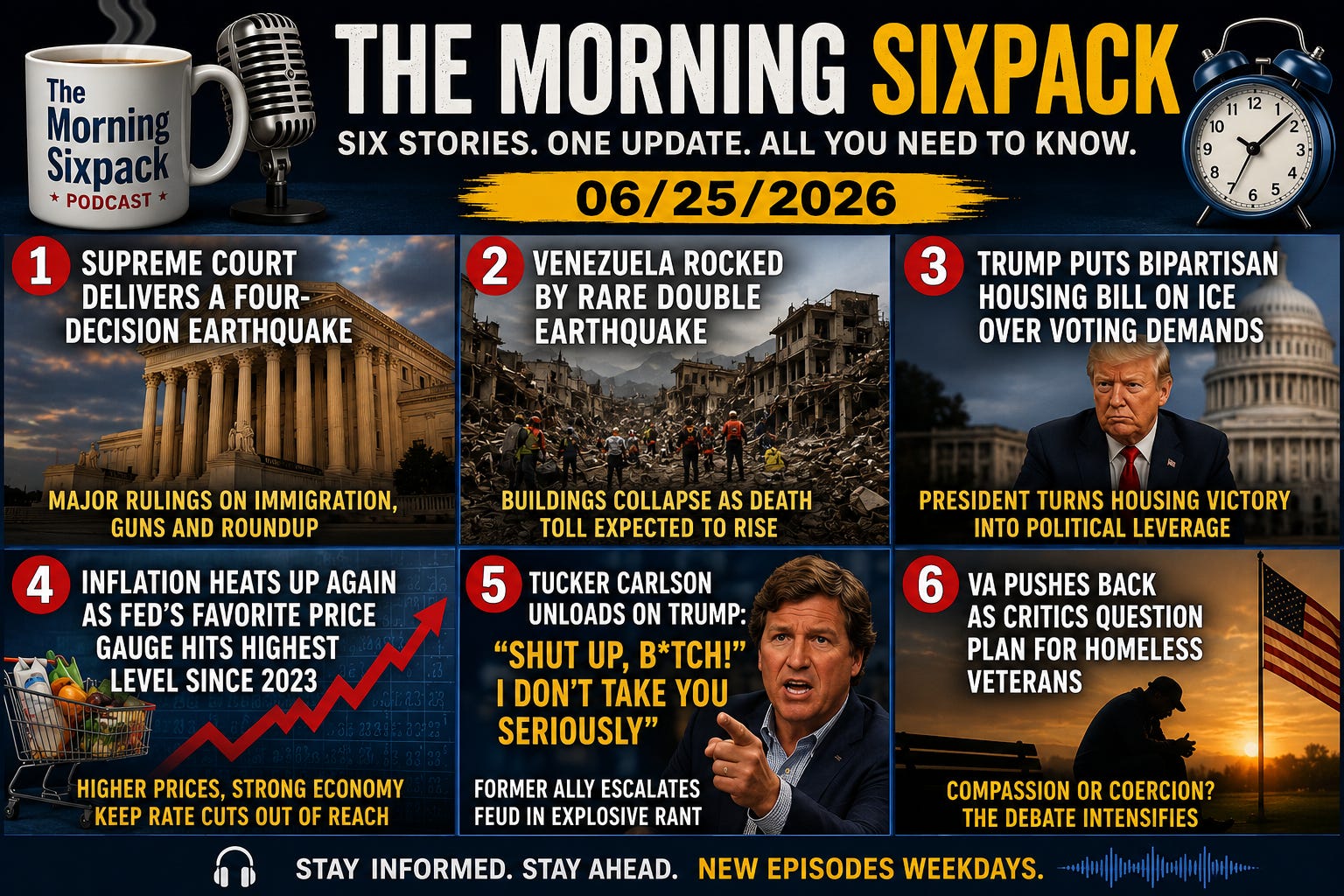
Four major Supreme Court rulings in one morning reshaped immigration, gun rights, and corporate liability—and Washington is going to be dealing with the fallout for a long time.
Supreme Court Delivers a Four-Decision Earthquake on Immigration, Guns and Roundup
The Supreme Court issued four major rulings Thursday that handed victories to conservatives on immigration, gun rights, and federal regulatory power while limiting challenges in state courts.
In a matter of minutes, the justices rewrote the legal landscape on asylum, Temporary Protected Status, concealed carry, and Roundup lawsuits.
If you were looking for one theme, here it is: The Court continued to reinforce federal authority where Congress has spoken, while expanding constitutional protections for gun owners and narrowing the avenues available for challenging executive actions in court. That’s a lot to squeeze into one opinion day.
The biggest immigration ruling held that migrants waiting on the Mexican side of the border have not legally “arrived in the United States” until they physically cross the border, allowing border officials to continue limiting who can present asylum claims at ports of entry. In a separate immigration case, the Court also cleared the way for the Trump administration to end Temporary Protected Status for Haiti and Syria while legal challenges continue, concluding Congress largely shielded those decisions from judicial review.
The Court also handed Monsanto a significant victory, ruling that federal pesticide law blocks state lawsuits claiming Roundup should have carried cancer warnings the EPA never required. That reverses a Missouri verdict awarded to a man who blamed years of using the herbicide for developing non-Hodgkin’s lymphoma, with the majority saying states cannot impose labeling requirements that differ from federal approval.
Finally, the justices struck down Hawaii’s law requiring concealed-carry permit holders to obtain a property owner’s express permission before bringing firearms into businesses open to the public. The majority said the law flipped the nation’s longstanding default rule and imposed an unconstitutional burden on the Second Amendment under the Court’s Bruen decision, while the dissent argued the case was fundamentally about property rights—not gun rights.
Source: SCOTUS Watch
Editor: Four opinions, four wins for the conservative majority, and about four years’ worth of political talking points handed to both parties before lunchtime.
Two massive earthquakes struck Venezuela just 39 seconds apart, turning a national holiday into a desperate race to rescue survivors.
Venezuela Rocked by Rare Double Earthquake as Buildings Collapse
Venezuela was hit by a devastating one-two punch Wednesday when magnitude 7.2 and 7.5 earthquakes struck less than a minute apart, collapsing buildings and leaving dozens dead with the toll expected to climb into the thousands.
Rescue crews are digging through mountains of concrete while officials warn this disaster is only beginning to unfold.
The twin quakes hit during a national holiday, meaning many Venezuelans were at home instead of commuting when the ground began shaking. Preliminary figures put the death toll at 32 with more than 700 injured, but entire buildings crumbled across Caracas and neighboring La Guaira, where officials say the worst damage occurred. Thousands remain unaccounted for as emergency crews continue searching for survivors. The U.S. Geological Survey warned there is a significant possibility the eventual death toll could reach into the thousands.
Interim President Delcy Rodríguez declared a nationwide state of emergency as hospitals filled with victims, power outages spread, and gas service was shut off to damaged buildings. The Venezuelan Red Cross reported its own headquarters suffered critical damage while warning that search-and-rescue operations, emergency shelter, trauma care, and clean drinking water are the country’s most urgent needs. President Donald Trump said the United States “stands ready, willing, and able to help,” as other nations also offered assistance. The proof, as always, will be in the pudding, as they say.
Source: UPI
Editor: Mother Nature doesn’t care about politics, borders, or holidays. When the earth decides to move, all the arguments stop and the only thing that matters is who can still be pulled from the rubble.
A rare bipartisan housing bill was on its way to becoming law—until President Trump hit the brakes over a completely different political fight.
Trump Puts Bipartisan Housing Bill on Ice Over Voting Demands
President Trump abruptly canceled plans to sign a landmark bipartisan housing bill Wednesday, insisting Congress first pass his election reform agenda before he’ll put pen to paper.
Just when Washington looked ready to celebrate a rare bipartisan win, the White House turned affordable housing into leverage for an entirely unrelated political battle.
The 21st Century Road to Housing Act had been hailed as the first major housing legislation in more than three decades, earning support from Republicans, Democrats, and even the White House. The bill aims to increase the nation’s housing supply by easing regulations, encouraging new construction, and tackling one of the biggest drivers of high home prices. White House Press Secretary Karoline Leavitt had even called it “one of the most significant pieces of housing affordability legislation in American history” before the president suddenly reversed course.
Instead, Trump declared he would not sign the measure unless Congress first approved the SAVE America Act, which would tighten voter identification requirements and restrict mail-in voting. He also blasted Senate Republicans after several members joined Democrats in supporting a resolution directing him to end U.S. military involvement with Iran. House Republican leaders delayed formally delivering the housing bill to the White House, leaving its future uncertain while lawmakers scrambled to calm an increasingly frustrated president.
The move stunned lawmakers in both parties and housing advocates who were literally on their way to the signing ceremony when it was canceled. While Trump still has time to sign or veto the legislation once it’s formally presented, Republicans now find themselves unable to tout one of their biggest legislative achievements heading into the midterm elections. Sometimes Washington proves that solving one problem isn’t nearly as interesting as creating three new ones.
Source: The New York Times
Editor: Affordable housing is one of the few issues that can unite both parties. Trump managed to turn it back into a food fight anyway.
Inflation just gave the Federal Reserve another reason to keep Americans waiting for lower interest rates.
Inflation Heats Up Again as Fed’s Favorite Price Gauge Hits Highest Level Since 2023
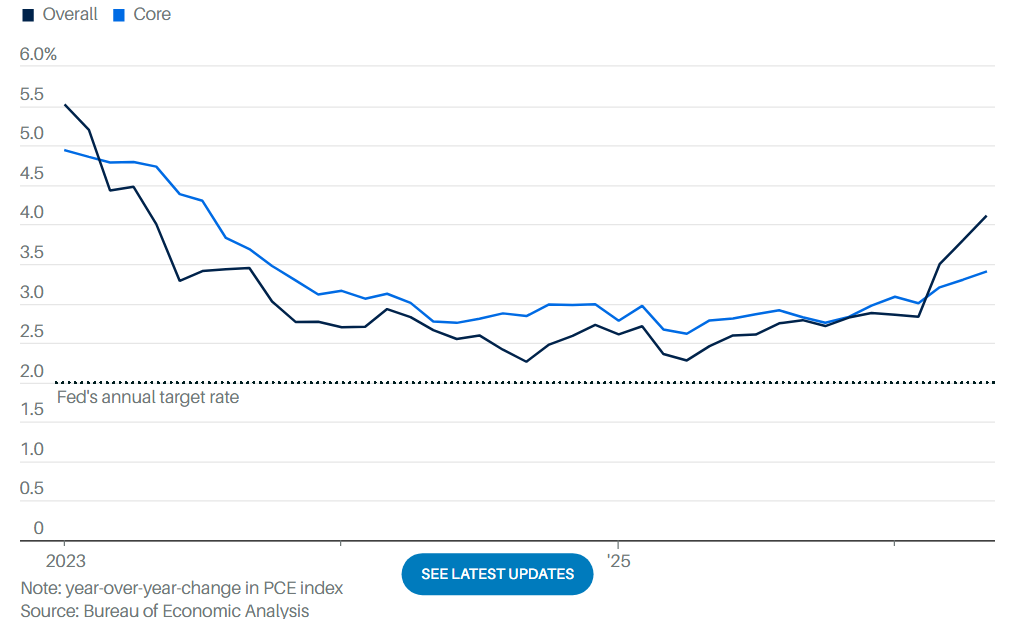
Core inflation climbed to 3.4% in May—the highest reading since October 2023—adding fresh pressure on the Federal Reserve to keep interest rates higher for longer. Overall inflation is way up. But nobody’s reporting on that.
The economy is still growing, consumers are still spending, and inflation still refuses to cooperate.
The Commerce Department’s latest Personal Consumption Expenditures (PCE) report, the inflation measure the Fed watches most closely, showed prices continuing to accelerate despite months of efforts to cool the economy. Overall inflation reached 4.1% on an annual basis, driven largely by higher energy costs tied to the war with Iran. Housing, insurance, and other everyday expenses also continued climbing, reinforcing concerns that inflation is spreading beyond gasoline prices. “Inflation is at a 3-year high due to the war in Iran and it’s painful for middle-class and moderate-income Americans,” said Navy Federal Credit Union Chief Economist Heather Long.
The report also showed the economy remains surprisingly resilient. Consumer spending jumped 0.7% in May, personal incomes rose by the same amount, and first-quarter economic growth was revised higher to a solid 2.1%. Weekly unemployment claims also fell, suggesting businesses are still hiring despite higher borrowing costs. For the Fed, that’s a mixed blessing: A healthy economy gives policymakers room to fight inflation, but it also means they’re less likely to cut interest rates anytime soon—and could even raise them later this year if price pressures don’t ease.
Source: CNBC
Editor: Every inflation report now feels like a weather forecast: “Relief is coming...eventually.” Meanwhile, families are still paying more for groceries, gas, and just about everything else while waiting for the forecast to finally be right.
Tucker Carlson just took his public feud with President Trump to a whole new level—and he didn’t bother to clean up the language.
Tucker Carlson Unloads on Trump: “Shut Up, B*tch! I Don’t Take You Seriously”
Former Fox News host Tucker Carlson blistered President Trump in a podcast interview, mocking his tough talk on Iran and declaring, “Shut up, b*tch! I don’t take you seriously.”
What started as a disagreement over Iran has turned into an all-out war of words between two of the biggest voices on the American right.
Appearing on the Jack Neel Podcast, Carlson argued that Trump’s handling of the Iran conflict exposed a president who was “super sophisticated about certain things” but “obviously buffoonish in other ways.” Carlson said Trump realized there was “no obvious military solution” and tried to “posture” his way out of the conflict through increasingly aggressive Truth Social posts threatening Iran’s regime. According to Carlson, repeated threats eventually lost their impact because, as he put it, “Strong people don’t brag about how strong they are. They just punch you in the face and end the conversation.”
Using a story about lessons from his boxer father, Carlson contrasted loud, confrontational people with those who quietly act. He then placed Trump firmly in the first category before delivering his blunt assessment:
“Shut up, b*tch! I don’t take you seriously.”
The comments mark the sharpest public criticism yet from Carlson, once one of Trump’s strongest media allies, and underscore how divisions over U.S. involvement in Iran continue to fracture parts of the conservative movement.
Source: Mediaite
Editor: Political alliances in Washington—and conservative media—seem to come with expiration dates. Yesterday’s ally can become today’s loudest critic with remarkable speed.
A proposed Trump administration plan for homeless veterans is raising concerns that compassion could be replaced with court orders.
VA Pushes Back as Critics Question Plan for Homeless Veterans
The Trump administration insists it is not preparing to force homeless veterans into treatment, but leaked planning documents have sparked concern among veterans advocates and lawmakers.
The debate isn’t about whether veterans need help—it’s about whether that help should ever come against their will.
Veterans Affairs Secretary Doug Collins says critics have misrepresented a proposed initiative known as “Safe Harbor,” which surfaced in leaked documents earlier this year. Collins insists a new agreement between the VA and the Justice Department is designed to help veterans already hospitalized who have no family and are unable to make important medical decisions. “We’re helping them do that,” Collins said, rejecting claims that the administration is targeting homeless veterans. He also blasted reports linking the proposal to President Trump’s executive order encouraging states to institutionalize some homeless individuals, saying accusations the VA was “attacking homeless” veterans made him “want to puke.”
Democrats and veterans advocacy groups remain unconvinced. Representative Mark Takano says the VA has refused repeated requests to clarify its plans, while organizations including Iraq and Afghanistan Veterans of America and the National Alliance to End Homelessness worry the proposal could become a pathway to involuntary commitment for vulnerable veterans. Outreach workers on the front lines argue trust—not force—is what changes lives, pointing to veterans like 87-year-old Navy veteran Curtis Ervin, who accepted housing only after years of patient relationship-building. His story, they say, shows that compassion often succeeds where coercion can fail.
Source: NPR
Editor: Anyone who’s spent time around veterans knows independence runs deep. Helping those who need it is essential, but if trust is replaced by government mandates, Washington risks making a difficult problem even harder to solve.
Conservatives need to put their money where their big mouths are: They always say, “We support our veterans” (as do I), but they never show it in any meaningful policy or legislation.