


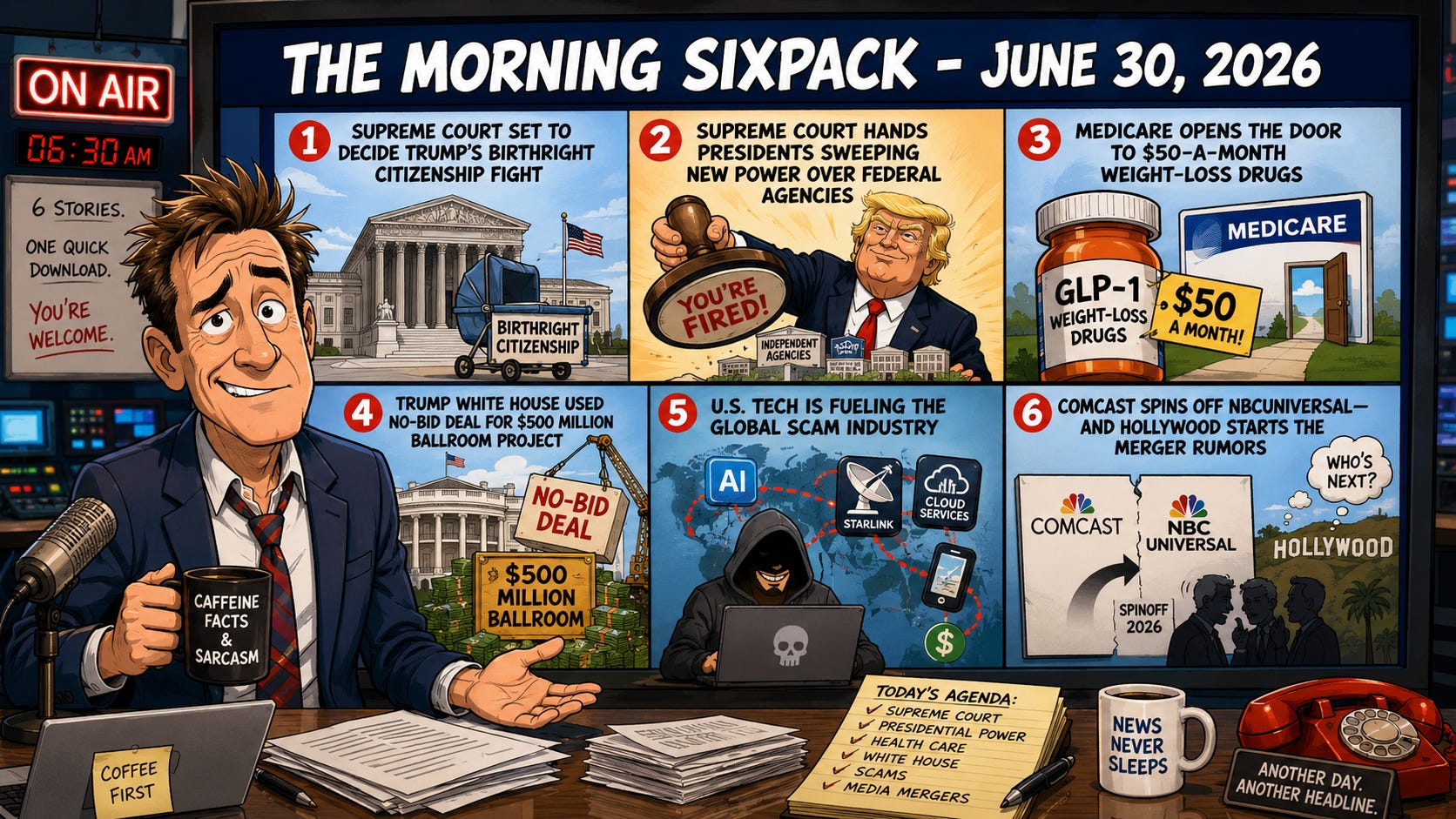
The Supreme Court is
about to decidejust decided whether President Trump can dramatically narrow birthright citizenship—and the ruling could redefine who gets to call themselves an American.
Supreme Court Set to Decide Trump’s Birthright Citizenship Fight
BREAKING NEWS: Supreme Court Rejects Trump’s Birthright Citizenship Order

The Supreme Court just told President Trump that birthright citizenship isn’t something a president can rewrite with the stroke of a pen.
The Supreme Court is poised to decide decided whether President Donald Trump can move forward with one of the biggest immigration policies of his second term by limiting birthright citizenship. SHORT STORY: He can’t.
The decision could reshape U.S. citizenship law for generations—and it lands just days before America marks its 250th birthday.
Trump’s executive order would deny automatic U.S. citizenship to children born in the country unless at least one parent is a U.S. citizen or lawful permanent resident. Lower courts blocked the order, saying it conflicts with the 14th Amendment, which has long been understood to guarantee citizenship to nearly everyone born on American soil.
The constitutional battle centers on the Citizenship Clause of the 14th Amendment, which states: “All persons born or naturalized in the United States, and subject to the jurisdiction thereof, are citizens of the United States.” The Trump administration argues that phrase excludes children whose parents are in the country illegally or only temporarily. Opponents counter that the Supreme Court settled the issue more than a century ago in the 1898 Wong Kim Ark decision.
The administration also argued that automatic citizenship has fueled “birth tourism,” with Solicitor General D. John Sauer telling the justices the practice has become a significant problem, though he acknowledged, “no one knows for sure” how widespread it is. Legal experts estimate Trump’s policy could affect as many as 250,000 babies born each year if allowed to take effect.
Source: Reuters
Editor: Timing is everything. Nothing says “constitutional cliffhanger” quite like dropping one of the biggest citizenship rulings in modern history right before Independence Day.
The Supreme Court just handed President Trums (and all future presidents) far more power over the federal bureaucracy—because apparently independent agencies were getting a little too independent.
Supreme Court Hands Presidents Sweeping New Power Over Federal Agencies
The Supreme Court dramatically expanded presidential authority by allowing presidents to remove leaders of most independent federal agencies, overturning nearly a century of legal precedent.
The ruling gives the White House far more control over regulators who oversee everything from financial markets to workplace safety—and it could permanently reshape how the federal government operates.
In a 6-3 decision, the court’s conservative majority threw out a 90-year-old precedent that protected the heads of independent agencies from being fired without cause. Writing for the majority, Chief Justice John Roberts said presidents must be able to rely on executive branch officials they trust, arguing that Congress cannot force a president to keep officials who stand in the way of carrying out the administration’s policies.
The ruling embraces the “unitary executive” theory, which holds that executive branch power ultimately belongs to the president. Supporters say that’s exactly what the Constitution requires. Critics warn the decision opens the door for presidents to exert far greater control over regulators—and potentially even career civil servants—creating wider policy swings every time the White House changes hands. Justice Sonia Sotomayor, writing for the dissent, said the decision replaces longstanding checks on executive power with “the majority’s theory of unitary, total executive control.”
The court stopped short of giving President Trump everything he wanted. In a separate 5-4 ruling, the justices declined to immediately remove Federal Reserve Governor Lisa Cook, signaling that the Fed’s independence may remain largely intact for now. Trump celebrated the broader ruling on social media as a “BIG WIN” and one of the most important decisions ever issued regarding presidential power.
Source: NPR
Editor: Washington has always swung like a pendulum. The court just made that pendulum a whole lot heavier—and every future president is going to take a turn pushing it.
Medicare is finally covering weight-loss drugs for obesity—but don’t pop the champagne just yet because the whole thing comes with an expiration date.
Medicare Opens the Door to $50-a-Month Weight-Loss Drugs
Millions of Medicare beneficiaries can begin getting GLP-1 obesity medications for just $50 a month starting July 1, marking the biggest expansion of weight-loss drug access in the program’s history.
The catch? The new benefit is temporary, meaning patients could begin lifelong treatment only to lose coverage at the end of 2027.
The new Medicare Bridge program allows eligible seniors with obesity—and some people who are overweight with related health conditions—to receive medications like Wegovy and Zepbound for a flat $50 monthly copay. Until now, Medicare generally covered GLP-1 drugs only for conditions such as diabetes or heart disease, not obesity itself. Federal officials estimate several million people could qualify during the demonstration program.
Patients won’t automatically receive the drugs. Doctors must certify that beneficiaries meet the medical requirements through a prior authorization process before prescriptions are approved. Healthcare providers are already warning that demand could overwhelm clinics and pharmacies in the program’s early months, creating delays as millions of Americans seek access to the medications.
The larger question is what happens after 2027. Unless Congress changes federal law or the program is extended, Medicare’s obesity drug coverage is scheduled to end, leaving many patients wondering whether they’ll be forced to stop treatments widely viewed as lifelong therapies. Drugmakers Novo Nordisk and Eli Lilly also stand to gain millions of new customers as the competition for the booming obesity market intensifies.
Source: CNBC
Editor: Washington finally found a way to make these drugs affordable for seniors. Now it just has to figure out whether it’s willing to keep paying for them after everyone gets used to having them.
The White House found a way to skip competitive bidding on a half-billion-dollar ballroom project—and taxpayers may still end up footing the bill.
Trump White House Used No-Bid Deal for $500 Million Ballroom Project
The Trump administration quietly awarded a no-bid contract worth up to $500 million to build the new White House East Wing ballroom, bypassing the competitive bidding process typically used for major federal construction projects.
The unusual arrangement routed the contract through the Executive Residence, an office largely exempt from federal procurement rules, raising fresh questions about transparency and taxpayer costs.
According to documents obtained by The Washington Post, the confidential agreement with Clark Construction was structured through the Executive Residence rather than agencies that normally oversee large government building projects. Administration officials maintain the arrangement is legal because the Executive Residence is exempt from many federal contracting requirements and has authority over improvements to the White House complex.
The ballroom project has become increasingly expensive since it was announced last year. Internal construction estimates have climbed dramatically, and records reviewed by the newspaper indicate Clark Construction expects tens of millions of dollars in profit and related costs from the project. President Trump was also personally involved in negotiating at least one major construction expense, helping reduce the price of concrete by roughly $2.3 million.
The administration argues the project serves national security interests and says the Executive Residence is best positioned to manage construction. Critics—including former federal procurement officials—counter that competitive bidding would have provided greater transparency and better protected taxpayers on a project of this size. The legality of the East Wing demolition and ballroom construction remains tied up in federal court after a judge ruled the administration exceeded its authority, a decision currently under appeal.
Source: The Washington Post (gift)
Editor: If you’re spending half a billion dollars on a ballroom, people tend to ask who’s paying, who got the contract, and why nobody else got to bid. Funny how that works.
The same American technology powering everyday life is also helping run a global scam machine—and nobody seems eager to pull the plug.
AP Investigation: U.S. Tech Is Fueling the Global Scam Industry
An Associated Press investigation found that American technology companies are providing critical infrastructure that scammers around the world use to steal billions from victims.
From artificial intelligence to satellite internet and cloud services, the tools driving legitimate innovation are also helping industrial-scale fraud flourish across the globe.
The AP and PBS FRONTLINE investigation found scammers operating from compounds in Southeast Asia are using AI tools such as ChatGPT and Google’s Gemini to create convincing fake identities, carry on conversations in dozens of languages, and automate fraud schemes targeting victims worldwide. After reviewing the findings, OpenAI said it shut down accounts linked to scam operations, while Google said it actively works to prevent abuse of its AI systems.
The investigation also found U.S.-based internet infrastructure companies—including cloud providers and network operators—carry significant amounts of traffic tied to scam centers. Meanwhile, Elon Musk’s Starlink satellite internet service remains widely used at scam compounds in Myanmar despite previous crackdowns. The companies say they cooperate with law enforcement but argue they have limited visibility into how customers use their services.
Cybersecurity experts told AP that much of the technology industry has little financial incentive to aggressively police abuse because current U.S. law places few penalties on companies whose services are exploited by criminals. Other countries, including the United Kingdom, Australia, Singapore and the European Union, have begun imposing stricter requirements aimed at forcing tech companies to do more to stop online fraud before it reaches consumers.
Source: Associated Press
Editor: Every week we’re told AI will change the world. Turns out it already has—and scammers apparently read the product brochure before the rest of us did.
Comcast says NBCUniversal is ready to stand on its own. Wall Street is already asking who’ll buy it.
Comcast Spins Off NBCUniversal—and Hollywood Starts the Merger Rumors
Comcast’s decision to spin off NBCUniversal next year has instantly made the entertainment giant one of Hollywood’s most talked-about acquisition targets.
Wall Street sees the breakup less as an ending than the opening act for the next blockbuster media merger.
The move separates NBCUniversal from Comcast’s cable business, giving the company control over its own future with assets that include NBC, Universal Pictures, Peacock, Bravo, Sky TV and the company’s growing theme park business. Comcast executives insist the new standalone company has the financial strength to compete on its own, but analysts are already speculating that major players like Netflix or Amazon could eventually come calling.
The restructuring reflects the continuing collapse of the old cable television model as streaming dominates entertainment. Comcast previously spun off many of its cable networks into a separate company, and now NBCUniversal becomes the latest major media company repositioning itself for a streaming-first future. Industry deal-making is already accelerating, with global media mergers climbing sharply this year.
No acquisition is likely anytime soon because tax rules surrounding the spinoff effectively require a waiting period before any major deal could occur. Still, NBCUniversal’s collection of movie franchises, sports rights, television studios and theme parks makes it one of the most attractive properties on the market if consolidation resumes. Whether it becomes a buyer—or gets bought—may be one of Hollywood’s biggest stories over the next two years.
Source: The Wall Street Journal (gift)
Editor: Hollywood executives never really stop playing musical chairs. They just wait until the lawyers and accountants tell them it’s safe to switch seats.