


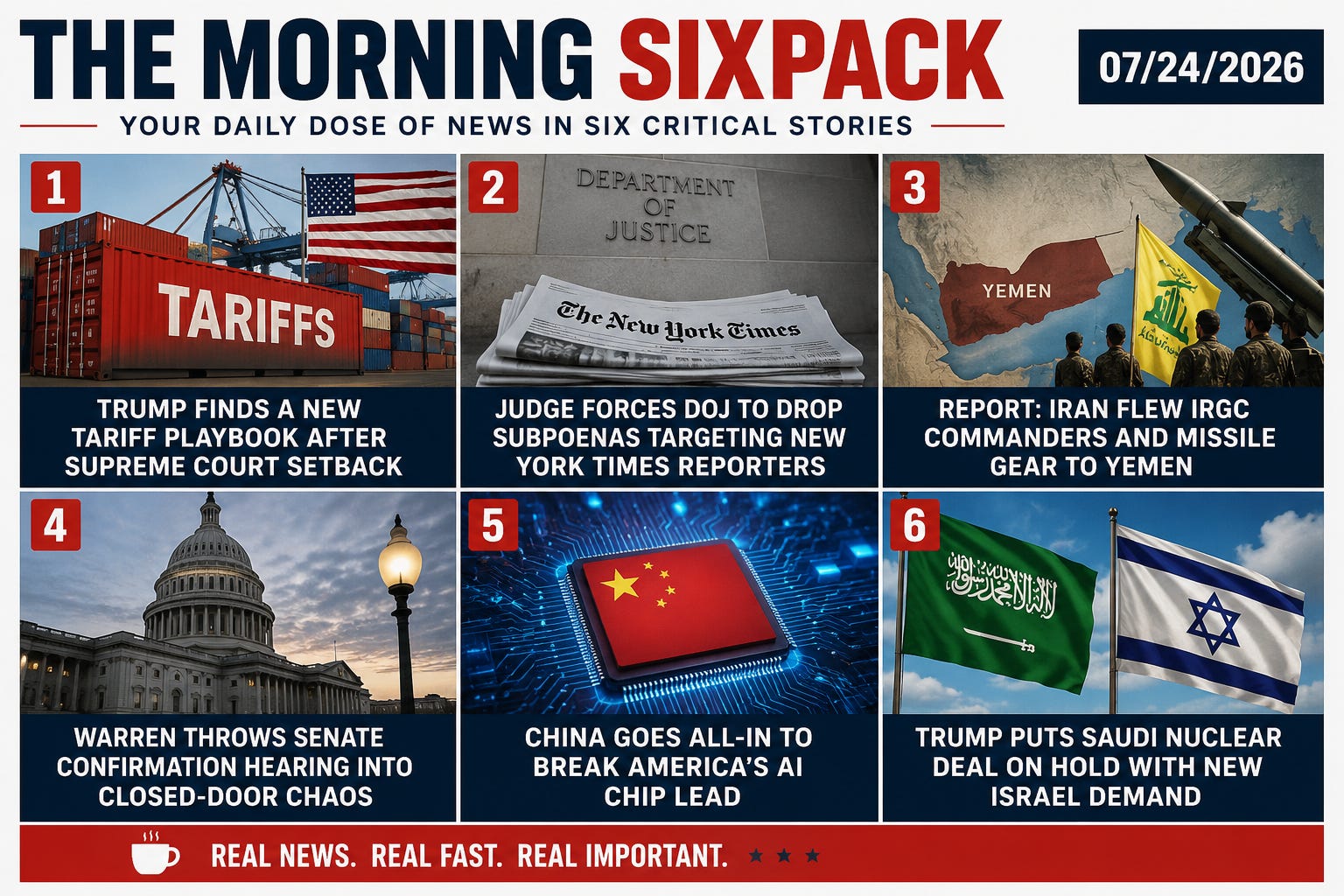
Trump found a new legal lane for tariffs after the Supreme Court closed the old one—and now 60 trading partners are paying attention.
Trump Finds a New Tariff Playbook After Supreme Court Setback
The Trump administration is rolling out new tariffs on imports from 60 trading partners by tying them to forced labor enforcement instead of the legal authority the Supreme Court rejected earlier this year.
It’s the same tariff strategy with a different legal wrapper—and the White House is betting it survives the next court fight.
The new import taxes range from 10% to 12.5% and cover countries responsible for roughly 99% of U.S. imports. Administration officials say the move is aimed at countries that have failed to adequately enforce bans on goods made with forced labor.1 Products such as oil, natural gas, fertilizer, and many USMCA-compliant goods are exempt—but not if you’re Canada.
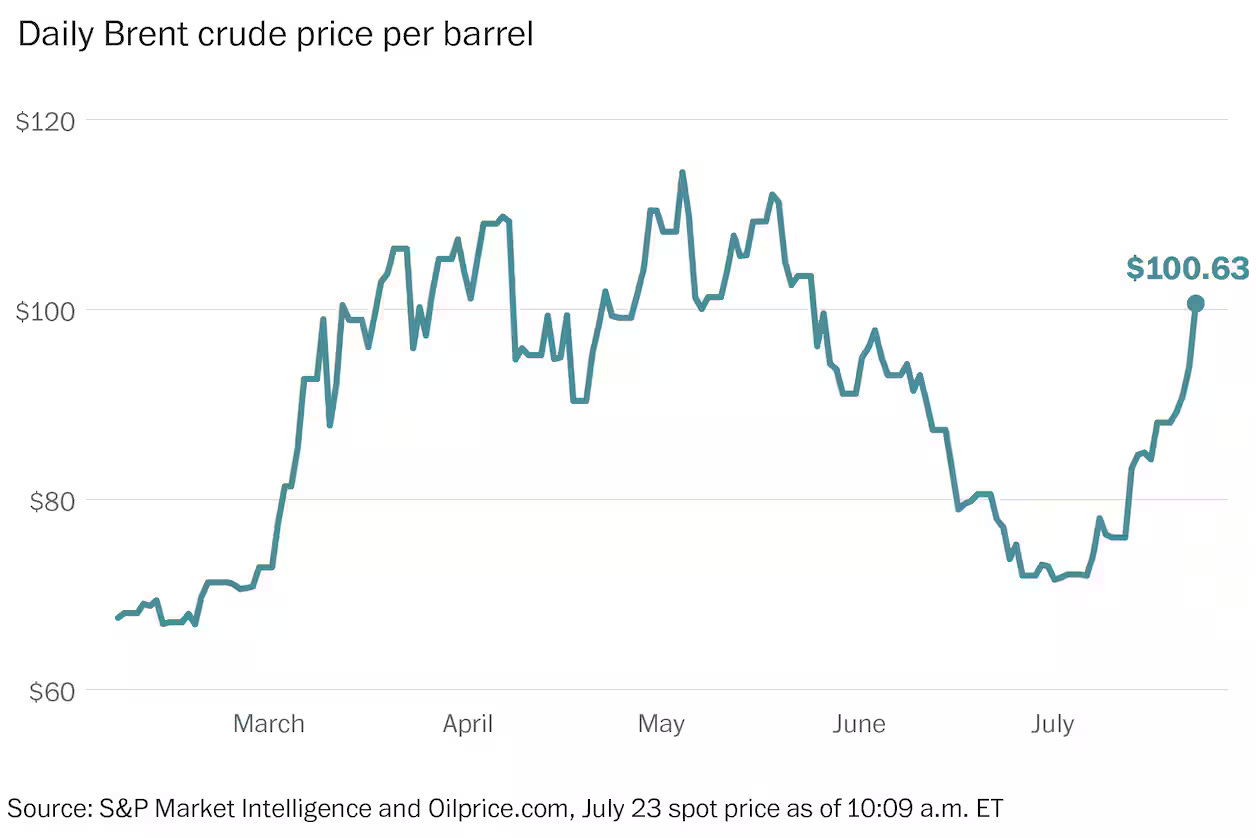
The bigger—and unreported—story is that Trump just handed all of us higher prices for nearly everything we buy. Trump’s tariffs and Trump’s war is not just driving up prices on oil and imports—it’s everything.
The administration is relying on Section 301 of the Trade Act of 19742 after the Supreme Court struck down Trump’s earlier global tariffs that had been imposed under emergency powers. That ruling forced the White House to find a different legal path if it wanted to keep broad tariffs in place.
“The United States has had a forced labor import ban for nearly a century, and rigorously enforces it; it’s well past time for our trading partners to do the same,” U.S. Trade Representative Jamieson Greer said.
Not everyone is buying the rationale. Several countries have criticized the tariffs as arbitrary, while some labor advocates question whether the forced labor justification is driving policy or simply providing legal cover for a broader trade agenda. Either way, expect more legal challenges—and more international pushback (and retaliation)—as this latest round of tariffs takes effect.
Source: Associated Press
Editor: Washington may have swapped the legal paperwork, but the economic debate didn’t change. Tariffs still have supporters, critics, and plenty of consumers who eventually see the bill. Any economist worth his salt will tell you that tariffs are taxes—and that many countries will find alternative trading partners, leaving the US without vital imports. It’s a fact, Jack!
A federal judge dismantled the Justice Department’s case against New York Times reporters—and the government folded before getting thrown out.
Judge Forces DOJ to Drop Subpoenas Targeting New York Times Reporters
The Justice Department abandoned its subpoenas seeking testimony and phone records from New York Times journalists after a federal judge made clear he would throw them out.
When the government’s legal arguments fell apart in open court, the subpoenas didn’t survive the afternoon.
The subpoenas were issued just two days after The New York Times published stories detailing security concerns surrounding President Trump’s use of a new Air Force One aircraft gifted by Qatar. Prosecutors argued they were investigating a national security leak, but U.S. District Judge Arun Subramanian repeatedly questioned why reporters were targeted so quickly instead of as a last resort.
The hearing quickly turned into a rough day for the Justice Department. Judge Subramanian challenged prosecutors over their legal reasoning, accused them of disregarding longstanding protections for journalists, and even threatened sanctions after pointing to misleading court filings and procedural mistakes. Prosecutors also admitted they mistakenly subpoenaed phone records belonging to a reporter’s wife, mother, and spouses because they relied on public databases.
“It’s a great day for the First Amendment and a great day for the rule of law,” New York Times attorney David McGraw said after the hearing.
The administration maintained the investigation into the leak will continue and criticized the judge’s handling of the case, insisting national security remains at stake. But the court made one thing clear: If the Justice Department hadn’t withdrawn the subpoenas, the judge was prepared to quash them himself.
Source: NPR
Editor: The First Amendment isn’t supposed to be optional paperwork. Courts exist for days exactly like this—when someone in power decides otherwise. And we all KNOW why the DOJ issued these subpoenas—they want to kill freedom of the press. They hate it.
Iran appears to be raising the stakes in the Red Sea by sending military personnel and missile expertise directly to its Houthi allies.
Report: Iran Flew IRGC Commanders and Missile Gear to Yemen
Iran secretly flew Revolutionary Guard commanders, military advisers, and missile- and drone-related equipment into Yemen this month, according to multiple sources familiar with the operation.
If confirmed, it’s another sign Tehran is investing more heavily in the Houthis as Red Sea tensions keep climbing.
According to Reuters, a July 13 Mahan Air flight carried between 10 and 21 Islamic Revolutionary Guard Corps personnel—including senior commanders—along with missile and drone components destined for Houthi-controlled territory. The aircraft was reportedly forced to divert from Sanaa to Hodeidah after Saudi-backed forces struck the airport. Sources also said Iran sent gold aboard the flight to help finance Houthi operations.
One Iranian source told Reuters, “The IRGC commanders travelled there to support Houthi operations and provide training on new missile systems.”
Iran has repeatedly denied providing the Houthis with missile capabilities, while a Houthi official who said he was aboard the flight dismissed the report as “lies and fabrications,” insisting all passengers were civilians. But Yemen’s information minister and a regional security analyst independently confirmed the reported transfers, saying the goal was to strengthen the Houthis’ ability to threaten shipping through the Red Sea and the Bab al-Mandab Strait. The report comes just days after the Houthis announced a naval blockade targeting Saudi Arabia and claimed attacks on Saudi oil tankers, marking a sharp escalation in the region.
Source: Reuters
Editor: Whether every detail proves accurate or not, the Red Sea is looking less like a shipping lane and more like a geopolitical pressure cooker. That’s bad news for global trade—and eventually, your wallet.
Elizabeth Warren hit the brakes on Trump nominees after raising concerns about FBI background checks—and one nomination never made it out of committee.
Warren Throws Senate Confirmation Hearing into Closed-Door Chaos
A Senate committee delayed consideration of three Trump nominees Thursday after Sen. Elizabeth Warren said FBI background checks raised “significant questions” that lawmakers hadn’t fully reviewed.
One nominee advanced, another advanced, and the third was left sitting on the sidelines after an unusual closed-door showdown.
The Senate Banking Committee abruptly suspended its public hearing after Warren requested a classified discussion with Chairman Tim Scott, saying members deserved more information before voting. Because the background checks involve confidential FBI material, Warren said she was limited in what she could discuss publicly.
After two closed sessions, the committee voted to advance Christopher Phelan for the Council of Economic Advisers and John Crews for the National Credit Union Administration along party-line votes. But lawmakers did not vote on Jeffrey Ledbetter’s nomination to become inspector general at the Department of Housing and Urban Development, leaving his confirmation in limbo.
“We should put off this markup until we have confidence that the FBI has run down all the answers,” Warren said.
Neither Warren nor committee Republicans disclosed what prompted the concern, and the FBI declined to comment on the confidential background investigations. The White House brushed aside the delay, saying it expects all of President Trump’s qualified nominees to be confirmed quickly.
Source: The Hill
Editor: Closed-door meetings are sometimes necessary. But when a confirmation hearing suddenly disappears behind closed doors, it usually means somebody found answers nobody was expecting.
China isn’t waiting for U.S. export controls to disappear—it’s throwing the full weight of the state behind building its own AI chip industry.
China Goes All-In to Break America’s AI Chip Lead
China has launched a government-backed campaign to build domestic AI chips capable of challenging U.S. technology, turning the race for artificial intelligence into a national priority.
Beijing’s message is simple: Build it at home—or risk falling behind for good.
According to The Wall Street Journal, Vice Premier Ding Xuexiang has spearheaded an aggressive effort to unite China’s top technology companies, research labs, and manufacturers to reduce the country’s dependence on American chipmakers. Officials have reportedly pushed major AI companies to adopt Chinese-made chips, with resistance viewed as undermining a strategic national goal.
Huawei has emerged as the centerpiece of that effort. The company says it has dramatically reduced China’s reliance on foreign AI chips over the past several years while developing workarounds that allow advanced processors to be built despite U.S. restrictions on cutting-edge manufacturing equipment. Chinese AI firms are increasingly using domestic hardware, although experts say China’s best chips still trail Nvidia’s top products by a significant margin.
“If the U.S. hadn’t forced our country, our company, and our industry into a corner, we would never have done something like this,” Huawei deputy chairman Eric Xu said.
Despite the progress, analysts caution that China still faces major hurdles, including limited manufacturing capacity and the challenge of matching the most advanced semiconductor technology available in the United States. But Beijing appears committed to playing the long game, betting that sustained government support and engineering talent can eventually close the gap in one of the world’s most important technological competitions.
Source: The Wall Street Journal (free)
Editor: Export controls may have slowed China’s sprint, but they also gave Beijing a reason to build its own track. That’s a competition that isn’t ending anytime soon.
Trump signed a Saudi nuclear deal—then added a major new condition the next day.
Trump Puts Saudi Nuclear Deal on Hold with New Israel Demand
President Trump says Saudi Arabia will only receive a U.S. civilian nuclear agreement if it agrees to normalize relations with Israel through the Abraham Accords.3
Adding that condition after the deal was signed suddenly threw one of the administration’s biggest Middle East agreements into doubt.
The agreement, announced a day earlier, would allow Saudi Arabia to develop civilian nuclear power using American technology. But Trump declared on social media that the pact is “totally subject” to the kingdom joining the Abraham Accords, reviving a diplomatic hurdle that had stalled similar negotiations in previous administrations.
“The Civil Nuclear Deal ... will be approved, but is totally subject to Saudi Arabia joining the very respected and successful Abraham Accords,” Trump wrote.
The new requirement complicates the agreement because Saudi Arabia has repeatedly insisted that normalizing relations with Israel depends on meaningful progress toward a Palestinian state—a prospect that has become even more difficult since the Gaza war. The deal is also facing scrutiny in Congress from lawmakers concerned that any pathway toward uranium enrichment could increase long-term nuclear proliferation risks, despite Trump’s insistence there will be “no enrichment of material.”
Source: The Washington Post
Editor: International agreements are hard enough before they’re signed. Changing the terms afterward tends to make the other side reach for the fine print—and maybe the exit.
The United States condemns—and at times penalizes through tariffs, sanctions, or import bans—forced labor abroad, even as the Thirteenth Amendment permits involuntary servitude “as a punishment for crime,” enabling compulsory prison labor at home. IOW forced labor. If you don’t comply, you are punished.
Section 301 of the Trade Act of 1974 is not a tariff schedule like Smoot–Hawley. Instead, it is a legal weapon the U.S. can use to re‑create Smoot–Hawley‑style tariff pressure whenever it wants—without rewriting the entire tariff code. Think of Smoot–Hawley as the original blunt-force tariff wall, and Section 301 as the modern scalpel that lets presidents selectively rebuild pieces of that wall on demand.
Their main weakness is that they did not resolve the Palestinian question. The Gaza conflict severely strained Arab public support and slowed expansion, although the participating governments did not formally sever relations. Kazakhstan joined the framework in November 2025 despite already having diplomatic ties with Israel; Saudi Arabia remains the most consequential potential entrant and continues to demand a pathway toward Palestinian statehood.