


There are stories that begin with money. There are stories that begin with politics.
This one begins with lettuce.
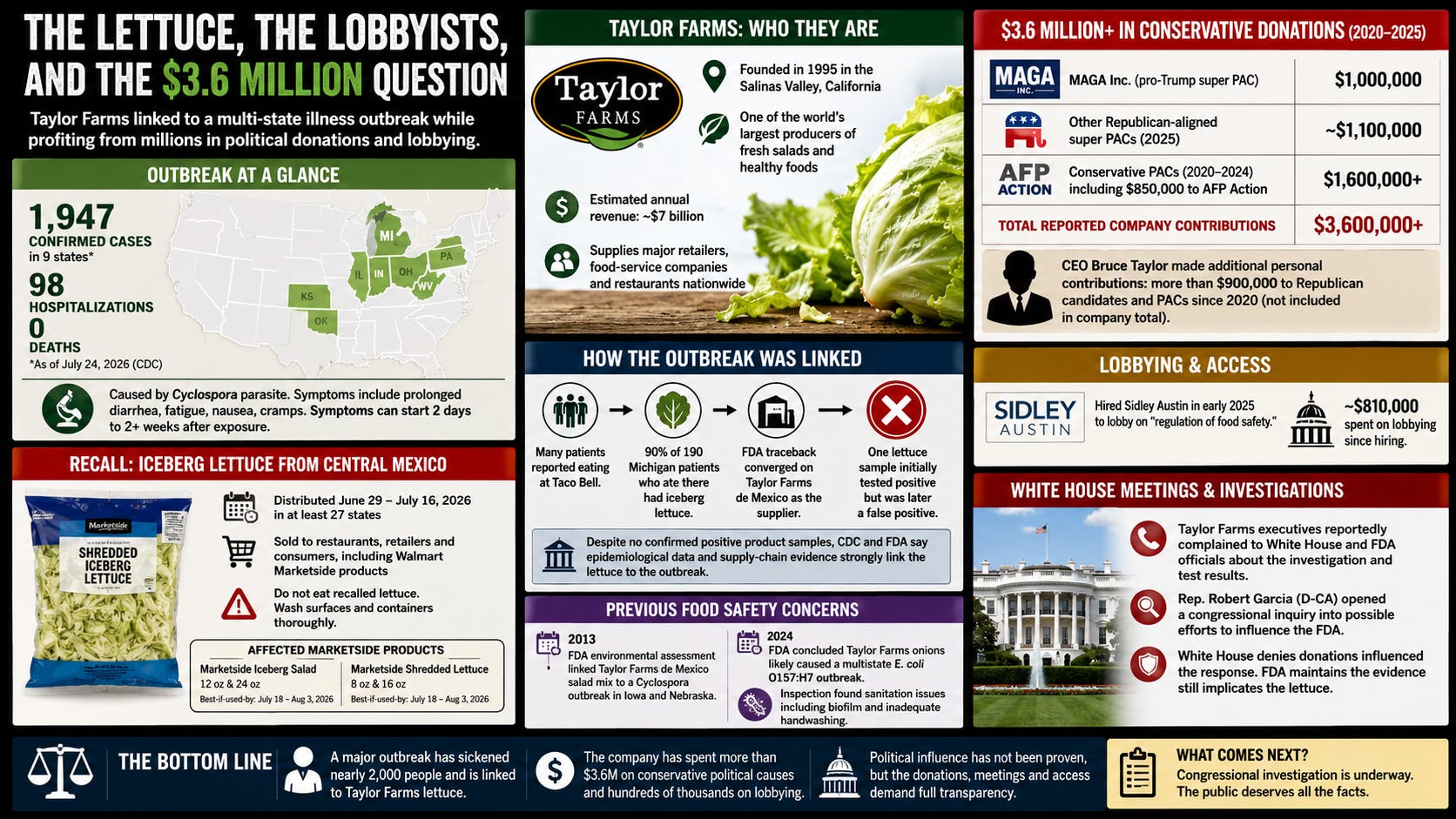
Shredded iceberg lettuce supplied by Taylor Farms de Mexico has been linked by federal health officials to a multistate outbreak of cyclosporiasis, a gastrointestinal illness caused by the microscopic Cyclospora parasite.
As of the Centers for Disease Control and Prevention’s July 24 update, the outbreak specifically linked to the lettuce included at least 1,947 confirmed illnesses in nine states, 98 hospitalizations, and no reported deaths. Taylor Farms recalled all iceberg lettuce it sourced from central Mexico, including certain Marketside products sold through Walmart and bulk products supplied to restaurants and food-service businesses. (CDC)
That is already a significant public-health story. Then the money entered the picture.
Federal Election Commission filings reviewed by WIRED show that Taylor Farms contributed more than $3.6 million to conservative political organizations between 2020 and 2025. That total included $1 million to MAGA Inc., the super PAC aligned with President Donald Trump, and another $1.1 million to Republican-oriented super PACs during 2025 alone. (WIRED)
The company also spent hundreds of thousands of dollars on federal lobbying—including lobbying connected to food-safety regulation. The owner of Taylor Farms, Bruce Taylor, also contributed nearly $1 million from his personal accounts to conservative entities.
None of that proves Taylor Farms purchased favorable treatment from the federal government. It does, however, produce one enormous, wilted credibility problem.
Here is the Morning Sixpack breakdown.
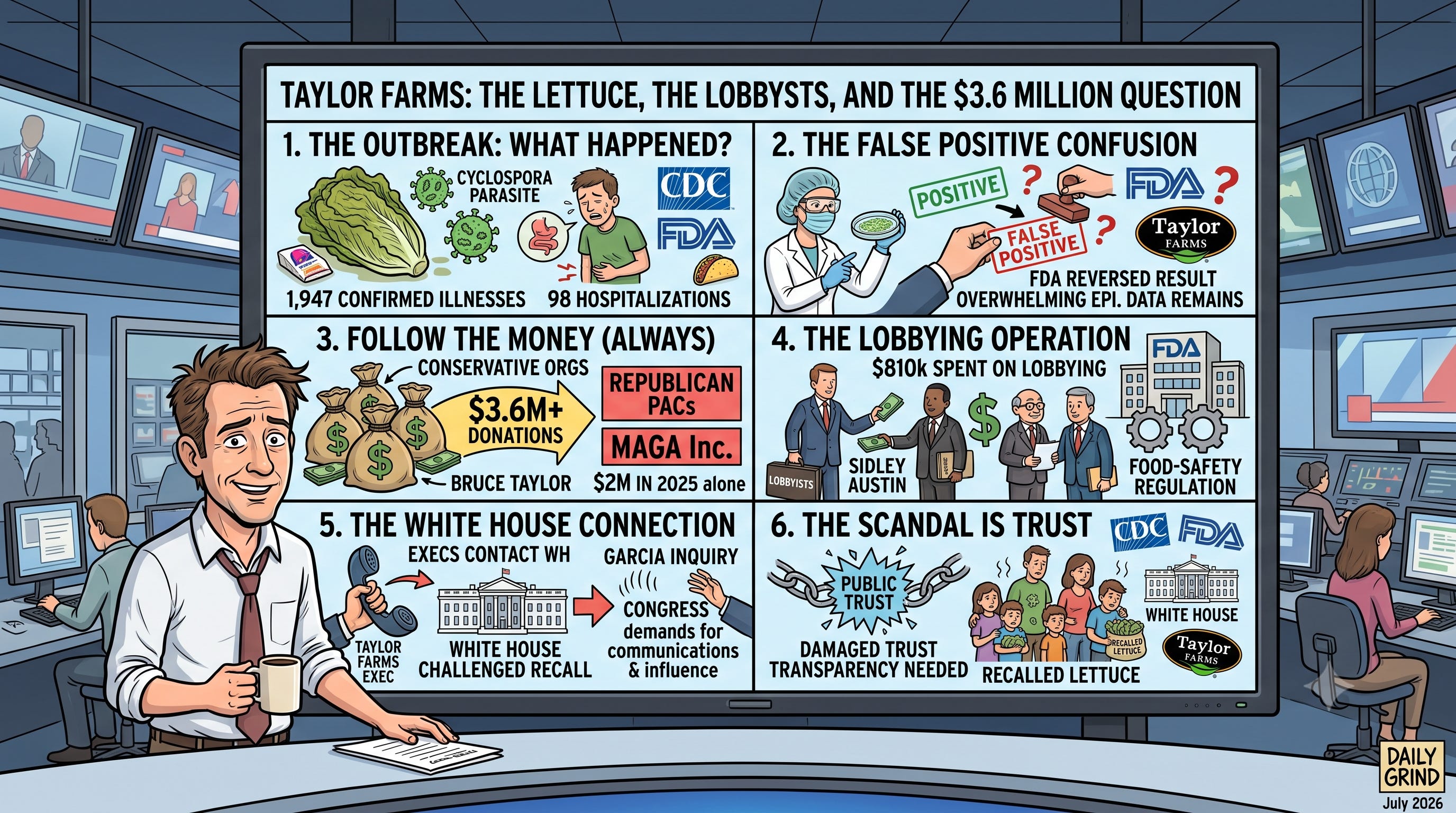
1. The outbreak: What happened?
Cyclospora is a parasite that can contaminate fresh produce through water or soil exposed to human fecal matter. It causes cyclosporiasis, an intestinal illness whose signature symptom is prolonged, watery diarrhea. Patients may also experience fatigue, nausea, loss of appetite, abdominal cramping, bloating, and weight loss.
Symptoms usually begin about one week after infection, although the incubation period can range from two days to two weeks or longer. Without treatment, symptoms may persist for weeks and can disappear and return. Routine stool testing does not always screen for Cyclospora, meaning patients may have to request a specific test. (CDC)
The initial investigation focused heavily on people who reported eating at Taco Bell restaurants (of course!) in Indiana, Kentucky, Michigan, Ohio, and West Virginia.
Michigan health officials reviewed detailed food histories from 190 patients who had eaten at Taco Bell. Ninety percent reported eating iceberg lettuce. Federal traceback investigators then followed the lettuce through the supply chain and found what the Food and Drug Administration called a convergence on a single supplier: Taylor Farms de Mexico. (U.S. Food and Drug Administration)
The investigation later expanded to include cases in Illinois, Kansas, Oklahoma, and Pennsylvania.
Taylor Farms initiated its recall on July 17. The recalled lettuce had been distributed in at least 27 states to consumers, restaurants, retailers, and food-service operations. Taco Bell said it stopped using lettuce from Taylor Farms de Mexico the same day. (CDC)
The company also temporarily suspended production at its central Mexico processing facility. That facility produced large bags of shredded iceberg lettuce distributed to Taco Bell, Sysco, and other major customers, according to Reuters. (Reuters)
The outbreak investigation remains open.
2. The laboratory test that wasn’t
This is where the story became confusing—and politically combustible.
On July 18, the FDA reported that a sample of lettuce supplied by Taylor Farms de Mexico had tested positive for Cyclospora.
The next day, the agency reversed itself.
FDA laboratory experts reviewed the data again and determined that the result did not represent true amplification of the parasite’s genetic material. The agency reclassified the finding as a false positive.
As of July 24, there were no confirmed positive Cyclospora results from product samples. (U.S. Food and Drug Administration)
Taylor Farms seized on that correction, emphasizing that no tested product had been confirmed positive.
That statement is true—but incomplete.
The FDA did not withdraw its broader conclusion about the outbreak. Instead, the agency said the false-positive correction did not change the “overwhelming epidemiological data” supporting the recall. Patient interviews and supply-chain records continued to point toward shredded iceberg lettuce from Taylor Farms and growers in central Mexico. (U.S. Food and Drug Administration)
In other words, there are two separate evidentiary questions.
Did investigators obtain a conclusive positive laboratory result from a retained lettuce sample? No.
Did the patterns of illness and the supply-chain traceback point toward Taylor Farms lettuce? According to both the CDC and FDA, yes.
That distinction matters. Contamination may be unevenly distributed across a shipment. By the time an outbreak is detected, the precise contaminated bags may have been eaten, discarded, or spoiled. Cyclospora is also notoriously difficult to detect in produce.
A missing positive sample does not automatically erase strong epidemiological evidence.
But the FDA’s premature announcement—and rapid retraction—gave Taylor Farms an opening to challenge the investigation and gave the public another reason to wonder what, exactly, was going on.
3. Follow the money (always)
Taylor Farms is not merely a lettuce company caught in an unfortunate news cycle.
It is also a substantial political spender.
According to WIRED’s review of public filings, Taylor Farms contributed more than $2 million to conservative political organizations in 2025. That included:
$1 million to MAGA Inc., the principal super PAC supporting Donald Trump.
Approximately $1.1 million to other super PACs devoted to electing Republican candidates.
Between 2020 and the end of 2024, the company contributed another $1.6 million-plus to conservative PACs, including $850,000 to AFP Action, a super PAC associated with the Koch political network and its anti-regulatory agenda. (WIRED)
The company’s chairman and CEO, Bruce Taylor, made additional personal contributions. WIRED found that Taylor had personally given more than $900,000 to Republican candidates and political committees since 2020. Those personal donations are separate from the company’s $3.6 million total. (WIRED)
Calling the $3.6 million a political “payment” would imply an established exchange that has not been proved. Calling it political spending or political contributions is more accurate. Still, $3.6 million purchases something even when it does not purchase a specific official act.
It purchases access. It purchases familiarity. It makes telephone calls more likely to be returned. And it can make every subsequent regulatory decision look suspicious—even when that decision is legitimate.
4. The lobbying operation
Taylor Farms’ political activity did not end with campaign contributions.
In early 2025, the company hired lobbyists from Sidley Austin to advocate on matters described in federal disclosure documents as involving the “regulation of food safety.”
WIRED reported that Taylor Farms had spent approximately $810,000 on lobbying efforts since hiring the firm. (WIRED)
That figure should not be folded into the $3.6 million in political contributions. The two categories are separate.
Campaign contributions support political committees and electoral activity. Lobbying expenditures pay professionals to advocate before government officials.
The disclosures also do not reveal every precise policy change Taylor Farms requested. Lobbying on “food-safety regulation” does not automatically mean lobbying against every food-safety rule.
But the timing and subject matter are relevant.
The company was spending heavily to influence the political environment while also employing lobbyists to discuss the rules governing its industry. Then its product became the focus of a large outbreak investigation.
That does not establish corruption. It does establish a public interest in knowing exactly what the company asked the government to do.
5. The White House connection
The political-spending story became substantially more serious when reports emerged that Taylor Farms executives had contacted the White House while the FDA was preparing or conducting its response.
Taylor Farms reportedly challenged the government’s evidence and handling of the recall. The company also complained to White House and FDA officials about the investigation and inspection process. Former FDA Commissioner Scott Gottlieb characterized an effort to obtain White House intervention in a recall dispute as outside the standard process. (The Guardian)
The top Democrat on the House Oversight Committee, Representative Robert Garcia of California, has now opened an inquiry.
Garcia is demanding communications between Taylor Farms, federal agencies, and the White House. His inquiry asks whether the company attempted to influence the FDA investigation, obscure its role, or mislead consumers.
The White House has rejected the allegation that Taylor Farms’ political contributions affected the government’s response. Taylor Farms says it acted quickly, removed potentially implicated products, suspended production at the central Mexico facility, and commissioned an independent review of its food-safety systems. (CBS News)
At this stage, there is no publicly available evidence establishing a quid pro quo.
There is no document saying: Taylor Farms donated money, and the administration therefore ordered the FDA to protect Taylor Farms.
There is no confirmed evidence that the false-positive correction was politically dictated rather than scientifically justified.
What exists is a concerning sequence:
A major corporate donor becomes the subject of a federal investigation.
Its executives gain access to senior administration officials.
The company challenges the regulator’s evidence.
The regulator corrects a significant laboratory claim.
The company highlights that correction while the regulator insists its broader case remains intact.
Then Congress begins asking whether political influence shaped the process.
Maybe every government decision was proper.
But this is precisely why regulatory systems need transparency. When the regulated company is also writing seven-figure checks to the president’s political operation, “trust us” is not enough.
6. The real scandal may be trust
There is a temptation to turn this into an easy story.
MAGA lettuce company sickens thousands, calls its political friends, and gets the investigation softened.
That version is satisfying. It is also ahead of the publicly established facts.
The more defensible story is less cinematic and more troubling.
America’s food-safety system depends on complicated coordination among companies, restaurants, local health departments, state laboratories, the CDC, and the FDA. Investigators must reconstruct what sick patients ate weeks earlier, identify common ingredients, trace those ingredients through enormous supply networks, and find contamination that may no longer exist in any testable package.
That system requires public trust.
Taylor Farms’ political spending did not create the outbreak. Its donations do not prove that it caused the FDA’s erroneous laboratory announcement. And the FDA’s false positive does not disprove the epidemiological evidence implicating the company’s lettuce.
But political money changes the context in which every decision is evaluated.
When a corporation gives $1 million to the president’s super PAC and later calls the president’s White House during a regulatory crisis, ordinary people are entitled to ask whether the corporation received access unavailable to a smaller business—or to the families who became sick.
The public is also entitled to know whether the administration gave Taylor Farms an opportunity to shape the government’s messaging before consumers received complete information.
Those questions cannot be answered through dueling press statements.
They require emails, meeting records, telephone logs, laboratory documentation, inspection reports, lobbying disclosures, and sworn testimony.
The Morning Sixpack bottom line
Three things can be true simultaneously.
First: Federal investigators have linked Taylor Farms de Mexico iceberg lettuce to an outbreak that caused nearly 2,000 confirmed illnesses in nine states. That link rests on patient interviews and traceback evidence, not a confirmed positive product sample. (CDC)
Second: Taylor Farms and its CEO have spent millions supporting Republican candidates and political organizations. The company contributed more than $3.6 million to conservative groups between 2020 and 2025, including $1 million to MAGA Inc. It also spent approximately $810,000 on lobbying efforts after hiring lobbyists to work on food-safety regulation. (WIRED)
Third: Political influence has not yet been proved. The donations, lobbying, and White House contacts justify investigation, but they are not by themselves evidence of a corrupt agreement.
The scandal we can already see is institutional.
A huge food supplier helped finance the political movement controlling the agencies responsible for regulating it. When a public-health emergency arrived, the company had a pathway into the White House—and the public received a confusing sequence of warnings, corrections, company statements, and disputed interpretations.
Maybe Taylor Farms received no special treatment.
The company and the administration should welcome the release of records proving it.
Until then, Americans are left with a recalled product, a parasite, a pile of political money, and a federal government asking for trust it has not yet earned.
What consumers should know
Do not eat recalled iceberg lettuce from Taylor Farms de Mexico. The recall includes multiple lots and package types distributed through restaurants, retailers, and food-service businesses in at least 27 states.
Certain affected retail products include Marketside Iceberg Salad in 12- and 24-ounce packages and Marketside Shredded Lettuce in 8- and 16-ounce packages, with specified July and August 2026 use-by dates.
Discard recalled lettuce or return it to the place of purchase. Wash containers, refrigerator shelves, utensils, and other surfaces that may have contacted it using hot, soapy water.
Anyone experiencing persistent watery diarrhea, fatigue, appetite loss, or other symptoms after eating iceberg lettuce should contact a healthcare provider and mention possible Cyclospora exposure. Patients may need to request a Cyclospora-specific test. (CDC)
This remains an active investigation. The outbreak-specific figures in this report reflect the CDC’s July 24, 2026 update.
The Morning Sixpack stays free because the news that shapes your life should not be hidden behind a paywall. Paid subscribers are not paying for access. They are helping fund the research, writing, and independent voice that goes into every issue. Become a paid subscriber and help keep smart, honest news analysis free for everyone.