



The Morning Sixpack stays free because the news that shapes your life should not be hidden behind a paywall. Paid subscribers are not paying for access. They are helping fund the research, writing, and independent voice that goes into every issue. Become a paid subscriber and help keep smart, honest news analysis free for everyone.
Tennessee Gave Christa Pike Two Lethal Injection Doses. She Survived.
Tennessee tried to execute Christa Pike, gave her two doses of pentobarbital, and wound up sending her to the hospital alive—a result that raises some fairly obvious questions about the state’s “established” execution protocol.
Christa Gail Pike was supposed to become the first woman executed by Tennessee in more than 200 years. Instead, after two doses of pentobarbital failed to kill her, the 50-year-old death row prisoner was transported to a hospital with her heart still beating. Pike was convicted and sentenced to death for the brutal 1995 torture and murder of 19-year-old Colleen Slemmer, a crime Pike committed when she was 18.
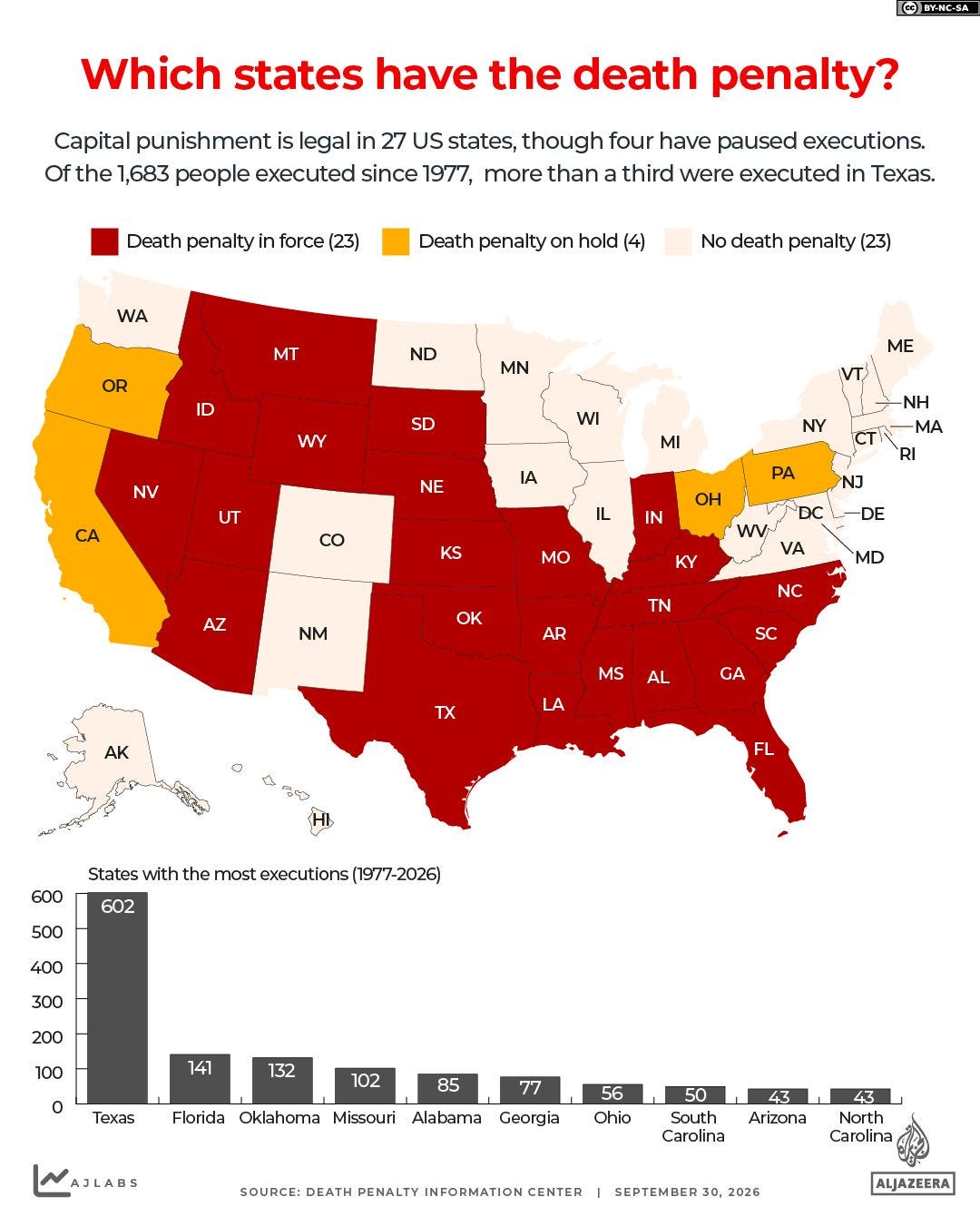
When the state sets out to kill someone and instead has to provide emergency medical care to keep that person alive, “execution protocol” starts sounding like a pretty generous description.
Media witnesses said Pike appeared awake after the injections, then began snoring loudly and gasping. AP journalist Kim Chandler reported that Pike could still be heard “loudly snoring, clearly very alive” until witnesses were removed from the area. Her lawyers filed an emergency motion during the procedure, saying: “Ms Pike has not lost consciousness and still has a heartbeat and is audibly snoring.” Tennessee officials had not explained exactly why the drugs failed.
Human rights lawyer Clive Stafford Smith offered two possible explanations: problems with the execution drugs or difficulty properly accessing Pike’s veins. Tennessee’s Department of Correction defended its actions, saying it had “followed every step of the state’s lawful, established execution protocol approved by the Attorney General’s Office.” The fallout was immediate: Gov. Bill Lee paused Tennessee’s remaining 2026 executions and ordered a comprehensive third-party review.
Research cited by Al Jazeera found that 276 of 8,776 U.S. executions between 1890 and 2010 were considered botched in some way, with lethal injection recording the highest failure rate among the methods studied at 7.2 percent. Pike’s case now adds an extraordinary chapter: Tennessee fought through the courts for permission to execute her, administered its prescribed drugs—and ended the night transporting her to a medical facility.
Editor: The state insisted it followed the protocol exactly. Pike being alive in a hospital is one hell of a performance review for the protocol.
Source: Al Jazeera
Cornell Rape Case Takes New Turn as Records Reveal What Happened Before Jane Doe Went to Police
A Cornell student’s own messages and later statements show her understanding of an alleged 2024 sexual assault changed over several weeks—but the bigger institutional question is why prosecutors apparently never received a police interview in which she explicitly said she was raped.
Newly reported records from Cornell University’s Title IX investigation trace how a former student went from initially telling friends about sex with multiple men without calling it rape to later declaring that much of what happened was nonconsensual—all while questions mount over what evidence prosecutors actually received. The documents, obtained by The New York Times and described by CNN, include texts, interviews, photographs and other records surrounding the alleged October 2024 assault at Cornell’s Chi Phi fraternity house.
Nearly two years later, everyone is still trying to figure out who had which documents in a case where the documents were rather important.
According to the records, Jane Doe initially told roommates she had used ketamine and had sex with multiple men but did not describe herself as having been raped. She even reportedly reassured one accused man afterward that “none of the sexual stuff was illegal.” Friends, however, described her as shocked and still processing what happened. By November 3, her language had changed dramatically: “Let’s be clear that 90% of what happened that night was not consensual. I was given more key than I can remember.” She later preserved her dress as potential evidence, photographed bruises and requested a rape kit. Her attorney said the progression reflected trauma, denial and shame.
Her statements to police included allegations that she was heavily intoxicated, repeatedly uncomfortable, physically struck and pressured into sexual activity. “To me that felt like coercion,” she said in a signed six-page statement. A separate transcript reportedly contains an even more direct declaration: “I can say with 100% confidence I was raped.” Tompkins County District Attorney Matthew Van Houten told CNN his office never received that transcript before deciding against criminal charges. Cornell, meanwhile, said it shared “all investigatory information” with prosecutors. The DA said his office would investigate the newly reported statements fully.
The questions have now moved beyond what allegedly happened inside the fraternity house to how the case was handled afterward. Cornell agreed to an outside investigation into whether the university fulfilled its obligations, while Ithaca’s mayor asked the school to consider involving city police whenever sexual assaults are reported on campus. Cornell closed the Chi Phi chapter in 2024, and the fraternity said the accused members were removed.
Editor: Whatever investigators ultimately determine about the allegations, “we gave prosecutors everything” and “we never got the interview where she explicitly alleged rape” cannot both comfortably occupy the same filing cabinet.
Source: CNN
Hegseth Targets the Pentagon’s “Woke” Culture—and Brings Elon Musk Back for the Future of War
Pete Hegseth used his State of the Force address to promise a military with fewer “politically correct” generals, attack what he calls a “woke” Pentagon culture and bring Elon Musk back into government to help study the future of warfare.
Defense Secretary Pete Hegseth used a sweeping address to argue that the U.S. military needs top-performing leaders rather than “politically correct generals,” while defending personnel and policy changes aimed at reshaping the armed forces. He said generals who “clung to the woke department” or failed to respect civilian control no longer worked there. His tenure has included barring transgender people from serving, rolling back diversity programs, reviewing ground combat units with female troops and introducing screening for testosterone deficiency among male personnel.
Apparently the Pentagon’s new battle plan includes culture wars, testosterone tests and Elon Musk back in the government group chat.
The changes have drawn sharp criticism from Democrats. Sen. Jack Reed said Americans should be “alarmed” and accused Hegseth of damaging the military through partisan actions and removing accomplished senior officers without adequate explanations. Sen. Mark Kelly said: “The US military doesn’t need more testosterone, it needs better leadership at this point.” Hegseth, meanwhile, attacked media scrutiny of military conditions and the war in Iran, rejecting reports of poor morale and calling journalists scrutinizing the war “anti-American losers in our media.”
Hegseth also pushed back against reports about conditions aboard the USS Abraham Lincoln after eight sailors reportedly attempted to end their own lives. The carrier had docked in Thailand after a record 286 days at sea. Hegseth dismissed what he called “disingenuous headlines about deployment lengths” and “patently false claims of low troop morale.”
Then came Musk. Hegseth announced that Elon Musk would work with Anduril chief Palmer Luckey and former Republican House Speaker Newt Gingrich on Project Meridian, a Pentagon effort examining the future of warfare. The appointment marks Musk’s return to a government role after his earlier stint with the Department of Government Efficiency.
Editor: Putting Musk, a defense-tech billionaire, and Newt Gingrich together to contemplate the future of warfare certainly answers one question: apparently the Pentagon decided the brainstorming session needed more personalities.
Source: The Telegraph
Treasury Yields Hit 24-Year High as the Bond Market Sends a Very Expensive Message
The 10-year Treasury yield just climbed above 5.33%, its highest level since 2002, meaning Wall Street’s bond problem is rapidly becoming everybody-with-a-mortgage-or-credit-card’s problem.
The benchmark 10-year U.S. Treasury yield surged to 5.3338% Thursday, reaching its highest level since April 2002 as a global bond sell-off pushed government borrowing costs sharply higher. The 30-year yield jumped to 5.6702%, its highest since July 2002, while the two-year yield climbed to 4.91%. That 10-year number matters far beyond Wall Street because it influences borrowing costs including mortgages, auto loans and credit-card debt.
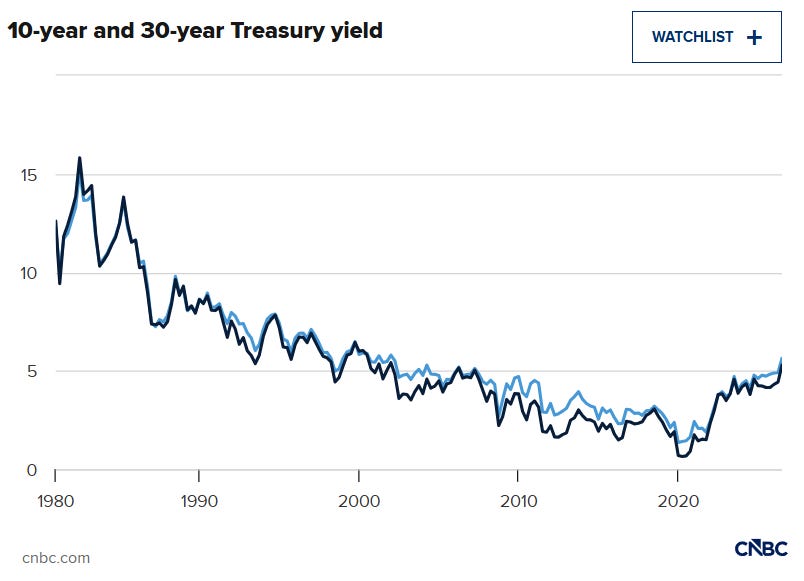
Twenty-four-year-high interest rates have a funny way of turning an abstract conversation about bond markets into a monthly-payment problem.
The sell-off isn’t confined to the United States. Government borrowing costs were rising around the world as investors contended with persistent inflation, higher interest rates and concern about political inaction on fiscal deficits. Treasury yields have also become increasingly sensitive to oil prices as the U.S.-Israel war with Iran disrupts Middle Eastern crude exports. Brent crude moved back above $100 a barrel Thursday, adding another dose of inflation anxiety to an already nervous bond market.
Nomi Prins, founder of Prinsights Global, told CNBC that higher yields could eventually attract buyers and push rates back down. But she said volatility at the long end of the Treasury curve remains closely connected to “what’s going on with oil, what’s going on with inflation.” Prins also said sovereign wealth funds and central banks—traditionally major long-term holders of Treasury debt—were unlikely to provide that buying. A significant decline in oil prices or a resolution in the Middle East could help bring yields lower, she said.
For consumers, the important part is considerably less complicated: benchmark rates sitting at levels unseen since 2002 mean expensive borrowing conditions can spread well beyond the bond market. Mortgages, auto financing and other debt all feel the gravitational pull of Treasury yields.
Editor: The bond market has discovered a remarkably effective way to get everyone’s attention—put 5.33% on the scoreboard and watch the mortgage calculators come out.
Source: CNBC
Kristi Noem Files for Divorce After 34 Years of Marriage
Former Homeland Security Secretary Kristi Noem has filed to end her 34-year marriage to Bryon Noem, citing “irreconcilable differences” after a turbulent stretch that included public questions about her relationship with adviser Corey Lewandowski—allegations Noem denied as “tabloid garbage.”
Former Homeland Security Secretary Kristi Noem has filed for divorce from her husband, Bryon Noem, ending a 34-year marriage that spanned her rise from South Dakota politics to Donald Trump’s Cabinet. The complaint was filed in April in Hamlin County, South Dakota, and posted online this week. It cites “irreconcilable differences” as the reason for the divorce. The couple married in May 1992 and have three children.
Thirty-four years, three kids, a governorship, a Cabinet job and one particularly messy trip through Washington later, the Noems are calling it quits.
The filing follows scrutiny over Noem’s relationship with Corey Lewandowski, a longtime Trump adviser who served as a special government employee and one of her lead advisers at Homeland Security. Members of Congress questioned Noem about allegations of an extramarital affair shortly before she left the department. Noem denied the allegations, calling them “tabloid garbage.” The divorce complaint cites irreconcilable differences and does not establish that an affair occurred.
The divorce also follows a dramatic change in Noem’s political circumstances. She served as Homeland Security secretary from January 2025 until March 2026, when Trump removed her from the Cabinet amid controversies over immigration enforcement, her statements following the shooting deaths of two protesters in Minneapolis and criticism from fellow Republicans over departmental spending. Trump replaced her with then-Sen. Markwayne Mullin and later made Noem special envoy for the Shield of the Americas.
Noem’s attorney said she would reserve further comment for the legal process. Bryon Noem’s attorney said his client is “saddened that the marriage is ending” and that his priority is protecting the family and moving forward as parents and grandparents.
Editor: Washington has produced plenty of career changes, staff shakeups and irreconcilable differences. This one just happens to require a divorce lawyer.
Source: AP News
What’s the Opposite of Brexit? Starmer Wants Britain Back at the Heart of Europe
Keir Starmer’s government proposed legislation making closer EU cooperation easier without actually undoing Brexit—which sounds a bit like keeping the divorce but renegotiating who gets the Netflix password.
Prime Minister Keir Starmer’s government unveiled a European Partnership Bill designed to make it easier for Britain to implement current and future agreements with the European Union, putting closer economic ties with Europe near the center of his agenda. The legislation was intended to help implement agreements covering areas including food and drink, emissions trading and electricity, while preserving parliamentary oversight over new treaties and the application of EU law in Britain.
Britain wasn’t rejoining the EU, but it was increasingly behaving like someone who had started texting the ex again.
Starmer was careful to preserve some very large Brexit guardrails. His government said Britain would not rejoin the EU single market or customs union and would not restore freedom of movement. At the same time, it argued that aligning with EU rules in certain industries could remove trade barriers and spur economic growth. The proposed legislation would give the government powers to put existing and future agreements into effect.
There was also a considerable political calculation behind the proposal. Starmer was under pressure from some lawmakers after Labour suffered heavy losses in Scottish, Welsh and English local elections. Rather than retreat from his European strategy, he made rebuilding the relationship with the EU central to his economic agenda, writing that Britain needed a new direction that meant “putting Britain at the heart of Europe.”
It didn’t amount to reversing Brexit, but it represented a deliberate attempt to reduce some of the economic friction between Britain and the EU without reopening the entire membership argument. The political challenge was explaining how Britain could move closer to Brussels while keeping Starmer’s promises on the single market, customs union and freedom of movement.
Editor: Brexit was still Brexit. It just came with regulatory alignment, new agreements and a European Partnership Bill. Please refrain from calling that dating again.
Source: Reuters