


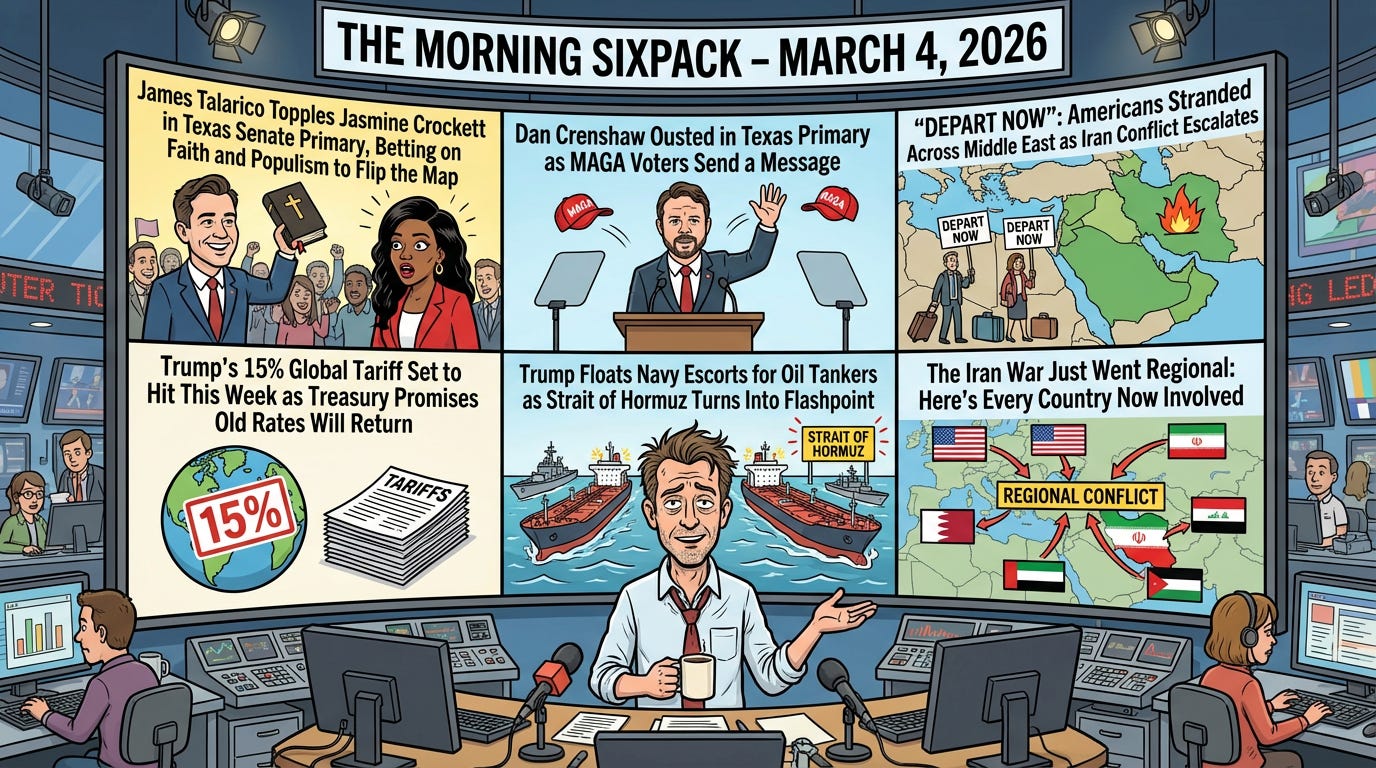
James Talarico Topples Jasmine Crockett in Texas Senate Primary, Betting on Faith and Populism to Flip the Map
State Rep. James Talarico beat U.S. Rep. Jasmine Crockett in Texas’ fiercest Democratic Senate primary in decades, riding a faith-fueled populist message to a decisive win.
After years of coming up short statewide, Texas Democrats just chose a preacher-politician promising a “politics of love” over partisan warfare.
Talarico, the Austin Democrat who built his campaign around a “top-versus-bottom” economic message rooted in his Christian faith, defeated Crockett in a race that doubled as a referendum on the party’s future. “This is a people-powered movement to take on this broken, corrupt political system,” Talarico told supporters after midnight. “Tonight, the people of our state gave this country a little bit of hope, and a little bit of hope is a dangerous thing.”
Crockett, never one to back down, quickly conceded and urged unity. “Texas is primed to turn blue and we must remain united because this is bigger than any one person,” she said, pledging to rally behind the nominee. The primary drew more than 1.5 million early voters—more than double the last midterm cycle—proving Democrats are still hungry, even if they haven’t won a Senate seat here since 1988.
The race wasn’t just about policy—there was little daylight there—it was about tone, identity, and electability. Crockett leaned into confrontation, arguing she was best positioned to take the fight straight to Republicans. (Editor: She was right.) Talarico campaigned in deep-red counties, courted Latino voters aggressively and preached coalition-building. Outside groups flooded the airwaves, with Talarico and his allies outspending Crockett by wide margins. Meanwhile, Republicans openly rooted for Crockett, telegraphing how they’d attack Talarico as “too radical for Texas” the minute the dust settled.
Now Democrats are staring at a general election that could pit Talarico against either Sen. John Cornyn or Attorney General Ken Paxton, who are headed to a May runoff. Texas isn’t on the national party’s top Senate target list—but state Democrats smell opportunity in Republican infighting and Trump-era backlash. They’ve smelled it before. This time, they’re betting on a Sunday school teacher with a viral moment and a message about love to do what no Democrat has done in nearly four decades.
Source: The Texas Tribune
Editor: Texas Democrats just rolled the dice on kumbaya in a state that hasn’t exactly been humming along. If it works, it’s a blueprint. If it doesn’t, expect the circular firing squad to reconvene by Thanksgiving.
My take? Texas won’t be turning blue. Texans can get from ANY candidate what Talarico is selling. Why buy a Ford when your whole family is all about Chevy?
Dan Crenshaw Ousted in Texas Primary as MAGA Voters Send a Message
Rep. Dan Crenshaw became the first House incumbent to lose a 2026 primary, falling to state Rep. Steve Toth in a decisive rebuke from Texas Republicans.
The former Navy SEAL who once looked like the GOP’s future just got steamrolled by its present.
With about 77% of the vote counted, Toth led Crenshaw 57% to 39%, according to the Associated Press projection. Toth—who brands himself a “true conservative” and once pastored at a Texas megachurch—ran to Crenshaw’s right and secured backing from Turning Point USA. President Trump notably did not endorse Crenshaw, a silence that spoke volumes in today’s GOP.
Crenshaw, who represents a Houston-area district that was redrawn before the election, spent years defending his MAGA credentials. But he didn’t vote to overturn the 2020 election and was openly critical of the Jan. 6 Capitol riot—positions that fueled doubts about his loyalty among the party’s most fervent activists. He also made enemies inside the House Freedom Caucus and online, where conservative influencers and even Tucker Carlson mocked him as “eyepatch McCain.”
The loss marks a stunning fall for a lawmaker who rocketed to fame before even being sworn in, brushing off an SNL skit about his war injury and later appearing on the show himself. But in today’s Republican Party, independence can look like heresy. Days before the vote, Sen. Ted Cruz backed Toth, a move that followed Crenshaw’s vote against Cruz’s ROTOR Act aviation bill.
Crenshaw’s defeat comes as other Texas Republicans head to runoffs, including Sen. John Cornyn, who faces Attorney General Ken Paxton in a bruising battle for the Senate nomination. The message from Tuesday night is clear: in Texas, the center of gravity in the GOP hasn’t just shifted—it’s hardened.
Source: The Wall Street Journal
Editor: When you’re getting flak from Tucker Carlson and silence from Trump, you’re not straddling the middle—you’re standing alone. Texas Republicans just decided that wasn’t good enough.
“DEPART NOW”: Americans Stranded Across Middle East as Iran Conflict Escalates
The State Department is urging Americans in 14 Middle Eastern countries to leave immediately—even as flights are canceled, airports are shuttered, and hundreds of thousands are stuck.
Telling people to “DEPART NOW” when the runway lights are off is not a strategy—it’s a warning flare.
Assistant Secretary of State Mora Namdar issued the blunt advisory Monday, telling U.S. citizens in Bahrain, Egypt, Iran, Iraq, Israel, the West Bank, Gaza, Jordan, Kuwait, Lebanon, Oman, Qatar, Saudi Arabia, Syria, the UAE and Yemen to leave “using available commercial transportation, due to serious safety risks.” The problem: commercial transportation is vanishing fast. More than 12,300 flights have been canceled across seven major Middle East airports since the weekend, according to Flightradar24, with major airlines suspending service and some airports pausing operations altogether.
The scramble comes after U.S. and Israeli forces launched sweeping strikes across Iran, including a strike that killed Iran’s supreme leader, Ayatollah Ali Khamenei. Iran has retaliated with missile attacks targeting Israeli and U.S. military facilities. The U.S. embassy in Saudi Arabia was hit by two drones, causing minor damage, while the embassy in Kuwait has closed “until further notice.” In Israel, Ambassador Mike Huckabee described exit options as “fairly limited,” with Americans told to shelter in place as airports remain closed.
Retired U.S. Army Maj. Gen. Randy Manner, stranded in Dubai, voiced what many are thinking:
“It feels a little bit disheartening to feel abandoned by our own government.” He noted that while the British government is arranging military evacuation flights, Americans are still waiting for clarity.
State Department officials now say they are “actively securing military aircraft and charter flights” and have contacted nearly 3,000 Americans seeking assistance.
An estimated 500,000 to 1 million U.S. citizens live in the Middle East. Many are now sheltering in place, watching a conflict that officials warn could last four to five weeks. (Editor: It will be much longer.) Secretary of State Marco Rubio has said the “hardest hits” are still ahead. Casualty numbers are already climbing: six U.S. service members killed, 18 seriously wounded; hundreds reported dead in Iran; dozens in Lebanon and Israel.
Washington’s message is urgent. The logistics are messy. And for Americans trying to get home, hope is boarding standby.
Source: The Guardian
Editor: If your evacuation plan depends on commercial flights that no longer exist, you don’t have a plan—you have a press release.
Trump’s 15% Global Tariff Set to Hit This Week as Treasury Promises Old Rates Will Return
Treasury Secretary Scott Bessent says President Trump’s long-promised 15% global tariff will finally kick in this week—after lingering at 10% despite White House claims it was already in effect.
The tariff was “effective immediately”—except it wasn’t.
In a CNBC “Squawk Box” interview, Bessent said the higher 15% rate is “likely sometime this week,” closing the gap between the president’s announcement and the actual 10% rate that took effect after the Supreme Court struck down Trump’s earlier, broader tariffs. The administration pivoted within hours of that 6-3 ruling, shifting to a different legal authority to keep the duties alive.
The Supreme Court ruled on Feb. 20 that Trump overstepped by using the International Emergency Economic Powers Act to impose sweeping tariffs without Congress. In response, Trump signed a new executive order invoking Section 122 of the Trade Act of 1974 to implement a 10% global tariff—then publicly said he would raise it to 15%. Markets heard 15%. Customs collected 10%.
Bessent insists this is a temporary bridge. Section 122 tariffs can last only 150 days unless Congress extends them. During that window, the U.S. Trade Representative and Commerce Department will conduct studies to justify reinstating broader duties under more durable trade laws. “It’s my strong belief that the tariff rates will be back to their old rate within five months,” Bessent said. “They are more slow-moving, but they are more robust.”
Translation: higher tariffs now, legal cleanup later. Businesses get another jolt of uncertainty, Congress gets sidelined again—for the moment—and the administration buys time to rebuild its trade wall on sturdier statutory ground.
Source: CNBC
Editor: If you’re a U.S. importer, keep your calculator handy. The only thing moving faster than the tariff rate is the legal theory behind it.
Trump Floats Navy Escorts for Oil Tankers as Strait of Hormuz Turns Into Flashpoint
President Trump says the U.S. Navy could begin escorting oil tankers through the Strait of Hormuz and ordered federal backing for maritime insurance as crude prices surge amid war with Iran.
When one-fifth of the world’s oil moves through a single chokepoint, even a rumor of closure can light up gas station signs back home.
With fighting between U.S.-Israeli forces and Iran disrupting tanker traffic, Trump vowed to ensure “the free flow of energy to the world,” signaling one of his most aggressive interventions yet to contain spiking fuel costs. Oil shipments have been largely blocked through the Strait of Hormuz—the narrow passage between Iran and Oman that handles roughly 20% of global crude flows—with damaged tankers, stranded vessels and insurers pulling back coverage.
The White House is leaning on both military and financial muscle. Trump said he directed the U.S. International Development Finance Corporation to provide political risk insurance and financial guarantees to keep maritime trade moving. War-risk premiums have already jumped, and some insurers have scaled back or withdrawn coverage altogether. As of Monday, the U.S. Navy had 12 warships in the region, including an aircraft carrier—but some are already engaged in strikes and missile defense, limiting escort capacity.
History offers precedent. During the Iran-Iraq “Tanker War” of the 1980s, Washington reflagged vessels and provided naval escorts when insurers fled. After 9/11, the U.S. stepped in with temporary insurance policies to stabilize shipping markets. Still, analysts warn that escorts and backstops may not be enough if missiles keep flying. “The attacks could still take place,” said Rohit Rathod of Vortexa, suggesting some operators may try cutting side deals for safe passage.
Trump acknowledged Americans may have to tolerate higher oil prices briefly, but promised they would fall “lower than even before” once the conflict ends. Behind the scenes, Treasury Secretary Scott Bessent and Energy Secretary Chris Wright were expected to present additional proposals, including the possibility—still politically sensitive—of tapping the Strategic Petroleum Reserve if prices keep climbing.
For now, the message is clear: keep the oil flowing, whatever it takes. The question is whether a handful of destroyers and a government insurance policy can outpace geopolitics in a narrow strip of water that moves the global economy.
Source: Reuters
Editor: Gas prices are the one foreign policy briefing every voter understands. If Hormuz sneezes, Washington reaches for the Navy—and the credit card.
The Iran War Just Went Regional: Here’s Every Country Now Involved
What began as U.S.-Israeli strikes on Iran has exploded into a multi-country conflict stretching from the Gulf to Europe.
This isn’t a two-nation fight anymore—it’s a regional powder keg with global consequences.
Since U.S. strikes began Saturday targeting Iran’s nuclear program, missile arsenal and proxy networks, Tehran has retaliated across the Middle East. Israel coordinated the initial assault, which killed Supreme Leader Ali Khamenei and dozens of senior Iranian officials. At least six U.S. service members have died since the fighting began, and American bases across the region have come under fire.
Iran has launched attacks against U.S. facilities in Saudi Arabia, Oman, Jordan and Bahrain, while striking targets in the United Arab Emirates and Qatar. In the UAE, drones hit sites in Dubai and Jebel Ali Port. Qatar suspended most natural gas production after strikes on energy facilities. Kuwait was hit early, with U.S. officials saying American jets were mistakenly downed by friendly fire. Meanwhile, the Strait-adjacent region is bracing for broader economic fallout as oil infrastructure and shipping lanes face mounting threats.
The conflict has widened further. In Lebanon, Hezbollah entered the fight on Iran’s side, launching missiles at Israel and drawing heavy Israeli airstrikes and a ground incursion. Pro-Iranian militias in Iraq attacked U.S. bases, and unrest flared near the U.S. embassy in Baghdad. Even Cyprus was pulled in after drones struck a British Royal Air Force base at Akrotiri, prompting the U.K. to authorize U.S. use of its bases and dispatch naval assets. France and Germany, initially urging diplomacy, are now reassessing after Iranian strikes hit European personnel.
U.S. embassies remain on high alert across the region, with the State Department urging Americans to leave immediately. What started as an effort to cripple Tehran’s capabilities has morphed into a sprawling regional confrontation involving the U.S., Israel, multiple Gulf states, Iran-backed militias and European powers. The map keeps expanding—and so does the risk.
Source: Axios
Editor: When Cyprus is taking drone fire and Qatar is shutting down gas fields, you’re no longer managing escalation—you’re chasing it.