


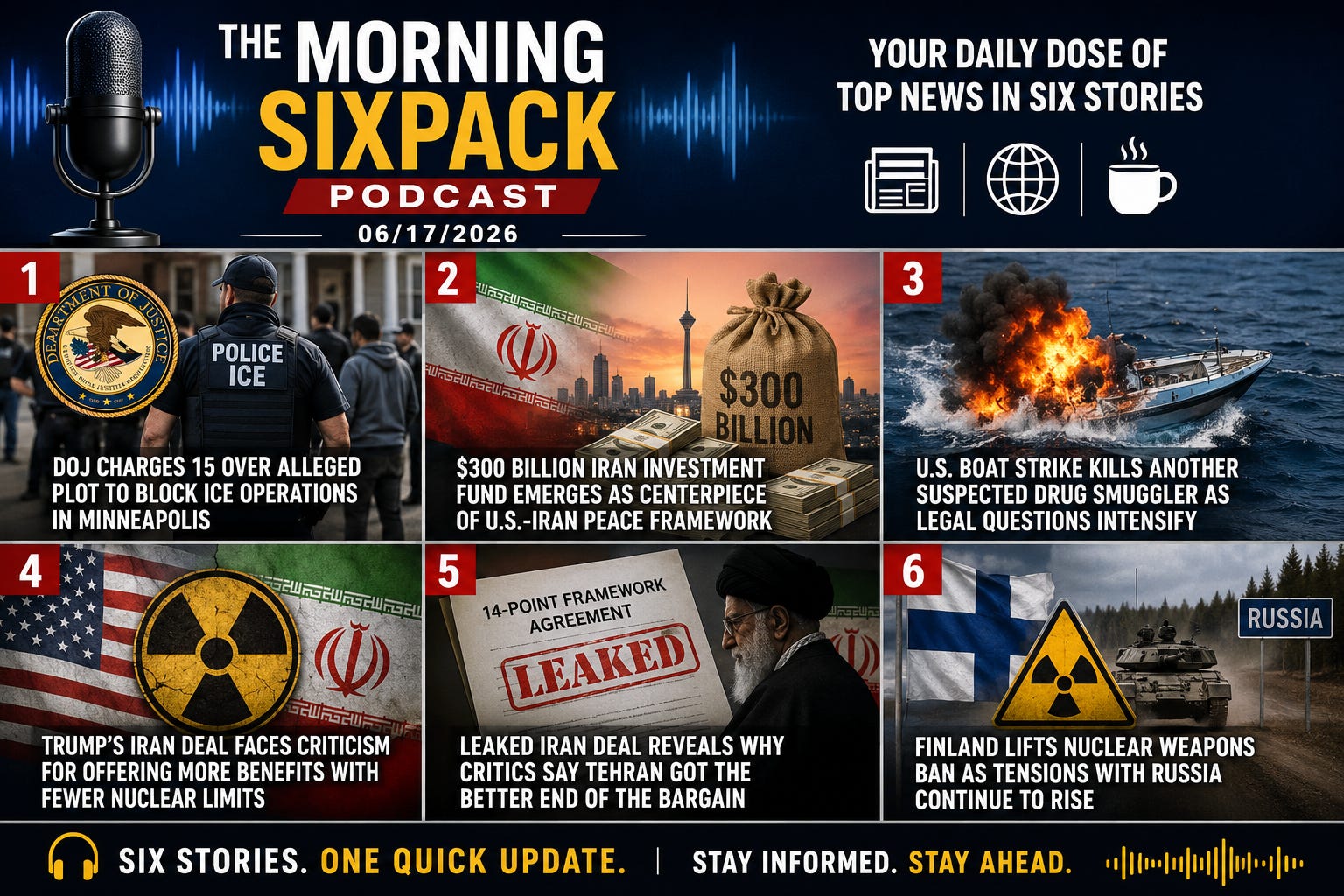
Fifteen people are facing federal charges over alleged efforts to disrupt ICE operations in Minneapolis, and the Justice Department is making it clear that organized interference—not just protest—is now squarely in its crosshairs.
DOJ Charges 15 Over Alleged Plot to Block ICE Operations in Minneapolis
Federal prosecutors have charged 15 Minneapolis activists with conspiring to impede or injure federal officers during the Trump administration’s immigration enforcement crackdown earlier this year. The indictment alleges coordinated efforts to block federal operations, damage property, and interfere with law enforcement activity.
The case signals a major escalation in the administration’s campaign against groups it says crossed the line from protest into organized obstruction.
According to prosecutors, the defendants are tied to Direct Action Minnesota and related activist groups that authorities describe as part of a broader antifa network. Five of the 15 face additional charges ranging from assault on a federal officer to interstate threats and destruction of government property.
U.S. Attorney Daniel Rosen argued the case is about conduct, not political views. “The conspiracy was not to interfere with their voice but to do it by force,” Rosen said. “That’s a crime.” Prosecutors say the defendants used “hard and soft blockades” and coordinated actions designed to disrupt federal immigration operations in Minneapolis.
Critics aren’t buying all of it. Some local officials and legal observers argue the case risks colliding with First Amendment protections and note that many earlier protest-related cases tied to the immigration operation were reduced or dismissed. University of Richmond law professor Carl Tobias called the indictment “pretty thin,” while supporters of the charges argue organized attacks on federal personnel deserve prosecution regardless of political ideology.
Source: Washington Post (gift)
Editor: The debate over immigration enforcement was already combustible. Now prosecutors are testing where protest ends and conspiracy begins—and that argument is headed for a courtroom, not a hashtag.
A proposed $300 billion investment fund for Iran isn’t taxpayer money—it’s private capital betting that peace is more profitable than another Middle East war.
$300 Billion Iran Investment Fund Emerges as Centerpiece of U.S.-Iran Peace Framework
A massive $300 billion private-sector investment fund is being positioned as the economic engine behind a proposed U.S.-Iran agreement aimed at ending the conflict and reopening Iran to global investment.
More than half of the money is reportedly already committed, giving the framework something rare in modern diplomacy: actual cash backing up the promises.
According to Reuters, the proposed Reconstruction and Development Fund would be financed entirely by private investors rather than governments. Companies from the United States, Gulf states, Asia, South America and Africa have reportedly pledged funding for projects spanning energy, logistics, manufacturing and transportation. The fund would only become operational after a final agreement is reached and implemented.
The proposal emerged after Iran reportedly sought $400 billion in compensation for war damages and Washington rejected the idea. Instead, negotiators developed a mechanism designed to attract private investment into an economy that has been largely isolated from global capital markets for decades despite possessing some of the world’s largest oil and natural gas reserves and a population exceeding 92 million people.
President Donald Trump sought to distance Washington from the funding effort during remarks at the G7 Summit, saying: “We’re not investing, we’re not putting up 10 cents.” Vice President JD Vance, however, described the initiative as a Gulf-backed reconstruction fund available if Iran complies with commitments including dismantling its nuclear program and accepting strict inspections.
The big unanswered question is whether investors will actually follow through once the hard work begins. A memorandum of understanding would create a 60-day negotiation period covering nuclear issues, sanctions relief and regional security before any final agreement takes effect. Until then, the $300 billion remains more blueprint than bank account.
Source: Reuters report
Editor: For decades, Iran has been one of the world’s biggest “potential” investment stories. Investors are now being asked to believe that this time the politics will stay stable long enough to cash the checks. History suggests bringing a pencil.
The administration says it’s waging war on “narcoterrorists,” but questions keep mounting about who is being targeted, what evidence exists, and whether the strikes are even legal.
U.S. Boat Strike Kills Another Suspected Drug Smuggler as Legal Questions Intensify
A U.S. military strike in the eastern Pacific killed one man aboard a suspected drug-smuggling vessel Tuesday, pushing the reported death toll from the administration’s anti-cartel maritime campaign above 200.
More than nine months into the operation, the government continues to announce kills while offering little public evidence that those targeted were actually trafficking drugs.
According to U.S. Southern Command, the vessel was struck along a known smuggling route in the eastern Pacific. Military officials said the Coast Guard was notified immediately to conduct rescue operations for two survivors. Video released on social media showed the boat being hit and erupting in flames.
The strike is the latest in a campaign launched after President Donald Trump declared the United States was in an “armed conflict” with Latin American cartels and designated them as “narcoterrorists.” The administration argues the operation is necessary to stop deadly drugs from reaching American communities. Critics counter that much of the fentanyl fueling overdose deaths enters through land routes from Mexico rather than by boat.
The controversy has only grown since the campaign’s first strike last September. In that incident, two survivors were reportedly clinging to wreckage when a second strike killed them. The White House defended the action as self-defense and compliant with the laws of armed conflict. Several military law experts strongly disagreed, arguing that attacking survivors would violate established legal standards under virtually any circumstance.
Now the Pentagon’s inspector general is reviewing whether military planners followed proper targeting procedures. Notably, the review is focused on process rather than the broader question hanging over the campaign: whether these strikes themselves are lawful.
Source: NPR report
Editor: When a military operation reaches 200-plus deaths and the public still can’t independently verify who many of the targets were, “trust us” starts sounding less like transparency and more like a placeholder.
Trump spent years blasting Obama’s Iran deal as dangerously weak. Now critics say his own emerging agreement may leave even more unanswered questions.
Trump’s Iran Deal Faces Criticism for Offering More Benefits With Fewer Nuclear Limits
President Donald Trump’s proposed Iran agreement is drawing criticism because it may impose fewer nuclear restrictions than the Obama-era deal he famously called “the worst agreement.”
The biggest concern: Iran could receive sweeping economic relief while key questions about its stockpile of near-weapons-grade uranium remain unresolved.
According to a draft memorandum reviewed by Bloomberg, the agreement requires that Iran’s uranium stockpile be “adequately addressed” but does not specify exactly what happens to material that could potentially be used in multiple nuclear weapons. That ambiguity has alarmed critics who note that the 2015 Obama agreement imposed strict limits on uranium stockpiles, enrichment activities, and inspection rights.
The proposed framework would reportedly deliver substantial financial incentives to Tehran. Iran could gain access to a $300 billion development fund, resume oil exports, recover frozen assets, and see sanctions lifted if negotiations progress successfully. Meanwhile, the memorandum reiterates Iran’s pledge not to pursue nuclear weapons—a promise Tehran has made repeatedly over the years as a signatory to international nonproliferation agreements.
Trump insists his deal is stronger than President Obama’s Joint Comprehensive Plan of Action. “That was a road to a nuclear weapon. Mine is a wall against a nuclear weapon,” Trump said at the G7 summit. But even some Republican allies are expressing doubts. Senator Lindsey Graham warned that if Iran retains any uranium enrichment capability, “it’s the same as JCPOA.”
Complicating matters further is the fact that international inspectors have not fully verified the status or location of Iran’s highly enriched uranium since military strikes damaged parts of its nuclear infrastructure. Vice President JD Vance has said inspectors will return, but the draft agreement reportedly does not yet spell out the details of any future inspection regime.
Source: Yahoo Finance / Bloomberg report
Editor: Politics has a funny way of aging campaign slogans. It’s one thing to call someone else’s deal a disaster. It’s another when your replacement starts getting measured against the same yardstick—and comes up shorter.
The leaked Iran agreement reads less like a surrender document and more like a wish list Tehran spent years trying to negotiate.
Leaked Iran Deal Reveals Why Critics Say Tehran Got the Better End of the Bargain
A leaked 14-point framework agreement shows Iran poised to receive sanctions relief, access to frozen assets, renewed oil exports and a $300 billion reconstruction fund in exchange for promises that many details will be negotiated later.
The biggest political risk for Trump may be that the deal delivers immediate economic wins for Tehran while leaving key nuclear questions unresolved.
According to the leaked memorandum, U.S. and Iranian officials are expected to sign the agreement Friday in Switzerland, launching a 60-day negotiation period aimed at producing a permanent settlement. The deal would reopen the Strait of Hormuz, end U.S. naval pressure on Iranian ports and establish a pathway toward broad economic normalization.
The economic incentives are substantial. Iran would gain access to a $300 billion reconstruction and development fund, receive sanctions relief, resume oil exports and regain access to billions of dollars in frozen assets. For a country whose economy has struggled under decades of sanctions, those provisions represent major victories at the negotiating table.
What’s missing is what critics see as the most important part. While the agreement includes a pledge that Iran will never pursue nuclear weapons, many of the hard details regarding enriched uranium stockpiles, future enrichment limits, inspection regimes and enforcement mechanisms are deferred to future negotiations. In effect, the framework creates a roadmap rather than a final destination.
The ceasefire provisions may also prove difficult. The agreement requires not only a halt in fighting between the United States and Iran but also between Israel and Hezbollah. Israeli Prime Minister Benjamin Netanyahu has reportedly resisted pressure to completely halt military operations, creating an early test for the deal’s durability.
For the White House, the argument is straightforward: economic incentives can accomplish what military force could not. For critics, the concern is equally simple: Iran appears to be receiving significant concessions today in exchange for promises that may not be fully verified until later.
Source: The Telegraph report
Editor: Diplomacy is usually about compromise. The challenge for this agreement is that supporters see a clever peace deal while opponents see a very expensive down payment on promises that haven’t been written yet.
Finland just removed a decades-old legal barrier to nuclear weapons, sending Moscow a reminder that NATO’s newest member isn’t interested in playing defense with one hand tied behind its back.
Finland Lifts Nuclear Weapons Ban as Tensions With Russia Continue to Rise
Finland has approved legislation allowing the import, transport, supply and possession of nuclear weapons, ending a ban that had been in place since 1987.
The move doesn’t put nuclear weapons in Finland tomorrow—but it gives NATO the option, and that’s exactly the message Moscow is meant to hear.
The Finnish government said the law change reflects an increasingly unpredictable security environment following Russia’s invasion of Ukraine and growing military activity near Finland’s eastern border. While officials stressed there are currently no plans to host nuclear weapons, the legislation removes a legal obstacle that had become increasingly awkward after Finland joined NATO in 2023.
Defence Minister Antti Häkkänen argued that the old Nuclear Energy Act no longer matched Finland’s role inside an alliance built in part around nuclear deterrence. NATO’s collective defense strategy relies on member nations supporting one another across the full spectrum of military capabilities, including nuclear forces.
The timing is difficult to ignore. Reports indicate Russia has begun constructing a new military base near Finland’s border capable of housing thousands of troops. Satellite imagery reportedly shows new barracks and military infrastructure taking shape just miles from Finnish territory, adding to concerns about Moscow’s long-term intentions in the region.
Finland has already hardened its border posture in recent years, including closing eastern crossing points and building extensive fencing after accusing Russia of orchestrating migrant flows toward the frontier. With an 830-mile border shared with Russia, Finnish leaders have little appetite for assuming tensions will ease anytime soon.
Source: Metro report
Editor: For years Finland’s message was, “We’d rather not talk about nuclear weapons.” Russia’s behavior appears to have changed that conversation to, “We’d rather have the option and never need it than need it and never have it.”