


Let’s start off with the most important part: The Morning Sixpack Podcast will NOT be published today at the normal time (if at all) due to the Amazon AWS outage.
Apparently, everybody on the internet who’s anybody uses (i.e., pays for) Amazon Web Services, or AWS.
And while most outlets are reporting that everything is a-ok, they’d be wrong. Anyhoo, let’s get to the story.
When the web’s biggest backbone took a knee, the ripple wasn’t just a tech hiccup—it was a warning shot about our overdependence on a single digital gatekeeper.
If you woke up Monday to find your apps frozen, your banking login spinning endlessly, or Alexa suddenly silent—congratulations, you witnessed a glimpse of the internet’s Achilles’ heel.
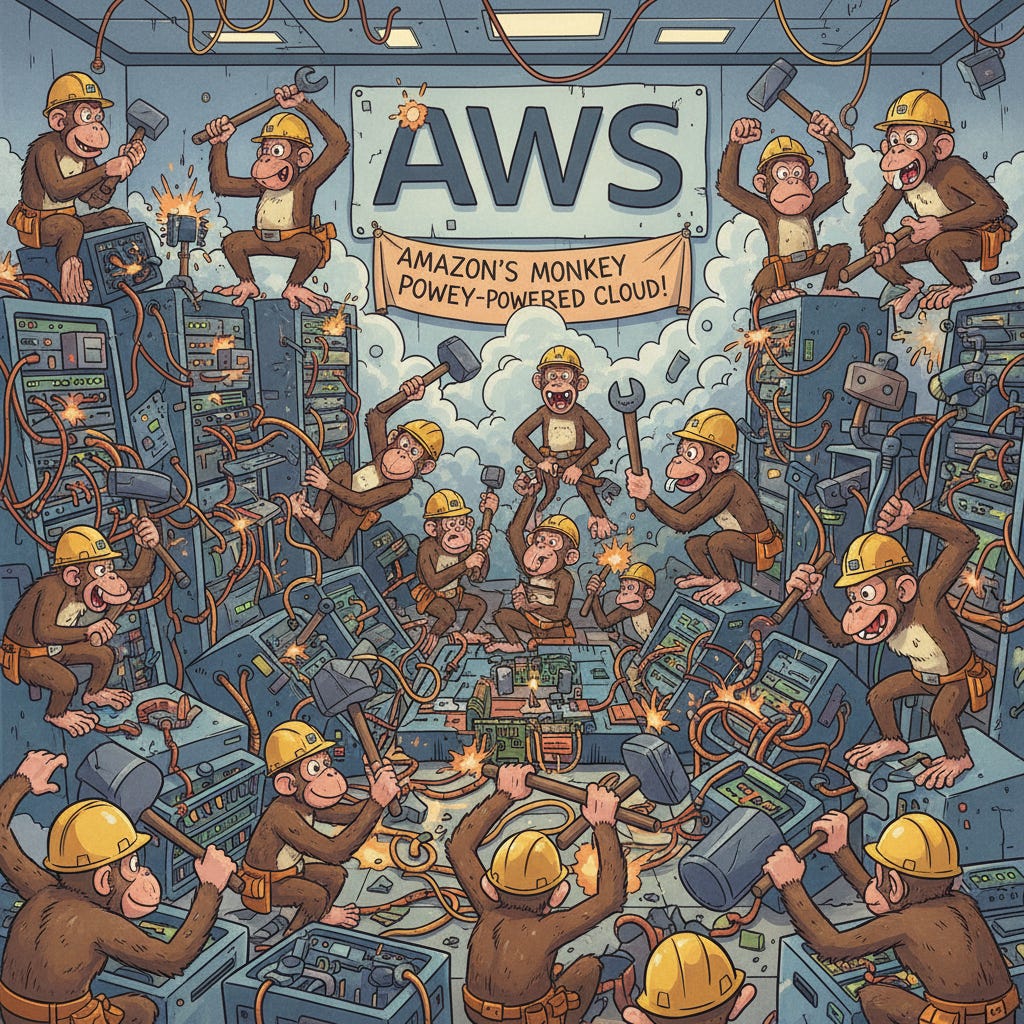
Amazon Web Services, the digital plumbing behind much of the modern internet, went dark—again. This wasn’t a minor speed bump. This was a full-on traffic jam on the Information Superhighway. From airlines and banks to gaming platforms and crypto exchanges, the digital dominoes fell fast and hard. And the kicker? The whole mess may have started with a glitch in an internal monitoring system that forgot how to monitor itself. Editor: Seems about right.
AWS, Amazon’s golden goose that powers everything from Netflix to the Pentagon, saw its massive EC2 network—the virtual backbone companies rent instead of owning their own servers—collapse under its own weight. The culprit? A system that checks network load basically forgot how to do math, taking half the internet with it. Amazon later said it was “seeing connectivity and API recovery,” which is corporate-speak for “we turned it off and on again.”
The fallout was global. Snapchat, Facebook, Delta, United Airlines, Coinbase, and even AI darling Perplexity all went down like dominoes. UK banks like Lloyds and Halifax went dark. Canva and PlayStation showed “Error 404” messages like a retro flashback to 1998. Even smart homes got dumber. One user told CNN that her Alexa-controlled lights stopped responding—because apparently, your lamp now depends on Jeff Bezos’ cloud mood swings.
Tech experts were quick to chime in with the obvious: this outage cost billions in lost productivity and sales. Mehdi Daoudi of Catchpoint estimated the total impact “will easily reach into the hundreds of billions.” Think about it—factory floors idled, flights delayed, and entire workforces staring at Slack screens that wouldn’t load. For a supposedly decentralized web, that’s a pretty centralized disaster.
And that’s the bigger story here. AWS isn’t just another service—it is the internet for huge swaths of the economy. Gartner says it commands 37% of the global cloud market and raked in $107.6 billion last year. When it sneezes, the rest of the web catches pneumonia. This is the risk baked into convenience: every time a company outsources its infrastructure “to the cloud,” it’s really handing the keys to one of a few giants—Amazon, Google, or Microsoft. When one stumbles, we all go offline.
The experts call it “concentration risk.” I call it the “Don’t put all your bandwidth in one basket” problem. Professor Feng Li from London’s Bayes Business School said the outage “reminds us how deeply our economies now depend on just a handful of cloud infrastructures.”
Translation: we’ve built our digital future on a few very big, very wobbly stilts.
And while Amazon insists there’s “no sign” this was a cyberattack, the line between technical fault and structural fragility is blurry. The Domain Name System—the web’s phone book—went haywire, leaving companies’ apps “separated from their data.” As one expert put it, it was as if “the internet suffered temporary amnesia.” Not exactly comforting when your bank balance, your job, and your lights all live online.
Of course, Elon Musk couldn’t resist gloating. “Not us,” he bragged on X, flexing that his platform wasn’t affected and taking the opportunity to shill X’s new chat feature. It’s peak Musk: mocking the world’s biggest cloud provider while selling you his next one.
The internet came back, mostly. But the takeaway lingers: resilience isn’t just a cybersecurity issue—it’s a design flaw in how we’ve built modern life. When a single company’s internal glitch can cause a global economic event, the question isn’t if it happens again—it’s when.
Source: CNN Live Updates: Amazon Tech Outage (Oct. 20, 2025)
Editor’s note: The internet wasn’t designed to have a king—but we’ve crowned one anyway. AWS didn’t just blink—it reminded us how fragile our digital empire really is. Maybe next time we build the “cloud,” we should bring a backup umbrella.
And guys, the INTERNET is decentralized. IF we had multiple services distributed over multiple servers, this shit would never happen. It, by design, is inherently fail-safe (even the DNS system works this way).