


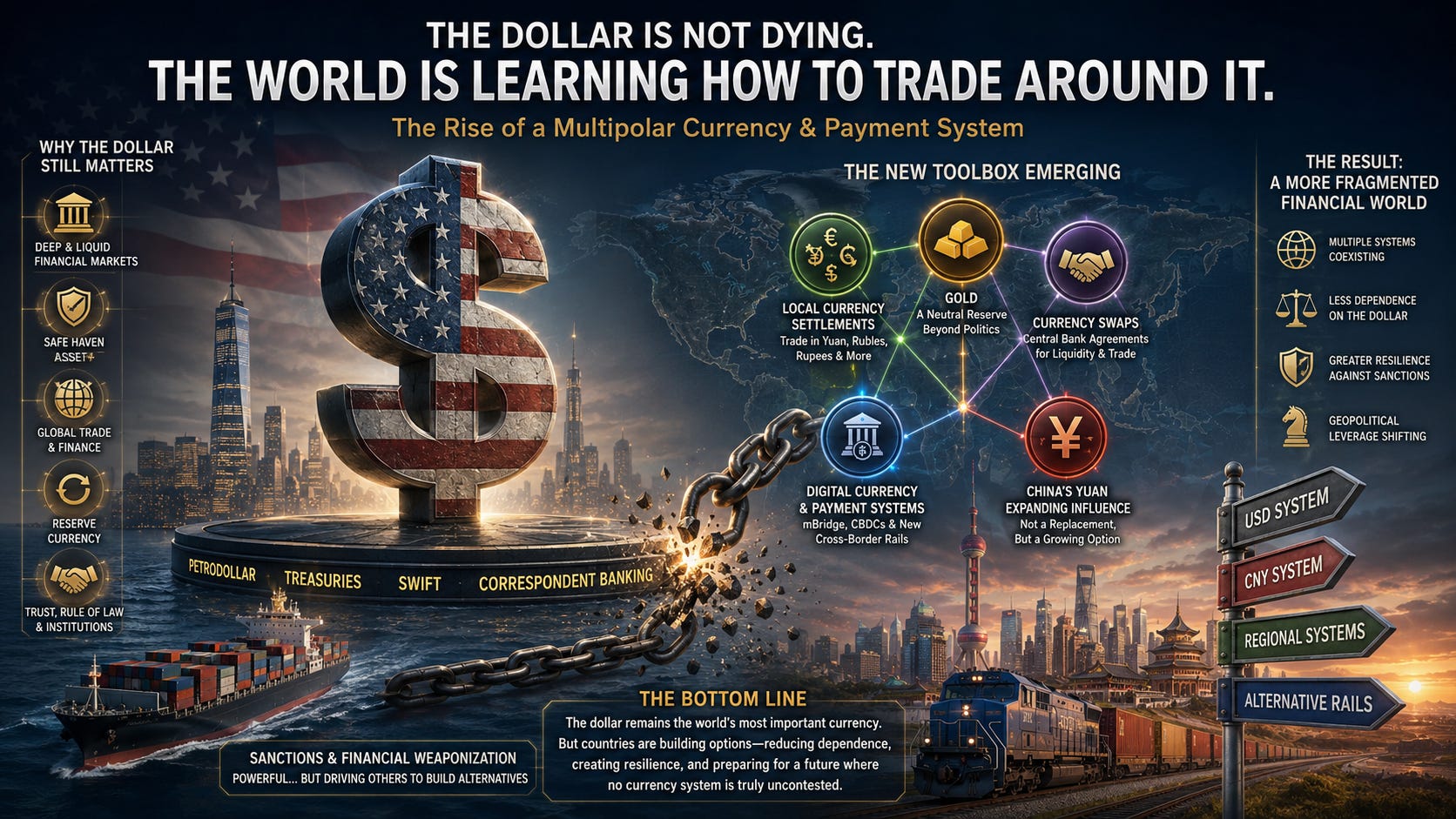
Editor’s Note: The more sanctions become America’s foreign policy Swiss Army knife, the more incentive rivals have to build a different toolbox. That toolbox now exists. It is not yet strong enough to replace the dollar, but it is increasingly good enough to reduce America’s control over the machinery of global trade.
For nearly eighty years, the U.S. dollar has been the central language of international commerce. It has priced oil, financed trade, anchored central-bank reserves, lubricated global banking, and given Washington a form of influence no military alliance could fully replicate. The dollar was not merely America’s currency. It became the settlement layer for the world economy.
That system is now changing.
Not collapsing. Not being overthrown. Not being replaced by the Chinese yuan in some clean handoff of monetary power from Washington to Beijing. The dollar remains the deepest, most liquid, most trusted currency in global finance. When markets panic, investors still seek dollar assets. When central banks need reserves, U.S. Treasuries remain the benchmark. When corporations borrow across borders, the dollar still dominates.
But dominance is not the same thing as exclusivity. And exclusivity is what is beginning to erode.
The emerging story in global trade is not “the end of the dollar.” It is the rise of a parallel financial architecture designed to make the dollar less necessary in selected markets, selected corridors, and selected political circumstances. That distinction matters. The global monetary order is not moving from the dollar to one new currency. It is moving from a dollar-centered system to a more fragmented system in which the dollar remains central, but no longer uncontested.
This is the real currency story of the decade.
The Dollar’s Power Was Built on Trust, Scale, and Habit
The modern dollar order was born out of World War II and institutionalized at Bretton Woods. The United States emerged from the war with unmatched industrial strength, the world’s largest gold reserves, and a financial system that looked stable compared with the wreckage in Europe and Asia. The dollar became the anchor of the postwar monetary system, originally tied to gold and used by other countries to stabilize their own currencies.
When President Richard Nixon ended dollar convertibility into gold in 1971, many assumed the system would weaken. Instead, the dollar remained dominant because the infrastructure around it had already become too large to abandon. Trade was invoiced in dollars. Banks funded themselves in dollars. Oil markets settled in dollars. Sovereigns and corporations borrowed in dollars. Central banks held dollars because everyone else held dollars.
The dollar became the ultimate network effect: Valuable because it was widely used, and widely used because it was valuable.
That network gave the United States extraordinary advantages. It allowed Washington to borrow more cheaply. It created persistent global demand for Treasury securities. It strengthened the purchasing power of American consumers. It gave U.S. officials the ability to influence global finance through access to banks, clearing systems, and payment channels. Over time, dollar dominance became one of the quiet pillars of American power.
It also created resentment.
For allies, the dollar system was a convenience and a source of stability. For rivals, it was a vulnerability. For nonaligned countries, it was a bargain that became less comfortable as Washington increasingly used financial access as an instrument of foreign policy.
Sanctions Changed the Strategic Calculation
The United States did not invent sanctions in the past decade, but it has expanded their role dramatically. Sanctions have become a preferred tool because they offer policymakers something between diplomacy and war. They can punish adversaries, restrict access to capital, immobilize assets, and signal resolve without deploying troops.
Against Iran, sanctions targeted energy exports, banking access, shipping networks, and financial intermediaries. Against Russia, the U.S. and its allies went further, freezing central-bank assets, cutting major institutions off from key financial channels, and forcing companies to choose between doing business with Moscow and retaining access to Western markets.
These moves imposed real costs. They also revealed something just as important: The dollar system could be weaponized at scale.
That lesson was not lost on Beijing, Moscow, Tehran, Riyadh, New Delhi, Brazil, Ankara, Abu Dhabi, or any government that imagines a future disagreement with Washington. Even countries that do not view themselves as adversaries have had to absorb the implications. If reserves can be frozen, banks disconnected, payments scrutinized, and trade routes disrupted by financial decree, then dependence on the dollar system is not merely an economic decision. It is a strategic exposure.
That exposure has produced a rational response. Countries are not abandoning the dollar wholesale, because they can’t. They are building optionality.
Optionality is the key concept. The next monetary order may not be anti-dollar. It may be post-exclusivity.
The New Toolbox: Local Currencies, Gold, Swaps, and Digital Rails
The challenge to the dollar is not coming from a single source. It is emerging through multiple tools that, taken together, reduce the need to use dollars in every transaction.
One tool is local-currency settlement. China and Russia have expanded trade in yuan and rubles. India has explored rupee settlement arrangements. Gulf states have shown increasing willingness to discuss non-dollar energy trade, especially with China. These arrangements are often limited, inefficient, or politically motivated, but they are meaningful because they normalize the idea that trade does not automatically need to pass through the dollar.
Another tool is the bilateral currency swap. Central banks can provide one another with access to local currencies, supporting trade and liquidity without relying entirely on dollar funding markets. These arrangements do not replace deep capital markets, but they can support regional trade and reduce dependence on the dollar in specific corridors.
Gold is also returning to prominence. For years, gold was treated by many Western analysts as a legacy reserve asset: useful, but old-fashioned. For countries worried about sanctions, it has a different appeal. Gold is no one else’s liability. It cannot be frozen by a foreign central bank in the same way a bank deposit or security can. It generates no yield, but it carries no counterparty risk. In a world where reserves can become political targets, that matters.
Then there is the yuan. China’s currency is not ready to replace the dollar. Beijing maintains capital controls. Its financial markets are not as open or trusted as U.S. markets. Foreign investors remain wary of political intervention, legal opacity, and the risk that money may not move freely when conditions deteriorate. These limitations are severe.
But the yuan does not need to become the world’s reserve currency to alter the balance of power. It only needs to become more useful in China-centered trade. If Beijing can persuade energy exporters, commodity producers, and trading partners to accept yuan in certain transactions, it can carve out a sphere of monetary influence without dethroning the dollar globally.
The most consequential tool, however, may be new payment infrastructure.
The Real Story Is the Plumbing
The global debate often focuses on which currency will replace the dollar. That question may be outdated. The more important question is whether the world still needs to use the same financial pipes.
For decades, cross-border payments have depended heavily on correspondent banking relationships. A company in one country paying a company in another often relies on a chain of banks, messaging systems, settlement accounts, and currency conversions. Because of the dollar’s liquidity and reach, many of those transactions touch the U.S. financial system even when neither party is American.
That gave the United States visibility and leverage.
Projects such as mBridge point toward a different model. Developed with participation from central banks including those of China, Hong Kong, Thailand, and the United Arab Emirates, mBridge explores the use of central-bank digital currencies for real-time cross-border settlement. In plain English, it is an effort to let banks in different countries settle directly using digital versions of their own currencies, rather than relying on the traditional correspondent banking maze.
The project remains limited. It is not yet a fully mature commercial replacement for existing systems. It faces major governance, regulatory, privacy, compliance, and geopolitical questions. But its significance lies in what it demonstrates. Central banks are no longer merely discussing alternatives to dollar-based settlement. They are testing them.
If these systems scale, the result would not be an immediate end to the dollar. It would be the creation of trade corridors where the dollar is unnecessary. That is a profound shift. The United States would still have the world’s most important currency, but its ability to monitor, influence, or block certain flows could decline.
The strategic implications are obvious. A sanctions regime is only as powerful as the network it controls. If enough trade moves onto networks outside that control, sanctions become less comprehensive. They may still hurt. They may still deter. But they become easier to manage around.
The Petrodollar Is No Longer the Whole Story
Much of the public debate still revolves around the petrodollar. That made sense in the 1970s and 1980s, when oil pricing was central to global dollar demand. The arrangement between the United States and Saudi Arabia helped reinforce the dollar after the collapse of the gold-backed Bretton Woods system. Oil exporters earned dollars and recycled them into U.S. financial assets, especially Treasuries. The world needed oil, oil needed dollars, and dollars flowed back into American markets.
That system was important. It still matters. But it is no longer sufficient to explain dollar dominance.
Today, the dollar’s deeper strength lies in finance. The U.S. Treasury market is the world’s premier safe-asset market. Dollar funding underpins global banking. Corporate debt is heavily dollar-denominated. Trade invoicing extends well beyond energy. Derivatives, collateral, liquidity backstops, and crisis funding all reinforce the dollar’s role.
That is why a Saudi decision to accept some yuan for oil would be symbolically important but not automatically transformative. It would signal geopolitical diversification, not necessarily monetary revolution. The dollar could lose some oil trade and still remain dominant because its core role is now embedded in the financial system rather than oil alone.
The more serious question is what happens if the financial system itself fragments. If new settlement platforms, regional banking arrangements, commodity pricing mechanisms, and reserve strategies develop outside the dollar’s orbit, the cumulative effect could be larger than any single oil contract.
The petrodollar may fade as a pillar. The financial dollar is harder to dislodge. But it is not immune.
Fragmentation Is More Likely Than Replacement
The yuan will not simply take the dollar’s place. The euro is too institutionally constrained. Gold cannot support the volume and flexibility of modern trade finance. Bitcoin and decentralized crypto assets remain too volatile and politically contested to serve as serious sovereign reserve replacements. Stablecoins, notably, often reinforce dollar demand rather than weaken it because most are dollar-denominated.
The future is therefore likely to be fragmented.
In one sphere, the dollar will remain dominant among the United States, its allies, global investors, multinational corporations, and crisis-driven capital flows. In another, China will push yuan settlement where its trade power gives it leverage. In sanctioned or semi-sanctioned economies, workarounds will multiply through regional banks, barter structures, commodity swaps, and alternative payment channels. In the reserve world, central banks will likely continue holding dollars while increasing allocations to gold and selected non-dollar assets. In payments, central-bank digital currency experiments and instant settlement networks will attempt to reduce reliance on correspondent banking.
This will be less efficient than a single dominant system in some respects. It may increase transaction costs, legal complexity, and currency risk. But countries may accept those costs in exchange for political autonomy.
That is the fundamental tradeoff. The dollar system offers unmatched liquidity and convenience. Alternative systems offer insulation from U.S. power. For many countries, the goal is not to choose one or the other. It is to have both.
What This Means for the United States
For Washington, the danger is not imminent dollar collapse. The danger is complacency.
American policymakers have grown accustomed to a world in which dollar access is indispensable. That assumption still holds in many areas, but it is weakening at the edges. Every sanction, asset freeze, debt-ceiling crisis, tariff shock, and institutional breakdown adds to the incentive for others to hedge.
The United States retains enormous advantages. Its capital markets remain unmatched. Its legal system, despite political strain, remains more trusted than those of most rivals. Its military alliances, innovation base, and financial depth continue to support the dollar’s role. No rival has assembled the full package required to replace it.
But the dollar’s dominance depends not only on the weakness of alternatives. It depends on the continued confidence of users. If Washington treats the dollar system as an inexhaustible weapon, it may accelerate the creation of systems designed to blunt that weapon.
That does not mean sanctions should never be used. It means they should be treated as a strategic resource, not an all-purpose substitute for policy. Overuse invites adaptation. Adaptation reduces effectiveness. Reduced effectiveness forces escalation. That cycle is already visible.
The Bottom Line
The global currency market is changing in a very big way, but not in the way the loudest headlines suggest.
The dollar is not being replaced by the yuan. The petrodollar is not collapsing overnight. A BRICS currency is not about to become the new reserve standard. The world is not suddenly abandoning the safest and most liquid financial system it has.
What is happening is more gradual and more consequential. Countries are building the ability to trade, settle, save, and finance outside the dollar system when they need to. They are not rejecting the dollar. They are reducing their dependence on it.
That is how monetary orders change: not through a single dramatic announcement, but through infrastructure, incentives, and repeated acts of hedging.
America’s sanctions power helped expose the reach of the dollar system. It also gave rivals and nonaligned powers a reason to design around it. The result is a world in which the dollar remains dominant, but less unavoidable.
For the United States, that should be the warning. The greatest threat to the dollar is not one superior currency waiting in the wings. It is a world with enough alternatives that American financial power becomes easier to avoid.