


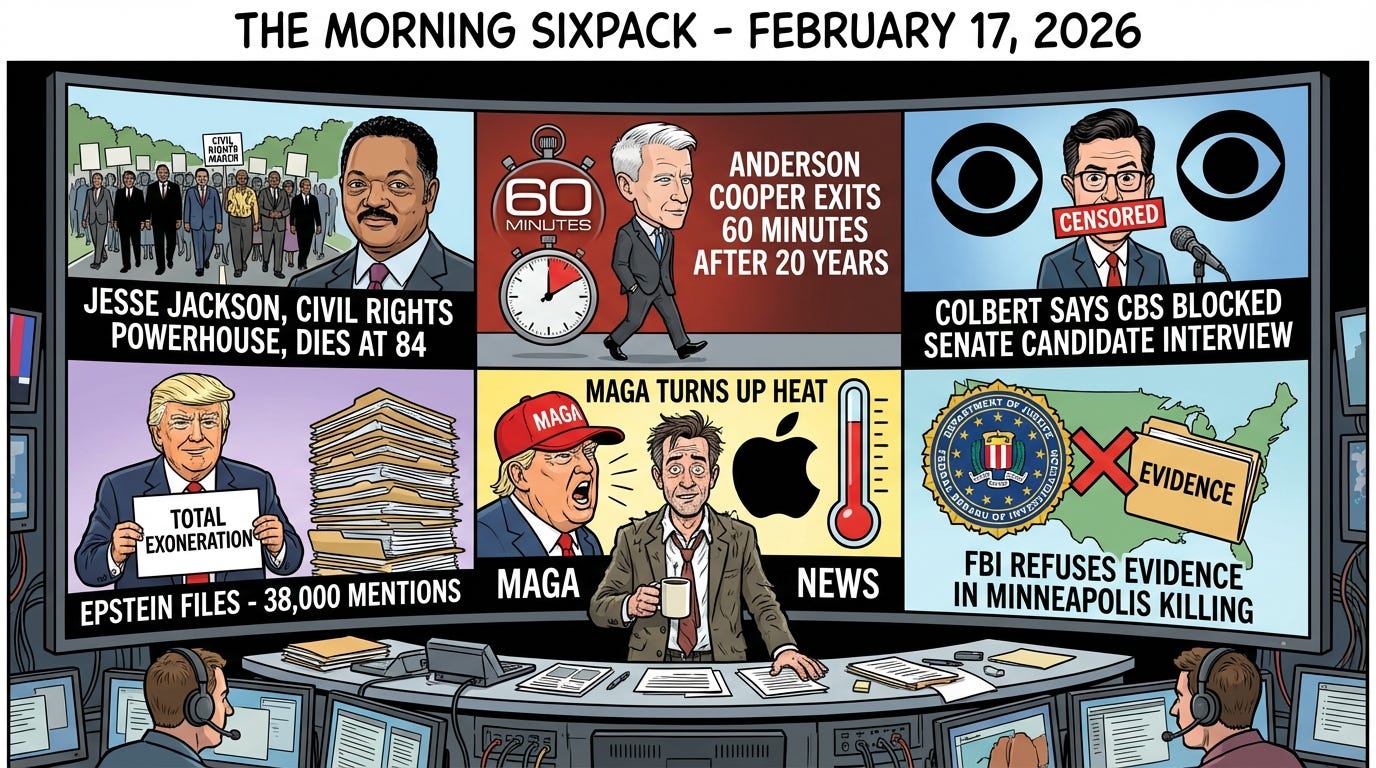
Jesse Jackson, Civil Rights Powerhouse and Presidential Trailblazer, Dies at 84
Jesse Jackson—the fiery preacher who carried the civil rights movement from Selma to the presidential stage—has died at 84.
For more than five decades, Jackson was the loudest, most relentless voice for Black political power in America, rising from the segregated South to become a two-time Democratic presidential contender and global dealmaker. A protégé of the Rev. Martin Luther King Jr., he marched in Selma, stood in Memphis the day King was assassinated, and refused to step out of the spotlight in the years that followed. Diagnosed with Parkinson’s disease in 2015 and later progressive supranuclear palsy, he remained a towering figure in public life until his retirement in 2023.
At his peak, Jackson was everywhere—on picket lines, at riot-scarred intersections, in corporate boardrooms, and on the world stage. His Saturday chant echoed across Chicago and beyond: “I am — somebody. I may be poor, but I am — somebody. I may be on welfare, but I am — somebody. I may be uneducated, but I am — somebody. I may be in jail, but I am — somebody.” He preached self-discipline and hope—“Keep hope alive”—while also pressing companies like Coca-Cola and Nike to hire and promote Black Americans. Admirers saw a moral force; critics saw a master of leverage who knew exactly how to turn pressure into results.
Then came politics. In 1984, he launched a presidential bid many dismissed as symbolic. It wasn’t. He won more than 3 million votes and 384 delegates. Four years later, he captured about 7 million votes and briefly led the Democratic race—an unprecedented feat for a Black candidate at the time. “My race was never about running for the White House alone,” he said. “It was about 10,000 people running in their states.” A generation later, he wept openly as Barack Obama claimed victory in Grant Park, reflecting on the martyrs who made that night possible.
Jackson’s career was not without controversy—feuds within King’s inner circle, tensions with Jewish leaders after offensive remarks during the 1984 campaign, questions about the management of Operation PUSH, and a deeply personal scandal in 2001. Yet even detractors conceded his stamina and reach. He negotiated prisoner releases in Syria, Cuba, Iraq, and Serbia, pushed for sanctions against apartheid South Africa, and reshaped Democratic voter mobilization for decades. By the time he first ran for president at 42, he had achieved something rare in American life: he was known simply as Jesse. And, as he told his followers for years, he was somebody.
Source: The Washington Post (free)
Editor: He was complicated, ambitious, sometimes maddening—and undeniably consequential. Love him or loathe him, Jesse Jackson forced America to answer questions it preferred to dodge. Not bad for a kid born into segregation who refused to wait his turn.
Anderson Cooper Exits 60 Minutes After Nearly 20 Years
Anderson Cooper is stepping away from 60 Minutes, closing the book on a nearly two-decade run at CBS’s crown-jewel newsmagazine.
The veteran anchor has declined a renewal offer and told the network weeks ago that he plans to leave 60 Minutes, according to a scoop from Breaker Media. Cooper, 58, will instead focus on his long-running role at CNN and spend more time with his family. The move ends one of the more high-profile dual-network balancing acts in modern TV news.
Cooper joined CBS’s flagship program in 2006, bringing star power and global reporting chops to the venerable Sunday night institution. Just this week, he introduced a segment featuring filmmaker Ken Burns—a reminder that even after all these years, he remained a central figure in the broadcast.
His departure will inevitably spark questions about the future direction of 60 Minutes, which has leaned on a mix of legacy correspondents and marquee names to maintain its dominance. Cooper’s exit leaves veterans like Lesley Stahl and Scott Pelley carrying even more institutional weight as the show navigates a shifting media landscape.
For Cooper, the decision appears less about drama and more about focus. After years of juggling prime-time duties at CNN with long-form reporting at 60 Minutes, he’s choosing consolidation over expansion. In an era when many anchors cling to every platform they can get, walking away from one of television’s most prestigious perches is its own statement.
Source: Breaker Media
Editor: Let’s be honest—there are only so many hours in the day, even if you anchor election nights that last a week. Cooper trimming the portfolio isn’t retreat; it’s strategy. And if you think 60 Minutes won’t feel the loss of a globally recognized name, you haven’t been paying attention to how TV news actually works in 2026.
And make no mistake: NOBODY is NOT thinking about Bari Weiss’ influence on his decision.
Colbert Says CBS Blocked Senate Candidate Interview Amid FCC Pressure
Stephen Colbert says CBS lawyers pulled his interview with a Texas Senate candidate before it ever hit the air—citing FCC concerns.
On Monday night, the The Late Show with Stephen Colbert host told viewers that Texas state Rep. James Talarico was scheduled to appear—but was barred from the broadcast after network attorneys stepped in.
“We were told in no uncertain terms by our network’s lawyers directly that we could not have him on the broadcast,” Colbert said, adding that he was also instructed not to mention the booking at all. Naturally, he mentioned it.
Colbert framed the decision as a preemptive move tied to renewed scrutiny from the Federal Communications Commission and its equal time rule, joking it’s “the FCC’s most time honored rule, after no nipples at the Super Bowl.” He then sharpened the punchline into a political point: “Let’s just call this what it is: Donald Trump’s administration wants to silence anyone who says anything bad about Trump on TV, because all Trump does is watch TV, okay? He’s like a toddler with too much screen time; he gets cranky and drops a load in his diaper.”
The interview didn’t vanish entirely. Colbert said the segment would live online, posting it to the show’s YouTube page while noting the network wouldn’t allow him to share a direct link on air. The workaround underscores the increasingly awkward line late-night hosts are walking as broadcast regulations collide with digital platforms that operate under different rules.
The flap comes as CBS navigates broader turbulence, including high-profile departures and internal tensions. Just days earlier, Anderson Cooper announced he would leave 60 Minutes after nearly two decades, citing family priorities while critics point to mounting pressure and programming controversies across the network.
Late night has long enjoyed exemptions from strict equal time enforcement, but Colbert’s monologue suggests networks may be enforcing guardrails even before regulators do. Whether that’s prudence or panic depends on who you ask. For viewers, it’s one more reminder that in 2026, the most interesting TV sometimes happens after the cameras stop rolling.
Source: A.V. Club
Editor: When comedians start sounding like First Amendment litigators, you know something’s off. If the lawyers are running the punchlines, don’t be shocked when the audience changes the channel—or just heads to YouTube.
And let’s not forget who runs CBS now. Paramount. And who owns them? The Ellisons, diehard Trumpers.
MAGA Turns Up the Heat on Apple News—And the Honeymoon May Be Over
Apple News is suddenly in the political crosshairs, with MAGA world pressuring regulators to force more conservative content onto the platform.
For years, Apple’s news app quietly positioned itself as a curated antidote to algorithmic chaos—a place where legacy outlets and lifestyle brands coexisted under a sleek iPhone interface. Now that low-drama strategy is colliding with a coordinated push from Trump allies who argue the platform sidelines right-leaning voices. The Federal Trade Commission has even sent a warning letter suggesting Apple could be skirting consumer protection rules by not showcasing explicitly conservative coverage.
The pressure campaign gained traction after the conservative Media Research Center claimed Apple News highlighted hundreds of stories from left-leaning or centrist outlets and none from right-leaning sources. That framing spread quickly across conservative media and into regulatory channels. Apple’s defenders note the app is personalized—users can follow outlets like The Daily Wire or National Review if they choose—and that Apple’s own terms of service don’t promise ideological balance. Still, perception can matter more than policy when Washington is involved.
There’s precedent for Apple bending when regulators lean in. In the UK, after the Daily Mail complained it had been “arbitrarily” blocked from Apple News and escalated the issue to regulators, Apple quietly reversed course and struck a partnership deal. Few noticed at the time—but it signaled that the tech giant can be responsive cucked when official scrutiny intensifies.
The irony is that Apple News is hardly a core business line for Apple. The company hasn’t spotlighted it in earnings calls in years. Yet for publishers, it’s become a crucial traffic and subscription pipeline, feeding tens of millions of readers through push alerts and curated feeds. That makes it more than a rounding error in the media ecosystem—even if it is one on Apple’s balance sheet.
What happens next depends on how much appetite Apple has for a fight. CEO Tim Cook once framed the product as a civic contribution, rooted in his belief that democracy depends on a free press. Now that civic-minded pitch is being tested in a far more combative political environment—one where content curation can be treated as a partisan act.
Source: Semafor
Editor: For a company that sells phones, this is a headache it never asked for. But when you control a news gateway for millions, neutrality becomes a political statement whether you like it or not. The question isn’t whether Apple News matters—it’s who gets to decide what “balance” looks like.
Let’s just see how the CrApple fandom REALLY feels about democracy and the First Amendment.
Trump Claims ‘Total Exoneration’ in Epstein Files—Despite 38,000 Mentions
Donald Trump is declaring himself “totally exonerated” in the Epstein files—even as newly released documents reportedly reference him more than 38,000 times. #PedoFiles
Speaking to reporters aboard Air Force One, the president insisted—no fewer than five times—that he has “nothing to hide” regarding his past relationship with convicted sex offender Jeffrey Epstein. “I have nothing to hide, I’ve been exonerated! I have nothing to do with Jeffrey Epstein! … I’ve been totally exonerated,” Trump said, brushing off renewed scrutiny tied to the Justice Department’s massive document release.
The comments came after longtime rival Hillary Clinton suggested Trump had “something to hide” about his ties to Epstein, who once described Trump as his “closest friend for 10 years.” Trump countered that investigators “went in hoping that they’d find it – they found just the opposite,” while also attempting to pivot blame toward Democrats.
But the numbers tell a messier story. According to reporting, Trump’s name appears more than 38,000 times across the newly released files. The document dump has also resurfaced allegations—including claims deemed credible by federal investigators—that Epstein abused underage girls, along with emails suggesting Trump may have spent extended time with one alleged victim and even holidays with Epstein during his first term.
Trump’s strategy is clear: repeat “exonerated” until it sounds like a legal ruling rather than a personal conclusion. Whether that framing holds up will depend less on press gaggles at 30,000 feet and more on what investigators—and voters—decide to do with the paper trail now in public view.
Source: Raw Story
Editor: Saying “totally exonerated” five times doesn’t magically transform thousands of mentions into a footnote. If this is what innocence looks like, it’s doing a lot of heavy lifting. The documents aren’t going away—and neither are the questions. #EpsteinFiles
FBI Refuses to Share Evidence in Minneapolis Killing—State Calls It ‘Unprecedented’
Minnesota’s top investigative agency says the FBI is refusing to hand over evidence in a fatal federal shooting—calling the standoff “concerning and unprecedented.”
The clash centers on the Jan. 24 killing of Alex Pretti in south Minneapolis, where federal agents shot and killed him. According to the Minnesota Bureau of Criminal Apprehension, agents from the Federal Bureau of Investigation physically blocked state investigators from collecting evidence at the scene. The BCA later secured a temporary restraining order to prevent the Department of Homeland Security from altering or destroying evidence—though a federal judge lifted it days later, citing insufficient proof of tampering concerns.
The BCA says the FBI has also withheld evidence in two other recent federal use-of-force cases: the killing of Renee Good and the shooting of a Venezuelan national last month. Superintendent Drew Evans made clear the agency isn’t backing down. “We will continue to pursue all legal avenues to gain access to relevant information and evidence,” he said, adding that Minnesota remains open to a joint investigation if federal authorities reverse course.
Local prosecutors are stepping in. Hennepin County Attorney Mary Moriarty told WCCO she plans to formally demand evidence from the U.S. Departments of Justice and Homeland Security in the Pretti case. She previously sent a similar letter regarding Good’s killing and is also reviewing the Venezuelan national’s shooting.
Pretti’s family has called for a joint federal-state investigation, saying, “Justice and accountability requires a thorough and impartial investigation to establish the facts.” Meanwhile, Democratic members of the U.S. House Committee on Oversight and Government Reform have accused the Trump administration of misleading the public about the circumstances surrounding the killings.
At its core, this is about more than one case. When state investigators say the federal government is stonewalling in officer-involved shootings, it raises a fundamental question: who investigates the investigators—and what happens when they won’t share the file?
Source: CBS News Minnesota
Editor: Transparency shouldn’t require a court order. If everyone’s confident in their conduct, open the books. The longer this drags on, the worse it looks—for everyone involved.