


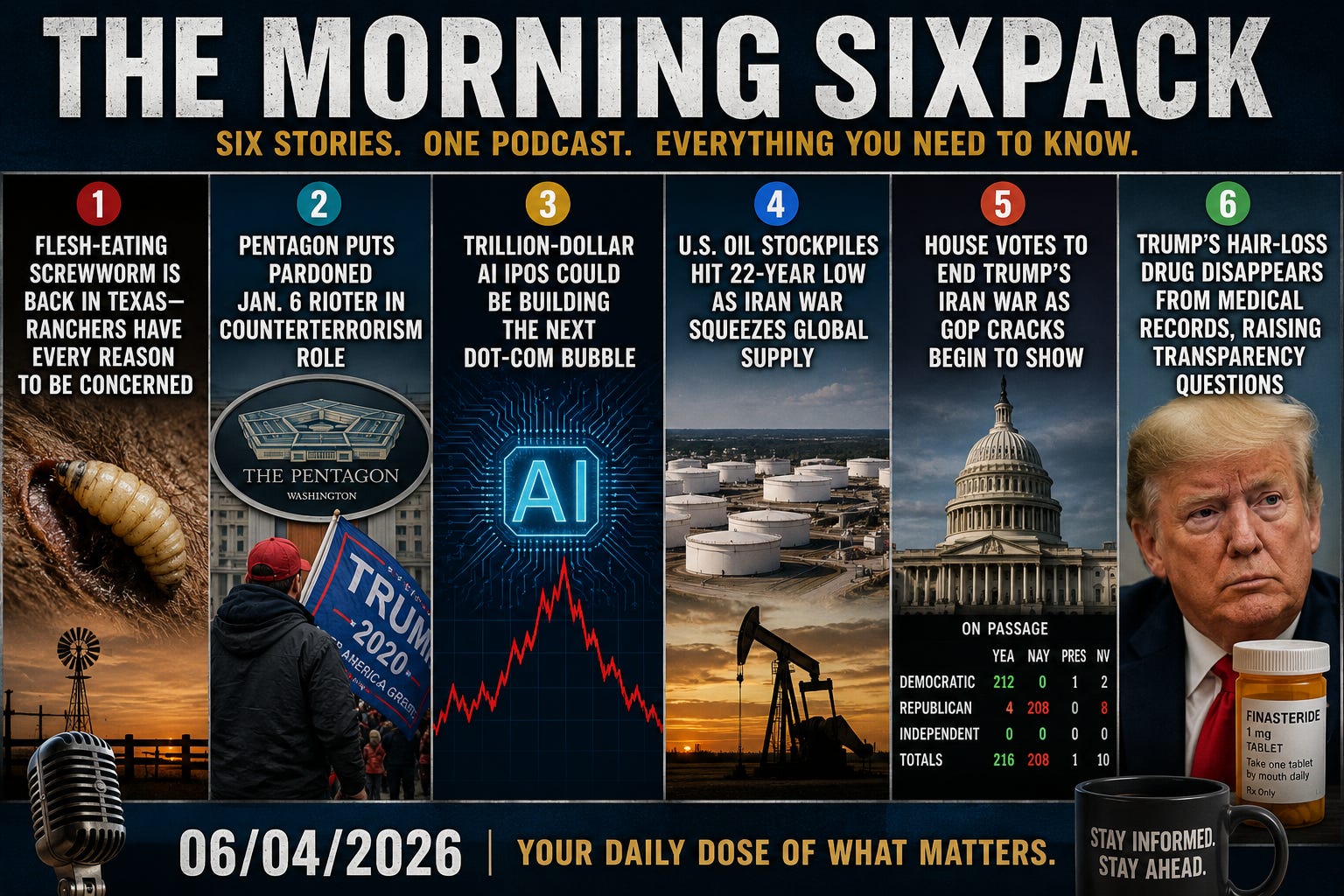
A flesh-eating parasite that America eradicated decades ago has reappeared in Texas, giving cattle producers one more thing to worry about besides weather, regulations, and markets.
Flesh-Eating Screwworm Is Back in Texas—and Ranchers Have Every Reason to Be Concerned
A New World screwworm infestation has been confirmed in a Texas calf, marking the parasite’s first appearance in U.S. livestock in decades and triggering an aggressive containment effort. The case was discovered in a 3-week-old calf in Zavala County, raising concerns that a pest once considered defeated could be making an unwelcome comeback.
One infected calf may not sound like much, but that’s exactly how agricultural disasters tend to introduce themselves.
The New World screwworm isn’t dangerous because it spreads disease. It’s dangerous because its larvae literally eat living flesh. The fly deposits eggs in open wounds or body openings, and the hatched maggots burrow into tissue, causing severe damage to livestock, wildlife, pets and, in rare cases, humans. The United States spent years and enormous resources eliminating the pest before officially declaring victory in 1966.
Federal officials say they have been preparing for this possibility ever since screwworm cases began marching north through Central America and Mexico. The USDA has expanded production of sterile flies, a proven strategy that disrupts breeding and eventually collapses wild populations. Officials stress there is no threat to the food supply and that meat, poultry and eggs remain safe for consumers.
The agency is also moving quickly to establish a control zone around the infected calf while increasing surveillance in the surrounding area. USDA Undersecretary Dudley Hoskins expressed confidence in the response effort, saying, “USDA invested heavily in the tools needed to eliminate NWS ever since cases started increasing in Central America and Mexico. The United States has defeated this pest before, and we will do it again.”
Not everyone is convinced. Texas Agriculture Commissioner Sid Miller blasted the federal response as too slow and too bureaucratic, arguing that officials had ample warning as the parasite advanced through Mexico. Now the focus shifts to preventing a single infected calf from becoming a much bigger problem for one of America’s most important industries.
Source: Washington Post (gift)
Editor: After spending decades keeping this pest out of the country, discovering it in a Texas calf is a bit like finding a leak in the roof right after telling everyone the house is hurricane-proof.
Why does this feel like COVID all over again?
The Pentagon has hired a pardoned Jan. 6 rioter for a counterterrorism role, proving that background checks apparently mean different things depending on who’s doing the hiring.
Pentagon Puts Pardoned Jan. 6 Rioter in Counterterrorism Role
A convicted Jan. 6 participant who later called the Capitol attack “the largest attack on our democracy since the Civil War” has been hired for a sensitive Pentagon counterterrorism position. The appointment of Elias Irizarry has sparked concern inside the Defense Department, where some officials question how someone involved in the Capitol riot ended up in a role tied to highly classified military operations.
Irizarry was 19 when he joined the mob that breached the Capitol on Jan. 6, 2021. He later pleaded guilty to a misdemeanor charge of entering and remaining in a restricted building and served a 14-day jail sentence. Court records show he entered the Capitol through a broken window while carrying a metal pole, though prosecutors said he never assaulted anyone. At his 2023 sentencing, he expressed remorse, telling the court, “I am ashamed because I will always be a part of this disgrace.”
The Trump administration has now placed him in the Pentagon’s Special Operations and Low Intensity Conflict office, specifically within its irregular warfare and counterterrorism division. According to officials familiar with the assignment, the office handles some of the military’s most sensitive missions, including hostage rescue, personnel recovery and embassy security operations. Current and former officials told The Washington Post that positions in the office typically require top-secret security clearances.
Defense Department officials defended the hire. Acting Pentagon Press Secretary Joel Valdez described Irizarry as “a qualified, patriotic young professional.” Critics inside the department disagree, arguing that his role in the Capitol attack should have disqualified him from such a sensitive assignment. The controversy is likely to intensify as the administration continues elevating individuals who received pardons following the Jan. 6 prosecutions.
The debate isn’t really about whether a young man deserves a second chance. It’s about whether a counterterrorism office responsible for some of America’s most sensitive national security missions is the place to hand one out.
Source: Washington Post (gift)
Editor: A few years ago, involvement in breaching the U.S. Capitol looked like the kind of thing that would end a security clearance application. In Washington these days, it may just be another line on the résumé. I guess, it takes a felon to know a felon?
Wall Street is racing to embrace trillion-dollar AI companies, but some veteran investors see echoes of the dot-com mania that ended with a very expensive lesson.
Trillion-Dollar AI IPOs Could Be Building the Next Dot-Com Bubble
The arrival of trillion-dollar AI companies on public markets could force massive index funds to reshuffle billions of dollars while pushing already stretched valuations even higher. As firms like Anthropic and OpenAI inch closer to potential mega-IPOs, some market veterans are warning that investor enthusiasm is beginning to look uncomfortably familiar.
When everyone starts assuming the future is guaranteed, that’s usually when markets begin teaching humility.
The concern isn’t just about sky-high valuations. Index funds and ETFs now dominate investing, meaning a giant AI flotation would trigger automatic buying across countless portfolios. Morningstar analyst Alex Bryan noted that because index weightings must total 100%, adding a new trillion-dollar company would require reducing holdings elsewhere. In practical terms, that could mean hundreds of millions of dollars flowing out of existing tech giants and into newly listed AI companies.
Ironically, the biggest casualties could be today’s market darlings. Nvidia, Apple, Microsoft, Amazon, and Broadcom currently occupy some of the largest positions in major technology indexes. Bryan estimates that a hypothetical $2 trillion fund adding a fast-tracked AI giant could require roughly $120 million in sales from each of those top holdings simply to make room for the newcomer.
Not everyone believes a collapse is imminent, but several experienced investors are flashing caution signs. John Hussman, president of Hussman Investment Trust, compared speculative bubbles to hippos—animals that appear harmless until they suddenly aren’t. “Speculative bubbles are the same way,” he said. “It’s all fun and exciting until you get a little too confident or wade in to get the full experience. Then, well, CHOMP.”
Hussman stopped short of predicting an immediate crash, but his broader warning was hard to miss. “As historically-informed investors, we have to observe that current conditions are no less extreme than at the 1929 and 2000 bubble peaks.” Whether AI ultimately changes the world as promised may be beside the point. Investors have a long history of correctly identifying transformative technologies while wildly overpaying for them along the way.
Source: The Telegraph
Editor: Every bubble starts with a revolutionary technology and a compelling story. The trouble begins when investors decide the story means price no longer matters.
Read Extraordinary Popular Delusions and the Madness of Crowds (link) which chronicles “Tulip mania.”
America’s oil stockpiles have fallen to their lowest level in more than two decades as the administration drains reserves and exports surge to fill a growing global supply gap.
U.S. Oil Stockpiles Hit 22-Year Low as Iran War Squeezes Global Supply
U.S. oil inventories have dropped to their lowest level since 2004, raising fears that consumers could soon face another painful jump in gasoline prices. The decline comes as the Trump administration taps strategic reserves and American exporters ship record volumes overseas to offset supply disruptions tied to the conflict with Iran.
The United States has become the world’s emergency oil supplier, but emergency suppliers eventually run out of inventory too.
According to newly released government data, total U.S. stocks of crude oil and petroleum products fell by 10.6 million barrels last week to roughly 1.57 billion barrels. Analysts say the drawdown reflects both domestic efforts to contain fuel prices and soaring demand from allies scrambling to replace Middle Eastern supplies disrupted by the conflict.
The pressure point remains the Strait of Hormuz, the critical shipping lane that handled roughly one-fifth of global oil supplies before the conflict escalated. With traffic severely restricted, global buyers have increasingly turned to American exports. U.S. crude shipments surged from 4.4 million barrels per day to 5.8 million barrels per day in just one week, a level that rivals the production of some major OPEC nations.
Industry analysts warn the situation may be approaching a breaking point. Bob McNally, president of Rapidan Energy Group and a former White House adviser, cautioned that oil prices could reach $200 per barrel if the Strait of Hormuz remains closed. Others note that while strategic reserves can cushion a shock, they cannot permanently replace lost global production. As inventories shrink, what once reassured markets can quickly become a source of anxiety.
For now, the administration insists inflationary effects will be temporary. But history suggests energy markets rarely stay calm when inventories hit multi-decade lows. If global buyers continue bidding aggressively for American crude, Washington may soon find itself confronting the same question every oil-importing nation faces: how long can you keep draining the tank before the gauge becomes the story?
Source: Financial Times
Editor: For years politicians bragged that America’s energy boom made the country independent. Now we’re emptying the pantry to feed the neighborhood and hoping nobody notices how fast the shelves are clearing.
The House just voted to force an end to Trump’s Iran war, a sign that even some Republicans are getting uncomfortable with a conflict that keeps getting more expensive and less popular.
House Votes to End Trump’s Iran War as GOP Cracks Begin to Show
The House has approved a resolution demanding an end to U.S. involvement in the Iran war, delivering a symbolic but politically significant rebuke to President Trump. The measure passed 215-208, with four Republicans joining every Democrat in support, highlighting growing unease over a conflict that has dragged on for months with mounting economic and political costs.
When lawmakers from both parties start invoking the Constitution instead of party loyalty, you know the political pressure is getting real.
The resolution argues that the war violates congressional war powers because lawmakers never explicitly authorized military action against Iran. Supporters say the Constitution is clear: Congress declares war, not the president. Rep. Jared Huffman called the vote a major step toward formally declaring the conflict illegal, while Democratic leaders have hammered the administration for launching what they describe as a costly war of choice.
The rebellion isn’t limited to Democrats. Four Republicans crossed party lines to support the measure, reflecting a broader trend of GOP lawmakers becoming more willing to challenge Trump as the midterm elections approach. Polling has shown growing opposition among independent voters, particularly as higher energy costs and trade disruptions hit household budgets. Gasoline prices remain sharply above year-ago levels, providing Democrats with a powerful political weapon.
Trump’s allies continue to defend the administration’s actions. Many House Republicans argue the conflict does not legally constitute a war requiring congressional approval, while the White House maintains that active hostilities effectively ended following a ceasefire announced in April. Administration officials have also argued that Congress cannot use a concurrent resolution to override executive authority on military operations.
The fight now moves to the Senate, where lawmakers are considering a separate war powers measure that would carry the force of law if enacted. Trump is expected to veto any legislation that reaches his desk. Even so, Wednesday’s vote puts Congress on record against the conflict and signals that cracks are beginning to appear in what had been a largely united Republican front.
Source: The Hill
Editor: Nothing says “mission accomplished” quite like members of your own party voting to stop the mission. The White House insists the war is basically over. Congress just voted like nobody got that memo.
Trump’s medical records dropped a hair-loss drug, but the real issue is whether transparency is thinning faster than his hair.
Trump’s Hair-Loss Drug Disappears from Medical Records, Raising Transparency Questions
President Trump’s latest medical report no longer lists finasteride, a hair-loss drug he previously took, and that omission is raising eyebrows among bioethicists and critics alike. For years, Trump’s doctors noted his use of the medication—commonly known as Propecia—but since returning to office, his medical summaries have stopped mentioning it.
If a hair-loss drug disappearing from records has us asking what else might be missing, you know trust in presidential health disclosures is in short supply.
The White House insists the omission is intentional, claiming the report only covers medications relevant to Trump’s ability to serve. But medical ethicists argue that even seemingly trivial omissions raise broader concerns about transparency. Columbia University’s Robert Klitzman stressed that openness is “crucial,” especially when medications could potentially affect mental health. NYU bioethicist Arthur Caplan went further, saying he doesn’t trust Trump’s health reports due to past attempts to conceal information.
Trump’s medical transparency has long faced scrutiny. Past physicians disclosed his finasteride use—explaining it lowered his PSA levels—but those disclosures are now gone. Trump’s current physician says he “remains in excellent health,” but experts note that without full disclosure, the public can’t assess the full story. Presidents aren’t legally required to share every detail, but as Penn’s Steve Joffe put it, there’s a “profound trust” placed in leaders, and a certain level of openness is expected.
Trump, of course, has been defensive about his hair for years—famously inviting someone to tug on it to prove it’s real. Now, the bigger question might be whether we can tug on the credibility of what we’re being told.
Source: Washington Post
Editor: Let’s be honest: When a hair-loss drug’s absence creates a hair-raising debate about transparency, it’s a sign we might need more than a comb-over of the facts.
BOOM!